Record Information
Version1.0
Creation Date2014-09-05 17:10:06 UTC
Update Date2026-05-14 17:31:43 UTC
Accession NumberCHEM003535
Identification
Common NamePyrocatechol
ClassSmall Molecule
Description
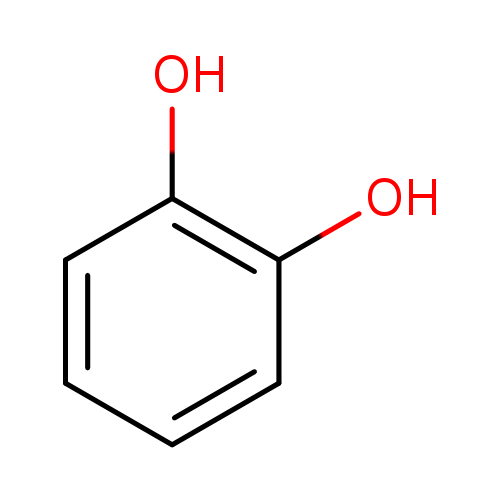
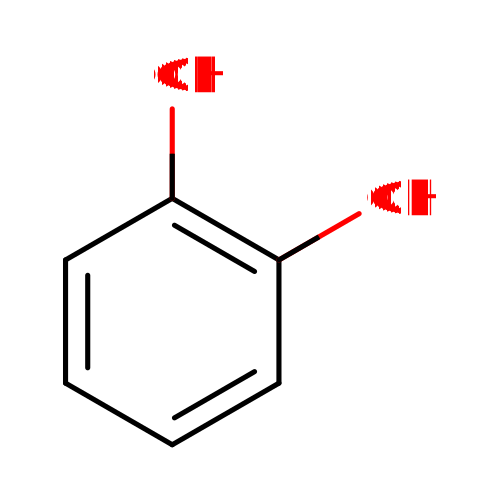
Pyrocatechol, often known as catechol or benzene-1,2-diol, is a benzenediol, with formula C6H4(OH)2. It was first prepared in 1839 by H. Reinsch by distilling catechin (the juice of Mimosa catechu). This colourless compound occurs naturally, but about 20000 tons are manufactured each year, mainly as precursors to pesticides, flavors, and fragrances. Its sulfonic acid is often present in the urine of many mammals. Small amounts of catechol occur naturally in fruits and vegetables, along with the enzyme polyphenol oxidase. Upon mixing the enzyme with the substrate and exposure to oxygen (as when a potato or apple is cut), the colorless catechol oxidizes to reddish-brown benzoquinone derivatives. The enzyme is inactivated by adding an acid, such as lemon juice, or by refrigeration. Excluding oxygen also prevents the browning reaction. Catechol melts at 28 oC and boils at 250 oC. It is employed in medicine as an expectorant. The dimethyl ether or veratrol is also used in medicine. Many other pyrocatechin derivatives have been suggested for therapeutic application.

Contaminant Sources
  • Clean Air Act Chemicals
  • FooDB Chemicals
  • HMDB Contaminants - Feces
  • HMDB Contaminants - Urine
  • HPV EPA Chemicals
  • IARC Carcinogens Group 2B
  • OECD HPV Chemicals
  • STOFF IDENT Compounds
  • T3DB toxins
  • Tobacco Smoke Compounds
  • ToxCast & Tox21 Chemicals
Contaminant Type
  • Cigarette Toxin
  • Food Toxin
  • Fragrance Toxin
  • Household Toxin
  • Metabolite
  • Organic Compound
  • Pesticide
  • Pollutant
  • Synthetic Compound
Chemical Structure
Synonyms
ValueSource
1,2-BenzenediolChEBI
1,2-DihydroxybenzeneChEBI
2-HydroxyphenolChEBI
alpha-HydroxyphenolChEBI
BrenzcatechinChEBI
O-BenzenediolChEBI
O-HydroxyphenolChEBI
PyrocatechinChEBI
a-HydroxyphenolGenerator
Α-hydroxyphenolGenerator
CatecholHMDB
Durafur developer CHMDB
Fouramine PCHHMDB
Fourrine 68HMDB
O-DihydroxybenzeneHMDB
O-DioxybenzeneHMDB
O-HydroquinoneHMDB
O-PhenylenediolHMDB
OxyphenateHMDB
Oxyphenic acidHMDB
Pelagol grey CHMDB
PhthalhydroquinoneHMDB
Phthalic alcoholHMDB
PyrocatechineHMDB
1,3-DihydroxybenzeneHMDB
Catechol dipotassium saltHMDB
Catechol, 14C-labeled CPDHMDB
Catechol sodium saltHMDB
Benzene-1,2-diolPhytoBank
PyrocatecholPhytoBank
1,2-HydroxybenzenePhytoBank
Chemical FormulaC6H6O2
Average Molecular Mass110.111 g/mol
Monoisotopic Mass110.037 g/mol
CAS Registry Number120-80-9
IUPAC Namebenzene-1,2-diol
Traditional Namecatechol
SMILESOC1=CC=CC=C1O
InChI IdentifierInChI=1S/C6H6O2/c7-5-3-1-2-4-6(5)8/h1-4,7-8H
InChI KeyYCIMNLLNPGFGHC-UHFFFAOYSA-N
Chemical Taxonomy
Description Belongs to the class of organic compounds known as catechols. Catechols are compounds containing a 1,2-benzenediol moiety.
KingdomOrganic compounds
Super ClassBenzenoids
ClassPhenols
Sub ClassBenzenediols
Direct ParentCatechols
Alternative Parents
Substituents
  • Catechol
  • 1-hydroxy-4-unsubstituted benzenoid
  • 1-hydroxy-2-unsubstituted benzenoid
  • Monocyclic benzene moiety
  • Organic oxygen compound
  • Hydrocarbon derivative
  • Organooxygen compound
  • Aromatic homomonocyclic compound
Molecular FrameworkAromatic homomonocyclic compounds
External Descriptors
Biological Properties
StatusDetected and Not Quantified
OriginExogenous
Cellular Locations
  • Cytoplasm
  • Extracellular
Biofluid LocationsNot Available
Tissue Locations
  • Adipose Tissue
  • Adrenal Gland
  • Bone Marrow
  • Brain
  • Intestine
  • Liver
  • Neuron
  • Prostate
PathwaysNot Available
ApplicationsNot Available
Biological Roles
Chemical RolesNot Available
Physical Properties
StateSolid
AppearanceWhite powder.
Experimental Properties
PropertyValue
Melting Point105°C
Boiling Point245°C
Solubility4.61E+005 mg/L (at 25°C)
Predicted Properties
PropertyValueSource
Water Solubility75 g/LALOGPS
logP0.74ALOGPS
logP1.37ChemAxon
logS-0.17ALOGPS
pKa (Strongest Acidic)9.34ChemAxon
pKa (Strongest Basic)-6.3ChemAxon
Physiological Charge0ChemAxon
Hydrogen Acceptor Count2ChemAxon
Hydrogen Donor Count2ChemAxon
Polar Surface Area40.46 ŲChemAxon
Rotatable Bond Count0ChemAxon
Refractivity30.02 m³·mol⁻¹ChemAxon
Polarizability10.69 ųChemAxon
Number of Rings1ChemAxon
BioavailabilityYesChemAxon
Rule of FiveYesChemAxon
Ghose FilterNoChemAxon
Veber's RuleNoChemAxon
MDDR-like RuleNoChemAxon
Spectra
Spectra
Toxicity Profile
Route of ExposureNot Available
Mechanism of ToxicityNot Available
MetabolismNot Available
Toxicity ValuesNot Available
Lethal DoseNot Available
Carcinogenicity (IARC Classification)2B, possibly carcinogenic to humans. (21)
Uses/SourcesThis is a man-made compound that is used as a pesticide.
Minimum Risk LevelNot Available
Health EffectsNot Available
SymptomsNot Available
TreatmentNot Available
Concentrations
Not Available
External Links
DrugBank IDDB02232
HMDB IDHMDB0000957
FooDB IDFDB001512
Phenol Explorer ID654
KNApSAcK IDC00002644
BiGG IDNot Available
BioCyc IDCATECHOL
METLIN ID282
PDB IDNot Available
Wikipedia LinkCatechol
Chemspider ID13837760
ChEBI ID18135
PubChem Compound ID289
Kegg Compound IDC15571
YMDB IDNot Available
ECMDB IDECMDB00957
References
Synthesis ReferenceNot Available
MSDSLink
General References
1. Lauterbach, Manfred; Zimmermann, Volker; Jaeger, Guenter; Radig, Wolfram; Adam, Johannes; Blady, Regina. Extraction and purification of pyrocatechol. Ger. (East) (1986), 4 pp.
2. Mung D, Li L: Development of Chemical Isotope Labeling LC-MS for Milk Metabolomics: Comprehensive and Quantitative Profiling of the Amine/Phenol Submetabolome. Anal Chem. 2017 Apr 18;89(8):4435-4443. doi: 10.1021/acs.analchem.6b03737. Epub 2017 Mar 28.
3. Mung D, Li L: Applying quantitative metabolomics based on chemical isotope labeling LC-MS for detecting potential milk adulterant in human milk. Anal Chim Acta. 2018 Feb 25;1001:78-85. doi: 10.1016/j.aca.2017.11.019. Epub 2017 Nov 14.
4. Lauterbach, Manfred; Zimmermann, Volker; Jaeger, Guenter; Radig, Wolfram; Adam, Johannes; Blady, Regina. Extraction and purification of pyrocatechol. Ger. (East) (1986), 4 pp.
5. Nguyen SD, Sok DE: Effect of 3,4-dihydroxyphenylalanine on Cu(2+)-induced inactivation of HDL-associated paraoxonasel and oxidation of HDL; inactivation of paraoxonasel activity independent of HDL lipid oxidation. Free Radic Res. 2004 Sep;38(9):969-76.
6. Kiso Y: Antioxidative roles of sesamin, a functional lignan in sesame seed, and it's effect on lipid- and alcohol-metabolism in the liver: a DNA microarray study. Biofactors. 2004;21(1-4):191-6.
7. Rivest J, Barclay CL, Suchowersky O: COMT inhibitors in Parkinson's disease. Can J Neurol Sci. 1999 Aug;26 Suppl 2:S34-8.
8. Goodall M, Diddle AW: Epinephrine and norepinephrine in pregnancy. A comparative study of the adrenal gland and catechol output in different species of animals and man. Am J Obstet Gynecol. 1971 Dec 1;111(7):896-904.
9. Olanow CW, Obeso JA: Pulsatile stimulation of dopamine receptors and levodopa-induced motor complications in Parkinson's disease: implications for the early use of COMT inhibitors. Neurology. 2000;55(11 Suppl 4):S72-7; discussion S78-81.
10. Zand R, Nelson SD, Slattery JT, Thummel KE, Kalhorn TF, Adams SP, Wright JM: Inhibition and induction of cytochrome P4502E1-catalyzed oxidation by isoniazid in humans. Clin Pharmacol Ther. 1993 Aug;54(2):142-9.
11. Swaminath G, Deupi X, Lee TW, Zhu W, Thian FS, Kobilka TS, Kobilka B: Probing the beta2 adrenoceptor binding site with catechol reveals differences in binding and activation by agonists and partial agonists. J Biol Chem. 2005 Jun 10;280(23):22165-71. Epub 2005 Apr 7.
12. Habecker BA, Willison BD, Shi X, Woodward WR: Chronic depolarization stimulates norepinephrine transporter expression via catecholamines. J Neurochem. 2006 May;97(4):1044-51. Epub 2006 Mar 29.
13. Goldstein DS, Holmes C, Kaufmann H, Freeman R: Clinical pharmacokinetics of the norepinephrine precursor L-threo-DOPS in primary chronic autonomic failure. Clin Auton Res. 2004 Dec;14(6):363-8.
14. Schapira AH, Obeso JA, Olanow CW: The place of COMT inhibitors in the armamentarium of drugs for the treatment of Parkinson's disease. Neurology. 2000;55(11 Suppl 4):S65-8; discussion S69-71.
15. Purba HS, Maggs JL, Orme ML, Back DJ, Park BK: The metabolism of 17 alpha-ethinyloestradiol by human liver microsomes: formation of catechol and chemically reactive metabolites. Br J Clin Pharmacol. 1987 Apr;23(4):447-53.
16. Moretti M, Villarini M, Simonucci S, Fatigoni C, Scassellati-Sforzolini G, Monarca S, Pasquini R, Angelucci M, Strappini M: Effects of co-exposure to extremely low frequency (ELF) magnetic fields and benzene or benzene metabolites determined in vitro by the alkaline comet assay. Toxicol Lett. 2005 Jun 17;157(2):119-28.
17. Poupaert J, Carato P, Colacino E, Yous S: 2(3H)-benzoxazolone and bioisosters as "privileged scaffold" in the design of pharmacological probes. Curr Med Chem. 2005;12(7):877-85.
18. Mosca L, Lendaro E, d'Erme M, Marcellini S, Moretti S, Rosei MA: 5-S-Cysteinyl-dopamine effect on the human dopaminergic neuroblastoma cell line SH-SY5Y. Neurochem Int. 2006 Aug;49(3):262-9. Epub 2006 Mar 20.
19. Santens P: Sleep attacks in Parkinson's disease induced by Entacapone, a COMT-inhibitor. Fundam Clin Pharmacol. 2003 Feb;17(1):121-3.
20. Cavalieri EL, Rogan EG, Chakravarti D: Initiation of cancer and other diseases by catechol ortho-quinones: a unifying mechanism. Cell Mol Life Sci. 2002 Apr;59(4):665-81.
21. Relling MV, Nemec J, Schuetz EG, Schuetz JD, Gonzalez FJ, Korzekwa KR: O-demethylation of epipodophyllotoxins is catalyzed by human cytochrome P450 3A4. Mol Pharmacol. 1994 Feb;45(2):352-8.
22. Irons RD: Quinones as toxic metabolites of benzene. J Toxicol Environ Health. 1985;16(5):673-8.
23. Luffer-Atlas D, Vincent SH, Painter SK, Arison BH, Stearns RA, Chiu SH: Orally active inhibitors of human leukocyte elastase. III. Identification and characterization of metabolites of L-694,458 by liquid chromatography-tandem mass spectrometry. Drug Metab Dispos. 1997 Aug;25(8):940-52.
24. Munns AJ, De Voss JJ, Hooper WD, Dickinson RG, Gillam EM: Bioactivation of phenytoin by human cytochrome P450: characterization of the mechanism and targets of covalent adduct formation. Chem Res Toxicol. 1997 Sep;10(9):1049-58.
25. Yam KC, D'Angelo I, Kalscheuer R, Zhu H, Wang JX, Snieckus V, Ly LH, Converse PJ, Jacobs WR Jr, Strynadka N, Eltis LD: Studies of a ring-cleaving dioxygenase illuminate the role of cholesterol metabolism in the pathogenesis of Mycobacterium tuberculosis. PLoS Pathog. 2009 Mar;5(3):e1000344. doi: 10.1371/journal.ppat.1000344. Epub 2009 Mar 20.
26. Balderas-Hernandez VE, Trevino-Quintanilla LG, Hernandez-Chavez G, Martinez A, Bolivar F, Gosset G: Catechol biosynthesis from glucose in Escherichia coli anthranilate-overproducer strains by heterologous expression of anthranilate 1,2-dioxygenase from Pseudomonas aeruginosa PAO1. Microb Cell Fact. 2014 Oct 4;13:136. doi: 10.1186/s12934-014-0136-x.
27. https://www.ncbi.nlm.nih.gov/pubmed/?term=10651166
28. https://www.ncbi.nlm.nih.gov/pubmed/?term=11470755
29. https://www.ncbi.nlm.nih.gov/pubmed/?term=15951152
30. https://www.ncbi.nlm.nih.gov/pubmed/?term=16610220