Dodecanoic acid (CED0002455)

Record Information
Version1.0
Creation Date2014-09-05 17:12:07 UTC
Update Date2026-05-14 17:47:43 UTC
SynCED IDCED0002455
Secondary Accession Numbers
  • CHEM003556
  • T3D4596
Identification
Common NameDodecanoic acid
ClassSmall Molecule
Description
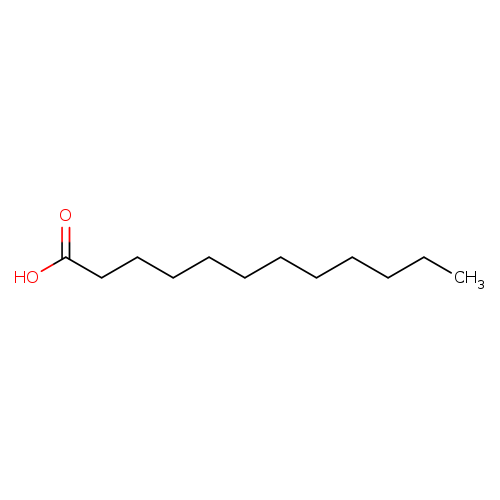
Dodecanoic acid (C12H24O2) is an endogenous organic compound with an average molecular weight of 200.32 g/mol. It exists as a solid at room temperature. Dodecanoic acid belongs to the fatty acids and conjugates, a subclass of fatty acyls within the organic compounds. Biologically, it functions as a plant metabolite and an antioxidant (PMC13425607 ). It acts as an antibacterial agent (PMC10856991 ) and has been detected in the thyroid gland, liver, prostate, and stratum corneum. The compound interacts with 20 recorded protein targets, including phospholipase A2, membrane associated (PLA2G2A), hepatocyte nuclear factor 4-alpha (HNF4A), alcohol dehydrogenase class-3 (ADH5), and ganglioside GM2 activator (GM2A). Regarding health effects, dodecanoic acid is associated with inflammation (PMC11642332 ). Industrially, the compound is used as a surfactant (PMC8329090 ), emulsifier, cleaning agent, fragrance, lubricating agent, solvent, and as a flavouring and nutrient (PMC12723342 ). It is also utilized as a surfactant (industrial). Dodecanoic acid is found in 39 recorded sources, including drinking water, indoor air, and building and construction materials such as roofs, floors, and ceilings. It is present in food, food processing, and cookware, including food preservation and the preparation of wine, sparkling wine, and vinegar. It is also found in household cleaning and consumer products, such as perfumes within detergents and soaps, bleaching agents, and smoking requisites. Additionally, it is found in electrical and electronic equipment, including antennas, amplifiers, coils, and communication cables. Recorded exposure routes include oral, touch, and inhalation.
Contaminant Type
  • Food Toxin
  • Household Toxin
  • Metabolite
  • Natural Compound
  • Organic Compound
  • Plant Toxin
Chemical Structure
Synonyms
ValueSource
1-Undecanecarboxylic acidChEBI
ABLChEBI
C12 Fatty acidChEBI
C12:0ChEBI
CH3-[CH2]10-COOHChEBI
Coconut oil fatty acidsChEBI
DAOChEBI
Dodecoic acidChEBI
DodecylcarboxylateChEBI
Dodecylic acidChEBI
Duodecyclic acidChEBI
Duodecylic acidChEBI
Lauric acidChEBI
LaurinsaeureChEBI
Laurostearic acidChEBI
N-Dodecanoic acidChEBI
Undecane-1-carboxylic acidChEBI
Vulvic acidChEBI
DodecanoateKegg
1-UndecanecarboxylateGenerator
DodecoateGenerator
Dodecylcarboxylic acidGenerator
DodecylateGenerator
DuodecyclateGenerator
DuodecylateGenerator
LaateGenerator
Laic acidGenerator
LaurostearateGenerator
N-DodecanoateGenerator
Undecane-1-carboxylateGenerator
VulvateGenerator
Aliphat no. 4HMDB
Edenor C 1298-100HMDB
Emery 651HMDB
Hystrene 9512HMDB
Kortacid 1299HMDB
LaurateHMDB
Lunac L 70HMDB
Lunac L 98HMDB
Neo-fat 12HMDB
Neo-fat 12-43HMDB
Nissan naa 122HMDB
Philacid 1200HMDB
Prifac 2920HMDB
Univol u 314HMDB
1-Dodecanoic acidHMDB
FA(12:0)HMDB
Dodecanoic acidPhytoBank
Chemical FormulaC12H24O2
Average Molecular Mass200.318 g/mol
Monoisotopic Mass200.178 g/mol
CAS Registry Number143-07-7
IUPAC Namedodecanoic acid
Traditional Namelauric acid
SMILESCCCCCCCCCCCC(O)=O
InChI IdentifierInChI=1S/C12H24O2/c1-2-3-4-5-6-7-8-9-10-11-12(13)14/h2-11H2,1H3,(H,13,14)
InChI KeyPOULHZVOKOAJMA-UHFFFAOYSA-N
Chemical Taxonomy
Description Belongs to the class of organic compounds known as medium-chain fatty acids. These are fatty acids with an aliphatic tail that contains between 4 and 12 carbon atoms.
KingdomOrganic compounds
Super ClassLipids and lipid-like molecules
ClassFatty Acyls
Sub ClassFatty acids and conjugates
Direct ParentMedium-chain fatty acids
Alternative Parents
Substituents
  • Medium-chain fatty acid
  • Straight chain fatty acid
  • Monocarboxylic acid or derivatives
  • Carboxylic acid
  • Carboxylic acid derivative
  • Organic oxygen compound
  • Organic oxide
  • Hydrocarbon derivative
  • Organooxygen compound
  • Carbonyl group
  • Aliphatic acyclic compound
Molecular FrameworkAliphatic acyclic compounds
External Descriptors
Biological Properties
StatusDetected and Not Quantified
OriginEndogenous
Cellular Locations
  • Cytoplasm
  • Extracellular
  • Membrane
Biofluid LocationsNot Available
Tissue Locations
  • Liver
  • Prostate
  • Stratum Corneum
  • Thyroid Gland
Applications
Biological Roles
Chemical RolesNot Available
Organoleptic EffectsNot Available
Physical Properties
StateSolid
AppearanceWhite powder.
Experimental Properties
PropertyValue
Melting Point44 - 46°C
Boiling Point298.9°C
Solubility4.81 mg/L (at 25°C)
Predicted Properties
PropertyValueSource
Water Solubility0.01 g/LALOGPS
logP5.13ALOGPS
logP4.48ChemAxon
logS-4.3ALOGPS
pKa (Strongest Acidic)4.95ChemAxon
Physiological Charge-1ChemAxon
Hydrogen Acceptor Count2ChemAxon
Hydrogen Donor Count1ChemAxon
Polar Surface Area37.3 ŲChemAxon
Rotatable Bond Count10ChemAxon
Refractivity58.68 m³·mol⁻¹ChemAxon
Polarizability25.85 ųChemAxon
Number of Rings0ChemAxon
BioavailabilityYesChemAxon
Rule of FiveYesChemAxon
Ghose FilterYesChemAxon
Veber's RuleYesChemAxon
MDDR-like RuleNoChemAxon
Spectra
Spectra
Spectrum TypeDescriptionSplash KeyDeposition DateView
GC-MSGC-MS Spectrumsplash10-0159-0910000000-a12b321a54a44ae28972Not AvailableView Spectrum
GC-MSGC-MS Spectrumsplash10-014i-2910000000-d52410168e784872a5a6Not AvailableView Spectrum
GC-MSGC-MS Spectrumsplash10-06xx-9100000000-1ef5cd411f38c53a0a92Not AvailableView Spectrum
GC-MSGC-MS Spectrumsplash10-0706-9100000000-e66a9147257053b93702Not AvailableView Spectrum
GC-MSGC-MS Spectrumsplash10-0706-9100000000-2dd666a9a0355b1ca144Not AvailableView Spectrum
GC-MSGC-MS Spectrumsplash10-074i-9300000000-405ec308fe8c935c62a2Not AvailableView Spectrum
GC-MSGC-MS Spectrumsplash10-067i-0930000000-6a80d41e346f4b10104cNot AvailableView Spectrum
GC-MSGC-MS Spectrumsplash10-0159-0910000000-a12b321a54a44ae28972Not AvailableView Spectrum
GC-MSGC-MS Spectrumsplash10-014i-2910000000-d52410168e784872a5a6Not AvailableView Spectrum
GC-MSGC-MS Spectrumsplash10-0159-1910000000-8246864bf316bce609a2Not AvailableView Spectrum
Predicted GC-MSPredicted GC-MS Spectrumsplash10-0006-9500000000-e05832f94ff0361363a2Not AvailableView Spectrum
Predicted GC-MSPredicted GC-MS Spectrumsplash10-05g0-9310000000-038e232cccb44582ec9cNot AvailableView Spectrum
Predicted GC-MSPredicted GC-MS SpectrumNot AvailableNot AvailableView Spectrum
LC-MS/MSLC-MS/MS Spectrumsplash10-0udi-2290000000-861c4b7b2da35b82ef7fNot AvailableView Spectrum
LC-MS/MSLC-MS/MS Spectrumsplash10-0a4l-9100000000-966cf4c6621fcec41368Not AvailableView Spectrum
LC-MS/MSLC-MS/MS Spectrumsplash10-054o-9000000000-d43dd32656ad22e95fddNot AvailableView Spectrum
LC-MS/MSLC-MS/MS Spectrumsplash10-06xx-9100000000-a71409efaf5fdd6ab0e1Not AvailableView Spectrum
LC-MS/MSLC-MS/MS Spectrumsplash10-0706-9100000000-eb09296a8c4c7c381b38Not AvailableView Spectrum
LC-MS/MSLC-MS/MS Spectrumsplash10-0002-0900000000-f22d8298d64e6f382279Not AvailableView Spectrum
LC-MS/MSLC-MS/MS Spectrumsplash10-0002-0900000000-4bb88d3b1d2b7ac88152Not AvailableView Spectrum
LC-MS/MSLC-MS/MS Spectrumsplash10-0002-0900000000-0c79a7257b53685108c6Not AvailableView Spectrum
LC-MS/MSLC-MS/MS Spectrumsplash10-0002-9600000000-25d268515337ef276c60Not AvailableView Spectrum
LC-MS/MSLC-MS/MS Spectrumsplash10-009b-9000000000-c00963f9b91f4a82e1efNot AvailableView Spectrum
LC-MS/MSLC-MS/MS Spectrumsplash10-0002-0900000000-f22d8298d64e6f382279Not AvailableView Spectrum
LC-MS/MSLC-MS/MS Spectrumsplash10-0002-0900000000-4bb88d3b1d2b7ac88152Not AvailableView Spectrum
LC-MS/MSLC-MS/MS Spectrumsplash10-0002-0900000000-0c79a7257b53685108c6Not AvailableView Spectrum
LC-MS/MSLC-MS/MS Spectrumsplash10-0002-9600000000-25d268515337ef276c60Not AvailableView Spectrum
LC-MS/MSLC-MS/MS Spectrumsplash10-0fg2-9000000000-c2f78a8d76b7888c7eaaNot AvailableView Spectrum
LC-MS/MSLC-MS/MS Spectrumsplash10-0002-0900000000-8b4b95bb57e24850213fNot AvailableView Spectrum
LC-MS/MSLC-MS/MS Spectrumsplash10-0002-0900000000-0e66fac0668404efae73Not AvailableView Spectrum
Predicted LC-MS/MSPredicted LC-MS/MS Spectrumsplash10-001i-0920000000-63cd88b9477cd281d342Not AvailableView Spectrum
Predicted LC-MS/MSPredicted LC-MS/MS Spectrumsplash10-0a5c-4910000000-94738a1f436dcf1abcedNot AvailableView Spectrum
Predicted LC-MS/MSPredicted LC-MS/MS Spectrumsplash10-052f-9100000000-07ca8cffe5ba2f9f920dNot AvailableView Spectrum
Predicted LC-MS/MSPredicted LC-MS/MS Spectrumsplash10-001i-0920000000-63cd88b9477cd281d342Not AvailableView Spectrum
Predicted LC-MS/MSPredicted LC-MS/MS Spectrumsplash10-0a5c-4910000000-94738a1f436dcf1abcedNot AvailableView Spectrum
Predicted LC-MS/MSPredicted LC-MS/MS Spectrumsplash10-052f-9100000000-07ca8cffe5ba2f9f920dNot AvailableView Spectrum
Predicted LC-MS/MSPredicted LC-MS/MS Spectrumsplash10-0002-0900000000-1655e63166b4d9dd4f59Not AvailableView Spectrum
Predicted LC-MS/MSPredicted LC-MS/MS Spectrumsplash10-0532-1900000000-7c55a9ca2b49d4920029Not AvailableView Spectrum
Predicted LC-MS/MSPredicted LC-MS/MS Spectrumsplash10-0a4l-9400000000-ed8f6bcf96c68ac84738Not AvailableView Spectrum
Predicted LC-MS/MSPredicted LC-MS/MS Spectrumsplash10-0002-0900000000-1655e63166b4d9dd4f59Not AvailableView Spectrum
Predicted LC-MS/MSPredicted LC-MS/MS Spectrumsplash10-0532-1900000000-7c55a9ca2b49d4920029Not AvailableView Spectrum
Predicted LC-MS/MSPredicted LC-MS/MS Spectrumsplash10-0a4l-9400000000-ed8f6bcf96c68ac84738Not AvailableView Spectrum
Predicted LC-MS/MSPredicted LC-MS/MS Spectrumsplash10-0002-0900000000-8f07bff6ce66feebc4e8Not AvailableView Spectrum
Predicted LC-MS/MSPredicted LC-MS/MS Spectrumsplash10-000t-0900000000-6a476a63061daecd67c6Not AvailableView Spectrum
Predicted LC-MS/MSPredicted LC-MS/MS Spectrumsplash10-006x-9400000000-e52289dcb55fd43c5095Not AvailableView Spectrum
Predicted LC-MS/MSPredicted LC-MS/MS Spectrumsplash10-0piu-9100000000-9581dafa33a06393c032Not AvailableView Spectrum
Predicted LC-MS/MSPredicted LC-MS/MS Spectrumsplash10-0avl-9000000000-8346aaa5fa3b8184649bNot AvailableView Spectrum
Predicted LC-MS/MSPredicted LC-MS/MS Spectrumsplash10-0a4l-9000000000-471a446b3defba08a1eeNot AvailableView Spectrum
MSMS Spectrumsplash10-074l-9100000000-911a01d38925d0de481fNot AvailableView Spectrum
Toxicity Profile
Toxicity Values
Toxicity ValueOrganismDose DescriptorRoute of ExposurePredicted or ExperimentalToxicity RatingReference
6470.0 Log mg/kg [3600:12000]RatLD50oralpredictedNot AvailableNot Available
Toxicity / Toxin ClassNot Available
Mechanism of ToxicityNot Available
Carcinogenicity (IARC Classification)No indication of carcinogenicity to humans (not listed by IARC).
Minimum Risk LevelNot Available
SymptomsNot Available
TreatmentNot Available
Health Effects
Health EffectRelationshipDirectionDescriptionReference
inflammationAssociated With?Not AvailableNot AvailablePMC11642332
inflammationElevated in Blood InincreaseNot AvailablePMC11858228
breast cancerDecreased in Blood IndecreaseA breast cancer that has material basis in abnormally proliferating cells derives from epithelial cells. (DO)PMC12382045
melanomaAssociated With?increaseA cell type cancer that has material basis in abnormally proliferating cells derives from melanocytes which are found in skin, the bowel and the eye. (DO)PMC9866771
Hepatocellular carcinomaHas Therapeutic Effect OnNot AvailableA liver carcinoma that has material basis in undifferentiated hepatocytes. (DO)PMC10515345
Dental cariesNot AvailableNot AvailableNot AvailablePMC11434369
ParkinsonismHas Therapeutic Effect OnNot AvailableNot AvailablePMC11773069
skin cancerAssociated With?increaseNot AvailablePMC9866771
renal fibrosisElevated in Blood InincreaseNot AvailablePMC12163407
Oxidative StressHas Therapeutic Effect OnNot AvailableNot AvailablePMC11773069
Oxidative StressAssociated With?increaseNot AvailablePMC9405245
bacterial infectious diseaseNot AvailableNot AvailableNot AvailablePMC9866831
Exposure Sources
Source IDSourceSectorReference
CEDs000010Insecticides?Insecticides are synthetic chemicals designed to control or eliminate insect pests that threaten crops and other agricultural products.Agriculture & land managementPubChem
CEDs000019Indoor air?Indoor air can be a significant reservoir for synthetic chemical contaminants, which often originate from various sources within enclosed environments.Air, dust & atmospheric transportNot Available
CEDs000070Stormwater runoff?Stormwater runoff refers to the flow of rainwater or melted snow that does not soak into the ground and instead collects pollutants as it travels over impervious surfaces such as roads and parking lots.Automotive & urban infrastructurePubChem
CEDs000115Drinking water?Drinking water can be a medium for synthetic chemical contamination, often originating from various industrial processes and agricultural practices.Drinking water & water supplyNot Available
CEDs000205Cardboard?Cardboard, primarily derived from pulp and paper processes, can be a source of synthetic chemical contamination due to the additives and treatments applied during its production.Paper, pulp & fiber productsPMC12662857
CEDs000233Brushes?Brushes used in personal care and cosmetics can be a source of synthetic chemical contamination due to the materials and coatings used in their manufacturing.Personal care & cosmeticsPubChem
CEDs000490Personal care & cosmeticsNot Available
CEDs000494Food contact materials?Food contact materials refer to substances and products that are intended to come into contact with food during processing, packaging, or preparation.Food, food processing & cookwareNot Available
CEDs000495Ceilings?Ceilings in built environments can be a source of synthetic chemical contamination due to the materials used in their construction and finishes.Building & ConstructionPubChem
CEDs000497Floors?Floors in built environments can be a significant source of synthetic chemical contamination due to the materials and finishes used in their construction.Building & ConstructionPubChem
CEDs000499Roofs?Roofs can be a significant source of synthetic chemical contamination due to the materials used in their construction and maintenance.Building & ConstructionPubChem
CEDs000505Amplifiers?Amplifiers, commonly used in various electronic devices to enhance signal strength, can be a source of synthetic chemical contamination due to the materials and processes involved in their production and disposal.Electrical & Electronic EquipmentPubChem
CEDs000506Antennas?Antennas, commonly used in communication technologies, can be a source of synthetic chemical contamination through the materials and coatings used in their construction.Electrical & Electronic EquipmentPubChem
CEDs000508Coils?Coils are components used in various electrical and electronic applications, such as transformers, inductors, and motors.Electrical & Electronic EquipmentPubChem
CEDs000510Communication Cables Or Conductors?Communication cables or conductors are essential components in the transmission of data and signals in various applications, including telecommunications and networking.Electrical & Electronic EquipmentPubChem
CEDs000511Conductors Or Conductive Bodies Characterised By The Conductive Materials?Conductors, or conductive bodies, are materials that allow the flow of electrical current, typically made from metals such as copper, aluminum, or silver.Electrical & Electronic EquipmentPubChem
CEDs000513Cores Yokes Or Armatures?Cores, yokes, or armatures are components commonly found in electrical devices, used to facilitate the magnetic and electrical functions within motors, transformers, and generators.Electrical & Electronic EquipmentPubChem
CEDs000517Electric Switches?Electric switches, integral components in numerous devices, can be a source of synthetic chemical contamination due to the materials and manufacturing processes involved in their production.Electrical & Electronic EquipmentPubChem
CEDs000518Electrically Stimulated Smoking Devices?Electrically stimulated smoking devices, commonly known as e-cigarettes or vape pens, utilize electrical components to heat a liquid solution, often containing nicotine, flavorings, and other additives, to produce an aerosol for inhalation.Electrical & Electronic EquipmentPubChem
CEDs000519Electrodes?Electrodes, used in various electrical and electronic applications, can be a source of synthetic chemical contamination due to the materials from which they are constructed and the processes involved in their manufacturing.Electrical & Electronic EquipmentPubChem
CEDs000521Fixed Capacitors And Their Manufacture?Fixed capacitors are passive electronic components used to store and release electrical energy, playing a critical role in various circuits.Electrical & Electronic EquipmentPubChem
CEDs000524Hybrid Capacitors?Hybrid capacitors are energy storage devices that combine the properties of electrolytic and supercapacitors, utilizing a combination of electrochemical principles to achieve higher energy density and power density.Electrical & Electronic EquipmentPubChem
CEDs000529Power Cables?Power cables are used to transmit electrical energy and are typically composed of conductive materials, insulation, and protective coatings.Electrical & Electronic EquipmentPubChem
CEDs000530Radio Transmission Systems?Radio transmission systems utilize a variety of synthetic chemicals in their manufacturing and maintenance processes.Electrical & Electronic EquipmentPubChem
CEDs000535Superconducting Magnets And Superconducting Coils?Superconducting magnets and coils are utilized in various applications that require strong magnetic fields, such as magnetic resonance imaging (MRI) and particle accelerators.Electrical & Electronic EquipmentPubChem
CEDs000537Television Systems?Television systems can be a source of synthetic chemical contamination due to the various materials and components used in their manufacture and operation.Electrical & Electronic EquipmentPubChem
CEDs000539Video Games?Video games, through their production and disposal processes, can be a source of synthetic chemical contamination.Electrical & Electronic EquipmentPubChem
CEDs000544Fermentation Processes For Beer?Fermentation processes for beer involve the conversion of sugars into alcohol and carbon dioxide by yeast.Food, food processing & cookwarePubChem
CEDs000545Food Preservation?Food preservation often involves the use of synthetic chemicals, such as preservatives, flavor enhancers, and color additives, to extend shelf life and enhance the sensory qualities of food products.Food, food processing & cookwarePubChem
CEDs000548Preparation Of Vinegar?Vinegar is produced through the fermentation of ethanol by acetic acid bacteria, resulting in a solution that typically contains 4-8% acetic acid.Food, food processing & cookwarePubChem
CEDs000549Preparation Of Wine Or Sparkling Wine?The preparation of wine or sparkling wine involves various stages, including fermentation, aging, and bottling, which can introduce potential sources of synthetic chemical contamination.Food, food processing & cookwarePubChem
CEDs000551Processing Fish?Processing fish can lead to synthetic chemical contamination through various stages of production and preservation.Food, food processing & cookwarePubChem
CEDs000552Processing Meats?Processing meats can lead to synthetic chemical contamination primarily through the use of additives and preservatives.Food, food processing & cookwarePubChem
CEDs000553Treatment Of Hops?Hops, a key ingredient in brewing and food flavoring, can be a source of synthetic chemical contamination due to various agricultural practices.Food, food processing & cookwarePubChem
CEDs000555Bleaching Agents?Bleaching agents are chemical substances used to whiten or lighten materials, often employed in various cleaning products for their stain removal and disinfecting properties.Household cleaning & consumer productsPubChem
CEDs000556Cigar Cigarettes?Cigar cigarettes are a source of synthetic chemical contamination due to the combustion of various tobacco blends and additives.Household cleaning & consumer productsPubChem
CEDs000559Non Electric Simulated Smoking Devices?Non-electric simulated smoking devices, often designed to mimic the experience of smoking without combustion, can be sources of synthetic chemical contamination due to the materials and chemicals used in their construction and operation.Household cleaning & consumer productsPubChem
CEDs000560Other Smoking Requisites?Other smoking requisites, including items such as lighters, matches, and rolling papers, can introduce synthetic chemical contamination through various components and additives.Household cleaning & consumer productsPubChem
CEDs000561Perfumes Within Detergents And Soaps?Perfumes within detergents and soaps are synthetic fragrance compounds added to enhance the sensory experience of cleaning products.Household cleaning & consumer productsPubChem
CEDs000563Soap Detergents?Soap detergents are synthetic surfactants designed to enhance the cleaning efficacy of water by reducing surface tension, allowing for better interaction with dirt and grease.Household cleaning & consumer productsPubChem
CEDs000566Tobacco Pipes?Tobacco pipes, often made from materials such as plastic, wood, or metal, can serve as sources of synthetic chemical contamination due to the residues left by tobacco products.Household cleaning & consumer productsPubChem
CEDs000567Tobacco Product Cases?Tobacco product cases can serve as a source of synthetic chemical contamination due to the presence of various additives and chemicals used in tobacco processing and product manufacturing.Household cleaning & consumer productsPubChem
CEDs000568Tobacco Product Moisture Control?Tobacco product moisture control involves the use of synthetic chemicals to manage the humidity levels in tobacco products, aiming to preserve flavor and extend shelf life.Household cleaning & consumer productsPubChem
CEDs000569Tobacco Smoke Filters?Tobacco smoke filters are designed to reduce the inhalation of harmful substances in cigarette smoke, including tar and other particulate matter.Household cleaning & consumer productsPubChem
CEDs000578Making Cigars?The process of making cigars involves several steps, including the cultivation of tobacco, fermentation, and the application of various additives to enhance flavor and preservation.Industrial manufacturing & chemical processingPubChem
CEDs000579Manufacture Of Iron Or Steel?The manufacture of iron or steel involves various processes, including smelting, refining, and alloying, which can result in the release of synthetic chemicals and contaminants.Industrial manufacturing & chemical processingPubChem
CEDs000580Manufacture Preparation Of Tobacco Products?The manufacture and preparation of tobacco products involve various processes that can result in the introduction of synthetic chemicals into the environment.Industrial manufacturing & chemical processingPubChem
CEDs000581Paper Making Machines?Paper making machines utilize various synthetic chemicals throughout the production process, including additives, coatings, and bleaching agents.Industrial manufacturing & chemical processingPubChem
CEDs000589Life Buoys?Life buoys, commonly used in marine environments for safety and rescue operations, can be a source of synthetic chemical contamination due to the materials used in their production.Marine, shipping & aquaculturePubChem
CEDs000596Acaricides?Acaricides are synthetic chemicals specifically designed to target and control mite populations that can damage crops and plants.Agriculture & land managementPubChem
CEDs000600Herbicides And Algicides?Herbicides and algicides are synthetic chemicals primarily used to control unwanted plants and algae in various environments.Agriculture & land managementPubChem
CEDs000603Nematocides?Nematocides are synthetic chemicals specifically designed to control nematodes, which are microscopic roundworms that can cause significant damage to crops and plants.Agriculture & land managementPubChem
CEDs000604Pest Attractants?Pest attractants are synthetic chemicals designed to lure specific pests for monitoring or control purposes.Agriculture & land managementPubChem
CEDs000605Pest Repellants?Pest repellents, often formulated from synthetic chemicals, are widely used to protect crops from insect infestations and other pests.Agriculture & land managementPubChem
CEDs000606Plant Growth Regulators?Plant Growth Regulators (PGRs) are synthetic chemicals designed to influence the growth and development of plants.Agriculture & land managementPubChem
CEDs000607Rodenticides(1)?Rodenticides are synthetic chemicals specifically formulated to control rodent populations, serving as a crucial tool in managing pests that can damage crops and spread diseases.Agriculture & land managementPubChem
CEDs000608Rodenticides?Rodenticides are chemical substances specifically designed to control rodent populations by causing death through various mechanisms, including anticoagulation or neurotoxicity.Agriculture & land managementPubChem
CEDs000609Aftershave?Aftershave is a grooming product typically used to soothe and protect the skin following shaving.Personal care & cosmeticsPubChem
CEDs000610Aftersun Products?Aftersun products are designed to soothe and hydrate the skin after sun exposure, often containing various synthetic chemicals such as emollients, preservatives, and fragrances.Personal care & cosmeticsPubChem
CEDs000611Anti Perspirants Or Body Deoderants?Antiperspirants and body deodorants commonly contain synthetic chemicals such as aluminum compounds, parabens, and synthetic fragrances.Personal care & cosmeticsPubChem
CEDs000612Body Washing Or Cleaning Implements?Body washing or cleaning implements, such as synthetic sponges, loofahs, and washcloths, can be sources of synthetic chemical contamination due to the materials used in their production.Personal care & cosmeticsPubChem
CEDs000613Depilatories?Depilatories are products designed to remove unwanted hair through the application of synthetic chemicals that break down the protein structure of hair, facilitating its removal.Personal care & cosmeticsPubChem
CEDs000614Essential Oils Or Perfumes?Essential oils and perfumes are complex mixtures of volatile compounds derived from natural or synthetic sources, commonly used for their aromatic properties.Personal care & cosmeticsPubChem
CEDs000615Eye Makeup Products?Eye makeup products, including mascaras, eyeliners, and eyeshadows, often contain a variety of synthetic chemicals such as pigments, preservatives, and film-forming agents.Personal care & cosmeticsPubChem
CEDs000616Face Mask Cosmetics?Face mask cosmetics often contain a variety of synthetic chemicals, including preservatives, emulsifiers, and fragrances, which can contribute to chemical contamination.Personal care & cosmeticsPubChem
CEDs000617Lip Care Products?Lip care products, including lipsticks, balms, and glosses, often contain a variety of synthetic chemicals such as parabens, phthalates, and synthetic fragrances.Personal care & cosmeticsPubChem
CEDs000618Lip Makeup Products?Lip makeup products, such as lipsticks, lip glosses, and lip liners, often contain a variety of synthetic chemicals, including pigments, preservatives, and emollients.Personal care & cosmeticsPubChem
CEDs000619Manicure Pedicure?Manicure and pedicure procedures often involve the use of various synthetic chemicals, including solvents, nail polishes, and nail adhesives.Personal care & cosmeticsPubChem
CEDs000630Toys?Toys, particularly those made from synthetic materials such as plastics, can be a source of chemical contamination due to the presence of various additives and compounds used in their production.Recreation & sports surfacesPubChem
CEDs000632Apparel?Apparel production often involves the use of various synthetic chemicals, including dyes, finishing agents, and preservatives.Textiles, leather & furnishingsPubChem
CEDs000633Azo Dyes?Azo dyes are synthetic organic compounds characterized by the presence of one or more azo groups (-N=N-), which are widely used for coloring textiles, leather, and furnishings.Textiles, leather & furnishingsPubChem
CEDs000638Decorating Textiles?Decorating textiles often involves the use of synthetic chemicals such as dyes, finishes, and coatings.Textiles, leather & furnishingsPubChem
CEDs000640Embroidering And Tufting?Embroidering and tufting processes often involve the use of synthetic chemicals such as dyes, adhesives, and finishing agents.Textiles, leather & furnishingsPubChem
CEDs000641Foam Dyeing?Foam dyeing is a textile dyeing technique that utilizes a foaming agent to create a dye solution in a gaseous form, allowing for the application of dyes onto fabrics.Textiles, leather & furnishingsPubChem
CEDs000642Footwear?Footwear production often involves the use of various synthetic chemicals, such as adhesives, dyes, and treatments, which can contribute to environmental contamination.Textiles, leather & furnishingsPubChem
CEDs000643Headwear?Headwear made from synthetic materials often incorporates chemicals used in the manufacturing and finishing processes, such as dyes, flame retardants, and water repellents.Textiles, leather & furnishingsPubChem
CEDs000647Multicolour Dyeing?Multicolour dyeing involves the application of multiple synthetic dyes to textiles and other materials to achieve vibrant, diverse color patterns.Textiles, leather & furnishingsPubChem
CEDs000650Purses Luggage Hand Bags?Purses, luggage, and handbags are often manufactured using synthetic materials such as polyvinyl chloride (PVC), polyurethane, and various types of nylon.Textiles, leather & furnishingsPubChem
CEDs000653Sewing?Sewing processes often involve the use of various synthetic chemicals, which can become sources of contamination in the environment.Textiles, leather & furnishingsPubChem
CEDs000657Surface Finishing Of Leather?Surface finishing of leather often involves the use of various synthetic chemicals, including dyes, resins, and finishing agents.Textiles, leather & furnishingsPubChem
CEDs000659Transfer Printing?Transfer printing is a process used to apply designs and patterns onto various substrates, commonly utilizing synthetic dyes and inks that can contain hazardous chemicals.Textiles, leather & furnishingsPubChem
CEDs000662Yarns Or Threads?Yarns or threads used in textiles can be a source of synthetic chemical contamination due to the production processes and treatments they undergo.Textiles, leather & furnishingsPubChem
CEDs000664Fire Fighting Gels?Fire fighting gels are synthetic chemical formulations designed to enhance fire suppression effectiveness by creating a protective barrier against heat and flames.Fire suppression systems & agentsPubChem
CEDs000667Gaseous Fire Fighting?Gaseous fire fighting systems utilize synthetic chemicals, such as halocarbons and inert gases, to suppress fires through chemical and physical processes.Fire suppression systems & agentsPubChem
CEDs000669PFAS Fire Fighting Foam?PFAS fire fighting foam refers to a class of synthetic foams containing per- and polyfluoroalkyl substances (PFAS), which are designed to suppress flammable liquid fires.Fire suppression systems & agentsPubChem
CEDs000670Solid Fire Fighting Substances?Solid fire fighting substances, such as certain types of dry chemical powders, are used in fire suppression applications to extinguish flames and prevent fire spread.Fire suppression systems & agentsPubChem
CEDs000671Airplanes And Helicopters?Airplanes and helicopters are significant sources of synthetic chemical contamination primarily through the use of aviation fuels, lubricants, and de-icing agents.Aviation & AerospacePubChem
CEDs000678Nitrogenous Fertilisers?Nitrogenous fertilizers are synthetic chemical compounds primarily used to enhance plant growth by supplying essential nitrogen, a crucial nutrient for photosynthesis and protein synthesis.Agriculture & land managementPubChem
CEDs000679Phosphatic Fertilisers?Phosphatic fertilizers are synthetic chemical products primarily composed of phosphorus, which is essential for plant growth.Agriculture & land managementPubChem
CEDs000684Cements?Cements are a composite material primarily used as a binding agent in construction applications, formed by the calcination of limestone and clay minerals at high temperatures.Building & ConstructionPubChem
CEDs000685Ceramics?Ceramics can be a source of synthetic chemical contamination through various additives and processing agents used in their production.Building & ConstructionPubChem
CEDs000686Clay Wares?Clay wares are ceramic products made from natural clay, often utilized in various construction applications such as tiles, bricks, and sanitary ware.Building & ConstructionPubChem
CEDs000688Glass Coatings?Glass coatings are synthetic chemical formulations applied to glass surfaces to enhance properties such as durability, UV resistance, and aesthetic appeal.Building & ConstructionPubChem
CEDs000690Lime?Lime, primarily comprised of calcium oxide (CaO) or calcium hydroxide (Ca(OH)₂), is widely used in various applications, including as a key ingredient in mortars, plasters, and cement.Building & ConstructionPubChem
CEDs000692Silica Free Oxide Glass?Silica Free Oxide Glass is a type of glass that is produced using alternative materials to traditional silica-based formulations.Building & ConstructionPubChem
CEDs000693Silica Glass?Silica glass, primarily composed of silicon dioxide (SiO2), is widely used in various applications, including windows, glass facades, and insulation materials.Building & ConstructionPubChem
CEDs000696Nanotechnology?Nanotechnology involves the manipulation of materials at the molecular or atomic level, typically within the range of 1 to 100 nanometers.Industrial manufacturing & chemical processingPubChem
CEDs000698Jewellery?Jewellery production often involves the use of various synthetic chemicals during the extraction and processing of metals.Mining & metal processingPubChem
CEDs000710Chalks?Chalks, primarily composed of calcium carbonate, are commonly used in various industrial applications, including as fillers and coatings in the production of paper and related products.Paper, pulp & fiber productsPubChem
CEDs000711Coloured Pencils?Coloured pencils are commonly used tools for artistic expression and education, composed primarily of a wood casing and a core made from a mixture of pigments, binders, and waxes.Paper, pulp & fiber productsPubChem
CEDs000716Erasers?Erasers, commonly used in writing and drawing applications, are often made from synthetic rubber or thermoplastic materials, which can contain various additives such as plasticizers, fillers, and colorants.Paper, pulp & fiber productsPubChem
CEDs000717Fountain Pens?Fountain pens utilize a liquid ink that often contains synthetic chemicals, including dyes, pigments, and solvents, which can contribute to environmental contamination.Paper, pulp & fiber productsPubChem
CEDs000720Ink Reservoir Pens2?Ink reservoir pens are writing instruments that utilize a reservoir to store ink, which is often composed of synthetic dyes, solvents, and additives.Paper, pulp & fiber productsPubChem
CEDs000727Printing Machines Or Presses?Printing machines or presses commonly utilize synthetic chemicals such as inks, solvents, and cleaning agents.Paper, pulp & fiber productsPubChem
CEDs000734Coating Compositions?Coating compositions, which include paints, sealants, and varnishes, are formulated with a variety of synthetic chemicals such as solvents, resins, pigments, and additives.Building & ConstructionPubChem
CEDs000735Explosives?Explosives are chemical compounds or mixtures designed to undergo rapid decomposition, releasing energy in the form of gas and heat.Defense & military infrastructurePubChem
CEDs000738Cooling Circuit Water?Cooling circuit water is utilized in various industrial processes to absorb and dissipate heat generated during operations.Industrial manufacturing & chemical processingPubChem
CEDs000739Inks?Inks are complex mixtures composed of pigments or dyes, solvents, resins, and additives used primarily for printing and writing applications.Paper, pulp & fiber productsPubChem
CEDs000740Paper?Paper production involves the processing of wood fibers and the use of various chemicals, which can lead to synthetic chemical contamination.Paper, pulp & fiber productsPubChem
CEDs000741Pigment Pastes?Pigment pastes are concentrated dispersions of pigments used to impart color and properties to materials.Paper, pulp & fiber productsPubChem
CEDs000742Leather Tanning?Leather tanning is a process that transforms raw animal hides into durable leather through the application of various chemicals, including chromium salts, aldehydes, and vegetable tannins.Textiles, leather & furnishingsPubChem
CEDs000743Sludge Treatment?Sludge treatment involves the processing of waste materials generated from wastewater treatment plants, which often contain a variety of organic and inorganic substances.Wastewater, sanitation & biosolidsPubChem
CEDs000744Water, Wastewater, & Sewage Treatment?Water, wastewater, and sewage treatment processes are critical for managing and mitigating pollutants in water systems.Wastewater, sanitation & biosolidsPubChem
CEDs01082PharmaceuticalsHealthcare, pharmaceuticals & veterinary productsPMC3879140 , PMC3008559
CEDs01144FoodFood, food processing & cookwarePMC3879140 , PMC12037664
CEDs01147BeerFood, food processing & cookwarePMC7149453
CEDs01148MilkFood, food processing & cookwarePMC9217113
CEDs01184Vegetable OilFood, food processing & cookwarePMC6918274
CEDs01208FruitFood, food processing & cookwarePMC11016700
CEDs01249Milk FatFood, food processing & cookwarePMC9217113
CEDs01302WineFood, food processing & cookwarePMC10534219
CEDs01830Packaging MaterialPackagingPMC10856991
CEDs01992Photocurable ResinIndustrial manufacturing & chemical processingPMC9937558
CEDs02255WaterAquatic systems & sedimentsPMC11458682 , PMC11458682
CEDs02298Aquatic EcosystemAquatic systems & sedimentsPMC13493149
CEDs02961Crude OilEnergy, oil & gasPMC9323222
Pathways
8 pathwaysPathway Source: PathBank
Targets
StructureProteinUniProt IDOrganismRelationshipDetails
Click to view 3D structureCytochrome P450 4B1P13584HumansKnownNot Available
Tyrosine-protein phosphatase non-receptor type 1 structureClick to view 3D structureTyrosine-protein phosphatase non-receptor type 1P18031HumansPredicted (SEA)
Prediction Confidence Score
0.896
Applicability Domain
1.0
Statistical Significance
1.00e-05
Supporting Reference Compounds
197
E-value
0.0778492
Peroxisome proliferator-activated receptor alpha structureClick to view 3D structurePeroxisome proliferator-activated receptor alphaQ07869HumansPredicted (SEA)
Prediction Confidence Score
0.896
Applicability Domain
1.0
Statistical Significance
2.00e-05
Supporting Reference Compounds
127
E-value
0.155698
Peroxisome proliferator-activated receptor delta structureClick to view 3D structurePeroxisome proliferator-activated receptor deltaQ03181HumansPredicted (SEA)
Prediction Confidence Score
0.826
Applicability Domain
1.0
Statistical Significance
3.00e-05
Supporting Reference Compounds
89
E-value
0.233548
Peroxisome proliferator-activated receptor gamma structureClick to view 3D structurePeroxisome proliferator-activated receptor gammaP37231HumansPredicted (SEA)
Prediction Confidence Score
0.757
Applicability Domain
1.0
Statistical Significance
3.00e-05
Supporting Reference Compounds
192
E-value
0.233548
Transient receptor potential cation channel subfamily V member 2 structureClick to view 3D structureTransient receptor potential cation channel subfamily V member 2Q9WUD2Rattus norvegicusPredicted (SEA)
Prediction Confidence Score
0.755
Applicability Domain
1.0
Statistical Significance
5.00e-05
Supporting Reference Compounds
21
E-value
0.389246
G-protein coupled receptor 84 structureClick to view 3D structureG-protein coupled receptor 84Q9NQS5HumansPredicted (SEA)
Prediction Confidence Score
0.711
Applicability Domain
1.0
Statistical Significance
1.00e-05
Supporting Reference Compounds
15
E-value
0.0778492
Click to view 3D structureHistone deacetylase 11Q96DB2HumansPredicted (SEA)
Prediction Confidence Score
0.699
Applicability Domain
1.0
Statistical Significance
3.00e-05
Supporting Reference Compounds
149
E-value
0.233548
Fatty acid-binding protein, adipocyte structureClick to view 3D structureFatty acid-binding protein, adipocyteP15090HumansPredicted (SEA)
Prediction Confidence Score
0.618
Applicability Domain
1.0
Statistical Significance
3.00e-05
Supporting Reference Compounds
19
E-value
0.233548
Free fatty acid receptor 1 structureClick to view 3D structureFree fatty acid receptor 1O14842HumansPredicted (SEA)
Prediction Confidence Score
0.578
Applicability Domain
1.0
Statistical Significance
6.00e-05
Supporting Reference Compounds
56
E-value
0.467095
Toll-like receptor 2 structureClick to view 3D structureToll-like receptor 2O60603HumansPredicted (SEA)
Prediction Confidence Score
0.531
Applicability Domain
1.0
Statistical Significance
1.00e-05
Supporting Reference Compounds
9
E-value
0.0778492
Free fatty acid receptor 4 structureClick to view 3D structureFree fatty acid receptor 4Q5NUL3HumansPredicted (SEA)
Prediction Confidence Score
0.527
Applicability Domain
1.0
Statistical Significance
8.00e-05
Supporting Reference Compounds
63
E-value
0.622794
Click to view 3D structureCAI-1 autoinducer sensor kinase/phosphatase CqsSQ9KM66Vibrio cholerae serotype O1 (strain ATCC 39315 / El Tor Inaba N16961)Predicted (SEA)
Prediction Confidence Score
0.5
Applicability Domain
0.5
Statistical Significance
4.00e-05
Supporting Reference Compounds
1
E-value
0.311397
Click to view 3D structureFatty-acid amide hydrolase 1O00519HumansPredicted (SEA)
Prediction Confidence Score
0.499
Applicability Domain
0.739
Statistical Significance
8.60e-04
Supporting Reference Compounds
106
E-value
6.69503
Click to view 3D structureSodium- and chloride-dependent GABA transporter 2P31646Rattus norvegicusPredicted (SEA)
Prediction Confidence Score
0.455
Applicability Domain
0.455
Statistical Significance
4.00e-05
Supporting Reference Compounds
1
E-value
0.311397
Fatty acid-binding protein, heart structureClick to view 3D structureFatty acid-binding protein, heartP05413HumansPredicted (SEA)
Prediction Confidence Score
0.438
Applicability Domain
1.0
Statistical Significance
4.00e-05
Supporting Reference Compounds
13
E-value
0.311397
Fatty acid-binding protein 5 structureClick to view 3D structureFatty acid-binding protein 5Q01469HumansPredicted (SEA)
Prediction Confidence Score
0.436
Applicability Domain
1.0
Statistical Significance
3.00e-05
Supporting Reference Compounds
13
E-value
0.233548
Juvenile hormone esterase structureClick to view 3D structureJuvenile hormone esteraseQ9GPG0Manduca sextaPredicted (SEA)
Prediction Confidence Score
0.432
Applicability Domain
0.52
Statistical Significance
4.00e-05
Supporting Reference Compounds
2
E-value
0.311397
Click to view 3D structureCocaine esteraseO00748HumansPredicted (SEA)
Prediction Confidence Score
0.424
Applicability Domain
0.52
Statistical Significance
9.00e-05
Supporting Reference Compounds
40
E-value
0.700643
Click to view 3D structureOxoeicosanoid receptor 1Q8TDS5HumansPredicted (SEA)
Prediction Confidence Score
0.414
Applicability Domain
0.654
Statistical Significance
1.00e-04
Supporting Reference Compounds
4
E-value
0.778492
Liver carboxylesterase 1 structureClick to view 3D structureLiver carboxylesterase 1P23141HumansPredicted (SEA)
Prediction Confidence Score
0.414
Applicability Domain
0.52
Statistical Significance
6.10e-04
Supporting Reference Compounds
55
E-value
4.7488
Click to view 3D structureCannabinoid receptor 1P20272Rattus norvegicusPredicted (SEA)
Prediction Confidence Score
0.41
Applicability Domain
0.481
Statistical Significance
0.0021
Supporting Reference Compounds
83
E-value
16.3483
Click to view 3D structurePutative inactive group IIC secretory phospholipase A2Q5R387HumansPredicted (SEA)
Prediction Confidence Score
0.405
Applicability Domain
0.405
Statistical Significance
5.00e-05
Supporting Reference Compounds
1
E-value
0.389246
Click to view 3D structureAcetylcholinesteraseO42275Electrophorus electricusPredicted (SEA)
Prediction Confidence Score
0.4
Applicability Domain
1.0
Statistical Significance
0.0056
Supporting Reference Compounds
206
E-value
43.5177
Fatty-acid amide hydrolase 1 structureClick to view 3D structureFatty-acid amide hydrolase 1P97612Rattus norvegicusPredicted (SEA)
Prediction Confidence Score
0.4
Applicability Domain
0.52
Statistical Significance
0.0017
Supporting Reference Compounds
102
E-value
13.4679
Click to view 3D structureCytosolic phospholipase A2A4IFJ5Bos taurusPredicted (SEA)
Prediction Confidence Score
0.395
Applicability Domain
0.395
Statistical Significance
1.70e-04
Supporting Reference Compounds
1
E-value
1.32344
Alcohol dehydrogenase class-3 structureClick to view 3D structureAlcohol dehydrogenase class-3P11766HumansKnownNot Available
Ganglioside GM2 activator structureClick to view 3D structureGanglioside GM2 activatorP17900HumansKnownNot Available
Complement component C8 gamma chain structureClick to view 3D structureComplement component C8 gamma chainP07360HumansKnownNot Available
Glycolipid transfer protein structureClick to view 3D structureGlycolipid transfer proteinQ9NZD2HumansKnownNot Available
Click to view 3D structureGroup IID secretory phospholipase A2Q9UNK4HumansKnownNot Available
Hepatocyte nuclear factor 4-alpha structureClick to view 3D structureHepatocyte nuclear factor 4-alphaP41235HumansKnownNot Available
Lactotransferrin structureClick to view 3D structureLactotransferrinP02788HumansKnownNot Available
Lymphocyte antigen 96 structureClick to view 3D structureLymphocyte antigen 96Q9Y6Y9HumansKnownNot Available
Peroxisome proliferator-activated receptor alpha structureClick to view 3D structurePeroxisome proliferator-activated receptor alphaQ07869HumansKnownNot Available
Phospholipase A2, membrane associated structureClick to view 3D structurePhospholipase A2, membrane associatedP14555HumansKnownNot Available
Toll-like receptor 4 structureClick to view 3D structureToll-like receptor 4O00206HumansKnownNot Available
Very low-density lipoprotein receptor structureClick to view 3D structureVery low-density lipoprotein receptorP98155HumansKnownNot Available
Estrogen receptor structureClick to view 3D structureEstrogen receptorP03372HumansKnownNot Available
Concentrations
Not Available
External Links
DrugBank IDDB03017
HMDB IDHMDB0000638
FooDB IDFDB003010
Phenol Explorer IDNot Available
KNApSAcK IDC00001221
BiGG ID40351
BioCyc IDDODECANOATE
METLIN ID5611
PDB IDNot Available
Wikipedia LinkLauric_acid
Chemspider ID3756
ChEBI ID30805
PubChem Compound ID3893
Kegg Compound IDC02679
YMDB IDYMDB00678
ECMDB IDECMDB24050
References
Synthesis ReferenceNot Available
MSDSNot Available
General References
  1. Sreekumar A, Poisson LM, Rajendiran TM, Khan AP, Cao Q, Yu J, Laxman B, Mehra R, Lonigro RJ, Li Y, Nyati MK, Ahsan A, Kalyana-Sundaram S, Han B, Cao X, Byun J, Omenn GS, Ghosh D, Pennathur S, Alexander DC, Berger A, Shuster JR, Wei JT, Varambally S, Beecher C, Chinnaiyan AM: Metabolomic profiles delineate potential role for sarcosine in prostate cancer progression. Nature. 2009 Feb 12;457(7231):910-4. doi: 10.1038/nature07762. [PubMed: 19212411]
  2. Hoffmann GF, Meier-Augenstein W, Stockler S, Surtees R, Rating D, Nyhan WL: Physiology and pathophysiology of organic acids in cerebrospinal fluid. J Inherit Metab Dis. 1993;16(4):648-69. [PubMed: 8412012]
  3. Amet Y, Berthou F, Fournier G, Dreano Y, Bardou L, Cledes J, Menez JF: Cytochrome P450 4A and 2E1 expression in human kidney microsomes. Biochem Pharmacol. 1997 Mar 21;53(6):765-71. [PubMed: 9113097]
  4. Smith SW, Anderson BD: Human skin permeability enhancement by lauric acid under equilibrium aqueous conditions. J Pharm Sci. 1995 May;84(5):551-6. [PubMed: 7658343]
  5. Powell PK, Wolf I, Lasker JM: Identification of CYP4A11 as the major lauric acid omega-hydroxylase in human liver microsomes. Arch Biochem Biophys. 1996 Nov 1;335(1):219-26. [PubMed: 8914854]
  6. Ryan MT, Chopra RK: The paradoxical effect of fatty acid on steroid-albumin interaction. Biochim Biophys Acta. 1976 Mar 18;427(1):337-49. [PubMed: 1260006]
  7. Amet Y, Berthou F, Baird S, Dreano Y, Bail JP, Menez JF: Validation of the (omega-1)-hydroxylation of lauric acid as an in vitro substrate probe for human liver CYP2E1. Biochem Pharmacol. 1995 Nov 27;50(11):1775-82. [PubMed: 8615855]
  8. Kitahara T, Koyama N, Matsuda J, Aoyama Y, Hirakata Y, Kamihira S, Kohno S, Nakashima M, Sasaki H: Antimicrobial activity of saturated fatty acids and fatty amines against methicillin-resistant Staphylococcus aureus. Biol Pharm Bull. 2004 Sep;27(9):1321-6. [PubMed: 15340213]
  9. NTP Toxicology and Carcinogenesis Studies of Lauric Acid Diethanolamine Condensate (CAS NO. 120-40-1) in F344/N Rats and B6C3F1 Mice (Dermal Studies). Natl Toxicol Program Tech Rep Ser. 1999 Jul;480:1-200. [PubMed: 12571683]
  10. Amet Y, Berthou F, Menez JF: Simultaneous radiometric and fluorimetric detection of lauric acid metabolites using high-performance liquid chromatography following esterification with 4-bromomethyl-6,7-dimethoxycoumarin in human and rat liver microsomes. J Chromatogr B Biomed Appl. 1996 Jun 7;681(2):233-9. [PubMed: 8811432]