Chloropicrin (CED0008825)

Record Information
Version1.0
Creation Date2014-09-08 02:41:17 UTC
Update Date2026-08-26 00:10:06 UTC
SynCED IDCED0008825
Secondary Accession Numbers
  • CHEM003613
  • T3D4655
Identification
Common NameChloropicrin
ClassSmall Molecule
Description
Chloropicrin is an exogenous organic compound with the formula CCl3NO2 and an average molecular weight of 164.38 g/mol. It exists as a liquid at room temperature. Chloropicrin belongs to the halomethanes, a subclass of alkyl halides within the organic compounds. The compound is utilized as a fumigant insecticide. It has been recorded in several sources, including food preservation and the processing of meats. Additionally, it is found in household cleaning and consumer products, specifically within bleaching agents and perfumes used in soaps and detergents. It is also associated with electrical and electronic equipment, including electrodes, magnets, antennas, discharge lamps, and radio transmission systems. At the molecular level, chloropicrin has one recorded protein target: transient receptor potential cation channel subfamily A member 1 (TRPA1).
Contaminant Type
  • Fungicide
  • Lachrymator
  • Organic Compound
  • Organochloride
  • Pesticide
  • Synthetic Compound
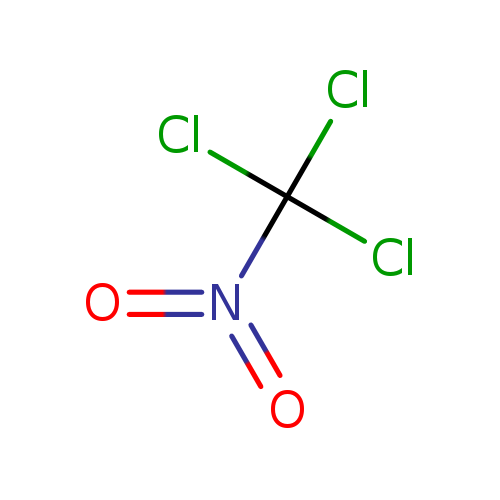
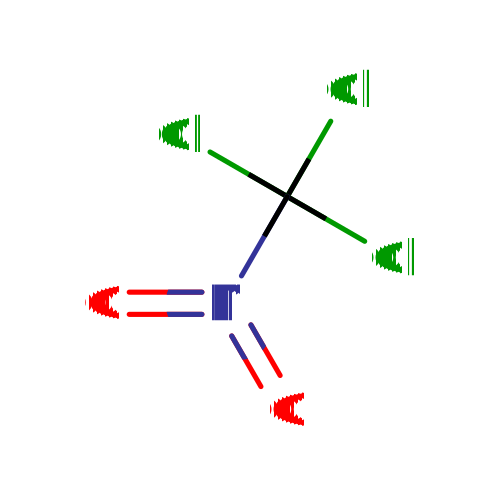
Chemical Structure
Synonyms
ValueSource
1,1,1-TrichloronitromethaneChEBI
CCL3NO2ChEBI
ChlorpikrinChEBI
CL3CNO2ChEBI
TrichlornitromethanChEBI
TrichloronitromethaneChEBI
Chemical FormulaCCl3NO2
Average Molecular Mass164.375 g/mol
Monoisotopic Mass162.899 g/mol
CAS Registry Number76-06-2
IUPAC Nametrichloro(nitro)methane
Traditional Namechloropicrin
SMILESClC(Cl)(Cl)N(=O)=O
InChI IdentifierInChI=1S/CCl3NO2/c2-1(3,4)5(6)7
InChI KeyLFHISGNCFUNFFM-UHFFFAOYSA-N
Chemical Taxonomy
Description Belongs to the class of organic compounds known as trihalomethanes. These are organic compounds in which exactly three of the four hydrogen atoms of methane (CH4) are replaced by halogen atoms.
KingdomOrganic compounds
Super ClassOrganohalogen compounds
ClassAlkyl halides
Sub ClassHalomethanes
Direct ParentTrihalomethanes
Alternative Parents
Substituents
  • C-nitro compound
  • Trihalomethane
  • Organic nitro compound
  • Organic oxoazanium
  • Allyl-type 1,3-dipolar organic compound
  • Propargyl-type 1,3-dipolar organic compound
  • Organic 1,3-dipolar compound
  • Alkyl chloride
  • Hydrocarbon derivative
  • Organic oxide
  • Organopnictogen compound
  • Organonitrogen compound
  • Organochloride
  • Organic oxygen compound
  • Organic nitrogen compound
  • Aliphatic acyclic compound
Molecular FrameworkAliphatic acyclic compounds
External Descriptors
Biological Properties
StatusDetected and Not Quantified
OriginExogenous
Cellular Locations
  • Cytosol
  • Endoplasmic reticulum
  • Membrane
  • Microsome
Biofluid LocationsNot Available
Tissue LocationsNot Available
Applications
Biological Roles
Chemical RolesNot Available
Organoleptic EffectsNot Available
Physical Properties
StateLiquid
AppearanceColorless liquid
Experimental Properties
PropertyValue
Melting Point-69°C
Boiling Point112°C (dec)
SolubilityNot Available
Predicted Properties
PropertyValueSource
Water Solubility0.13 g/LALOGPS
logP2.1ALOGPS
logP2.47ChemAxon
logS-3.1ALOGPS
Physiological Charge0ChemAxon
Hydrogen Acceptor Count2ChemAxon
Hydrogen Donor Count0ChemAxon
Polar Surface Area45.82 ŲChemAxon
Rotatable Bond Count1ChemAxon
Refractivity9.19 m³·mol⁻¹ChemAxon
Polarizability10.57 ųChemAxon
Number of Rings0ChemAxon
BioavailabilityYesChemAxon
Rule of FiveYesChemAxon
Ghose FilterNoChemAxon
Veber's RuleNoChemAxon
MDDR-like RuleNoChemAxon
Spectra
Spectra
Spectrum TypeDescriptionSplash KeyDeposition DateView
Predicted GC-MSPredicted GC-MS Spectrumsplash10-02t9-1900000000-b880bd911a7b1c3641bdNot AvailableView Spectrum
Predicted GC-MSPredicted GC-MS SpectrumNot AvailableNot AvailableView Spectrum
Predicted LC-MS/MSPredicted LC-MS/MS Spectrumsplash10-03di-2900000000-b87302c8573f1a84d7efNot AvailableView Spectrum
Predicted LC-MS/MSPredicted LC-MS/MS Spectrumsplash10-0002-0900000000-490e14dcba0ab27abbb7Not AvailableView Spectrum
Predicted LC-MS/MSPredicted LC-MS/MS Spectrumsplash10-0002-9800000000-3bd82ea05629ac1f4c59Not AvailableView Spectrum
Predicted LC-MS/MSPredicted LC-MS/MS Spectrumsplash10-03di-0900000000-2f6b786f0387e1a5d1cbNot AvailableView Spectrum
Predicted LC-MS/MSPredicted LC-MS/MS Spectrumsplash10-03di-1900000000-1186710e20df73f207ccNot AvailableView Spectrum
Predicted LC-MS/MSPredicted LC-MS/MS Spectrumsplash10-014i-2900000000-0b318d856df2dfe79f85Not AvailableView Spectrum
Predicted LC-MS/MSPredicted LC-MS/MS Spectrumsplash10-03di-0900000000-d1165238c528e9ffc958Not AvailableView Spectrum
Predicted LC-MS/MSPredicted LC-MS/MS Spectrumsplash10-03xr-0900000000-7e7b4cf50bc251d9a869Not AvailableView Spectrum
MSMS Spectrumsplash10-0159-7900000000-67b245e8df3a0c1c871eNot AvailableView Spectrum
Toxicity Profile
Toxicity Values
Toxicity ValueOrganismDose DescriptorRoute of ExposurePredicted or ExperimentalToxicity RatingReference
18.0 Log mg/kg [10:32]RatLD50oralpredictedNot AvailableNot Available
8.0 mg/kg-day RatNOAELoralexperimentalNot AvailableECOTOX - EPA ORD
Toxicity / Toxin ClassNot Available
Mechanism of ToxicityNot Available
Carcinogenicity (IARC Classification)No indication of carcinogenicity to humans (not listed by IARC).
Minimum Risk LevelNot Available
SymptomsNot Available
TreatmentNot Available
Health Effects
Health EffectRelationshipDirectionDescriptionReference
pulmonary edemaAssociated With?Not AvailableAccumulation of fluid in the lung tissues causing disturbance of the gas exchange that may lead to respiratory failure. It is caused by direct injury to the lung parenchyma or congestive heart failure. (NCI)PMC4744107
painAssociated With?Not AvailableA disorder characterized by the sensation of marked discomfort, distress or agony. (NCI CTCAE)PMC3153014
coughAssociated With?Not AvailableA sudden, often repetitive, spasmodic contraction of the thoracic cavity, resulting in violent release of air from the lungs and usually accompanied by a distinctive sound. (NCI CTCAE)PMC3153014
nauseaAssociated With?Not AvailableA disorder characterized by a queasy sensation and/or the urge to vomit. (NCI CTCAE)PMC4744107
vomitingAssociated With?Not AvailableA disorder characterized by the reflexive act of ejecting the contents of the stomach through the mouth. (NCI CTCAE)PMC4744107
dyspneaAssociated With?Not AvailableNot AvailablePMC3153014
chest painAssociated With?Not AvailableA disorder characterized by marked discomfort sensation in the chest wall region, either due to cardiac event or for other reasons. (NCI CTCAE)PMC3153014
DeathAssociated With?Not AvailableNot AvailablePMC4744107
Exposure Sources
Source IDSourceSectorReference
CEDs000010Insecticides?Insecticides are synthetic chemicals designed to control or eliminate insect pests that threaten crops and other agricultural products.Agriculture & land managementPubChem
CEDs000013Soil?Soil serves as a critical medium for plant growth and sustains various ecological functions; however, it can become a reservoir for synthetic chemical contamination.Agriculture & land managementPMC7461845 , PMC7461845
CEDs000070Stormwater runoff?Stormwater runoff refers to the flow of rainwater or melted snow that does not soak into the ground and instead collects pollutants as it travels over impervious surfaces such as roads and parking lots.Automotive & urban infrastructurePubChem
CEDs000115Drinking water?Drinking water can be a medium for synthetic chemical contamination, often originating from various industrial processes and agricultural practices.Drinking water & water supplyPMC7724572
CEDs000181Ballast water?Ballast water, taken on by ships to maintain stability and balance, often contains a diverse array of microorganisms, including bacteria, viruses, and plankton.Marine, shipping & aquaculturePubChem
CEDs000182Bilge water?Bilge water is a byproduct generated from the accumulation of water in the lowest part of a ship's hull, which may include a mixture of seawater, oil, fuel residues, and various contaminants.Marine, shipping & aquaculturePubChem
CEDs000506Antennas?Antennas, commonly used in communication technologies, can be a source of synthetic chemical contamination through the materials and coatings used in their construction.Electrical & Electronic EquipmentPubChem
CEDs000514Discharge Lamps?Discharge lamps, including fluorescent and high-intensity discharge (HID) lamps, are commonly used for lighting applications due to their energy efficiency and brightness.Electrical & Electronic EquipmentPubChem
CEDs000519Electrodes?Electrodes, used in various electrical and electronic applications, can be a source of synthetic chemical contamination due to the materials from which they are constructed and the processes involved in their manufacturing.Electrical & Electronic EquipmentPubChem
CEDs000527Magnets?Magnets, commonly used in various electrical and electronic applications, can be a source of synthetic chemical contamination due to the materials used in their production.Electrical & Electronic EquipmentPubChem
CEDs000530Radio Transmission Systems?Radio transmission systems utilize a variety of synthetic chemicals in their manufacturing and maintenance processes.Electrical & Electronic EquipmentPubChem
CEDs000537Television Systems?Television systems can be a source of synthetic chemical contamination due to the various materials and components used in their manufacture and operation.Electrical & Electronic EquipmentPubChem
CEDs000545Food Preservation?Food preservation often involves the use of synthetic chemicals, such as preservatives, flavor enhancers, and color additives, to extend shelf life and enhance the sensory qualities of food products.Food, food processing & cookwarePubChem
CEDs000552Processing Meats?Processing meats can lead to synthetic chemical contamination primarily through the use of additives and preservatives.Food, food processing & cookwarePubChem
CEDs000555Bleaching Agents?Bleaching agents are chemical substances used to whiten or lighten materials, often employed in various cleaning products for their stain removal and disinfecting properties.Household cleaning & consumer productsPubChem
CEDs000561Perfumes Within Detergents And Soaps?Perfumes within detergents and soaps are synthetic fragrance compounds added to enhance the sensory experience of cleaning products.Household cleaning & consumer productsPubChem
CEDs000563Soap Detergents?Soap detergents are synthetic surfactants designed to enhance the cleaning efficacy of water by reducing surface tension, allowing for better interaction with dirt and grease.Household cleaning & consumer productsPubChem
CEDs000580Manufacture Preparation Of Tobacco Products?The manufacture and preparation of tobacco products involve various processes that can result in the introduction of synthetic chemicals into the environment.Industrial manufacturing & chemical processingPubChem
CEDs000583Anchoring Equipment?Anchoring equipment, commonly used in marine applications, can be a source of synthetic chemical contamination due to the materials and coatings utilized in their manufacturing.Marine, shipping & aquaculturePubChem
CEDs000592Marine Propulsion Or Steering?Marine propulsion and steering systems often rely on various synthetic chemicals, including lubricants, fuels, and hydraulic fluids.Marine, shipping & aquaculturePubChem
CEDs000594Ship Hulls?Ship hulls are often treated with various synthetic chemicals to enhance durability, prevent corrosion, and inhibit the growth of marine organisms.Marine, shipping & aquaculturePubChem
CEDs000595Ships?Ships, as vehicles for international trade and transportation, can be significant sources of synthetic chemical contamination in marine environments.Marine, shipping & aquaculturePubChem
CEDs000596Acaricides?Acaricides are synthetic chemicals specifically designed to target and control mite populations that can damage crops and plants.Agriculture & land managementPubChem
CEDs000597Chemosterilants?Chemosterilants are synthetic chemicals designed to induce sterility in target pest populations, thereby controlling their reproduction and mitigating damage to crops.Agriculture & land managementPubChem
CEDs000598Fertiliser Distributors?Fertiliser distributors play a critical role in the supply of synthetic fertilizers, which are widely used to enhance soil fertility and crop yield.Agriculture & land managementPubChem
CEDs000600Herbicides And Algicides?Herbicides and algicides are synthetic chemicals primarily used to control unwanted plants and algae in various environments.Agriculture & land managementPubChem
CEDs000602Molluscicides?Molluscicides are synthetic chemicals specifically designed to control and eliminate mollusks, such as snails and slugs, which can be detrimental to crops and agricultural productivity.Agriculture & land managementPubChem
CEDs000603Nematocides?Nematocides are synthetic chemicals specifically designed to control nematodes, which are microscopic roundworms that can cause significant damage to crops and plants.Agriculture & land managementPubChem
CEDs000604Pest Attractants?Pest attractants are synthetic chemicals designed to lure specific pests for monitoring or control purposes.Agriculture & land managementPubChem
CEDs000605Pest Repellants?Pest repellents, often formulated from synthetic chemicals, are widely used to protect crops from insect infestations and other pests.Agriculture & land managementPubChem
CEDs000606Plant Growth Regulators?Plant Growth Regulators (PGRs) are synthetic chemicals designed to influence the growth and development of plants.Agriculture & land managementPubChem
CEDs000607Rodenticides(1)?Rodenticides are synthetic chemicals specifically formulated to control rodent populations, serving as a crucial tool in managing pests that can damage crops and spread diseases.Agriculture & land managementPubChem
CEDs000608Rodenticides?Rodenticides are chemical substances specifically designed to control rodent populations by causing death through various mechanisms, including anticoagulation or neurotoxicity.Agriculture & land managementPubChem
CEDs000610Aftersun Products?Aftersun products are designed to soothe and hydrate the skin after sun exposure, often containing various synthetic chemicals such as emollients, preservatives, and fragrances.Personal care & cosmeticsPubChem
CEDs000611Anti Perspirants Or Body Deoderants?Antiperspirants and body deodorants commonly contain synthetic chemicals such as aluminum compounds, parabens, and synthetic fragrances.Personal care & cosmeticsPubChem
CEDs000614Essential Oils Or Perfumes?Essential oils and perfumes are complex mixtures of volatile compounds derived from natural or synthetic sources, commonly used for their aromatic properties.Personal care & cosmeticsPubChem
CEDs000615Eye Makeup Products?Eye makeup products, including mascaras, eyeliners, and eyeshadows, often contain a variety of synthetic chemicals such as pigments, preservatives, and film-forming agents.Personal care & cosmeticsPubChem
CEDs000618Lip Makeup Products?Lip makeup products, such as lipsticks, lip glosses, and lip liners, often contain a variety of synthetic chemicals, including pigments, preservatives, and emollients.Personal care & cosmeticsPubChem
CEDs000624Merry Go Rounds?Merry-go-rounds, commonly found in playgrounds and recreational areas, can be a source of synthetic chemical contamination primarily due to the materials used in their construction.Recreation & sports surfacesPubChem
CEDs000632Apparel?Apparel production often involves the use of various synthetic chemicals, including dyes, finishing agents, and preservatives.Textiles, leather & furnishingsPubChem
CEDs000642Footwear?Footwear production often involves the use of various synthetic chemicals, such as adhesives, dyes, and treatments, which can contribute to environmental contamination.Textiles, leather & furnishingsPubChem
CEDs000662Yarns Or Threads?Yarns or threads used in textiles can be a source of synthetic chemical contamination due to the production processes and treatments they undergo.Textiles, leather & furnishingsPubChem
CEDs000665Fire Extinguishers?Fire extinguishers contain various synthetic chemicals designed to suppress flames and prevent the spread of fire.Fire suppression systems & agentsPubChem
CEDs000671Airplanes And Helicopters?Airplanes and helicopters are significant sources of synthetic chemical contamination primarily through the use of aviation fuels, lubricants, and de-icing agents.Aviation & AerospacePubChem
CEDs000673Unmanned Aerial Vehicles?Unmanned Aerial Vehicles (UAVs), commonly known as drones, utilize various synthetic chemicals in their manufacturing, operation, and maintenance processes.Aviation & AerospacePubChem
CEDs000678Nitrogenous Fertilisers?Nitrogenous fertilizers are synthetic chemical compounds primarily used to enhance plant growth by supplying essential nitrogen, a crucial nutrient for photosynthesis and protein synthesis.Agriculture & land managementPubChem
CEDs000679Phosphatic Fertilisers?Phosphatic fertilizers are synthetic chemical products primarily composed of phosphorus, which is essential for plant growth.Agriculture & land managementPubChem
CEDs000685Ceramics?Ceramics can be a source of synthetic chemical contamination through various additives and processing agents used in their production.Building & ConstructionPubChem
CEDs000688Glass Coatings?Glass coatings are synthetic chemical formulations applied to glass surfaces to enhance properties such as durability, UV resistance, and aesthetic appeal.Building & ConstructionPubChem
CEDs000693Silica Glass?Silica glass, primarily composed of silicon dioxide (SiO2), is widely used in various applications, including windows, glass facades, and insulation materials.Building & ConstructionPubChem
CEDs000696Nanotechnology?Nanotechnology involves the manipulation of materials at the molecular or atomic level, typically within the range of 1 to 100 nanometers.Industrial manufacturing & chemical processingPubChem
CEDs000735Explosives?Explosives are chemical compounds or mixtures designed to undergo rapid decomposition, releasing energy in the form of gas and heat.Defense & military infrastructurePubChem
CEDs000738Cooling Circuit Water?Cooling circuit water is utilized in various industrial processes to absorb and dissipate heat generated during operations.Industrial manufacturing & chemical processingPubChem
CEDs000739Inks?Inks are complex mixtures composed of pigments or dyes, solvents, resins, and additives used primarily for printing and writing applications.Paper, pulp & fiber productsPubChem
CEDs000740Paper?Paper production involves the processing of wood fibers and the use of various chemicals, which can lead to synthetic chemical contamination.Paper, pulp & fiber productsPubChem
CEDs000741Pigment Pastes?Pigment pastes are concentrated dispersions of pigments used to impart color and properties to materials.Paper, pulp & fiber productsPubChem
CEDs000743Sludge Treatment?Sludge treatment involves the processing of waste materials generated from wastewater treatment plants, which often contain a variety of organic and inorganic substances.Wastewater, sanitation & biosolidsPubChem
CEDs000744Water, Wastewater, & Sewage Treatment?Water, wastewater, and sewage treatment processes are critical for managing and mitigating pollutants in water systems.Wastewater, sanitation & biosolidsPubChem
CEDs00894Sandy Loam SoilsAgriculture & land managementPMC9958975
CEDs02293Fresh WaterAquatic systems & sedimentsPMC8908297
CEDs02359Marine WaterAquatic systems & sedimentsPMC8908297
CEDs02589AirAir, dust & atmospheric transportPMC5435304
Pathways
0 pathwaysPathway Source: PathBank

No pathways found

No metabolic pathways have been associated with this synthetic chemical

Targets
StructureProteinUniProt IDOrganismRelationshipDetails
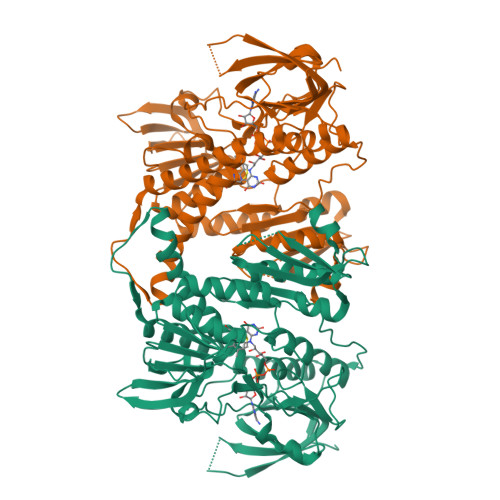
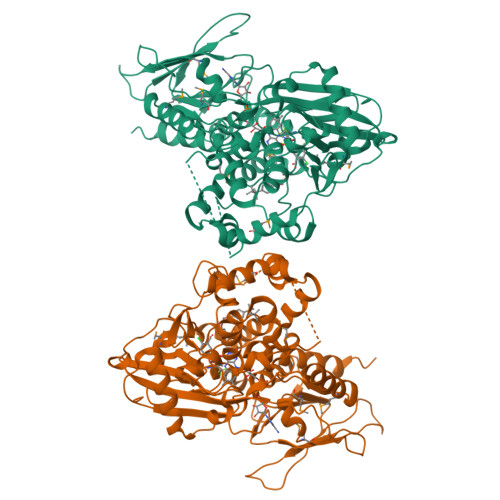
Click to view 3D structureType IV secretion-like conjugative transfer relaxase protein TraIB1LRJ1Escherichia coli (strain SMS-3-5 / SECEC)Predicted (SEA)
Prediction Confidence Score
0.211
Applicability Domain
0.211 Low confidence
Statistical Significance
1.20e-04
Supporting Reference Compounds
1
E-value
0.934191
Endolysin structureClick to view 3D structureEndolysinP00720Enterobacteria phage T4Predicted (SEA)
Prediction Confidence Score
0.208
Applicability Domain
0.208 Low confidence
Statistical Significance
0.0077
Supporting Reference Compounds
1
E-value
60.3331
Click to view 3D structureCatechol O-methyltransferaseQ99028Sus scrofaPredicted (SEA)
Prediction Confidence Score
0.156
Applicability Domain
0.156 Low confidence
Statistical Significance
0.0108
Supporting Reference Compounds
2
E-value
84.2329
Carbonic anhydrase 2 structureClick to view 3D structureCarbonic anhydrase 2P00918HumansPredicted (SEA)
Prediction Confidence Score
0.151
Applicability Domain
0.185 Low confidence
Statistical Significance
0.9688
Supporting Reference Compounds
472
E-value
7542.34
Toll-like receptor 9 structureClick to view 3D structureToll-like receptor 9Q9NR96HumansPredicted (SEA)
Prediction Confidence Score
0.148
Applicability Domain
0.162 Low confidence
Statistical Significance
0.9234
Supporting Reference Compounds
111
E-value
7188.75
Thioredoxin reductase structureClick to view 3D structureThioredoxin reductaseP61076Plasmodium falciparum 3D7Predicted (SEA)
Prediction Confidence Score
0.147
Applicability Domain
0.147 Low confidence
Statistical Significance
0.0123
Supporting Reference Compounds
1
E-value
96.0659
Protoporphyrinogen oxidase, mitochondrial structureClick to view 3D structureProtoporphyrinogen oxidase, mitochondrialO24164Nicotiana tabacumPredicted (SEA)
Prediction Confidence Score
0.146
Applicability Domain
0.146 Low confidence
Statistical Significance
0.1098
Supporting Reference Compounds
1
E-value
854.784
Protein RecA structureClick to view 3D structureProtein RecAP9WHJ3Mycobacterium tuberculosisPredicted (SEA)
Prediction Confidence Score
0.144
Applicability Domain
0.162 Low confidence
Statistical Significance
0.9698
Supporting Reference Compounds
296
E-value
7549.58
Click to view 3D structureHeat shock factor protein 1P38532Mus musculusPredicted (SEA)
Prediction Confidence Score
0.144
Applicability Domain
0.162 Low confidence
Statistical Significance
0.957
Supporting Reference Compounds
166
E-value
7450.33
Click to view 3D structurePutative nitroreductaseQ4A0P1Staphylococcus saprophyticus subsp. saprophyticus (strain ATCC 15305 / DSM20229 / NCIMB 8711 / NCTC 7292 / S-41)Predicted (SEA)
Prediction Confidence Score
0.143
Applicability Domain
0.152 Low confidence
Statistical Significance
0.0203
Supporting Reference Compounds
2
E-value
158.267
Arylsulfatase structureClick to view 3D structureArylsulfataseP51691Pseudomonas aeruginosa (strain ATCC 15692 / PAO1 / 1C / PRS 101 / LMG 12228)Predicted (SEA)
Prediction Confidence Score
0.143
Applicability Domain
0.143 Low confidence
Statistical Significance
0.0499
Supporting Reference Compounds
1
E-value
388.39
Catechol O-methyltransferase structureClick to view 3D structureCatechol O-methyltransferaseP22734Rattus norvegicusPredicted (SEA)
Prediction Confidence Score
0.143
Applicability Domain
0.172 Low confidence
Statistical Significance
0.156
Supporting Reference Compounds
15
E-value
1214.37
Click to view 3D structureAcetylcholine receptor subunit beta-like 2P25162Drosophila melanogasterPredicted (SEA)
Prediction Confidence Score
0.14
Applicability Domain
0.167 Low confidence
Statistical Significance
0.1552
Supporting Reference Compounds
13
E-value
1208.61
Click to view 3D structureP2Y purinoceptor 6Q15077HumansPredicted (SEA)
Prediction Confidence Score
0.139
Applicability Domain
0.175 Low confidence
Statistical Significance
0.4646
Supporting Reference Compounds
38
E-value
3617.19
Click to view 3D structureATP-dependent molecular chaperone HSP82C4YTQ8Candida albicans (strain WO-1) (Yeast)Predicted (SEA)
Prediction Confidence Score
0.137
Applicability Domain
0.149 Low confidence
Statistical Significance
0.9723
Supporting Reference Compounds
205
E-value
7569.36
G-protein coupled receptor 55 structureClick to view 3D structureG-protein coupled receptor 55Q9Y2T6HumansPredicted (SEA)
Prediction Confidence Score
0.137
Applicability Domain
0.171 Low confidence
Statistical Significance
0.9695
Supporting Reference Compounds
125
E-value
7547.56
Fatty acid synthase structureClick to view 3D structureFatty acid synthaseP49327HumansPredicted (SEA)
Prediction Confidence Score
0.135
Applicability Domain
0.171 Low confidence
Statistical Significance
0.9782
Supporting Reference Compounds
117
E-value
7614.9
Tyrosine-protein kinase JAK2 structureClick to view 3D structureTyrosine-protein kinase JAK2O60674HumansPredicted (SEA)
Prediction Confidence Score
0.135
Applicability Domain
0.163 Low confidence
Statistical Significance
0.9956
Supporting Reference Compounds
1022
E-value
7750.51
Carbonic anhydrase 1 structureClick to view 3D structureCarbonic anhydrase 1P00915HumansPredicted (SEA)
Prediction Confidence Score
0.135
Applicability Domain
0.161 Low confidence
Statistical Significance
0.9905
Supporting Reference Compounds
407
E-value
7710.97
Click to view 3D structureStreptokinase AP10520Streptococcus pyogenes serotype M1Predicted (SEA)
Prediction Confidence Score
0.134
Applicability Domain
0.146 Low confidence
Statistical Significance
0.9954
Supporting Reference Compounds
425
E-value
7749.5
NH(3)-dependent NAD(+) synthetase structureClick to view 3D structureNH(3)-dependent NAD(+) synthetaseQ81RP3Bacillus anthracisPredicted (SEA)
Prediction Confidence Score
0.133
Applicability Domain
0.133 Low confidence
Statistical Significance
0.1557
Supporting Reference Compounds
1
E-value
1211.96
Sphingosine 1-phosphate receptor 4 structureClick to view 3D structureSphingosine 1-phosphate receptor 4O95977HumansPredicted (SEA)
Prediction Confidence Score
0.133
Applicability Domain
0.143 Low confidence
Statistical Significance
0.9737
Supporting Reference Compounds
117
E-value
7580.26
Caspase-3 structureClick to view 3D structureCaspase-3P42574HumansPredicted (SEA)
Prediction Confidence Score
0.132
Applicability Domain
0.147 Low confidence
Statistical Significance
0.98
Supporting Reference Compounds
125
E-value
7629.46
Click to view 3D structureGlucose-6-phosphate dehydrogenase-6-phosphogluconolactonaseQ9BHT9Plasmodium bergheiPredicted (SEA)
Prediction Confidence Score
0.132
Applicability Domain
0.172 Low confidence
Statistical Significance
0.9395
Supporting Reference Compounds
105
E-value
7313.7
Click to view 3D structureBeta LactamaseQ932Y6Pseudomonas aeruginosaPredicted (SEA)
Prediction Confidence Score
0.132
Applicability Domain
0.158 Low confidence
Statistical Significance
0.9619
Supporting Reference Compounds
91
E-value
7488.39
Pyruvate oxidase structureClick to view 3D structurePyruvate oxidaseP37063Lactobacillus plantarum (strain ATCC BAA-793 / NCIMB 8826 / WCFS1)KnownNot Available
Transient receptor potential cation channel subfamily A member 1 structureClick to view 3D structureTransient receptor potential cation channel subfamily A member 1O75762HumansKnownNot Available
Concentrations
Not Available
External Links
DrugBank IDNot Available
HMDB IDHMDB0062271
FooDB IDNot Available
Phenol Explorer IDNot Available
KNApSAcK IDNot Available
BiGG IDNot Available
BioCyc IDNot Available
METLIN IDNot Available
PDB IDNot Available
Wikipedia LinkChloropicrin
Chemspider IDNot Available
ChEBI ID39285
PubChem Compound ID6423
Kegg Compound IDC18445
YMDB IDNot Available
ECMDB IDNot Available
References
Synthesis ReferenceNot Available
MSDSNot Available
General References
  1. Bessac BF, Jordt SE: Sensory detection and responses to toxic gases: mechanisms, health effects, and countermeasures. Proc Am Thorac Soc. 2010 Jul;7(4):269-77. doi: 10.1513/pats.201001-004SM. [PubMed: 20601631]