Ethinyl Estradiol (CED0003381)

Record Information
Version1.0
Creation Date2014-09-11 05:14:23 UTC
Update Date2026-08-20 06:07:54 UTC
SynCED IDCED0003381
Secondary Accession Numbers
  • CHEM003700
  • T3D4743
Identification
Common NameEthinyl Estradiol
ClassSmall Molecule
Description
Ethinyl Estradiol belongs to the estrane steroids, a subclass of steroids and steroid derivatives within the organic compounds. This exogenous solid has the formula C20H24O2 and an average molecular weight of 296.41 g/mol. Biologically, it functions as an estrogen (PMC7432732 ), drug (PMC7408367 ), xenoestrogen (PMC4712149 ), and endocrine disruptor (PMC11942373 ). Industrially, it is used as a softener and conditioner. It is recorded as being found in food preservation, household cleaning and consumer products—including soap detergents, perfumes within detergents and soaps, cigar cigarettes, pipe accessories, and non electric simulated smoking devices—as well as healthcare, pharmaceuticals and veterinary products such as estrogens, hormones and related agents, and hormonal contraceptives for systemic use. Additionally, it is found in electrical and electronic equipment, including antennas, conductors or conductive bodies characterised by the conductive materials, electric switches, electrodes, and electrically stimulated smoking devices. Exposure routes include oral, topical, transdermal, and vaginal administration. The compound is detected in various tissues, including the brain, liver, kidney, bladder, pancreas, spleen, placenta, prostate, gonads, testes, adrenal gland, adrenal cortex, epidermis, stratum corneum, muscle, skeletal muscle, fibroblasts, platelet, nerve cells, and neuron. It interacts with 17 protein targets, including the estrogen receptor (ESR1), nuclear receptor subfamily 1 group I member 2 (NR1I2), cytochrome P450 2C18 (CYP2C18), and cytochrome P450 2C19 (CYP2C19). In clinical use, it is a treatment for acne (PMC7382647 ) and endometriosis (PMC11224878 ), though it is associated with mixed cholestasis (PMC4458072 ).
Contaminant Type
  • Drug
  • Estrogen
  • Food Toxin
  • Metabolite
  • Organic Compound
  • Synthetic Compound
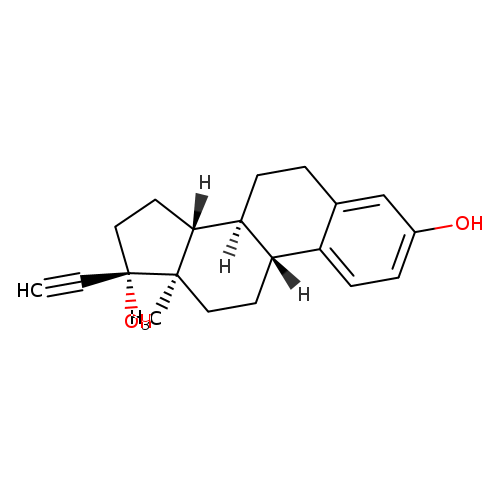
Chemical Structure
SynonymsNot Available
Chemical FormulaC20H24O2
Average Molecular Mass296.410 g/mol
Monoisotopic Mass296.178 g/mol
CAS Registry Number57-63-6
IUPAC Name(1R,10S,11R,14S,15R)-14-ethynyl-15-methyltetracyclo[8.7.0.0²,⁷.0¹¹,¹⁵]heptadeca-2,4,6-triene-5,14-diol
Traditional Name(1R,10S,11R,14S,15R)-14-ethynyl-15-methyltetracyclo[8.7.0.0²,⁷.0¹¹,¹⁵]heptadeca-2,4,6-triene-5,14-diol
SMILES[H][C@]12CC[C@](O)(C#C)[C@]1(C)CC[C@@]1([H])C3=CC=C(O)C=C3CC[C@]21[H]
InChI IdentifierInChI=1S/C20H24O2/c1-3-20(22)11-9-18-17-6-4-13-12-14(21)5-7-15(13)16(17)8-10-19(18,20)2/h1,5,7,12,16-18,21-22H,4,6,8-11H2,2H3/t16-,17-,18+,19+,20+/m0/s1
InChI KeyBFPYWIDHMRZLRN-CENDIDJXSA-N
Chemical Taxonomy
Description Belongs to the class of organic compounds known as estrogens and derivatives. These are steroids with a structure containing a 3-hydroxylated estrane.
KingdomOrganic compounds
Super ClassLipids and lipid-like molecules
ClassSteroids and steroid derivatives
Sub ClassEstrane steroids
Direct ParentEstrogens and derivatives
Alternative Parents
Substituents
  • Estrogen-skeleton
  • 17-hydroxysteroid
  • Hydroxysteroid
  • 3-hydroxysteroid
  • Phenanthrene
  • Tetralin
  • 1-hydroxy-2-unsubstituted benzenoid
  • Benzenoid
  • Ynone
  • Tertiary alcohol
  • Cyclic alcohol
  • Acetylide
  • Organic oxygen compound
  • Hydrocarbon derivative
  • Organooxygen compound
  • Alcohol
  • Aromatic homopolycyclic compound
Molecular FrameworkAromatic homopolycyclic compounds
External DescriptorsNot Available
Biological Properties
StatusDetected and Not Quantified
OriginExogenous
Cellular Locations
  • Extracellular
  • Membrane
Biofluid LocationsNot Available
Tissue Locations
  • Adipose Tissue
  • Adrenal Cortex
  • Adrenal Gland
  • Bladder
  • Brain
  • Epidermis
  • Fibroblasts
  • Gonads
  • Intestine
  • Kidney
  • Liver
  • Muscle
  • Nerve Cells
  • Neuron
  • Pancreas
  • Placenta
  • Platelet
  • Prostate
  • Skeletal Muscle
  • Spleen
  • Stratum Corneum
  • Testes
  • Thyroid Gland
ApplicationsNot Available
Biological Roles
Chemical RolesNot Available
Organoleptic EffectsNot Available
Physical Properties
StateSolid
AppearanceWhite powder.
Experimental Properties
PropertyValue
Melting Point142-144°C
Boiling PointNot Available
Solubility11.3 mg/L (at 27°C)
Predicted Properties
PropertyValueSource
Water Solubility0.0068 g/LALOGPS
logP3.63ALOGPS
logP3.9ChemAxon
logS-4.6ALOGPS
pKa (Strongest Acidic)10.33ChemAxon
pKa (Strongest Basic)-1.7ChemAxon
Physiological Charge0ChemAxon
Hydrogen Acceptor Count2ChemAxon
Hydrogen Donor Count2ChemAxon
Polar Surface Area40.46 ŲChemAxon
Rotatable Bond Count0ChemAxon
Refractivity87.37 m³·mol⁻¹ChemAxon
Polarizability34.42 ųChemAxon
Number of Rings4ChemAxon
BioavailabilityYesChemAxon
Rule of FiveYesChemAxon
Ghose FilterYesChemAxon
Veber's RuleNoChemAxon
MDDR-like RuleNoChemAxon
Spectra
Spectra
Spectrum TypeDescriptionSplash KeyDeposition DateView
Predicted LC-MS/MSPredicted LC-MS/MS Spectrumsplash10-0002-0190000000-075ad04641619da4b2f5Not AvailableView Spectrum
Predicted LC-MS/MSPredicted LC-MS/MS Spectrumsplash10-004j-0390000000-70fa13954d5025b402baNot AvailableView Spectrum
Predicted LC-MS/MSPredicted LC-MS/MS Spectrumsplash10-0fbc-6980000000-8d3156c6218c2f54df34Not AvailableView Spectrum
Predicted LC-MS/MSPredicted LC-MS/MS Spectrumsplash10-0002-0090000000-6490bc65476d939667d6Not AvailableView Spectrum
Predicted LC-MS/MSPredicted LC-MS/MS Spectrumsplash10-0002-0090000000-9c8e8277a610eab839c8Not AvailableView Spectrum
Predicted LC-MS/MSPredicted LC-MS/MS Spectrumsplash10-00p0-0090000000-87d77005eb0529ab1abbNot AvailableView Spectrum
Toxicity Profile
Toxicity Values
Toxicity ValueOrganismDose DescriptorRoute of ExposurePredicted or ExperimentalToxicity RatingReference
2200.0 Log mg/kg [1200:3900]RatLD50oralpredictedNot AvailableNot Available
1000.0 mg/kg-day RatNOELoralexperimentalNot AvailableECOTOX - EPA ORD
0.03 mg/kg-day RatNOELoralexperimentalNot AvailableECOTOX - EPA ORD
0.1 mg/kg-day MouseNOELoralexperimentalNot AvailableECOTOX - EPA ORD
1000.0 mg/kg-day RatNOELoralexperimentalNot AvailableECOTOX - EPA ORD
0.1 mg/kg-day MouseLOELoralexperimentalNot AvailableECOTOX - EPA ORD
0.03 mg/kg-day RatLOELoralexperimentalNot AvailableECOTOX - EPA ORD
1000.0 mg/kg-day RatNOELoralexperimentalNot AvailableECOTOX - EPA ORD
0.01 mg RatLOELinjectionexperimentalNot AvailableECOTOX - EPA ORD
0.0006 mg/kg-day RatLOELinjectionexperimentalNot AvailableECOTOX - EPA ORD
10.0 mg/kg-day RatNOELinjectionexperimentalNot AvailableECOTOX - EPA ORD
0.001 mg/kg-day RatLOECoralexperimentalNot AvailableECOTOX - EPA ORD
0.001 mg/kg-day RatNOELoralexperimentalNot AvailableECOTOX - EPA ORD
0.001 mg/kg-day RatLOELoralexperimentalNot AvailableECOTOX - EPA ORD
0.01 mg RatNOELinjectionexperimentalNot AvailableECOTOX - EPA ORD
0.01 mg RatLOELinjectionexperimentalNot AvailableECOTOX - EPA ORD
Toxicity / Toxin ClassNot Available
Mechanism of ToxicityEstrogens diffuse into their target cells and interact with a protein receptor. Target cells include the female reproductive tract, the mammary gland, the hypothalamus, and the pituitary. Estrogens increase the hepatic synthesis of sex hormone binding globulin (SHBG), thyroid-binding globulin (TBG), and other serum proteins and suppress follicle-stimulating hormone (FSH) from the anterior pituitary. This cascade is initiated by initially binding to the estrogen receptors. The combination of an estrogen with a progestin suppresses the hypothalamic-pituitary system, decreasing the secretion of gonadotropin-releasing hormone (GnRH). Oral, mouse LD50: 1737 mg/kg.
Carcinogenicity (IARC Classification)No indication of carcinogenicity to humans (not listed by IARC).
Minimum Risk LevelNot Available
SymptomsSymptoms of overdose include nausea and vomiting, and withdrawal bleeding may occur in females. The FDA label includes a black box warning that states that combination oral contraceptives with ethinyl estradiol should not be used in women over 35 years old who smoke due to the increased risk of serious cardiovascular side effects.
TreatmentNot Available
Health Effects
Health EffectRelationshipDirectionDescriptionReference
inflammationAssociated With?Not AvailableNot AvailablePMC12353454
cancerAssociated With?Not AvailableCancer is a group of diseases involving abnormal cell growth with the potential to invade or spread to other parts of the body. Possible signs and symptoms include a lump, abnormal bleeding, prolonged cough, unexplained weight loss, and a change in bowel movements. There are over 100 types of cancers affect humans. The risk of developing certain cancers can be reduced by not smoking, maintaining a healthy weight, not drinking too much alcohol, eating plenty of vegetables, fruits and whole grains, vaccination against certain infectious diseases, not eating too much processed and red meat and avoiding too much sunlight exposure. Cancer is often treated with some combination of radiation therapy, surgery, chemotherapy and targeted therapy. The majority of cancers, some 90–95% of cases, are due to genetic mutations from environmental and lifestyle factors. The remaining 5–10% are due to inherited genetics.PMC7036085 , PMC5872049
breast cancerHas Therapeutic Effect OnNot AvailableA breast cancer that has material basis in abnormally proliferating cells derives from epithelial cells. (DO)PMC314450
breast cancerAssociated With?Not AvailableA breast cancer that has material basis in abnormally proliferating cells derives from epithelial cells. (DO)PMC8268473
breast cancerNot AvailableNot AvailableA breast cancer that has material basis in abnormally proliferating cells derives from epithelial cells. (DO)PMC8911978
breast cancerAssociated With?increaseA breast cancer that has material basis in abnormally proliferating cells derives from epithelial cells. (DO)PMC12735493 , PMC5488396
infertilityAssociated With?Not AvailableA disorder characterized by the inability to reproduce by natural means.PMC7036085
osteoporosisNot AvailableNot AvailableA disorder characterized by reduced bone mass, with a decrease in cortical thickness and in the number and size of the trabeculae of cancellous bone (but normal chemical composition), resulting in increased fracture incidence. (NCI CTCAE)PMC8911978 , PMC10369132
fatigueAssociated With?increaseA disorder characterized by a state of generalized weakness with a pronounced inability to summon sufficient energy to accomplish daily activities. (NCI CTCAE)PMC11134286
ischemic strokeAssociated With?increaseNot AvailablePMC11022834
headacheAssociated With?increaseA disorder characterized by a sensation of marked discomfort in various parts of the head, not confined to the area of distribution of any nerve. (NCI CTCAE)PMC11134286
headacheAssociated With?Not AvailableA disorder characterized by a sensation of marked discomfort in various parts of the head, not confined to the area of distribution of any nerve. (NCI CTCAE)PMC10932431
Prostate cancerNot AvailableNot AvailableA male reproductive organ cancer that is located in the prostate. (DO)PMC3125604 , PMC8911978
liver cancerAssociated With?increaseLiver cancer, also known as hepatic cancer and primary hepatic cancer, is cancer that starts in the liver. Cancer which has spread from elsewhere to the liver, known as liver metastasis, is more common than that which starts in the liver. Symptoms of liver cancer may include a lump or pain in the right side below the rib cage, swelling of the abdomen, yellowish skin, easy bruising, weight loss and weakness.("Adult Primary Liver Cancer Treatment (PDQ®)–Patient Version". NCI. 6 July 2016. Archived from the original on 2 October 2016. Retrieved 29 September 2016) The leading cause of liver cancer is cirrhosis due to hepatitis B, hepatitis C or alcohol.(PMID: 25530442) The most common types of liver cancer are hepatocellular carcinoma (HCC), which makes up 80% of cases, and cholangiocarcinoma.(World Cancer Report 2014. World Health Organization. 2014. pp. Chapter 5.6. ISBN 978-9283204299) Globally, as of 2010, liver cancer resulted in 754,000 deaths, up from 460,000 in 1990, making it the third leading cause of cancer death after lung and stomach.(PMID: 23245604) In 2012, it represented 7% of cancer diagnoses in men, the 5th most diagnosed cancer that year.(World Cancer Report 2014. International Agency for Research on Cancer, World Health Organization. 2014. ISBN 978-92-832-0432-9)PMC9611524
cardiomyopathyAssociated With?increaseA heart disease and a myopathy that is characterized by deterioration of the function of the heart muscle. (DO)PMC5526598 , PMC5526598
nauseaAssociated With?Not AvailableA disorder characterized by a queasy sensation and/or the urge to vomit. (NCI CTCAE)PMC3987360 , PMC10932431
nauseaAssociated With?increaseA disorder characterized by a queasy sensation and/or the urge to vomit. (NCI CTCAE)PMC11134286
vomitingAssociated With?Not AvailableA disorder characterized by the reflexive act of ejecting the contents of the stomach through the mouth. (NCI CTCAE)PMC3987360
AcneNot AvailableNot AvailableA disorder of the skin in which oil glands and hair glands become inflamed.PMC7382647 , PMC12589320
thrombosisAssociated With?increaseA formation of a blood clot inside a blood vessel, obstructing the flow of blood through the circulatory system.PMC13108057 , PMC8454215
ovarian cancerAssociated With?increaseA female reproductive organ cancer that is located in the ovary. (DO)PMC12271989
EndometriosisNot AvailableNot AvailableEndometriosis is a condition that affects women in which cells similar to those in the endometrium, the layer of tissue that normally covers the inside of the uterus, grow outside the uterus (mainly in the ovaries and fallopian tubes). The main symptoms are pelvic pain and infertility, although 20-25% of women are asymptomatic. Pain during sexual intercourse is also common. Other symptoms include diarrhea or constipation, chronic fatigue, nausea and vomiting, headaches, low-grade fevers, heavy and/or irregular periods, and hypoglycemia. Endometriosis is a common condition. About 6–10% of women are affected. Endometriosis is most common in those in their thirties and forties; however, it can begin in girls as early as eight years old.PMC11224878
EndometriosisIs Biomarker OfNot AvailableEndometriosis is a condition that affects women in which cells similar to those in the endometrium, the layer of tissue that normally covers the inside of the uterus, grow outside the uterus (mainly in the ovaries and fallopian tubes). The main symptoms are pelvic pain and infertility, although 20-25% of women are asymptomatic. Pain during sexual intercourse is also common. Other symptoms include diarrhea or constipation, chronic fatigue, nausea and vomiting, headaches, low-grade fevers, heavy and/or irregular periods, and hypoglycemia. Endometriosis is a common condition. About 6–10% of women are affected. Endometriosis is most common in those in their thirties and forties; however, it can begin in girls as early as eight years old.PMC12271989
breastAssociated With?increaseNot AvailablePMC12271989
cholestasisAssociated With?mixedImpairment of the bile flow caused by obstruction within the liver, or outside the liver in the bile duct system.PMC4458072
uterine cancerIs Biomarker OfNot AvailableNot AvailablePMC12271989
panic disorderAssociated With?Not AvailableAn anxiety disorder that is characterized by unexpected and repeated episodes of intense fear accompanied by physical symptoms that may include chest pain, heart palpitations, shortness of breath, dizziness, or abdominal distress. (DO)PMC13321492
intrahepatic cholestasisAssociated With?Not AvailableNot AvailablePMC9213752 , PMC9213752
MortalityAssociated With?increaseNot AvailablePMC12735493
metabolic diseaseAssociated With?increaseNot AvailablePMC13193906
reproductive system disorderAssociated With?Not AvailableNot AvailablePMC7036085
hyperplasiaAssociated With?Not AvailableNot AvailablePMC12703411 , PMC12703411
venous thromboembolismAssociated With?decreaseNot AvailablePMC9773763
venous thromboembolismAssociated With?increaseNot AvailablePMC8697849
infertility disorderAssociated With?Not AvailableNot AvailablePMC5845777
Sperm MotilityAssociated With?decreaseNot AvailablePMC10907143
MetrorrhagiaHas Therapeutic Effect OnNot AvailableNot AvailablePMC10852998
HirsutismNot AvailableNot AvailableNot AvailablePMC7382647
MenopauseNot AvailableNot AvailableNot AvailablePMC3125604
disease susceptibilityAssociated With?Not AvailableNot AvailablePMC10907143
FeminizationAssociated With?Not AvailableNot AvailablePMC7753967
disorder of sexual differentiationAssociated With?decreaseNot AvailablePMC9544883
Thrombotic StrokeAssociated With?Not AvailableNot AvailablePMC9773763
vaginal dischargeAssociated With?Not AvailableNot AvailablePMC10932431
invasive ductal breast carcinomaAssociated With?Not AvailableNot AvailablePMC12167661
Androgen insufficiencyAssociated With?Not AvailableNot AvailablePMC8836660
Exposure Sources
Source IDSourceSectorReference
CEDs000001Manure?Manure, a byproduct of livestock farming, is commonly used as a fertilizer in agricultural practices.Agriculture & land managementPMC8280996 , PMC5800224
CEDs000010Insecticides?Insecticides are synthetic chemicals designed to control or eliminate insect pests that threaten crops and other agricultural products.Agriculture & land managementPubChem
CEDs000013Soil?Soil serves as a critical medium for plant growth and sustains various ecological functions; however, it can become a reservoir for synthetic chemical contamination.Agriculture & land managementPMC8911978 , PMC9740990
CEDs000050Groundwater?Groundwater serves as a vital resource for drinking water and agricultural irrigation but is increasingly susceptible to contamination from synthetic chemicals.Aquatic systems & sedimentsPMC4366817 , PMC13468172
CEDs000051Surface water?Surface water can serve as a significant vector for the introduction of synthetic chemical contaminants into aquatic ecosystems.Aquatic systems & sedimentsPMC10458904 , PMC9785829
CEDs000070Stormwater runoff?Stormwater runoff refers to the flow of rainwater or melted snow that does not soak into the ground and instead collects pollutants as it travels over impervious surfaces such as roads and parking lots.Automotive & urban infrastructurePubChem
CEDs000115Drinking water?Drinking water can be a medium for synthetic chemical contamination, often originating from various industrial processes and agricultural practices.Drinking water & water supplyPMC11533287 , PMC6370520
CEDs000116Tap water?Tap water can be a potential source of synthetic chemical contamination due to various industrial processes and agricultural runoff.Drinking water & water supplyPMC7408367
CEDs000317Hormonal contraceptives for systemic use?Hormonal contraceptives for systemic use are synthetic compounds designed to regulate reproductive functions by altering hormonal levels in the body.Healthcare, pharmaceuticals & veterinary productsNot Available
CEDs000319Estrogens?Estrogens are a group of steroid hormones that play a crucial role in the regulation of the reproductive system and secondary sexual characteristics.Healthcare, pharmaceuticals & veterinary productsNot Available
CEDs000359Hormones and related agents?Hormones and related agents are biologically active compounds that regulate various physiological processes in living organisms.Healthcare, pharmaceuticals & veterinary productsNot Available
CEDs000462Landfill leachate?Landfill leachate is a liquid that forms when rainwater or moisture percolates through waste materials in a landfill, dissolving various soluble substances and contaminants.Waste management, landfill & incinerationPMC6291825
CEDs000464Leachate?Leachate is a liquid that forms when water percolates through waste material, dissolving soluble compounds and carrying various contaminants.Waste management, landfill & incinerationPMC8300725
CEDs000469Sewage sludge?Sewage sludge is a byproduct generated during the treatment of wastewater in municipal and industrial processes.Wastewater, sanitation & biosolidsPMC3662172
CEDs000479Effluent?Effluent refers to liquid waste or sewage that is discharged into the environment, typically resulting from industrial processes, municipal wastewater treatment, or agricultural runoff.Wastewater, sanitation & biosolidsPMC6324466 , PMC9041579
CEDs000483WWTP effluent?Wastewater treatment plant (WWTP) effluent can serve as a significant source of synthetic chemical contamination in the environment.Wastewater, sanitation & biosolidsPMC3662172 , PMC9826432
CEDs000484Activated sludge?Activated sludge refers to a mixture of microorganisms and organic matter used in the biological treatment of wastewater.Wastewater, sanitation & biosolidsPMC11771509 , PMC12502722
CEDs000506Antennas?Antennas, commonly used in communication technologies, can be a source of synthetic chemical contamination through the materials and coatings used in their construction.Electrical & Electronic EquipmentPubChem
CEDs000511Conductors Or Conductive Bodies Characterised By The Conductive Materials?Conductors, or conductive bodies, are materials that allow the flow of electrical current, typically made from metals such as copper, aluminum, or silver.Electrical & Electronic EquipmentPubChem
CEDs000517Electric Switches?Electric switches, integral components in numerous devices, can be a source of synthetic chemical contamination due to the materials and manufacturing processes involved in their production.Electrical & Electronic EquipmentPubChem
CEDs000518Electrically Stimulated Smoking Devices?Electrically stimulated smoking devices, commonly known as e-cigarettes or vape pens, utilize electrical components to heat a liquid solution, often containing nicotine, flavorings, and other additives, to produce an aerosol for inhalation.Electrical & Electronic EquipmentPubChem
CEDs000519Electrodes?Electrodes, used in various electrical and electronic applications, can be a source of synthetic chemical contamination due to the materials from which they are constructed and the processes involved in their manufacturing.Electrical & Electronic EquipmentPubChem
CEDs000527Magnets?Magnets, commonly used in various electrical and electronic applications, can be a source of synthetic chemical contamination due to the materials used in their production.Electrical & Electronic EquipmentPubChem
CEDs000537Television Systems?Television systems can be a source of synthetic chemical contamination due to the various materials and components used in their manufacture and operation.Electrical & Electronic EquipmentPubChem
CEDs000545Food Preservation?Food preservation often involves the use of synthetic chemicals, such as preservatives, flavor enhancers, and color additives, to extend shelf life and enhance the sensory qualities of food products.Food, food processing & cookwarePubChem
CEDs000556Cigar Cigarettes?Cigar cigarettes are a source of synthetic chemical contamination due to the combustion of various tobacco blends and additives.Household cleaning & consumer productsPubChem
CEDs000559Non Electric Simulated Smoking Devices?Non-electric simulated smoking devices, often designed to mimic the experience of smoking without combustion, can be sources of synthetic chemical contamination due to the materials and chemicals used in their construction and operation.Household cleaning & consumer productsPubChem
CEDs000561Perfumes Within Detergents And Soaps?Perfumes within detergents and soaps are synthetic fragrance compounds added to enhance the sensory experience of cleaning products.Household cleaning & consumer productsPubChem
CEDs000562Pipe Accessories?Pipe accessories, such as fittings, connectors, and seals, are components used in plumbing systems to facilitate the flow of liquids and gases.Household cleaning & consumer productsPubChem
CEDs000563Soap Detergents?Soap detergents are synthetic surfactants designed to enhance the cleaning efficacy of water by reducing surface tension, allowing for better interaction with dirt and grease.Household cleaning & consumer productsPubChem
CEDs000569Tobacco Smoke Filters?Tobacco smoke filters are designed to reduce the inhalation of harmful substances in cigarette smoke, including tar and other particulate matter.Household cleaning & consumer productsPubChem
CEDs000580Manufacture Preparation Of Tobacco Products?The manufacture and preparation of tobacco products involve various processes that can result in the introduction of synthetic chemicals into the environment.Industrial manufacturing & chemical processingPubChem
CEDs000584Buoys?Buoys, often used for navigation and marine monitoring, can be sources of synthetic chemical contamination due to the materials and coatings employed in their construction.Marine, shipping & aquaculturePubChem
CEDs000596Acaricides?Acaricides are synthetic chemicals specifically designed to target and control mite populations that can damage crops and plants.Agriculture & land managementPubChem
CEDs000597Chemosterilants?Chemosterilants are synthetic chemicals designed to induce sterility in target pest populations, thereby controlling their reproduction and mitigating damage to crops.Agriculture & land managementPubChem
CEDs000601Lawn Mowers?Lawn mowers, particularly those powered by gasoline, can be a source of synthetic chemical contamination due to the combustion of fossil fuels and the use of engine oils.Agriculture & land managementPubChem
CEDs000604Pest Attractants?Pest attractants are synthetic chemicals designed to lure specific pests for monitoring or control purposes.Agriculture & land managementPubChem
CEDs000605Pest Repellants?Pest repellents, often formulated from synthetic chemicals, are widely used to protect crops from insect infestations and other pests.Agriculture & land managementPubChem
CEDs000606Plant Growth Regulators?Plant Growth Regulators (PGRs) are synthetic chemicals designed to influence the growth and development of plants.Agriculture & land managementPubChem
CEDs000607Rodenticides(1)?Rodenticides are synthetic chemicals specifically formulated to control rodent populations, serving as a crucial tool in managing pests that can damage crops and spread diseases.Agriculture & land managementPubChem
CEDs000608Rodenticides?Rodenticides are chemical substances specifically designed to control rodent populations by causing death through various mechanisms, including anticoagulation or neurotoxicity.Agriculture & land managementPubChem
CEDs000609Aftershave?Aftershave is a grooming product typically used to soothe and protect the skin following shaving.Personal care & cosmeticsPubChem
CEDs000610Aftersun Products?Aftersun products are designed to soothe and hydrate the skin after sun exposure, often containing various synthetic chemicals such as emollients, preservatives, and fragrances.Personal care & cosmeticsPubChem
CEDs000611Anti Perspirants Or Body Deoderants?Antiperspirants and body deodorants commonly contain synthetic chemicals such as aluminum compounds, parabens, and synthetic fragrances.Personal care & cosmeticsPubChem
CEDs000612Body Washing Or Cleaning Implements?Body washing or cleaning implements, such as synthetic sponges, loofahs, and washcloths, can be sources of synthetic chemical contamination due to the materials used in their production.Personal care & cosmeticsPubChem
CEDs000613Depilatories?Depilatories are products designed to remove unwanted hair through the application of synthetic chemicals that break down the protein structure of hair, facilitating its removal.Personal care & cosmeticsPubChem
CEDs000614Essential Oils Or Perfumes?Essential oils and perfumes are complex mixtures of volatile compounds derived from natural or synthetic sources, commonly used for their aromatic properties.Personal care & cosmeticsPubChem
CEDs000615Eye Makeup Products?Eye makeup products, including mascaras, eyeliners, and eyeshadows, often contain a variety of synthetic chemicals such as pigments, preservatives, and film-forming agents.Personal care & cosmeticsPubChem
CEDs000616Face Mask Cosmetics?Face mask cosmetics often contain a variety of synthetic chemicals, including preservatives, emulsifiers, and fragrances, which can contribute to chemical contamination.Personal care & cosmeticsPubChem
CEDs000617Lip Care Products?Lip care products, including lipsticks, balms, and glosses, often contain a variety of synthetic chemicals such as parabens, phthalates, and synthetic fragrances.Personal care & cosmeticsPubChem
CEDs000618Lip Makeup Products?Lip makeup products, such as lipsticks, lip glosses, and lip liners, often contain a variety of synthetic chemicals, including pigments, preservatives, and emollients.Personal care & cosmeticsPubChem
CEDs000632Apparel?Apparel production often involves the use of various synthetic chemicals, including dyes, finishing agents, and preservatives.Textiles, leather & furnishingsPubChem
CEDs000642Footwear?Footwear production often involves the use of various synthetic chemicals, such as adhesives, dyes, and treatments, which can contribute to environmental contamination.Textiles, leather & furnishingsPubChem
CEDs000650Purses Luggage Hand Bags?Purses, luggage, and handbags are often manufactured using synthetic materials such as polyvinyl chloride (PVC), polyurethane, and various types of nylon.Textiles, leather & furnishingsPubChem
CEDs000662Yarns Or Threads?Yarns or threads used in textiles can be a source of synthetic chemical contamination due to the production processes and treatments they undergo.Textiles, leather & furnishingsPubChem
CEDs000685Ceramics?Ceramics can be a source of synthetic chemical contamination through various additives and processing agents used in their production.Building & ConstructionPubChem
CEDs000686Clay Wares?Clay wares are ceramic products made from natural clay, often utilized in various construction applications such as tiles, bricks, and sanitary ware.Building & ConstructionPubChem
CEDs000692Silica Free Oxide Glass?Silica Free Oxide Glass is a type of glass that is produced using alternative materials to traditional silica-based formulations.Building & ConstructionPubChem
CEDs000693Silica Glass?Silica glass, primarily composed of silicon dioxide (SiO2), is widely used in various applications, including windows, glass facades, and insulation materials.Building & ConstructionPubChem
CEDs000696Nanotechnology?Nanotechnology involves the manipulation of materials at the molecular or atomic level, typically within the range of 1 to 100 nanometers.Industrial manufacturing & chemical processingPubChem
CEDs000727Printing Machines Or Presses?Printing machines or presses commonly utilize synthetic chemicals such as inks, solvents, and cleaning agents.Paper, pulp & fiber productsPubChem
CEDs000732Spectacle Cases?Spectacle cases can serve as a source of synthetic chemical contamination due to the materials used in their production, such as polycarbonate, PVC, and various plastics, which may leach harmful substances over time.Healthcare, pharmaceuticals & veterinary productsPubChem
CEDs000738Cooling Circuit Water?Cooling circuit water is utilized in various industrial processes to absorb and dissipate heat generated during operations.Industrial manufacturing & chemical processingPubChem
CEDs000739Inks?Inks are complex mixtures composed of pigments or dyes, solvents, resins, and additives used primarily for printing and writing applications.Paper, pulp & fiber productsPubChem
CEDs000740Paper?Paper production involves the processing of wood fibers and the use of various chemicals, which can lead to synthetic chemical contamination.Paper, pulp & fiber productsPubChem
CEDs000741Pigment Pastes?Pigment pastes are concentrated dispersions of pigments used to impart color and properties to materials.Paper, pulp & fiber productsPubChem
CEDs000743Sludge Treatment?Sludge treatment involves the processing of waste materials generated from wastewater treatment plants, which often contain a variety of organic and inorganic substances.Wastewater, sanitation & biosolidsPubChem
CEDs000744Water, Wastewater, & Sewage Treatment?Water, wastewater, and sewage treatment processes are critical for managing and mitigating pollutants in water systems.Wastewater, sanitation & biosolidsPubChem
CEDs00745Corn OilAgriculture & land managementPMC7696188 , PMC6595493
CEDs00751FeedAgriculture & land managementPMC8910684 , PMC9879825
CEDs00767FertilizersAgriculture & land managementPMC9293921
CEDs00789Livestock ManureAgriculture & land managementPMC5800224 , PMC5800224
CEDs00821Tocopherol-stripped Corn OilAgriculture & land managementPMC11980919
CEDs00998Cow ManureAgriculture & land managementPMC5800224
CEDs01081TabletsHealthcare, pharmaceuticals & veterinary productsPMC11780360
CEDs01082PharmaceuticalsHealthcare, pharmaceuticals & veterinary productsPMC8008741 , PMC10831895
CEDs01143DietFood, food processing & cookwarePMC5351298
CEDs01144FoodFood, food processing & cookwarePMC6835794
CEDs01148MilkFood, food processing & cookwarePMC10671995
CEDs01170EggsFood, food processing & cookwarePMC9189287
CEDs01218EggFood, food processing & cookwarePMC4366817 , PMC4366817
CEDs01411Maternal DietFood, food processing & cookwarePMC4334464
CEDs02185Recycled WaterWaste management, landfill & incinerationPMC2672392
CEDs02217Water SuppliesDrinking water & water supplyPMC3447581 , PMC9310441
CEDs02227Raw WaterDrinking water & water supplyPMC11153180
CEDs02255WaterAquatic systems & sedimentsPMC7036085 , PMC7036085
CEDs02257WatersAquatic systems & sedimentsPMC3173749 , PMC10907143
CEDs02260Aquatic SystemsAquatic systems & sedimentsPMC3447581 , PMC6194206
CEDs02261Sea WaterAquatic systems & sedimentsPMC11381450 , PMC10369132
CEDs02264SedimentAquatic systems & sedimentsPMC9041579 , PMC2174414
CEDs02265River WaterAquatic systems & sedimentsPMC3345074 , PMC12648576
CEDs02268Water SamplesAquatic systems & sedimentsPMC9041579 , PMC6982722
CEDs02270RiverAquatic systems & sedimentsPMC7408367 , PMC12407060
CEDs02276Aquatic EnvironmentAquatic systems & sedimentsPMC4231597 , PMC4366817
CEDs02282CoralsAquatic systems & sedimentsPMC7854615
CEDs02284Marine EcosystemAquatic systems & sedimentsPMC7854615
CEDs02286LakeAquatic systems & sedimentsPMC12407060 , PMC13117087
CEDs02293Fresh WaterAquatic systems & sedimentsPMC11599994
CEDs02298Aquatic EcosystemAquatic systems & sedimentsPMC11431550
CEDs02310Brackish WaterAquatic systems & sedimentsPMC10369132
CEDs02340Water BodyAquatic systems & sedimentsPMC7854615 , PMC12787899
CEDs02359Marine WaterAquatic systems & sedimentsPMC3967214
CEDs02376PondsAquatic systems & sedimentsPMC10907143
CEDs02377Natural WaterAquatic systems & sedimentsPMC4690931
CEDs02380EstuaryAquatic systems & sedimentsPMC3016494
CEDs02392Natural Water BodiesAquatic systems & sedimentsPMC9544883
CEDs02451Huangpu RiverAquatic systems & sedimentsPMC9041579
CEDs02459Artificial SeawaterAquatic systems & sedimentsPMC2174414
CEDs02485Aquatic CompartmentsAquatic systems & sedimentsPMC7221825
CEDs02538BrackishAquatic systems & sedimentsPMC11381450
CEDs02750Asphalt BinderBuilding & ConstructionPMC10450899
CEDs02767Asphalt BindersBuilding & ConstructionPMC10450899 , PMC10450899
CEDs02847Personal Care ProductsPersonal care & cosmeticsPMC12565789
CEDs03009Waste WaterWastewater, sanitation & biosolidsPMC9720157 , PMC7854615
CEDs03012Wastewater EffluentsWastewater, sanitation & biosolidsPMC2839367
CEDs03013EffluentsWastewater, sanitation & biosolidsPMC4949178 , PMC4231597
CEDs03016Simulated WastewaterWastewater, sanitation & biosolidsPMC6982337
CEDs03018Municipal WastewaterWastewater, sanitation & biosolidsPMC8060166
CEDs03021Wastewater Treatment PlantWastewater, sanitation & biosolidsPMC6324466 , PMC7854615
CEDs03022Wastewater SamplesWastewater, sanitation & biosolidsPMC13150622
CEDs03028Wastewater EffluentWastewater, sanitation & biosolidsPMC9599273
CEDs03030Sewage EffluentWastewater, sanitation & biosolidsPMC11641370 , PMC3807508
CEDs03035Municipal EffluentsWastewater, sanitation & biosolidsPMC3173749
CEDs03037WWTP effluentsWastewater, sanitation & biosolidsPMC11771509
CEDs03043WWTPsWastewater, sanitation & biosolidsPMC9041579
CEDs03046Hospital EffluentWastewater, sanitation & biosolidsPMC7112026
CEDs03049Raw SewageWastewater, sanitation & biosolidsPMC3345074
CEDs03053Hospital WastewaterWastewater, sanitation & biosolidsPMC6982337
CEDs03061WWTPWastewater, sanitation & biosolidsPMC9026580
CEDs03067Treated SewageWastewater, sanitation & biosolidsPMC6982867
CEDs03072Urban WastewaterWastewater, sanitation & biosolidsPMC9026580
CEDs03073Treated WastewaterWastewater, sanitation & biosolidsPMC9720157
CEDs03079Secondary EffluentWastewater, sanitation & biosolidsPMC6890904
CEDs03084Waste Activated SludgeWastewater, sanitation & biosolidsPMC9026580 , PMC9026580
CEDs03098Municipal Wastewater EffluentWastewater, sanitation & biosolidsPMC8625148
CEDs03121Effluent DischargesWastewater, sanitation & biosolidsPMC12926234
CEDs03130FaecalWastewater, sanitation & biosolidsPMC11153180
CEDs03136Untreated SewageWastewater, sanitation & biosolidsPMC6982867
CEDs03148Sewage DischargeWastewater, sanitation & biosolidsPMC2759673
Pathways
1 pathwayPathway Source: PathBank
Targets
StructureProteinUniProt IDOrganismRelationshipDetails
Sulfotransferase 1E1 structureClick to view 3D structureSulfotransferase 1E1P49888HumansKnownNot Available
Click to view 3D structureUDP-glucuronosyltransferase 1A1P22309HumansKnownNot Available
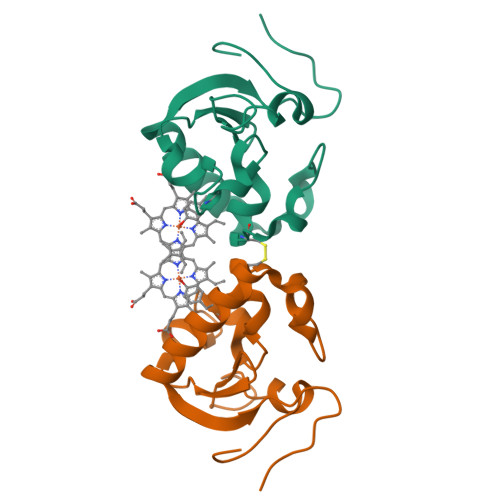
Cytochrome P450 3A5 structureClick to view 3D structureCytochrome P450 3A5P20815HumansKnownNot Available
Sulfotransferase 1A1 structureClick to view 3D structureSulfotransferase 1A1P50225HumansKnownNot Available
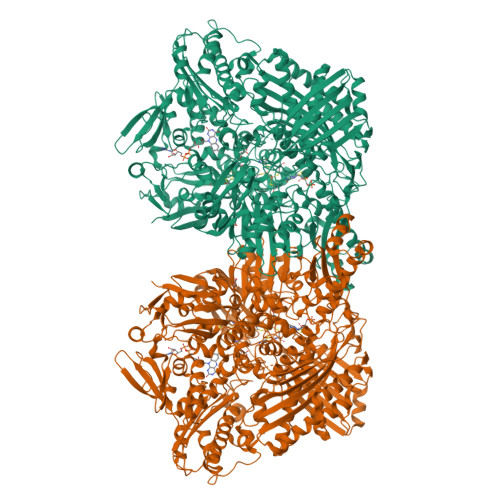
Estrogen receptor structureClick to view 3D structureEstrogen receptorP03372HumansKnownNot Available
Sodium-dependent serotonin transporter structureClick to view 3D structureSodium-dependent serotonin transporterP31645HumansPredicted (SEA)
Prediction Confidence Score
0.697
Applicability Domain
1.0
Statistical Significance
1.70e-04
Supporting Reference Compounds
593
E-value
1.32344
Estrogen receptor structureClick to view 3D structureEstrogen receptorP03372HumansPredicted (SEA)
Prediction Confidence Score
0.697
Applicability Domain
1.0
Statistical Significance
4.00e-05
Supporting Reference Compounds
201
E-value
0.311397
Androgen receptor structureClick to view 3D structureAndrogen receptorP15207Rattus norvegicusPredicted (SEA)
Prediction Confidence Score
0.684
Applicability Domain
1.0
Statistical Significance
5.00e-05
Supporting Reference Compounds
73
E-value
0.389246
Estrogen receptor beta structureClick to view 3D structureEstrogen receptor betaQ92731HumansPredicted (SEA)
Prediction Confidence Score
0.653
Applicability Domain
1.0
Statistical Significance
4.00e-05
Supporting Reference Compounds
174
E-value
0.311397
Sex hormone-binding globulin structureClick to view 3D structureSex hormone-binding globulinP04278HumansPredicted (SEA)
Prediction Confidence Score
0.644
Applicability Domain
1.0
Statistical Significance
3.00e-05
Supporting Reference Compounds
33
E-value
0.233548
Click to view 3D structureProgesterone receptorQ690N0Bos taurusPredicted (SEA)
Prediction Confidence Score
0.627
Applicability Domain
1.0
Statistical Significance
3.00e-05
Supporting Reference Compounds
40
E-value
0.233548
Glucocorticoid receptor structureClick to view 3D structureGlucocorticoid receptorP04150HumansPredicted (SEA)
Prediction Confidence Score
0.572
Applicability Domain
1.0
Statistical Significance
3.40e-04
Supporting Reference Compounds
154
E-value
2.64687
Sodium-dependent noradrenaline transporter structureClick to view 3D structureSodium-dependent noradrenaline transporterP23975HumansPredicted (SEA)
Prediction Confidence Score
0.564
Applicability Domain
1.0
Statistical Significance
4.60e-04
Supporting Reference Compounds
451
E-value
3.58106
Polyunsaturated fatty acid lipoxygenase ALOX15 structureClick to view 3D structurePolyunsaturated fatty acid lipoxygenase ALOX15P12530Oryctolagus cuniculusPredicted (SEA)
Prediction Confidence Score
0.52
Applicability Domain
1.0
Statistical Significance
3.00e-05
Supporting Reference Compounds
47
E-value
0.233548
17-beta-hydroxysteroid dehydrogenase type 1 structureClick to view 3D structure17-beta-hydroxysteroid dehydrogenase type 1P14061HumansPredicted (SEA)
Prediction Confidence Score
0.483
Applicability Domain
0.577
Statistical Significance
2.50e-04
Supporting Reference Compounds
42
E-value
1.94623
Corticosteroid-binding globulin structureClick to view 3D structureCorticosteroid-binding globulinP08185HumansPredicted (SEA)
Prediction Confidence Score
0.45
Applicability Domain
0.577
Statistical Significance
4.40e-04
Supporting Reference Compounds
21
E-value
3.42537
Cytochrome P450 3A4 structureClick to view 3D structureCytochrome P450 3A4P08684HumansKnownNot Available
Steryl-sulfatase structureClick to view 3D structureSteryl-sulfataseP08842HumansPredicted (SEA)
Prediction Confidence Score
0.45
Applicability Domain
0.492
Statistical Significance
1.00e-04
Supporting Reference Compounds
14
E-value
0.778492
Click to view 3D structureSolute carrier organic anion transporter family member 1A1P46720Rattus norvegicusPredicted (SEA)
Prediction Confidence Score
0.437
Applicability Domain
0.577
Statistical Significance
1.00e-04
Supporting Reference Compounds
10
E-value
0.778492
Sodium-dependent dopamine transporter structureClick to view 3D structureSodium-dependent dopamine transporterQ01959HumansPredicted (SEA)
Prediction Confidence Score
0.426
Applicability Domain
1.0
Statistical Significance
0.0038
Supporting Reference Compounds
506
E-value
29.7384
Cytochrome P450 2B6 structureClick to view 3D structureCytochrome P450 2B6P20813HumansPredicted (SEA)
Prediction Confidence Score
0.422
Applicability Domain
1.0
Statistical Significance
5.10e-04
Supporting Reference Compounds
150
E-value
3.97031
Bile salt export pump structureClick to view 3D structureBile salt export pumpO95342HumansPredicted (SEA)
Prediction Confidence Score
0.42
Applicability Domain
1.0
Statistical Significance
3.80e-04
Supporting Reference Compounds
104
E-value
2.95827
Sulfotransferase 1A1 structureClick to view 3D structureSulfotransferase 1A1P50225HumansPredicted (SEA)
Prediction Confidence Score
0.401
Applicability Domain
1.0
Statistical Significance
2.00e-05
Supporting Reference Compounds
5
E-value
0.155698
Aldehyde oxidase structureClick to view 3D structureAldehyde oxidaseQ06278HumansPredicted (SEA)
Prediction Confidence Score
0.399
Applicability Domain
1.0
Statistical Significance
3.00e-05
Supporting Reference Compounds
14
E-value
0.233548
Carbonic anhydrase 2 structureClick to view 3D structureCarbonic anhydrase 2P00918HumansPredicted (SEA)
Prediction Confidence Score
0.374
Applicability Domain
0.492
Statistical Significance
0.0113
Supporting Reference Compounds
472
E-value
87.7361
Mineralocorticoid receptor structureClick to view 3D structureMineralocorticoid receptorP08235HumansPredicted (SEA)
Prediction Confidence Score
0.368
Applicability Domain
0.565
Statistical Significance
0.0019
Supporting Reference Compounds
74
E-value
14.7135
Click to view 3D structureEstrogen sulfotransferaseQ95MF8Sus scrofaPredicted (SEA)
Prediction Confidence Score
0.354
Applicability Domain
0.354
Statistical Significance
2.30e-04
Supporting Reference Compounds
1
E-value
1.79053
Androgen receptor structureClick to view 3D structureAndrogen receptorP10275HumansPredicted (SEA)
Prediction Confidence Score
0.347
Applicability Domain
0.577
Statistical Significance
0.0045
Supporting Reference Compounds
146
E-value
35.4214
Aromatase structureClick to view 3D structureAromataseP11511HumansPredicted (SEA)
Prediction Confidence Score
0.344
Applicability Domain
0.577
Statistical Significance
0.0039
Supporting Reference Compounds
127
E-value
30.6726
Aldo-keto reductase family 1 member B10 structureClick to view 3D structureAldo-keto reductase family 1 member B10O60218HumansPredicted (SEA)
Prediction Confidence Score
0.344
Applicability Domain
0.577
Statistical Significance
0.0021
Supporting Reference Compounds
49
E-value
16.504
5-hydroxytryptamine receptor 2B structureClick to view 3D structure5-hydroxytryptamine receptor 2BP41595HumansPredicted (SEA)
Prediction Confidence Score
0.332
Applicability Domain
0.577
Statistical Significance
0.0263
Supporting Reference Compounds
686
E-value
204.588
Membrane-associated progesterone receptor component 1 structureClick to view 3D structureMembrane-associated progesterone receptor component 1O00264HumansKnownNot Available
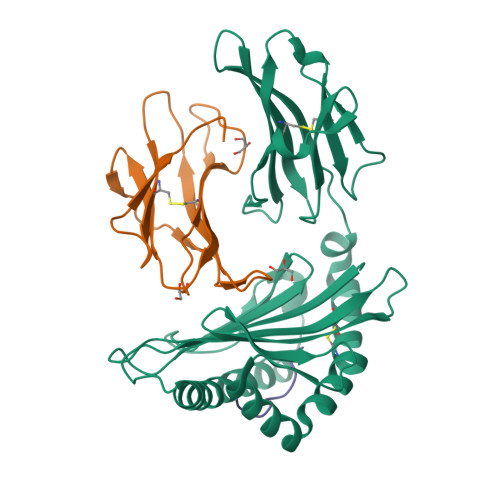
Estrogen receptor structureClick to view 3D structureEstrogen receptorP03372HumansKnownNot Available
Androgen receptor structureClick to view 3D structureAndrogen receptorP10275HumansKnownNot Available
Estrogen receptor beta structureClick to view 3D structureEstrogen receptor betaQ92731HumansKnownNot Available
Progesterone receptor structureClick to view 3D structureProgesterone receptorP06401HumansKnownNot Available
Sodium-dependent serotonin transporter structureClick to view 3D structureSodium-dependent serotonin transporterP31645HumansKnownNot Available
Sodium-dependent dopamine transporter structureClick to view 3D structureSodium-dependent dopamine transporterQ01959HumansKnownNot Available
Sodium-dependent noradrenaline transporter structureClick to view 3D structureSodium-dependent noradrenaline transporterP23975HumansKnownNot Available
Glucocorticoid receptor structureClick to view 3D structureGlucocorticoid receptorP04150HumansKnownNot Available
Cytochrome P450 2C19 structureClick to view 3D structureCytochrome P450 2C19P33261HumansKnownNot Available
Click to view 3D structureCytochrome P450 2J2P51589HumansKnownNot Available
Cytochrome P450 2C18 structureClick to view 3D structureCytochrome P450 2C18P33260HumansKnownNot Available
Cytochrome P450 3A5 structureClick to view 3D structureCytochrome P450 3A5P20815HumansKnownNot Available
Nuclear receptor subfamily 1 group I member 2 structureClick to view 3D structureNuclear receptor subfamily 1 group I member 2O75469HumansKnownNot Available
Cytochrome P450 2C9 structureClick to view 3D structureCytochrome P450 2C9P11712HumansKnownNot Available
Nuclear receptor subfamily 1 group I member 3 structureClick to view 3D structureNuclear receptor subfamily 1 group I member 3Q14994HumansKnownNot Available
Bile acid receptor structureClick to view 3D structureBile acid receptorQ96RI1HumansKnownNot Available
Click to view 3D structureTranslocator proteinP30536HumansKnownNot Available
Concentrations
Not Available
External Links
DrugBank IDNot Available
HMDB IDNot Available
FooDB IDNot Available
Phenol Explorer IDNot Available
KNApSAcK IDNot Available
BiGG IDNot Available
BioCyc IDNot Available
METLIN IDNot Available
PDB IDNot Available
Wikipedia LinkNot Available
Chemspider IDNot Available
ChEBI IDNot Available
PubChem Compound ID124302178
Kegg Compound IDNot Available
YMDB IDNot Available
ECMDB IDNot Available
References
Synthesis Reference

Andreas Sachse, “Method of female hormonal contraception using a fixed extended cycle hormonal preparation containing dienogest and ethinyl estradiol.” U.S. Patent US20060079491, issued April 13, 2006.

MSDSLink
General References
  1. Li X, Strauss L, Kaatrasalo A, Mayerhofer A, Huhtaniemi I, Santti R, Makela S, Poutanen M: Transgenic mice expressing p450 aromatase as a model for male infertility associated with chronic inflammation in the testis. Endocrinology. 2006 Mar;147(3):1271-7. Epub 2005 Nov 23. [PubMed: 16306085]
  2. Wernert N: [Immunohistochemistry of the prostate and prostate carcinomas]. Veroff Pathol. 1991;135:1-163. [PubMed: 2038892]
  3. Kaufer D, Ogle WO, Pincus ZS, Clark KL, Nicholas AC, Dinkel KM, Dumas TC, Ferguson D, Lee AL, Winters MA, Sapolsky RM: Restructuring the neuronal stress response with anti-glucocorticoid gene delivery. Nat Neurosci. 2004 Sep;7(9):947-53. Epub 2004 Aug 8. [PubMed: 15300253]
  4. Zhang L, Sukhareva M, Barker JL, Maric D, Hao Y, Chang YH, Ma W, O'Shaughnessy T, Rubinow DR: Direct binding of estradiol enhances Slack (sequence like a calcium-activated potassium channel) channels' activity. Neuroscience. 2005;131(2):275-82. [PubMed: 15708472]
  5. Herrero P, Soto PF, Dence CS, Kisrieva-Ware Z, Delano DA, Peterson LR, Gropler RJ: Impact of hormone replacement on myocardial fatty acid metabolism: potential role of estrogen. J Nucl Cardiol. 2005 Sep-Oct;12(5):574-81. [PubMed: 16171718]
  6. Shah MG, Maibach HI: Estrogen and skin. An overview. Am J Clin Dermatol. 2001;2(3):143-50. [PubMed: 11705091]
  7. Safi R, Kovacic A, Gaillard S, Murata Y, Simpson ER, McDonnell DP, Clyne CD: Coactivation of liver receptor homologue-1 by peroxisome proliferator-activated receptor gamma coactivator-1alpha on aromatase promoter II and its inhibition by activated retinoid X receptor suggest a novel target for breast-specific antiestrogen therapy. Cancer Res. 2005 Dec 15;65(24):11762-70. [PubMed: 16357189]
  8. vom Saal FS, Grant WM, McMullen CW, Laves KS: High fetal estrogen concentrations: correlation with increased adult sexual activity and decreased aggression in male mice. Science. 1983 Jun 17;220(4603):1306-9. [PubMed: 6857252]
  9. Schmitt PM, Gohil K, Kaufman MP: Spinal estrogen attenuates the exercise pressor reflex but has little effect on the expression of genes regulating neurotransmitters in the dorsal root ganglia. J Appl Physiol (1985). 2006 Mar;100(3):958-64. Epub 2005 Nov 23. [PubMed: 16306253]
  10. Kalaitzidis D, Ok J, Sulak L 2nd, Starczynowski DT, Gilmore TD: Characterization of a human REL-estrogen receptor fusion protein with a reverse conditional transforming activity in chicken spleen cells. Oncogene. 2004 Sep 30;23(45):7580-7. [PubMed: 15326488]
  11. Pierard-Franchimont C, Letawe C, Goffin V, Pierard GE: Skin water-holding capacity and transdermal estrogen therapy for menopause: a pilot study. Maturitas. 1995 Sep;22(2):151-4. [PubMed: 8538484]
  12. de la Monte SM, Moore GW, Hutchins GM: Metastatic behavior of prostate cancer. Cluster analysis of patterns with respect to estrogen treatment. Cancer. 1986 Aug 15;58(4):985-93. [PubMed: 3719562]
  13. Czernik PJ, Little JM, Barone GW, Raufman JP, Radominska-Pandya A: Glucuronidation of estrogens and retinoic acid and expression of UDP-glucuronosyltransferase 2B7 in human intestinal mucosa. Drug Metab Dispos. 2000 Oct;28(10):1210-6. [PubMed: 10997942]
  14. Harris H, Henderson R, Bhat R, Komm B: Regulation of metallothionein II messenger ribonucleic acid measures exogenous estrogen receptor-beta activity in SAOS-2 and LNCaPLN3 cells. Endocrinology. 2001 Feb;142(2):645-52. [PubMed: 11159835]
  15. Stabile LP, Davis AL, Gubish CT, Hopkins TM, Luketich JD, Christie N, Finkelstein S, Siegfried JM: Human non-small cell lung tumors and cells derived from normal lung express both estrogen receptor alpha and beta and show biological responses to estrogen. Cancer Res. 2002 Apr 1;62(7):2141-50. [PubMed: 11929836]
  16. Frolich A, Christensen L, Andersen J: Estrogen receptors appear undetectable in the C-cells of the human thyroid gland. Bone. 1990;11(6):393-6. [PubMed: 1706609]
  17. Siiteri PK: Review of studies on estrogen biosynthesis in the human. Cancer Res. 1982 Aug;42(8 Suppl):3269s-3273s. [PubMed: 7083184]
  18. Koehler KF, Helguero LA, Haldosen LA, Warner M, Gustafsson JA: Reflections on the discovery and significance of estrogen receptor beta. Endocr Rev. 2005 May;26(3):465-78. Epub 2005 Apr 27. [PubMed: 15857973]
  19. Moro L, Reineri S, Piranda D, Pietrapiana D, Lova P, Bertoni A, Graziani A, Defilippi P, Canobbio I, Torti M, Sinigaglia F: Nongenomic effects of 17beta-estradiol in human platelets: potentiation of thrombin-induced aggregation through estrogen receptor beta and Src kinase. Blood. 2005 Jan 1;105(1):115-21. Epub 2004 Jun 15. [PubMed: 15198955]
  20. Nakano Y, Oshima T, Ozono R, Ueda A, Oue Y, Matsuura H, Sanada M, Ohama K, Chayama K, Kambe M: Estrogen replacement suppresses function of thrombin stimulated platelets by inhibiting Ca(2+) influx and raising cyclic adenosine monophosphate. Cardiovasc Res. 2002 Feb 15;53(3):634-41. [PubMed: 11861034]
  21. FDA label.