Stavudine (CED0003216)

Record Information
Version1.0
Creation Date2014-09-11 05:15:56 UTC
Update Date2026-08-17 23:36:28 UTC
SynCED IDCED0003216
Secondary Accession Numbers
  • CHEM003729
  • T3D4772
Identification
Common NameStavudine
ClassSmall Molecule
Description
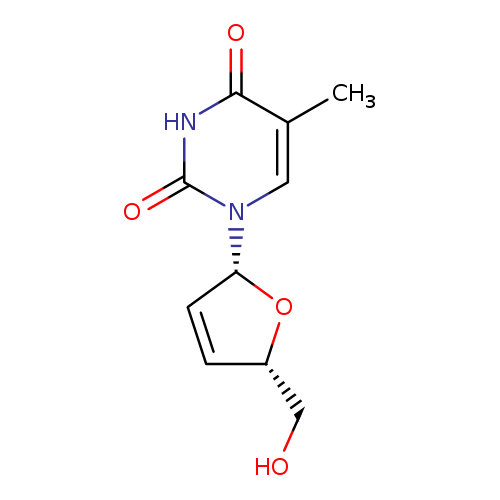
Stavudine is an exogenous organic compound with the formula C10H12N2O4 and an average molecular weight of 224.21 g/mol. It exists as a solid at room temperature. Stavudine belongs to the nucleoside and nucleotide analogues, a class of nucleosides, nucleotides, and analogues within the organic compounds. This compound acts as an inhibitor of the Gag-Pol polyprotein (gag-pol), Estrogen receptor (ESR1), and Reverse transcriptase/RNaseH (pol). It is a dideoxynucleoside analog that inhibits reverse transcriptase and exhibits in vitro activity against HIV. Stavudine is identified in 17 recorded sources. Within healthcare, pharmaceuticals, and veterinary products, it is found in antivirals. It is also recorded in building and construction materials such as fencing. Further sources include household cleaning and consumer products, specifically tobacco pipes, soap dispensers, cigar cigarettes, non electric simulated smoking devices, and tobacco smoke filters. Additionally, it is found in electrical and electronic equipment, including antennas, loudspeakers, electrically stimulated smoking devices, electric switches, and gas filled discharge tubes with solid cathode, among five other items. The recorded exposure route for this compound is oral.
Contaminant Type
  • Amide
  • Anti-HIV Agent
  • Antimetabolite
  • Drug
  • Ether
  • Human Neurotoxin
  • Metabolite
  • Organic Compound
  • Reverse Transcriptase Inhibitor
  • Synthetic Compound
Chemical Structure
Synonyms
ValueSource
1-(2,3-Dideoxy-beta-D-glycero-pent-2-enofuranosyl)thymineChEBI
2',3'-Didehydro-3'-deoxythimidineChEBI
3'-Deoxy-2'-thymidineneChEBI
d4TChEBI
EstavudinaChEBI
SanilvudineChEBI
StavudinumChEBI
STVChEBI
ZeritKegg
ABBR D4TKegg
1-(2,3-Dideoxy-b-D-glycero-pent-2-enofuranosyl)thymineGenerator
1-(2,3-Dideoxy-β-D-glycero-pent-2-enofuranosyl)thymineGenerator
2',3'-Didehydro-2',3'-dideoxythmidineHMDB
2',3' Didehydro 3' deoxythymidineHMDB
2',3'-Didehydro-3'-deoxythymidineHMDB
Bristol-myers squibb brand OF stavudineHMDB
Bristol-myers brand OF stavudineHMDB
Stavudine, monosodium saltHMDB
Chemical FormulaC10H12N2O4
Average Molecular Mass224.213 g/mol
Monoisotopic Mass224.080 g/mol
CAS Registry Number3056-17-5
IUPAC Name1-[(2R,5S)-5-(hydroxymethyl)-2,5-dihydrofuran-2-yl]-5-methyl-1,2,3,4-tetrahydropyrimidine-2,4-dione
Traditional Namestavudine
SMILESCC1=CN([C@@H]2O[C@H](CO)C=C2)C(=O)NC1=O
InChI IdentifierInChI=1S/C10H12N2O4/c1-6-4-12(10(15)11-9(6)14)8-3-2-7(5-13)16-8/h2-4,7-8,13H,5H2,1H3,(H,11,14,15)/t7-,8+/m0/s1
InChI KeyXNKLLVCARDGLGL-JGVFFNPUSA-N
Chemical Taxonomy
Description Belongs to the class of organic compounds known as nucleoside and nucleotide analogues. These are analogues of nucleosides and nucleotides. These include phosphonated nucleosides, C-glycosylated nucleoside bases, analogues where the sugar unit is a pyranose, and carbocyclic nucleosides, among others.
KingdomOrganic compounds
Super ClassNucleosides, nucleotides, and analogues
ClassNucleoside and nucleotide analogues
Sub ClassNot Available
Direct ParentNucleoside and nucleotide analogues
Alternative Parents
Substituents
  • Pyrimidone
  • Hydropyrimidine
  • Pyrimidine
  • Dihydrofuran
  • Vinylogous amide
  • Heteroaromatic compound
  • Lactam
  • Urea
  • Organoheterocyclic compound
  • Azacycle
  • Oxacycle
  • Hydrocarbon derivative
  • Organic oxide
  • Organopnictogen compound
  • Primary alcohol
  • Organooxygen compound
  • Organonitrogen compound
  • Alcohol
  • Organic oxygen compound
  • Organic nitrogen compound
  • Aromatic heteromonocyclic compound
Molecular FrameworkAromatic heteromonocyclic compounds
External Descriptors
Biological Properties
StatusDetected and Not Quantified
OriginExogenous
Cellular Locations
  • Cytoplasm
  • Extracellular
Biofluid LocationsNot Available
Tissue LocationsNot Available
ApplicationsNot Available
Biological Roles
Chemical RolesNot Available
Organoleptic Effects
  • bitter taste ?
  • sweet taste ?
  • bitter aftertaste taste ?
Physical Properties
StateSolid
AppearanceWhite powder.
Experimental Properties
PropertyValue
Melting Point159-160°C
Boiling PointNot Available
Solubility5-10 g/100 mL at 21°C
Predicted Properties
PropertyValueSource
Water Solubility40.5 g/LALOGPS
logP-0.73ALOGPS
logP-0.23ChemAxon
logS-0.74ALOGPS
pKa (Strongest Acidic)9.95ChemAxon
pKa (Strongest Basic)-3ChemAxon
Physiological Charge0ChemAxon
Hydrogen Acceptor Count4ChemAxon
Hydrogen Donor Count2ChemAxon
Polar Surface Area78.87 ŲChemAxon
Rotatable Bond Count2ChemAxon
Refractivity55.32 m³·mol⁻¹ChemAxon
Polarizability21.33 ųChemAxon
Number of Rings2ChemAxon
BioavailabilityYesChemAxon
Rule of FiveYesChemAxon
Ghose FilterYesChemAxon
Veber's RuleNoChemAxon
MDDR-like RuleNoChemAxon
Spectra
Spectra
Spectrum TypeDescriptionSplash KeyDeposition DateView
Predicted GC-MSPredicted GC-MS Spectrumsplash10-004i-9710000000-ec1b8accee7609d895afNot AvailableView Spectrum
Predicted GC-MSPredicted GC-MS Spectrumsplash10-0fi9-9710000000-a08eaef1e27e4362b56eNot AvailableView Spectrum
Predicted GC-MSPredicted GC-MS SpectrumNot AvailableNot AvailableView Spectrum
LC-MS/MSLC-MS/MS Spectrumsplash10-00di-0970000000-1b5ba27caa3ca46a5b79Not AvailableView Spectrum
LC-MS/MSLC-MS/MS Spectrumsplash10-0fk9-0910000000-0c32425ddc6552e762c7Not AvailableView Spectrum
LC-MS/MSLC-MS/MS Spectrumsplash10-053i-1900000000-8995ae3343a9f5bbbd7eNot AvailableView Spectrum
LC-MS/MSLC-MS/MS Spectrumsplash10-052r-1900000000-b232bf6bd07c73125776Not AvailableView Spectrum
LC-MS/MSLC-MS/MS Spectrumsplash10-0006-9000000000-b6b8d8a7acd0cee4a6beNot AvailableView Spectrum
LC-MS/MSLC-MS/MS Spectrumsplash10-004i-0900000000-bfecc35d096bfac41070Not AvailableView Spectrum
LC-MS/MSLC-MS/MS Spectrumsplash10-014r-0900000000-7eaff645bdf6c4509bafNot AvailableView Spectrum
LC-MS/MSLC-MS/MS Spectrumsplash10-014i-0910000000-14958ea9ed30262a4313Not AvailableView Spectrum
LC-MS/MSLC-MS/MS Spectrumsplash10-0a4i-0900000000-f6122db2223358609e31Not AvailableView Spectrum
LC-MS/MSLC-MS/MS Spectrumsplash10-0a4i-0900000000-c3ebc31e7ad70d77da44Not AvailableView Spectrum
LC-MS/MSLC-MS/MS Spectrumsplash10-0a4i-0900000000-d5d5a96f8199343194ceNot AvailableView Spectrum
LC-MS/MSLC-MS/MS Spectrumsplash10-0a4i-0900000000-2e40076ad350727ab3efNot AvailableView Spectrum
Predicted LC-MS/MSPredicted LC-MS/MS Spectrumsplash10-004i-0900000000-a15778802feedb7e8702Not AvailableView Spectrum
Predicted LC-MS/MSPredicted LC-MS/MS Spectrumsplash10-004i-5900000000-1e77dd699ba1244d96ddNot AvailableView Spectrum
Predicted LC-MS/MSPredicted LC-MS/MS Spectrumsplash10-0a7j-9600000000-42ce2a756eceb750ac46Not AvailableView Spectrum
Predicted LC-MS/MSPredicted LC-MS/MS Spectrumsplash10-00c0-2940000000-3e2b43ac1b4b3b11d540Not AvailableView Spectrum
Predicted LC-MS/MSPredicted LC-MS/MS Spectrumsplash10-01di-3920000000-0a634444532bc0df9549Not AvailableView Spectrum
Predicted LC-MS/MSPredicted LC-MS/MS Spectrumsplash10-0006-9200000000-5a3e9da67f3d054c39c8Not AvailableView Spectrum
Predicted LC-MS/MSPredicted LC-MS/MS Spectrumsplash10-004i-0910000000-3590697dc556ba789bc3Not AvailableView Spectrum
Predicted LC-MS/MSPredicted LC-MS/MS Spectrumsplash10-004i-4930000000-0d37f8daf0a0e84719bfNot AvailableView Spectrum
Predicted LC-MS/MSPredicted LC-MS/MS Spectrumsplash10-0a59-9400000000-0f2472d56e156d73d0deNot AvailableView Spectrum
Predicted LC-MS/MSPredicted LC-MS/MS Spectrumsplash10-00di-0090000000-2b6aa9078cee3df72a6fNot AvailableView Spectrum
Predicted LC-MS/MSPredicted LC-MS/MS Spectrumsplash10-00bc-7960000000-a5ae84e7332328ddeee2Not AvailableView Spectrum
Predicted LC-MS/MSPredicted LC-MS/MS Spectrumsplash10-0006-9100000000-22b5a0eeff96c030db6aNot AvailableView Spectrum
Toxicity Profile
Toxicity Values
Toxicity ValueOrganismDose DescriptorRoute of ExposurePredicted or ExperimentalToxicity RatingReference
2113.0 Log mg/kg [1200:3800]RatLD50oralpredictedNot AvailableNot Available
Toxicity / Toxin ClassNot Available
Mechanism of ToxicityStavudine inhibits the activity of HIV-1 reverse transcriptase (RT) both by competing with the natural substrate dGTP and by its incorporation into viral DNA.
Carcinogenicity (IARC Classification)No indication of carcinogenicity to humans (not listed by IARC).
Minimum Risk LevelNot Available
SymptomsSide effects include peripheral neuropathy tingling, burning, numbness, or pain in the hands or feet), fatal lactic acidosis has been reported in patients treated with stavudine (ZERIT) in combination with other antiretroviral agents, severe liver enlargement, inflammation (pain and swelling) of the liver, and liver failure.
TreatmentNot Available
Health Effects
Health EffectRelationshipDirectionDescriptionReference
cancerHas Therapeutic Effect OnNot AvailableCancer is a group of diseases involving abnormal cell growth with the potential to invade or spread to other parts of the body. Possible signs and symptoms include a lump, abnormal bleeding, prolonged cough, unexplained weight loss, and a change in bowel movements. There are over 100 types of cancers affect humans. The risk of developing certain cancers can be reduced by not smoking, maintaining a healthy weight, not drinking too much alcohol, eating plenty of vegetables, fruits and whole grains, vaccination against certain infectious diseases, not eating too much processed and red meat and avoiding too much sunlight exposure. Cancer is often treated with some combination of radiation therapy, surgery, chemotherapy and targeted therapy. The majority of cancers, some 90–95% of cases, are due to genetic mutations from environmental and lifestyle factors. The remaining 5–10% are due to inherited genetics.PMC12844822
type 2 diabetes mellitusHas Therapeutic Effect OnNot AvailableNot AvailablePMC12844822
Hepatocellular carcinomaHas Therapeutic Effect OnNot AvailableA liver carcinoma that has material basis in undifferentiated hepatocytes. (DO)PMC12844822
neuropathyAssociated With?Not AvailableA nervous system disease that is located in nerves or nerve cells. (do).PMC2289805
colitisHas Therapeutic Effect OnNot AvailableA disorder characterized by inflammation of the colon. (NCI CTCAE)PMC12844822
AIDSNot AvailableNot AvailableNot AvailablePMC7127805
Intestinal inflammationHas Therapeutic Effect OnNot AvailableNot AvailablePMC12844822
Exposure Sources
Source IDSourceSectorReference
CEDs000115Drinking water?Drinking water can be a medium for synthetic chemical contamination, often originating from various industrial processes and agricultural practices.Drinking water & water supplyPMC11554600
CEDs000233Brushes?Brushes used in personal care and cosmetics can be a source of synthetic chemical contamination due to the materials and coatings used in their manufacturing.Personal care & cosmeticsPubChem
CEDs000351Antivirals?Antivirals are synthetic chemicals designed to inhibit the replication of viruses and are widely used in the treatment of viral infections in humans and animals.Healthcare, pharmaceuticals & veterinary productsNot Available
CEDs000496Fencing?Fencing materials, particularly those used in construction and landscaping, can be a source of synthetic chemical contamination due to the treatments and coatings applied for durability and weather resistance.Building & ConstructionPubChem
CEDs000506Antennas?Antennas, commonly used in communication technologies, can be a source of synthetic chemical contamination through the materials and coatings used in their construction.Electrical & Electronic EquipmentPubChem
CEDs000511Conductors Or Conductive Bodies Characterised By The Conductive Materials?Conductors, or conductive bodies, are materials that allow the flow of electrical current, typically made from metals such as copper, aluminum, or silver.Electrical & Electronic EquipmentPubChem
CEDs000517Electric Switches?Electric switches, integral components in numerous devices, can be a source of synthetic chemical contamination due to the materials and manufacturing processes involved in their production.Electrical & Electronic EquipmentPubChem
CEDs000518Electrically Stimulated Smoking Devices?Electrically stimulated smoking devices, commonly known as e-cigarettes or vape pens, utilize electrical components to heat a liquid solution, often containing nicotine, flavorings, and other additives, to produce an aerosol for inhalation.Electrical & Electronic EquipmentPubChem
CEDs000519Electrodes?Electrodes, used in various electrical and electronic applications, can be a source of synthetic chemical contamination due to the materials from which they are constructed and the processes involved in their manufacturing.Electrical & Electronic EquipmentPubChem
CEDs000523Gas Filled Discharge Tubes With Solid Cathode?Gas Filled Discharge Tubes with Solid Cathodes are electrical components that facilitate the flow of current by ionizing gas within a sealed tube.Electrical & Electronic EquipmentPubChem
CEDs000526Loudspeakers?Loudspeakers, as components in audio systems, can be sources of synthetic chemical contamination primarily due to the materials used in their construction.Electrical & Electronic EquipmentPubChem
CEDs000527Magnets?Magnets, commonly used in various electrical and electronic applications, can be a source of synthetic chemical contamination due to the materials used in their production.Electrical & Electronic EquipmentPubChem
CEDs000530Radio Transmission Systems?Radio transmission systems utilize a variety of synthetic chemicals in their manufacturing and maintenance processes.Electrical & Electronic EquipmentPubChem
CEDs000531Relays?Relays are electromechanical switches used to control circuits and manage electrical loads.Electrical & Electronic EquipmentPubChem
CEDs000537Television Systems?Television systems can be a source of synthetic chemical contamination due to the various materials and components used in their manufacture and operation.Electrical & Electronic EquipmentPubChem
CEDs000539Video Games?Video games, through their production and disposal processes, can be a source of synthetic chemical contamination.Electrical & Electronic EquipmentPubChem
CEDs000545Food Preservation?Food preservation often involves the use of synthetic chemicals, such as preservatives, flavor enhancers, and color additives, to extend shelf life and enhance the sensory qualities of food products.Food, food processing & cookwarePubChem
CEDs000556Cigar Cigarettes?Cigar cigarettes are a source of synthetic chemical contamination due to the combustion of various tobacco blends and additives.Household cleaning & consumer productsPubChem
CEDs000559Non Electric Simulated Smoking Devices?Non-electric simulated smoking devices, often designed to mimic the experience of smoking without combustion, can be sources of synthetic chemical contamination due to the materials and chemicals used in their construction and operation.Household cleaning & consumer productsPubChem
CEDs000564Soap Dispensers?Soap dispensers, commonly used for dispensing liquid soaps and sanitizers, can become a source of synthetic chemical contamination due to the materials used in their construction and the products they dispense.Household cleaning & consumer productsPubChem
CEDs000566Tobacco Pipes?Tobacco pipes, often made from materials such as plastic, wood, or metal, can serve as sources of synthetic chemical contamination due to the residues left by tobacco products.Household cleaning & consumer productsPubChem
CEDs000569Tobacco Smoke Filters?Tobacco smoke filters are designed to reduce the inhalation of harmful substances in cigarette smoke, including tar and other particulate matter.Household cleaning & consumer productsPubChem
CEDs000578Making Cigars?The process of making cigars involves several steps, including the cultivation of tobacco, fermentation, and the application of various additives to enhance flavor and preservation.Industrial manufacturing & chemical processingPubChem
CEDs000579Manufacture Of Iron Or Steel?The manufacture of iron or steel involves various processes, including smelting, refining, and alloying, which can result in the release of synthetic chemicals and contaminants.Industrial manufacturing & chemical processingPubChem
CEDs000580Manufacture Preparation Of Tobacco Products?The manufacture and preparation of tobacco products involve various processes that can result in the introduction of synthetic chemicals into the environment.Industrial manufacturing & chemical processingPubChem
CEDs000592Marine Propulsion Or Steering?Marine propulsion and steering systems often rely on various synthetic chemicals, including lubricants, fuels, and hydraulic fluids.Marine, shipping & aquaculturePubChem
CEDs000600Herbicides And Algicides?Herbicides and algicides are synthetic chemicals primarily used to control unwanted plants and algae in various environments.Agriculture & land managementPubChem
CEDs000605Pest Repellants?Pest repellents, often formulated from synthetic chemicals, are widely used to protect crops from insect infestations and other pests.Agriculture & land managementPubChem
CEDs000606Plant Growth Regulators?Plant Growth Regulators (PGRs) are synthetic chemicals designed to influence the growth and development of plants.Agriculture & land managementPubChem
CEDs000609Aftershave?Aftershave is a grooming product typically used to soothe and protect the skin following shaving.Personal care & cosmeticsPubChem
CEDs000610Aftersun Products?Aftersun products are designed to soothe and hydrate the skin after sun exposure, often containing various synthetic chemicals such as emollients, preservatives, and fragrances.Personal care & cosmeticsPubChem
CEDs000611Anti Perspirants Or Body Deoderants?Antiperspirants and body deodorants commonly contain synthetic chemicals such as aluminum compounds, parabens, and synthetic fragrances.Personal care & cosmeticsPubChem
CEDs000615Eye Makeup Products?Eye makeup products, including mascaras, eyeliners, and eyeshadows, often contain a variety of synthetic chemicals such as pigments, preservatives, and film-forming agents.Personal care & cosmeticsPubChem
CEDs000632Apparel?Apparel production often involves the use of various synthetic chemicals, including dyes, finishing agents, and preservatives.Textiles, leather & furnishingsPubChem
CEDs000642Footwear?Footwear production often involves the use of various synthetic chemicals, such as adhesives, dyes, and treatments, which can contribute to environmental contamination.Textiles, leather & furnishingsPubChem
CEDs000643Headwear?Headwear made from synthetic materials often incorporates chemicals used in the manufacturing and finishing processes, such as dyes, flame retardants, and water repellents.Textiles, leather & furnishingsPubChem
CEDs000662Yarns Or Threads?Yarns or threads used in textiles can be a source of synthetic chemical contamination due to the production processes and treatments they undergo.Textiles, leather & furnishingsPubChem
CEDs000671Airplanes And Helicopters?Airplanes and helicopters are significant sources of synthetic chemical contamination primarily through the use of aviation fuels, lubricants, and de-icing agents.Aviation & AerospacePubChem
CEDs000673Unmanned Aerial Vehicles?Unmanned Aerial Vehicles (UAVs), commonly known as drones, utilize various synthetic chemicals in their manufacturing, operation, and maintenance processes.Aviation & AerospacePubChem
CEDs000685Ceramics?Ceramics can be a source of synthetic chemical contamination through various additives and processing agents used in their production.Building & ConstructionPubChem
CEDs000692Silica Free Oxide Glass?Silica Free Oxide Glass is a type of glass that is produced using alternative materials to traditional silica-based formulations.Building & ConstructionPubChem
CEDs000693Silica Glass?Silica glass, primarily composed of silicon dioxide (SiO2), is widely used in various applications, including windows, glass facades, and insulation materials.Building & ConstructionPubChem
CEDs000696Nanotechnology?Nanotechnology involves the manipulation of materials at the molecular or atomic level, typically within the range of 1 to 100 nanometers.Industrial manufacturing & chemical processingPubChem
CEDs000739Inks?Inks are complex mixtures composed of pigments or dyes, solvents, resins, and additives used primarily for printing and writing applications.Paper, pulp & fiber productsPubChem
CEDs000740Paper?Paper production involves the processing of wood fibers and the use of various chemicals, which can lead to synthetic chemical contamination.Paper, pulp & fiber productsPubChem
CEDs000741Pigment Pastes?Pigment pastes are concentrated dispersions of pigments used to impart color and properties to materials.Paper, pulp & fiber productsPubChem
CEDs000744Water, Wastewater, & Sewage Treatment?Water, wastewater, and sewage treatment processes are critical for managing and mitigating pollutants in water systems.Wastewater, sanitation & biosolidsPubChem
CEDs01145BeveragesFood, food processing & cookwarePMC12844822
CEDs01168Food ProductsFood, food processing & cookwarePMC12844822
CEDs03009Waste WaterWastewater, sanitation & biosolidsPMC7697808
Pathways
3 pathwaysPathway Source: PathBank
Targets
StructureProteinUniProt IDOrganismRelationshipDetails
Click to view 3D structureThymidine kinase 2D3ZGQ2Rattus norvegicusPredicted (SEA)
Prediction Confidence Score
0.448
Applicability Domain
0.448
Statistical Significance
8.00e-05
Supporting Reference Compounds
1
E-value
0.622794
Click to view 3D structureThymidine kinase, cytosolicP27158Rattus norvegicusPredicted (SEA)
Prediction Confidence Score
0.444
Applicability Domain
0.471
Statistical Significance
1.20e-04
Supporting Reference Compounds
2
E-value
0.934191
Thymidine kinase, cytosolic structureClick to view 3D structureThymidine kinase, cytosolicP04183HumansPredicted (SEA)
Prediction Confidence Score
0.428
Applicability Domain
0.542
Statistical Significance
1.10e-04
Supporting Reference Compounds
11
E-value
0.856341
Reverse transcriptase/RNaseH structureClick to view 3D structureReverse transcriptase/RNaseHQ72547Human immunodeficiency virus 1Predicted (SEA)
Prediction Confidence Score
0.403
Applicability Domain
0.473
Statistical Significance
0.0015
Supporting Reference Compounds
79
E-value
11.4438
Thymidylate kinase structureClick to view 3D structureThymidylate kinaseP9WKE1Mycobacterium tuberculosis (strain ATCC 25618 / H37Rv)Predicted (SEA)
Prediction Confidence Score
0.393
Applicability Domain
0.429
Statistical Significance
1.50e-04
Supporting Reference Compounds
6
E-value
1.16774
Click to view 3D structureThymidine kinaseP06479Human herpesvirus 1 (strain SC16) (HHV-1) (Human herpes simplex virus1)Predicted (SEA)
Prediction Confidence Score
0.387
Applicability Domain
0.542
Statistical Significance
1.20e-04
Supporting Reference Compounds
10
E-value
0.934191
Click to view 3D structureThymidine phosphorylaseQ5FVR2Rattus norvegicusPredicted (SEA)
Prediction Confidence Score
0.382
Applicability Domain
0.382
Statistical Significance
4.00e-05
Supporting Reference Compounds
1
E-value
0.311397
Click to view 3D structureThymidine kinase 2, mitochondrialO00142HumansPredicted (SEA)
Prediction Confidence Score
0.36
Applicability Domain
0.429
Statistical Significance
1.00e-04
Supporting Reference Compounds
7
E-value
0.778492
Click to view 3D structureThymidine kinaseA3RLP8Macacine herpesvirus 1Predicted (SEA)
Prediction Confidence Score
0.354
Applicability Domain
0.542
Statistical Significance
1.10e-04
Supporting Reference Compounds
4
E-value
0.856341
DNA polymerase delta catalytic subunit structureClick to view 3D structureDNA polymerase delta catalytic subunitP28340HumansPredicted (SEA)
Prediction Confidence Score
0.353
Applicability Domain
0.353
Statistical Significance
3.00e-04
Supporting Reference Compounds
1
E-value
2.33548
Deoxynucleoside kinase structureClick to view 3D structureDeoxynucleoside kinaseQ9XZT6Drosophila melanogasterPredicted (SEA)
Prediction Confidence Score
0.347
Applicability Domain
0.429
Statistical Significance
9.00e-05
Supporting Reference Compounds
4
E-value
0.700643
Thymidylate synthase structureClick to view 3D structureThymidylate synthaseP00469Lactobacillus caseiPredicted (SEA)
Prediction Confidence Score
0.338
Applicability Domain
0.429
Statistical Significance
0.0014
Supporting Reference Compounds
33
E-value
10.9767
Click to view 3D structureThymidine kinaseP09250HHV-3Predicted (SEA)
Prediction Confidence Score
0.333
Applicability Domain
0.4
Statistical Significance
9.00e-05
Supporting Reference Compounds
3
E-value
0.700643
Click to view 3D structureThymidine kinaseQ9QNF7HHV-1Predicted (SEA)
Prediction Confidence Score
0.33
Applicability Domain
0.4
Statistical Significance
9.00e-05
Supporting Reference Compounds
11
E-value
0.700643
Carbonic anhydrase 12 structureClick to view 3D structureCarbonic anhydrase 12O43570HumansPredicted (SEA)
Prediction Confidence Score
0.321
Applicability Domain
0.365
Statistical Significance
0.0198
Supporting Reference Compounds
332
E-value
153.908
Carbonic anhydrase 2 structureClick to view 3D structureCarbonic anhydrase 2P00918HumansPredicted (SEA)
Prediction Confidence Score
0.319
Applicability Domain
0.365
Statistical Significance
0.0305
Supporting Reference Compounds
472
E-value
237.596
Carbonic anhydrase 1 structureClick to view 3D structureCarbonic anhydrase 1P00915HumansPredicted (SEA)
Prediction Confidence Score
0.319
Applicability Domain
0.365
Statistical Significance
0.0257
Supporting Reference Compounds
407
E-value
200.15
Carbonic anhydrase 7 structureClick to view 3D structureCarbonic anhydrase 7P43166HumansPredicted (SEA)
Prediction Confidence Score
0.315
Applicability Domain
0.365
Statistical Significance
0.0151
Supporting Reference Compounds
242
E-value
117.942
Click to view 3D structureCarbonic anhydrase 5B, mitochondrialQ9Y2D0HumansPredicted (SEA)
Prediction Confidence Score
0.313
Applicability Domain
0.365
Statistical Significance
0.0098
Supporting Reference Compounds
157
E-value
76.0587
Click to view 3D structureCarbonic anhydrase 5A, mitochondrialP35218HumansPredicted (SEA)
Prediction Confidence Score
0.313
Applicability Domain
0.365
Statistical Significance
0.0123
Supporting Reference Compounds
165
E-value
95.521
Thymidylate synthase ThyA structureClick to view 3D structureThymidylate synthase ThyAP9WFR9Mycobacterium tuberculosisPredicted (SEA)
Prediction Confidence Score
0.281
Applicability Domain
0.281 Low confidence
Statistical Significance
5.00e-04
Supporting Reference Compounds
1
E-value
3.89246
Click to view 3D structureP2Y purinoceptor 2P41231HumansPredicted (SEA)
Prediction Confidence Score
0.281
Applicability Domain
0.417
Statistical Significance
0.0067
Supporting Reference Compounds
44
E-value
51.9254
Click to view 3D structureP2Y purinoceptor 6Q15077HumansPredicted (SEA)
Prediction Confidence Score
0.28
Applicability Domain
0.417
Statistical Significance
0.0021
Supporting Reference Compounds
38
E-value
16.1148
Thymidylate synthase structureClick to view 3D structureThymidylate synthaseP07607Mus musculusPredicted (SEA)
Prediction Confidence Score
0.279
Applicability Domain
0.37
Statistical Significance
0.0022
Supporting Reference Compounds
24
E-value
16.9711
Click to view 3D structureP2Y purinoceptor 4P51582HumansPredicted (SEA)
Prediction Confidence Score
0.278
Applicability Domain
0.417
Statistical Significance
0.0023
Supporting Reference Compounds
36
E-value
18.061
Estrogen receptor structureClick to view 3D structureEstrogen receptorP03372HumansKnownNot Available
Concentrations
Not Available
External Links
DrugBank IDDB00649
HMDB IDHMDB0014787
FooDB IDNot Available
Phenol Explorer IDNot Available
KNApSAcK IDNot Available
BiGG IDNot Available
BioCyc IDNot Available
METLIN IDNot Available
PDB IDNot Available
Wikipedia LinkStavudine
Chemspider ID17270
ChEBI ID63581
PubChem Compound ID18283
Kegg Compound IDC07312
YMDB IDNot Available
ECMDB IDNot Available
References
Synthesis Reference

Purna Chandra Ray, Jagan Mohana Chary Tummanapalli, Seeta Ramanjaneyulu Gorantla, “Process for the Large Scale Production of Stavudine.” U.S. Patent US20080312428, issued December 18, 2008.

MSDSLink
General ReferencesNot Available