Record Information
Version1.0
Creation Date2014-09-11 05:16:33 UTC
Update Date2026-08-22 04:07:02 UTC
Accession NumberCHEM003744
Identification
Common NameLovastatin
ClassSmall Molecule
Description
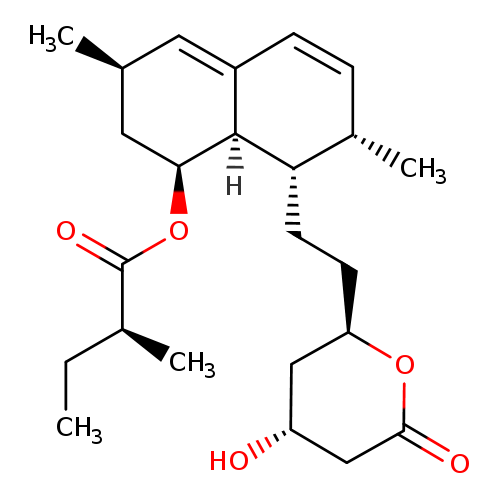
Lovastatin is a cholesterol-lowering agent that belongs to the class of medications called statins. It was the second agent of this class discovered. It was discovered by Alfred Alberts and his team at Merck in 1978 after screening only 18 compounds over 2 weeks. The agent, also known as mevinolin, was isolated from the fungi Aspergillus terreus. Research on this compound was suddenly shut down in 1980 and the drug was not approved until 1987. Interesting, Akira Endo at Sankyo Co. (Japan) patented lovastatin isolated from Monascus ruber four months before Merck. Lovastatin was found to be 2 times more potent than its predecessor, mevastatin, the first discovered statin. Like mevastatin, lovastatin is structurally similar to hydroxymethylglutarate (HMG), a substituent of HMG-Coenzyme A (HMG-CoA), a substrate of the cholesterol biosynthesis pathway via the mevalonic acid pathway. Lovastatin is a competitive inhibitor of HMG-CoA reductase with a binding affinity 20,000 times greater than HMG-CoA. Lovastatin differs structurally from mevastatin by a single methyl group at the 6' position. Lovastatin is a prodrug that is activated by in vivo hydrolysis of the lactone ring. It, along with mevastatin, has served as one of the lead compounds for the development of the synthetic compounds used today.
Contaminant Sources
  • HMDB Contaminants - Urine
  • STOFF IDENT Compounds
  • T3DB toxins
  • ToxCast & Tox21 Chemicals
Contaminant Type
  • Anticholesteremic Agent
  • Drug
  • Ester
  • Ether
  • Human Neurotoxin
  • Hydroxymethylglutaryl-CoA Reductase Inhibitor
  • Metabolite
  • Organic Compound
  • Synthetic Compound
Chemical Structure
Synonyms
ValueSource
(1S,3R,7S,8S,8AR)-1,2,3,7,8,8a-hexahydro-3,7-dimethyl-8-(2-(2R,4R)-(tetrahydro-4-hydroxy-6-oxo-2H-pyran-2-yl)ethyl)-1-naphthalenyl (S)-2-methyl-butyrateChEBI
2beta,6alpha-Dimethyl-8alpha-(2-methyl-1-oxobutoxy)-mevinic acid lactoneChEBI
6alpha-MethylcompactinChEBI
MevacorChEBI
MevinolinChEBI
MK-803ChEBI
ML-530bChEBI
(1S,3R,7S,8S,8AR)-1,2,3,7,8,8a-hexahydro-3,7-dimethyl-8-(2-(2R,4R)-(tetrahydro-4-hydroxy-6-oxo-2H-pyran-2-yl)ethyl)-1-naphthalenyl (S)-2-methyl-butyric acidGenerator
2b,6a-Dimethyl-8a-(2-methyl-1-oxobutoxy)-mevinate lactoneGenerator
2b,6a-Dimethyl-8a-(2-methyl-1-oxobutoxy)-mevinic acid lactoneGenerator
2beta,6alpha-Dimethyl-8alpha-(2-methyl-1-oxobutoxy)-mevinate lactoneGenerator
2Β,6α-dimethyl-8α-(2-methyl-1-oxobutoxy)-mevinate lactoneGenerator
2Β,6α-dimethyl-8α-(2-methyl-1-oxobutoxy)-mevinic acid lactoneGenerator
6a-MethylcompactinGenerator
6Α-methylcompactinGenerator
6 alpha-MethylcompactinHMDB
1 alpha-Isomer lovastatinHMDB
6 MethylcompactinHMDB
6-MethylcompactinHMDB
Lovastatin, 1 alpha-isomerHMDB
alpha-Isomer lovastatin, 1HMDB
Lovastatin, (1 alpha(s*))-isomerHMDB
Lovastatin, 1 alpha isomerHMDB
Monacolin KHMDB
Chemical FormulaC24H36O5
Average Molecular Mass404.540 g/mol
Monoisotopic Mass404.256 g/mol
CAS Registry Number75330-75-5
IUPAC Name(1S,3R,7S,8S,8aR)-8-{2-[(2R,4R)-4-hydroxy-6-oxooxan-2-yl]ethyl}-3,7-dimethyl-1,2,3,7,8,8a-hexahydronaphthalen-1-yl (2S)-2-methylbutanoate
Traditional Namelovastatin
SMILES[H][C@]12[C@H](C[C@@H](C)C=C1C=C[C@H](C)[C@@H]2CC[C@@H]1C[C@@H](O)CC(=O)O1)OC(=O)[C@@H](C)CC
InChI IdentifierInChI=1S/C24H36O5/c1-5-15(3)24(27)29-21-11-14(2)10-17-7-6-16(4)20(23(17)21)9-8-19-12-18(25)13-22(26)28-19/h6-7,10,14-16,18-21,23,25H,5,8-9,11-13H2,1-4H3/t14-,15-,16-,18+,19+,20-,21-,23-/m0/s1
InChI KeyPCZOHLXUXFIOCF-BXMDZJJMSA-N
Chemical Taxonomy
Description Belongs to the class of organic compounds known as delta valerolactones. These are cyclic organic compounds containing an oxan-2- one moiety.
KingdomOrganic compounds
Super ClassOrganoheterocyclic compounds
ClassLactones
Sub ClassDelta valerolactones
Direct ParentDelta valerolactones
Alternative Parents
Substituents
  • Delta valerolactone
  • Fatty acid ester
  • Delta_valerolactone
  • Dicarboxylic acid or derivatives
  • Oxane
  • Fatty acyl
  • Carboxylic acid ester
  • Secondary alcohol
  • Carboxylic acid derivative
  • Oxacycle
  • Organooxygen compound
  • Hydrocarbon derivative
  • Organic oxide
  • Alcohol
  • Organic oxygen compound
  • Carbonyl group
  • Aliphatic heteropolycyclic compound
Molecular FrameworkAliphatic heteropolycyclic compounds
External Descriptors
Biological Properties
StatusDetected and Not Quantified
OriginExogenous
Cellular Locations
  • Cytoplasm
  • Extracellular
  • Membrane
Biofluid LocationsNot Available
Tissue LocationsNot Available
Pathways
NameSMPDB LinkKEGG Link
Lovastatin PathwayNot AvailableNot Available
ApplicationsNot Available
Biological RolesNot Available
Chemical RolesNot Available
Physical Properties
StateSolid
AppearanceWhite powder.
Experimental Properties
PropertyValue
Melting Point174.5°C
Boiling PointNot Available
Solubility0.0004 mg/mL
Predicted Properties
PropertyValueSource
Water Solubility0.024 g/LALOGPS
logP4.11ALOGPS
logP3.9ChemAxon
logS-4.2ALOGPS
pKa (Strongest Acidic)14.91ChemAxon
pKa (Strongest Basic)-2.8ChemAxon
Physiological Charge0ChemAxon
Hydrogen Acceptor Count3ChemAxon
Hydrogen Donor Count1ChemAxon
Polar Surface Area72.83 ŲChemAxon
Rotatable Bond Count7ChemAxon
Refractivity113.18 m³·mol⁻¹ChemAxon
Polarizability46.11 ųChemAxon
Number of Rings3ChemAxon
BioavailabilityYesChemAxon
Rule of FiveYesChemAxon
Ghose FilterYesChemAxon
Veber's RuleNoChemAxon
MDDR-like RuleYesChemAxon
Spectra
Spectra
Toxicity Profile
Route of ExposureStudies suggest that <5% of the oral dose reaches the general circulation as active inhibitors. Time to peak serum concentration is 2-4 hours. Lovastatin undergoes extensive first-pass metabolism so the availability of the drug in the system is low and variable.
Mechanism of ToxicityLovastatin is structurally similar to the HMG, a substituent of the endogenous substrate of HMG-CoA reductase. Lovastatin is a prodrug that is activated in vivo via hydrolysis of the lactone ring to form the ‘_-hydroxyacid. The hydrolyzed lactone ring mimics the tetrahedral intermediate produced by the reductase allowing the agent to bind to HMG-CoA reductase with 20,000 times greater affinity than its natural substrate. The bicyclic portion of lovastatin binds to the coenzyme A portion of the active site.
MetabolismLovastatin is hepatically metabolized in which the major active metabolites are the beta-hydroxyacid of lovastatin, the 6'-hydroxy derivative, and two additional metabolites. Route of Elimination: Lovastatin undergoes extensive first-pass extraction in the liver, its primary site of action, with subsequent excretion of drug equivalents in the bile. 83% of the orally administered dose is excreted in bile and 10% is excreted in urine. Half Life: 5.3 hours
Toxicity ValuesLD50>1000 mg/kg (orally in mice)
Lethal DoseNot Available
Carcinogenicity (IARC Classification)No indication of carcinogenicity to humans (not listed by IARC).
Uses/SourcesFor management as an adjunct to diet to reduce elevated total-C, LDL-C, apo B, and TG levels in patients with primary hypercholesterolemia and mixed dyslipidemia. For primary prevention of coronary heart disease and to slow progression of coronary atherosclerosis in patients with coronary heart disease.

Minimum Risk LevelNot Available
Health EffectsNot Available
SymptomsNot Available
TreatmentNot Available
Concentrations
Not Available
External Links
DrugBank IDDB00227
HMDB IDHMDB0014372
FooDB IDNot Available
Phenol Explorer IDNot Available
KNApSAcK IDC00000547
BiGG IDNot Available
BioCyc IDNot Available
METLIN IDNot Available
PDB ID803
Wikipedia LinkLovastatin
Chemspider ID48085
ChEBI ID40303
PubChem Compound ID53232
Kegg Compound IDC07074
YMDB IDNot Available
ECMDB IDNot Available
References
Synthesis Reference

Donald F. Gerson, Xinfa Xiao, “Process for the production of lovastatin using Coniothyrium fuckelii.” U.S. Patent US5409820, issued January, 1984.

MSDSLink
General References
1. Bobek P, Ozdin L, Galbavy S: Dose- and time-dependent hypocholesterolemic effect of oyster mushroom (Pleurotus ostreatus) in rats. Nutrition. 1998 Mar;14(3):282-6.
2. https://www.ncbi.nlm.nih.gov/pubmed/?term=11375168
3. https://www.ncbi.nlm.nih.gov/pubmed/?term=11389707
4. https://www.ncbi.nlm.nih.gov/pubmed/?term=11483865
5. https://www.ncbi.nlm.nih.gov/pubmed/?term=18642339
6. https://www.ncbi.nlm.nih.gov/pubmed/?term=24093797
7. https://www.ncbi.nlm.nih.gov/pubmed/?term=7720768