Record Information
Version1.0
Creation Date2014-09-11 05:18:22 UTC
Update Date2026-04-05 15:31:20 UTC
Accession NumberCHEM003788
Identification
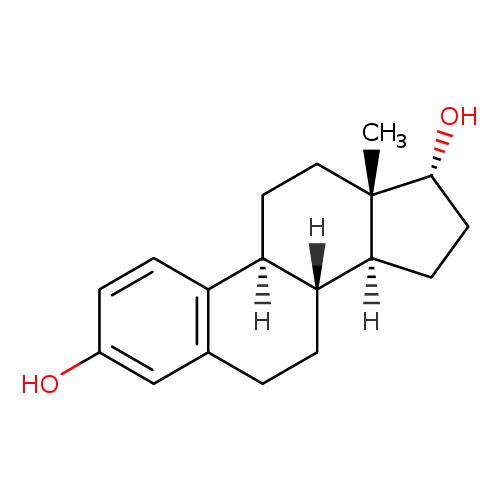
Common Name17a-Estradiol
ClassSmall Molecule
Description
17a-estradiol is found in the estrogen patch. The estrogen patch is a delivery system for estradiol used as hormone replacement therapy to treat the symptoms of menopause, such as hot flashes and vaginal dryness, and to prevent osteoporosis. Originally marketed as Vivelle (Novartis), it was discontinued in 2003 and reintroduced in a smaller form as Vivelle-Dot. Although the estrogen is given transdermally rather than in the standard oral tablets, the estrogen patch carries similar risks and benefits as more conventional forms of estrogen-only hormone replacement therapy.

Contaminant Sources
  • FooDB Chemicals
  • HMDB Contaminants - Urine
  • STOFF IDENT Compounds
  • T3DB toxins
  • ToxCast & Tox21 Chemicals
Contaminant Type
  • Animal Toxin
  • Drug
  • Food Toxin
  • Metabolite
  • Natural Compound
  • Organic Compound
Chemical Structure
Synonyms
ValueSource
AlfatradiolChEBI
alpha-EstradiolChEBI
Estra-1,3,5(10)trien-3,17alpha-diolChEBI
Estradiol-17alphaChEBI
a-EstradiolGenerator
Α-estradiolGenerator
Estra-1,3,5(10)trien-3,17a-diolGenerator
Estra-1,3,5(10)trien-3,17α-diolGenerator
Estradiol-17aGenerator
Estradiol-17αGenerator
17a-EstradiolGenerator
17Α-estradiolGenerator
1,3,5-Estratriene-3,17a-diolHMDB
13b-Methyl-1,3,5(10)-gonatriene-3,17a-diolHMDB
17-EpiestradiolHMDB
17a-OestradiolHMDB
3,17-DihydroxyestratrieneHMDB
3,17a-Dihydroxyestra-1,3,5(10)-trieneHMDB
3,17a-Dihydroxyoestra-1,3,5(10)-trieneHMDB
EpiestradiolHMDB
EpiestrolHMDB
Estra-1,3,5(10)-triene-3,17a-diolHMDB
Oestra-1,3,5(10)-triene-3,17a-diolHMDB
17alpha-EstradiolKEGG
Chemical FormulaC18H24O2
Average Molecular Mass272.382 g/mol
Monoisotopic Mass272.178 g/mol
CAS Registry Number57-91-0
IUPAC Name(1S,10R,11S,14R,15S)-15-methyltetracyclo[8.7.0.0^{2,7}.0^{11,15}]heptadeca-2(7),3,5-triene-5,14-diol
Traditional Name(1S,10R,11S,14R,15S)-15-methyltetracyclo[8.7.0.0^{2,7}.0^{11,15}]heptadeca-2(7),3,5-triene-5,14-diol
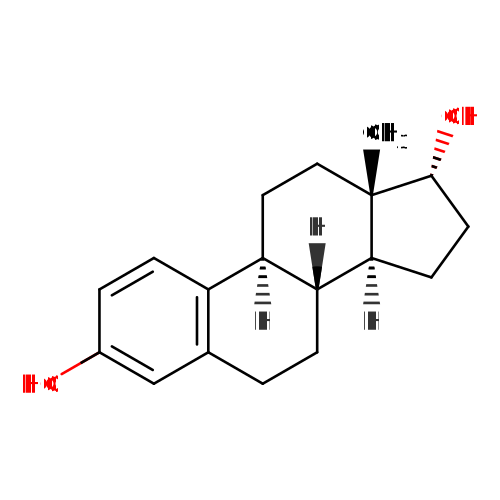
SMILES[H][C@@]12CC[C@@H](O)[C@@]1(C)CC[C@]1([H])C3=C(CC[C@@]21[H])C=C(O)C=C3
InChI IdentifierInChI=1S/C18H24O2/c1-18-9-8-14-13-5-3-12(19)10-11(13)2-4-15(14)16(18)6-7-17(18)20/h3,5,10,14-17,19-20H,2,4,6-9H2,1H3/t14-,15-,16+,17-,18+/m1/s1
InChI KeyVOXZDWNPVJITMN-SFFUCWETSA-N
Chemical Taxonomy
Description Belongs to the class of organic compounds known as estrogens and derivatives. These are steroids with a structure containing a 3-hydroxylated estrane.
KingdomOrganic compounds
Super ClassLipids and lipid-like molecules
ClassSteroids and steroid derivatives
Sub ClassEstrane steroids
Direct ParentEstrogens and derivatives
Alternative Parents
Substituents
  • Estrogen-skeleton
  • 17-hydroxysteroid
  • Hydroxysteroid
  • 3-hydroxysteroid
  • Phenanthrene
  • Tetralin
  • 1-hydroxy-2-unsubstituted benzenoid
  • Benzenoid
  • Cyclic alcohol
  • Secondary alcohol
  • Organic oxygen compound
  • Hydrocarbon derivative
  • Organooxygen compound
  • Alcohol
  • Aromatic homopolycyclic compound
Molecular FrameworkAromatic homopolycyclic compounds
External Descriptors
Biological Properties
StatusDetected and Not Quantified
OriginEndogenous
Cellular Locations
  • Extracellular
  • Membrane
Biofluid LocationsNot Available
Tissue LocationsNot Available
PathwaysNot Available
ApplicationsNot Available
Biological RolesNot Available
Chemical RolesNot Available
Physical Properties
StateSolid
AppearanceWhite powder.
Experimental Properties
PropertyValue
Melting Point216 - 219 °C
Boiling PointNot Available
Solubility0.0039 mg/mL
Predicted Properties
PropertyValueSource
Water Solubility0.021 g/LALOGPS
logP3.57ALOGPS
logP3.75ChemAxon
logS-4.1ALOGPS
pKa (Strongest Acidic)10.33ChemAxon
pKa (Strongest Basic)-0.88ChemAxon
Physiological Charge0ChemAxon
Hydrogen Acceptor Count2ChemAxon
Hydrogen Donor Count2ChemAxon
Polar Surface Area40.46 ŲChemAxon
Rotatable Bond Count0ChemAxon
Refractivity79.9 m³·mol⁻¹ChemAxon
Polarizability31.93 ųChemAxon
Number of Rings4ChemAxon
BioavailabilityYesChemAxon
Rule of FiveYesChemAxon
Ghose FilterYesChemAxon
Veber's RuleNoChemAxon
MDDR-like RuleNoChemAxon
Spectra
Spectra
Toxicity Profile
Route of ExposureNot Available
Mechanism of ToxicityNot Available
MetabolismNot Available
Toxicity ValuesNot Available
Lethal DoseNot Available
Carcinogenicity (IARC Classification)No indication of carcinogenicity to humans (not listed by IARC).
Uses/SourcesNot Available
Minimum Risk LevelNot Available
Health EffectsNot Available
SymptomsNot Available
TreatmentNot Available
Concentrations
Not Available
External Links
DrugBank IDNot Available
HMDB IDHMDB0000429
FooDB IDFDB112198
Phenol Explorer IDNot Available
KNApSAcK IDNot Available
BiGG IDNot Available
BioCyc IDNot Available
METLIN ID5418
PDB IDNot Available
Wikipedia Link17α-Estradiol
Chemspider ID61840
ChEBI ID17160
PubChem Compound ID68570
Kegg Compound IDC02537
YMDB IDNot Available
ECMDB IDNot Available
References
Synthesis ReferenceGardi, Rinaldo; Pedrali, Cesare; Ercoli, Alberto. 3-Cyclopentyl ethers of 16,17-oxygenated estrogens. New synthesis of 17a-estradiol. Gazzetta Chimica Italiana (1963), 93(8-9), 1028-43.
MSDSNot Available
General References
1. https://www.ncbi.nlm.nih.gov/pubmed/?term=12115026
2. https://www.ncbi.nlm.nih.gov/pubmed/?term=16042770
3. https://www.ncbi.nlm.nih.gov/pubmed/?term=24564600
4. Gardi, Rinaldo; Pedrali, Cesare; Ercoli, Alberto. 3-Cyclopentyl ethers of 16,17-oxygenated estrogens. New synthesis of 17a-estradiol. Gazzetta Chimica Italiana (1963), 93(8-9), 1028-43.
5. Corbier P, Roffi J, Rhoda J, Valens M: [Female sex behavior of male rats castrated at birth and given female sex hormones: effects of hour of castration]. C R Seances Acad Sci III. 1981 Nov 23;293(11):649-54.
6. Vic P, Garcia M, Andre J, Humeau C, Rochefort H: [Early effect of estradiol on ultrastructure of chromatin in the endometrium and hormone-dependent mammary tumors]. C R Acad Sci Hebd Seances Acad Sci D. 1978 Jul 17;287(3):141-4.
7. Salat-Baroux J, Scemama-Kestenberg H, Couturier JY, Firmin C, Agnes E, Levy G, Vuillard E: [Postovulatory hormones in plasma, peritoneal and follicular compartments]. J Gynecol Obstet Biol Reprod (Paris). 1982;11(4):447-56.
8. Zhu BT, Han GZ, Shim JY, Wen Y, Jiang XR: Quantitative structure-activity relationship of various endogenous estrogen metabolites for human estrogen receptor alpha and beta subtypes: Insights into the structural determinants favoring a differential subtype binding. Endocrinology. 2006 Sep;147(9):4132-50. doi: 10.1210/en.2006-0113. Epub 2006 May 25.
9. Stout MB, Steyn FJ, Jurczak MJ, Camporez JG, Zhu Y, Hawse JR, Jurk D, Palmer AK, Xu M, Pirtskhalava T, Evans GL, de Souza Santos R, Frank AP, White TA, Monroe DG, Singh RJ, Casaclang-Verzosa G, Miller JD, Clegg DJ, LeBrasseur NK, von Zglinicki T, Shulman GI, Tchkonia T, Kirkland JL: 17alpha-Estradiol Alleviates Age-related Metabolic and Inflammatory Dysfunction in Male Mice Without Inducing Feminization. J Gerontol A Biol Sci Med Sci. 2017 Jan;72(1):3-15. doi: 10.1093/gerona/glv309. Epub 2016 Jan 24.