Propyl gallate (CED0003862)

Record Information
Version1.0
Creation Date2014-09-11 05:19:10 UTC
Update Date2026-05-14 19:21:45 UTC
SynCED IDCED0003862
Secondary Accession Numbers
  • CHEM003806
  • T3D4850
Identification
Common NamePropyl gallate
ClassSmall Molecule
Description
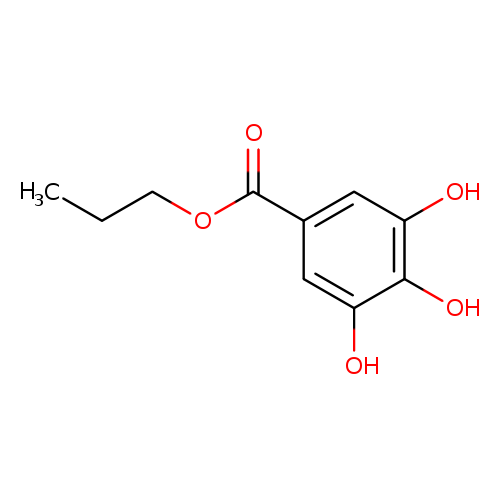
Propyl gallate (C10H12O5) is a solid organic compound with an average molecular weight of 212.20 g/mol. Propyl gallate belongs to the benzoic acids and derivatives, a subclass of benzene and substituted derivatives within the organic compounds. This exogenous substance is used industrially as an antioxidant (PMC9826852 ), a fragrance, a flavouring and nutrient, and a food additive (PMC10902759 ). In plastics, it is utilized in polypropylene, polyvinyl chloride, high-density polyethylene, and low-density polyethylene. The compound is found in or released from 34 recorded sources. These include food, food processing and cookware—specifically food preservation, food contact materials, fermentation processes for beer, and the preparation of vinegar, wine, or sparkling wine. Other sources include household cleaning and consumer products such as perfumes within detergents and soaps, bleaching agents, and smoking requisites; building and construction materials like tents, canopies, and ceilings; electrical and electronic equipment including electrodes, discharge lamps, and electric switches; and indoor air. Recorded exposure routes include touch, oral, and inhalation, with inhalation supported by literature (PMC10902759 ). Propyl gallate interacts with three recorded protein targets: the estrogen receptor (ESR1), aryl hydrocarbon receptor (AHR), and bile acid receptor (NR1H4). Regarding health effects, the compound is associated with diarrhea (PMC9826852 ) and cancer (PMC6270656 , PMC9181963 ).
Contaminant Type
  • Ester
  • Ether
  • Food Additive
  • Food Toxin
  • Household Toxin
  • Metabolite
  • Natural Compound
  • Organic Compound
  • Plant Toxin
Chemical Structure
Synonyms
ValueSource
Propyl gallic acidGenerator
Gallate, propylMeSH
3,4,5-Trihydroxybenzene-1-propylcarboxylateHMDB
3,4,5-Trihydroxybenzoic acid N-propyl esterHMDB
3,4,5-Trihydroxybenzoic acid propyl esterHMDB
3,4,5-Trihydroxybenzoic acid, propyl esterHMDB
Benzoic acid, 3,4,5-trihydroxy-, propyl esterHMDB
e310HMDB
FEMA 2947HMDB
Gallic acid N-propyl esterHMDB
Gallic acid propyl esterHMDB
Gallic acid, propyl esterHMDB
N-Propyl 3,4,5-trihydroxybenzoateHMDB
N-Propyl ester OF 3,4,5-trihydroxybenzoic acidHMDB
N-Propyl gallateHMDB
N-Propyl-3,4,5-trihydroxybenzoateHMDB
N-Propyl-gallateHMDB
Nipa 49HMDB
Nipagallin PHMDB
Nipanox S 1HMDB
PGHMDB
pro Gallin PHMDB
Progallin PHMDB
Propyl 3,4,5-trihydroxybenzoateHMDB
Propyl galiateHMDB
Propyl gallate (NF)HMDB
Propylester kyseliny galloveHMDB
Sustane PGHMDB
Tenox PGHMDB
Propyl gallateKEGG
N-Propyl gallic acidGenerator
Chemical FormulaC10H12O5
Average Molecular Mass212.199 g/mol
Monoisotopic Mass212.068 g/mol
CAS Registry Number121-79-9
IUPAC Namepropyl 3,4,5-trihydroxybenzoate
Traditional Namepropyl gallate
SMILESCCCOC(=O)C1=CC(O)=C(O)C(O)=C1
InChI IdentifierInChI=1S/C10H12O5/c1-2-3-15-10(14)6-4-7(11)9(13)8(12)5-6/h4-5,11-13H,2-3H2,1H3
InChI KeyZTHYODDOHIVTJV-UHFFFAOYSA-N
Chemical Taxonomy
Description Belongs to the class of organic compounds known as galloyl esters. These are organic compounds that contain an ester derivative of 3,4,5-trihydroxybenzoic acid.
KingdomOrganic compounds
Super ClassBenzenoids
ClassBenzene and substituted derivatives
Sub ClassBenzoic acids and derivatives
Direct ParentGalloyl esters
Alternative Parents
Substituents
  • Galloyl ester
  • P-hydroxybenzoic acid alkyl ester
  • M-hydroxybenzoic acid ester
  • P-hydroxybenzoic acid ester
  • Benzoate ester
  • Benzenetriol
  • Pyrogallol derivative
  • Benzoyl
  • 1-hydroxy-4-unsubstituted benzenoid
  • 1-hydroxy-2-unsubstituted benzenoid
  • Phenol
  • Carboxylic acid ester
  • Monocarboxylic acid or derivatives
  • Carboxylic acid derivative
  • Polyol
  • Organooxygen compound
  • Organic oxygen compound
  • Organic oxide
  • Hydrocarbon derivative
  • Aromatic homomonocyclic compound
Molecular FrameworkAromatic homomonocyclic compounds
External Descriptors
Biological Properties
StatusDetected and Not Quantified
OriginExogenous
Cellular Locations
  • Cytoplasm
  • Extracellular
Biofluid LocationsNot Available
Tissue LocationsNot Available
ApplicationsNot Available
Biological Roles
Chemical RolesNot Available
Organoleptic EffectsNot Available
Physical Properties
StateSolid
AppearanceWhite powder.
Experimental Properties
PropertyValue
Melting Point150 °C
Boiling PointDecomposes
Solubility3.5 mg/mL at 25 °C
Predicted Properties
PropertyValueSource
Water Solubility1.71 g/LALOGPS
logP1.84ALOGPS
logP1.95ChemAxon
logS-2.1ALOGPS
pKa (Strongest Acidic)8.11ChemAxon
pKa (Strongest Basic)-5.5ChemAxon
Physiological Charge0ChemAxon
Hydrogen Acceptor Count4ChemAxon
Hydrogen Donor Count3ChemAxon
Polar Surface Area86.99 ŲChemAxon
Rotatable Bond Count4ChemAxon
Refractivity53.3 m³·mol⁻¹ChemAxon
Polarizability21.21 ųChemAxon
Number of Rings1ChemAxon
BioavailabilityYesChemAxon
Rule of FiveYesChemAxon
Ghose FilterYesChemAxon
Veber's RuleNoChemAxon
MDDR-like RuleNoChemAxon
Spectra
Spectra
Spectrum TypeDescriptionSplash KeyDeposition DateView
GC-MSGC-MS Spectrumsplash10-003r-1591200000-83ddc9d65f8d1fc4dc59Not AvailableView Spectrum
Predicted GC-MSPredicted GC-MS Spectrumsplash10-0udi-3900000000-21920ec0bc1944203acdNot AvailableView Spectrum
Predicted GC-MSPredicted GC-MS Spectrumsplash10-0300-3009200000-4c9cb5458fd589cfb9f5Not AvailableView Spectrum
Predicted GC-MSPredicted GC-MS SpectrumNot AvailableNot AvailableView Spectrum
LC-MS/MSLC-MS/MS Spectrumsplash10-004u-1900000000-2c928c0529e1e856b4cfNot AvailableView Spectrum
LC-MS/MSLC-MS/MS Spectrumsplash10-020c-2900000000-6126b5c9249291690c34Not AvailableView Spectrum
LC-MS/MSLC-MS/MS Spectrumsplash10-004u-1900000000-3c677dc5e935ac8b92a7Not AvailableView Spectrum
LC-MS/MSLC-MS/MS Spectrumsplash10-020c-2900000000-0f7125c76f6115f1a362Not AvailableView Spectrum
LC-MS/MSLC-MS/MS Spectrumsplash10-03di-0490000000-801c27e3621d93ec37c1Not AvailableView Spectrum
LC-MS/MSLC-MS/MS Spectrumsplash10-03di-0190000000-b3af9cab9a755c2515e0Not AvailableView Spectrum
LC-MS/MSLC-MS/MS Spectrumsplash10-0400-0920000000-ee4ea381c88a5b7f07e3Not AvailableView Spectrum
LC-MS/MSLC-MS/MS Spectrumsplash10-004r-1900000000-fdda012f6b2915b52ddeNot AvailableView Spectrum
Predicted LC-MS/MSPredicted LC-MS/MS Spectrumsplash10-03di-3590000000-e327edc472bde7205749Not AvailableView Spectrum
Predicted LC-MS/MSPredicted LC-MS/MS Spectrumsplash10-0f6x-9610000000-d6337dfac07ea957e6daNot AvailableView Spectrum
Predicted LC-MS/MSPredicted LC-MS/MS Spectrumsplash10-0f6x-9700000000-019f1f6b94c68335f988Not AvailableView Spectrum
Predicted LC-MS/MSPredicted LC-MS/MS Spectrumsplash10-03di-1490000000-ff8794d740e2004569eaNot AvailableView Spectrum
Predicted LC-MS/MSPredicted LC-MS/MS Spectrumsplash10-016r-1910000000-1acf485109a5d1fc39e6Not AvailableView Spectrum
Predicted LC-MS/MSPredicted LC-MS/MS Spectrumsplash10-0fvi-3900000000-6045394c44a28e539509Not AvailableView Spectrum
Predicted LC-MS/MSPredicted LC-MS/MS Spectrumsplash10-03di-0690000000-f4a4482ba53c556490b7Not AvailableView Spectrum
Predicted LC-MS/MSPredicted LC-MS/MS Spectrumsplash10-0w90-1910000000-a11c00d19f2bc9ffbcdeNot AvailableView Spectrum
Predicted LC-MS/MSPredicted LC-MS/MS Spectrumsplash10-0uxr-5900000000-7756697004244c98da58Not AvailableView Spectrum
Predicted LC-MS/MSPredicted LC-MS/MS Spectrumsplash10-03di-0090000000-a3bb7cbc13a749439d3cNot AvailableView Spectrum
Predicted LC-MS/MSPredicted LC-MS/MS Spectrumsplash10-0j4i-0930000000-524d0f46faeeb372fe28Not AvailableView Spectrum
Predicted LC-MS/MSPredicted LC-MS/MS Spectrumsplash10-016s-9500000000-3ed22349cc0c3913984eNot AvailableView Spectrum
MSMS Spectrumsplash10-0uk9-2910000000-9f307d16268eddd77840Not AvailableView Spectrum
Toxicity Profile
Toxicity Values
Toxicity ValueOrganismDose DescriptorRoute of ExposurePredicted or ExperimentalToxicity RatingReference
2121.0 Log mg/kg [1200:3800]RatLD50oralpredictedNot AvailableNot Available
2000.0 mg/kg-day MouseNOELoralexperimentalNot AvailableECOTOX - EPA ORD
Toxicity / Toxin ClassNot Available
Mechanism of ToxicityNot Available
Carcinogenicity (IARC Classification)No indication of carcinogenicity to humans (not listed by IARC).
Minimum Risk LevelNot Available
SymptomsNot Available
TreatmentNot Available
Health Effects
Health EffectRelationshipDirectionDescriptionReference
cancerAssociated With?Not AvailableCancer is a group of diseases involving abnormal cell growth with the potential to invade or spread to other parts of the body. Possible signs and symptoms include a lump, abnormal bleeding, prolonged cough, unexplained weight loss, and a change in bowel movements. There are over 100 types of cancers affect humans. The risk of developing certain cancers can be reduced by not smoking, maintaining a healthy weight, not drinking too much alcohol, eating plenty of vegetables, fruits and whole grains, vaccination against certain infectious diseases, not eating too much processed and red meat and avoiding too much sunlight exposure. Cancer is often treated with some combination of radiation therapy, surgery, chemotherapy and targeted therapy. The majority of cancers, some 90–95% of cases, are due to genetic mutations from environmental and lifestyle factors. The remaining 5–10% are due to inherited genetics.PMC6270656 , PMC9181963
diarrheaAssociated With?Not AvailableA disorder characterized by an increase in frequency and/or loose or watery bowel movements. (NCI CTCAE)PMC9826852
feverAssociated With?Not AvailableA disorder characterized by an abnormally high body temperature.PMC9392978
painAssociated With?Not AvailableA disorder characterized by the sensation of marked discomfort, distress or agony. (NCI CTCAE)PMC9392978
liver cirrhosisAssociated With?Not AvailableNot AvailablePMC12981716
leukemiaAssociated With?decreaseA cancer that affects the blood or bone marrow characterized by an abnormal proliferation of blood cells. (DO)PMC3756414
allergic diseaseAssociated With?Not AvailableAllergic diseases, also known as allergies, are a number of conditions caused by hypersensitivity of the immune system to typically harmless substances in the environment. These diseases include hay fever, food allergies, atopic dermatitis, allergic asthma, and anaphylaxis. Symptoms may include red eyes, an itchy rash, sneezing, a runny nose, shortness of breath, or swelling. Common allergens include pollen and certain foods. Metals and other substances may also cause allergies. Food, insect stings, and medications are common causes of severe allergic reactions. Allergies can be due to both genetic and environmental factors. The underlying mechanism involves immunoglobulin E antibodies (IgE) binding to an allergen and then to a receptor on mast cells or basophils where it triggers the release of inflammatory chemicals such as histamine. Allergies are among the most common conditions in the world. In the developed world, about 20% of people are affected by allergic rhinitis, about 6% of people have at least one food allergy, and about 20% have atopic dermatitis at some point in time.PMC11273418
Cell DeathAssociated With?increaseNot AvailablePMC5598233
Oxidative StressAssociated With?increaseNot AvailablePMC12981716
Oxidative StressHas Therapeutic Effect OnNot AvailableNot AvailablePMC7537683
FibrosisAssociated With?Not AvailableNot AvailablePMC12981716
CarcinogenesisAssociated With?Not AvailableNot AvailablePMC12114875
hyperemiaAssociated With?Not AvailableNot AvailablePMC8788381
gastrointestinal system diseaseAssociated With?Not AvailableNot AvailablePMC11273418
Reperfusion InjuryHas Therapeutic Effect OnNot AvailableNot AvailablePMC10499917
Exposure Sources
Source IDSourceSectorReference
CEDs000010Insecticides?Insecticides are synthetic chemicals designed to control or eliminate insect pests that threaten crops and other agricultural products.Agriculture & land managementPubChem
CEDs000019Indoor air?Indoor air can be a significant reservoir for synthetic chemical contaminants, which often originate from various sources within enclosed environments.Air, dust & atmospheric transportNot Available
CEDs000226Fragrances?Fragrances are complex mixtures of aromatic compounds used to impart pleasant scents to various products.Personal care & cosmeticsPMC6781352
CEDs000233Brushes?Brushes used in personal care and cosmetics can be a source of synthetic chemical contamination due to the materials and coatings used in their manufacturing.Personal care & cosmeticsPubChem
CEDs000490Personal care & cosmeticsNot Available
CEDs000494Food contact materials?Food contact materials refer to substances and products that are intended to come into contact with food during processing, packaging, or preparation.Food, food processing & cookwareNot Available
CEDs000495Ceilings?Ceilings in built environments can be a source of synthetic chemical contamination due to the materials used in their construction and finishes.Building & ConstructionPubChem
CEDs000503Tents Or Canopies?Tents and canopies used in various applications can be a source of synthetic chemical contamination primarily due to the materials from which they are made.Building & ConstructionPubChem
CEDs000511Conductors Or Conductive Bodies Characterised By The Conductive Materials?Conductors, or conductive bodies, are materials that allow the flow of electrical current, typically made from metals such as copper, aluminum, or silver.Electrical & Electronic EquipmentPubChem
CEDs000514Discharge Lamps?Discharge lamps, including fluorescent and high-intensity discharge (HID) lamps, are commonly used for lighting applications due to their energy efficiency and brightness.Electrical & Electronic EquipmentPubChem
CEDs000517Electric Switches?Electric switches, integral components in numerous devices, can be a source of synthetic chemical contamination due to the materials and manufacturing processes involved in their production.Electrical & Electronic EquipmentPubChem
CEDs000518Electrically Stimulated Smoking Devices?Electrically stimulated smoking devices, commonly known as e-cigarettes or vape pens, utilize electrical components to heat a liquid solution, often containing nicotine, flavorings, and other additives, to produce an aerosol for inhalation.Electrical & Electronic EquipmentPubChem
CEDs000519Electrodes?Electrodes, used in various electrical and electronic applications, can be a source of synthetic chemical contamination due to the materials from which they are constructed and the processes involved in their manufacturing.Electrical & Electronic EquipmentPubChem
CEDs000521Fixed Capacitors And Their Manufacture?Fixed capacitors are passive electronic components used to store and release electrical energy, playing a critical role in various circuits.Electrical & Electronic EquipmentPubChem
CEDs000524Hybrid Capacitors?Hybrid capacitors are energy storage devices that combine the properties of electrolytic and supercapacitors, utilizing a combination of electrochemical principles to achieve higher energy density and power density.Electrical & Electronic EquipmentPubChem
CEDs000525Line Transmission Systems?Line Transmission Systems, commonly used for the distribution of electrical energy, can be a source of synthetic chemical contamination through the insulation materials and coatings utilized in their construction.Electrical & Electronic EquipmentPubChem
CEDs000527Magnets?Magnets, commonly used in various electrical and electronic applications, can be a source of synthetic chemical contamination due to the materials used in their production.Electrical & Electronic EquipmentPubChem
CEDs000529Power Cables?Power cables are used to transmit electrical energy and are typically composed of conductive materials, insulation, and protective coatings.Electrical & Electronic EquipmentPubChem
CEDs000531Relays?Relays are electromechanical switches used to control circuits and manage electrical loads.Electrical & Electronic EquipmentPubChem
CEDs000537Television Systems?Television systems can be a source of synthetic chemical contamination due to the various materials and components used in their manufacture and operation.Electrical & Electronic EquipmentPubChem
CEDs000538Thin Magnetic Films?Thin magnetic films are layers of magnetic material ranging from a few nanometers to several micrometers in thickness, commonly used in applications such as magnetic sensors, data storage devices, and electronic components.Electrical & Electronic EquipmentPubChem
CEDs000544Fermentation Processes For Beer?Fermentation processes for beer involve the conversion of sugars into alcohol and carbon dioxide by yeast.Food, food processing & cookwarePubChem
CEDs000545Food Preservation?Food preservation often involves the use of synthetic chemicals, such as preservatives, flavor enhancers, and color additives, to extend shelf life and enhance the sensory qualities of food products.Food, food processing & cookwarePubChem
CEDs000548Preparation Of Vinegar?Vinegar is produced through the fermentation of ethanol by acetic acid bacteria, resulting in a solution that typically contains 4-8% acetic acid.Food, food processing & cookwarePubChem
CEDs000549Preparation Of Wine Or Sparkling Wine?The preparation of wine or sparkling wine involves various stages, including fermentation, aging, and bottling, which can introduce potential sources of synthetic chemical contamination.Food, food processing & cookwarePubChem
CEDs000550Preparation Of Wort?The preparation of wort involves the extraction of sugars from malted grains, a crucial step in the brewing process.Food, food processing & cookwarePubChem
CEDs000552Processing Meats?Processing meats can lead to synthetic chemical contamination primarily through the use of additives and preservatives.Food, food processing & cookwarePubChem
CEDs000553Treatment Of Hops?Hops, a key ingredient in brewing and food flavoring, can be a source of synthetic chemical contamination due to various agricultural practices.Food, food processing & cookwarePubChem
CEDs000555Bleaching Agents?Bleaching agents are chemical substances used to whiten or lighten materials, often employed in various cleaning products for their stain removal and disinfecting properties.Household cleaning & consumer productsPubChem
CEDs000556Cigar Cigarettes?Cigar cigarettes are a source of synthetic chemical contamination due to the combustion of various tobacco blends and additives.Household cleaning & consumer productsPubChem
CEDs000559Non Electric Simulated Smoking Devices?Non-electric simulated smoking devices, often designed to mimic the experience of smoking without combustion, can be sources of synthetic chemical contamination due to the materials and chemicals used in their construction and operation.Household cleaning & consumer productsPubChem
CEDs000560Other Smoking Requisites?Other smoking requisites, including items such as lighters, matches, and rolling papers, can introduce synthetic chemical contamination through various components and additives.Household cleaning & consumer productsPubChem
CEDs000561Perfumes Within Detergents And Soaps?Perfumes within detergents and soaps are synthetic fragrance compounds added to enhance the sensory experience of cleaning products.Household cleaning & consumer productsPubChem
CEDs000562Pipe Accessories?Pipe accessories, such as fittings, connectors, and seals, are components used in plumbing systems to facilitate the flow of liquids and gases.Household cleaning & consumer productsPubChem
CEDs000563Soap Detergents?Soap detergents are synthetic surfactants designed to enhance the cleaning efficacy of water by reducing surface tension, allowing for better interaction with dirt and grease.Household cleaning & consumer productsPubChem
CEDs000564Soap Dispensers?Soap dispensers, commonly used for dispensing liquid soaps and sanitizers, can become a source of synthetic chemical contamination due to the materials used in their construction and the products they dispense.Household cleaning & consumer productsPubChem
CEDs000567Tobacco Product Cases?Tobacco product cases can serve as a source of synthetic chemical contamination due to the presence of various additives and chemicals used in tobacco processing and product manufacturing.Household cleaning & consumer productsPubChem
CEDs000569Tobacco Smoke Filters?Tobacco smoke filters are designed to reduce the inhalation of harmful substances in cigarette smoke, including tar and other particulate matter.Household cleaning & consumer productsPubChem
CEDs000580Manufacture Preparation Of Tobacco Products?The manufacture and preparation of tobacco products involve various processes that can result in the introduction of synthetic chemicals into the environment.Industrial manufacturing & chemical processingPubChem
CEDs000581Paper Making Machines?Paper making machines utilize various synthetic chemicals throughout the production process, including additives, coatings, and bleaching agents.Industrial manufacturing & chemical processingPubChem
CEDs000592Marine Propulsion Or Steering?Marine propulsion and steering systems often rely on various synthetic chemicals, including lubricants, fuels, and hydraulic fluids.Marine, shipping & aquaculturePubChem
CEDs000596Acaricides?Acaricides are synthetic chemicals specifically designed to target and control mite populations that can damage crops and plants.Agriculture & land managementPubChem
CEDs000598Fertiliser Distributors?Fertiliser distributors play a critical role in the supply of synthetic fertilizers, which are widely used to enhance soil fertility and crop yield.Agriculture & land managementPubChem
CEDs000600Herbicides And Algicides?Herbicides and algicides are synthetic chemicals primarily used to control unwanted plants and algae in various environments.Agriculture & land managementPubChem
CEDs000602Molluscicides?Molluscicides are synthetic chemicals specifically designed to control and eliminate mollusks, such as snails and slugs, which can be detrimental to crops and agricultural productivity.Agriculture & land managementPubChem
CEDs000603Nematocides?Nematocides are synthetic chemicals specifically designed to control nematodes, which are microscopic roundworms that can cause significant damage to crops and plants.Agriculture & land managementPubChem
CEDs000604Pest Attractants?Pest attractants are synthetic chemicals designed to lure specific pests for monitoring or control purposes.Agriculture & land managementPubChem
CEDs000605Pest Repellants?Pest repellents, often formulated from synthetic chemicals, are widely used to protect crops from insect infestations and other pests.Agriculture & land managementPubChem
CEDs000606Plant Growth Regulators?Plant Growth Regulators (PGRs) are synthetic chemicals designed to influence the growth and development of plants.Agriculture & land managementPubChem
CEDs000607Rodenticides(1)?Rodenticides are synthetic chemicals specifically formulated to control rodent populations, serving as a crucial tool in managing pests that can damage crops and spread diseases.Agriculture & land managementPubChem
CEDs000608Rodenticides?Rodenticides are chemical substances specifically designed to control rodent populations by causing death through various mechanisms, including anticoagulation or neurotoxicity.Agriculture & land managementPubChem
CEDs000609Aftershave?Aftershave is a grooming product typically used to soothe and protect the skin following shaving.Personal care & cosmeticsPubChem
CEDs000610Aftersun Products?Aftersun products are designed to soothe and hydrate the skin after sun exposure, often containing various synthetic chemicals such as emollients, preservatives, and fragrances.Personal care & cosmeticsPubChem
CEDs000611Anti Perspirants Or Body Deoderants?Antiperspirants and body deodorants commonly contain synthetic chemicals such as aluminum compounds, parabens, and synthetic fragrances.Personal care & cosmeticsPubChem
CEDs000612Body Washing Or Cleaning Implements?Body washing or cleaning implements, such as synthetic sponges, loofahs, and washcloths, can be sources of synthetic chemical contamination due to the materials used in their production.Personal care & cosmeticsPubChem
CEDs000613Depilatories?Depilatories are products designed to remove unwanted hair through the application of synthetic chemicals that break down the protein structure of hair, facilitating its removal.Personal care & cosmeticsPubChem
CEDs000614Essential Oils Or Perfumes?Essential oils and perfumes are complex mixtures of volatile compounds derived from natural or synthetic sources, commonly used for their aromatic properties.Personal care & cosmeticsPubChem
CEDs000615Eye Makeup Products?Eye makeup products, including mascaras, eyeliners, and eyeshadows, often contain a variety of synthetic chemicals such as pigments, preservatives, and film-forming agents.Personal care & cosmeticsPubChem
CEDs000616Face Mask Cosmetics?Face mask cosmetics often contain a variety of synthetic chemicals, including preservatives, emulsifiers, and fragrances, which can contribute to chemical contamination.Personal care & cosmeticsPubChem
CEDs000617Lip Care Products?Lip care products, including lipsticks, balms, and glosses, often contain a variety of synthetic chemicals such as parabens, phthalates, and synthetic fragrances.Personal care & cosmeticsPubChem
CEDs000618Lip Makeup Products?Lip makeup products, such as lipsticks, lip glosses, and lip liners, often contain a variety of synthetic chemicals, including pigments, preservatives, and emollients.Personal care & cosmeticsPubChem
CEDs000630Toys?Toys, particularly those made from synthetic materials such as plastics, can be a source of chemical contamination due to the presence of various additives and compounds used in their production.Recreation & sports surfacesPubChem
CEDs000632Apparel?Apparel production often involves the use of various synthetic chemicals, including dyes, finishing agents, and preservatives.Textiles, leather & furnishingsPubChem
CEDs000638Decorating Textiles?Decorating textiles often involves the use of synthetic chemicals such as dyes, finishes, and coatings.Textiles, leather & furnishingsPubChem
CEDs000640Embroidering And Tufting?Embroidering and tufting processes often involve the use of synthetic chemicals such as dyes, adhesives, and finishing agents.Textiles, leather & furnishingsPubChem
CEDs000642Footwear?Footwear production often involves the use of various synthetic chemicals, such as adhesives, dyes, and treatments, which can contribute to environmental contamination.Textiles, leather & furnishingsPubChem
CEDs000647Multicolour Dyeing?Multicolour dyeing involves the application of multiple synthetic dyes to textiles and other materials to achieve vibrant, diverse color patterns.Textiles, leather & furnishingsPubChem
CEDs000650Purses Luggage Hand Bags?Purses, luggage, and handbags are often manufactured using synthetic materials such as polyvinyl chloride (PVC), polyurethane, and various types of nylon.Textiles, leather & furnishingsPubChem
CEDs000652Ropes?Ropes manufactured from synthetic fibers, such as polypropylene, nylon, and polyester, are widely used in various applications, including marine, construction, and outdoor activities.Textiles, leather & furnishingsPubChem
CEDs000653Sewing?Sewing processes often involve the use of various synthetic chemicals, which can become sources of contamination in the environment.Textiles, leather & furnishingsPubChem
CEDs000657Surface Finishing Of Leather?Surface finishing of leather often involves the use of various synthetic chemicals, including dyes, resins, and finishing agents.Textiles, leather & furnishingsPubChem
CEDs000659Transfer Printing?Transfer printing is a process used to apply designs and patterns onto various substrates, commonly utilizing synthetic dyes and inks that can contain hazardous chemicals.Textiles, leather & furnishingsPubChem
CEDs000662Yarns Or Threads?Yarns or threads used in textiles can be a source of synthetic chemical contamination due to the production processes and treatments they undergo.Textiles, leather & furnishingsPubChem
CEDs000670Solid Fire Fighting Substances?Solid fire fighting substances, such as certain types of dry chemical powders, are used in fire suppression applications to extinguish flames and prevent fire spread.Fire suppression systems & agentsPubChem
CEDs000673Unmanned Aerial Vehicles?Unmanned Aerial Vehicles (UAVs), commonly known as drones, utilize various synthetic chemicals in their manufacturing, operation, and maintenance processes.Aviation & AerospacePubChem
CEDs000678Nitrogenous Fertilisers?Nitrogenous fertilizers are synthetic chemical compounds primarily used to enhance plant growth by supplying essential nitrogen, a crucial nutrient for photosynthesis and protein synthesis.Agriculture & land managementPubChem
CEDs000679Phosphatic Fertilisers?Phosphatic fertilizers are synthetic chemical products primarily composed of phosphorus, which is essential for plant growth.Agriculture & land managementPubChem
CEDs000684Cements?Cements are a composite material primarily used as a binding agent in construction applications, formed by the calcination of limestone and clay minerals at high temperatures.Building & ConstructionPubChem
CEDs000685Ceramics?Ceramics can be a source of synthetic chemical contamination through various additives and processing agents used in their production.Building & ConstructionPubChem
CEDs000686Clay Wares?Clay wares are ceramic products made from natural clay, often utilized in various construction applications such as tiles, bricks, and sanitary ware.Building & ConstructionPubChem
CEDs000688Glass Coatings?Glass coatings are synthetic chemical formulations applied to glass surfaces to enhance properties such as durability, UV resistance, and aesthetic appeal.Building & ConstructionPubChem
CEDs000693Silica Glass?Silica glass, primarily composed of silicon dioxide (SiO2), is widely used in various applications, including windows, glass facades, and insulation materials.Building & ConstructionPubChem
CEDs000696Nanotechnology?Nanotechnology involves the manipulation of materials at the molecular or atomic level, typically within the range of 1 to 100 nanometers.Industrial manufacturing & chemical processingPubChem
CEDs000698Jewellery?Jewellery production often involves the use of various synthetic chemicals during the extraction and processing of metals.Mining & metal processingPubChem
CEDs000719Ink Reservoir Pens?Ink reservoir pens are writing instruments that contain a reservoir filled with ink, often made from synthetic dyes and solvents.Paper, pulp & fiber productsPubChem
CEDs000727Printing Machines Or Presses?Printing machines or presses commonly utilize synthetic chemicals such as inks, solvents, and cleaning agents.Paper, pulp & fiber productsPubChem
CEDs000730Contact Lens Cases?Contact lens cases are small containers designed to store contact lenses in a sterile environment, typically made from various synthetic materials including plastics such as polypropylene or polycarbonate.Healthcare, pharmaceuticals & veterinary productsPubChem
CEDs000734Coating Compositions?Coating compositions, which include paints, sealants, and varnishes, are formulated with a variety of synthetic chemicals such as solvents, resins, pigments, and additives.Building & ConstructionPubChem
CEDs000735Explosives?Explosives are chemical compounds or mixtures designed to undergo rapid decomposition, releasing energy in the form of gas and heat.Defense & military infrastructurePubChem
CEDs000738Cooling Circuit Water?Cooling circuit water is utilized in various industrial processes to absorb and dissipate heat generated during operations.Industrial manufacturing & chemical processingPubChem
CEDs000739Inks?Inks are complex mixtures composed of pigments or dyes, solvents, resins, and additives used primarily for printing and writing applications.Paper, pulp & fiber productsPubChem
CEDs000740Paper?Paper production involves the processing of wood fibers and the use of various chemicals, which can lead to synthetic chemical contamination.Paper, pulp & fiber productsPubChem
CEDs000741Pigment Pastes?Pigment pastes are concentrated dispersions of pigments used to impart color and properties to materials.Paper, pulp & fiber productsPubChem
CEDs000742Leather Tanning?Leather tanning is a process that transforms raw animal hides into durable leather through the application of various chemicals, including chromium salts, aldehydes, and vegetable tannins.Textiles, leather & furnishingsPubChem
CEDs000743Sludge Treatment?Sludge treatment involves the processing of waste materials generated from wastewater treatment plants, which often contain a variety of organic and inorganic substances.Wastewater, sanitation & biosolidsPubChem
CEDs000744Water, Wastewater, & Sewage Treatment?Water, wastewater, and sewage treatment processes are critical for managing and mitigating pollutants in water systems.Wastewater, sanitation & biosolidsPubChem
CEDs00751FeedAgriculture & land managementPMC10902759 , PMC10902759
CEDs00769SilageAgriculture & land managementPMC8888572 , PMC8888572
CEDs00923Complete FeedAgriculture & land managementPMC10902759 , PMC10902759
CEDs01091Pharmaceutical FormulationsHealthcare, pharmaceuticals & veterinary productsPMC6781352
CEDs01144FoodFood, food processing & cookwarePMC11273418 , PMC4632414
CEDs01148MilkFood, food processing & cookwarePMC10902759 , PMC10902759
CEDs01157FoodsFood, food processing & cookwarePMC8888572 , PMC9910098
CEDs01170EggsFood, food processing & cookwarePMC10902759 , PMC10902759
CEDs01171MeatFood, food processing & cookwarePMC7664241 , PMC7692755
CEDs01213FoodstuffsFood, food processing & cookwarePMC10894300
CEDs01259Meat ProductsFood, food processing & cookwarePMC7664241
CEDs01349Food of Animal OriginFood, food processing & cookwarePMC10902759
CEDs01801Food PackagingPackagingPMC11475518 , PMC8888572
CEDs01900Epoxy ResinIndustrial manufacturing & chemical processingPMC7408016
CEDs02127Industrial Solid WasteWaste management, landfill & incinerationPMC11396579
CEDs02255WaterAquatic systems & sedimentsPMC11015124 , PMC10934072
CEDs02340Water BodyAquatic systems & sedimentsPMC11425614
CEDs02845CosmeticsPersonal care & cosmeticsPMC6781352
CEDs02847Personal Care ProductsPersonal care & cosmeticsPMC6781352
CEDs02851CosmeticPersonal care & cosmeticsPMC7760651
CEDs02874Skin Care ProductsPersonal care & cosmeticsPMC11721023
CEDs02977BiodieselEnergy, oil & gasPMC10534917
Pathways
0 pathwaysPathway Source: PathBank

No pathways found

No metabolic pathways have been associated with this synthetic chemical

Targets
StructureProteinUniProt IDOrganismRelationshipDetails
Click to view 3D structureSqualene monooxygenaseP52020Rattus norvegicusPredicted (SEA)
Prediction Confidence Score
0.56
Applicability Domain
0.75
Statistical Significance
1.00e-05
Supporting Reference Compounds
12
E-value
0.0778492
Click to view 3D structureLeukotriene C4 synthaseA6XA80Cavia porcellusPredicted (SEA)
Prediction Confidence Score
0.373
Applicability Domain
0.373
Statistical Significance
4.00e-05
Supporting Reference Compounds
1
E-value
0.311397
Dipeptidyl peptidase 1 structureClick to view 3D structureDipeptidyl peptidase 1P53634HumansPredicted (SEA)
Prediction Confidence Score
0.364
Applicability Domain
0.422
Statistical Significance
0.0015
Supporting Reference Compounds
44
E-value
11.9888
Anthrax toxin receptor 2 structureClick to view 3D structureAnthrax toxin receptor 2P58335HumansPredicted (SEA)
Prediction Confidence Score
0.356
Applicability Domain
0.422
Statistical Significance
6.00e-05
Supporting Reference Compounds
3
E-value
0.467095
Carbonic anhydrase 9 structureClick to view 3D structureCarbonic anhydrase 9Q16790HumansPredicted (SEA)
Prediction Confidence Score
0.355
Applicability Domain
0.433
Statistical Significance
0.0119
Supporting Reference Compounds
372
E-value
92.952
Carbonic anhydrase 2 structureClick to view 3D structureCarbonic anhydrase 2P00918HumansPredicted (SEA)
Prediction Confidence Score
0.355
Applicability Domain
0.433
Statistical Significance
0.0155
Supporting Reference Compounds
472
E-value
120.666
Carbonic anhydrase 7 structureClick to view 3D structureCarbonic anhydrase 7P43166HumansPredicted (SEA)
Prediction Confidence Score
0.355
Applicability Domain
0.433
Statistical Significance
0.0077
Supporting Reference Compounds
242
E-value
59.6325
Carbonic anhydrase 12 structureClick to view 3D structureCarbonic anhydrase 12O43570HumansPredicted (SEA)
Prediction Confidence Score
0.355
Applicability Domain
0.433
Statistical Significance
0.0113
Supporting Reference Compounds
332
E-value
87.7361
Carbonic anhydrase 14 structureClick to view 3D structureCarbonic anhydrase 14Q9ULX7HumansPredicted (SEA)
Prediction Confidence Score
0.355
Applicability Domain
0.433
Statistical Significance
0.0054
Supporting Reference Compounds
172
E-value
42.1943
Carbonic anhydrase 1 structureClick to view 3D structureCarbonic anhydrase 1P00915HumansPredicted (SEA)
Prediction Confidence Score
0.355
Applicability Domain
0.433
Statistical Significance
0.0135
Supporting Reference Compounds
407
E-value
104.785
Click to view 3D structureEquilibrative nucleoside transporter 2O54699Rattus norvegicusPredicted (SEA)
Prediction Confidence Score
0.348
Applicability Domain
0.348
Statistical Significance
4.00e-04
Supporting Reference Compounds
1
E-value
3.11397
Estrogen receptor structureClick to view 3D structureEstrogen receptorP03372HumansPredicted (SEA)
Prediction Confidence Score
0.347
Applicability Domain
0.75
Statistical Significance
0.0061
Supporting Reference Compounds
201
E-value
47.4102
Beta-secretase 1 structureClick to view 3D structureBeta-secretase 1P56817HumansPredicted (SEA)
Prediction Confidence Score
0.345
Applicability Domain
0.422
Statistical Significance
0.0097
Supporting Reference Compounds
163
E-value
75.903
Isocitrate lyase structureClick to view 3D structureIsocitrate lyaseQ9P8Q7Candida albicansPredicted (SEA)
Prediction Confidence Score
0.343
Applicability Domain
0.343
Statistical Significance
3.00e-05
Supporting Reference Compounds
1
E-value
0.233548
Click to view 3D structureNS3A3EZJ3Hepatitis C virusPredicted (SEA)
Prediction Confidence Score
0.343
Applicability Domain
0.422
Statistical Significance
0.001
Supporting Reference Compounds
70
E-value
8.09632
Cyclic nucleotide-gated channel alpha-1 structureClick to view 3D structureCyclic nucleotide-gated channel alpha-1Q00194Bos taurusPredicted (SEA)
Prediction Confidence Score
0.334
Applicability Domain
0.34
Statistical Significance
6.00e-05
Supporting Reference Compounds
2
E-value
0.467095
Replicase polyprotein 1ab structureClick to view 3D structureReplicase polyprotein 1abP0DTD1SARS-CoV-2Predicted (SEA)
Prediction Confidence Score
0.334
Applicability Domain
0.373
Statistical Significance
0.0097
Supporting Reference Compounds
215
E-value
75.2802
Click to view 3D structureAlpha-(1,3)-fucosyltransferase 4P22083HumansPredicted (SEA)
Prediction Confidence Score
0.333
Applicability Domain
0.333
Statistical Significance
1.30e-04
Supporting Reference Compounds
1
E-value
1.01204
3-oxoacyl-(Acyl-carrier protein) reductase structureClick to view 3D structure3-oxoacyl-(Acyl-carrier protein) reductaseQ8I2S7Plasmodium falciparum (isolate 3D7)Predicted (SEA)
Prediction Confidence Score
0.333
Applicability Domain
0.333
Statistical Significance
1.30e-04
Supporting Reference Compounds
1
E-value
1.01204
Latent membrane protein 1 structureClick to view 3D structureLatent membrane protein 1P03230HHV-4Predicted (SEA)
Prediction Confidence Score
0.333
Applicability Domain
0.333
Statistical Significance
1.30e-04
Supporting Reference Compounds
1
E-value
1.01204
Alpha-synuclein structureClick to view 3D structureAlpha-synucleinP37840HumansPredicted (SEA)
Prediction Confidence Score
0.329
Applicability Domain
0.433
Statistical Significance
6.30e-04
Supporting Reference Compounds
38
E-value
4.9045
Dual specificity tyrosine-phosphorylation-regulated kinase 1A structureClick to view 3D structureDual specificity tyrosine-phosphorylation-regulated kinase 1AQ13627HumansPredicted (SEA)
Prediction Confidence Score
0.324
Applicability Domain
0.333
Statistical Significance
0.059
Supporting Reference Compounds
906
E-value
459.466
Click to view 3D structureEctonucleoside triphosphate diphosphohydrolase 1P55772Mus musculusPredicted (SEA)
Prediction Confidence Score
0.324
Applicability Domain
0.422
Statistical Significance
5.00e-05
Supporting Reference Compounds
2
E-value
0.389246
Seed linoleate 13S-lipoxygenase-1 structureClick to view 3D structureSeed linoleate 13S-lipoxygenase-1P08170Glycine maxPredicted (SEA)
Prediction Confidence Score
0.323
Applicability Domain
0.75
Statistical Significance
1.40e-04
Supporting Reference Compounds
14
E-value
1.08989
Reverse transcriptase/RNaseH structureClick to view 3D structureReverse transcriptase/RNaseHQ72547Human immunodeficiency virus 1Predicted (SEA)
Prediction Confidence Score
0.322
Applicability Domain
0.583
Statistical Significance
0.0031
Supporting Reference Compounds
79
E-value
24.1333
Bile acid receptor structureClick to view 3D structureBile acid receptorQ96RI1HumansKnownNot Available
Aryl hydrocarbon receptor structureClick to view 3D structureAryl hydrocarbon receptorP35869HumansKnownNot Available
Estrogen receptor structureClick to view 3D structureEstrogen receptorP03372HumansKnownNot Available
Concentrations
Not Available
External Links
DrugBank IDDB12450
HMDB IDHMDB0033835
FooDB IDFDB012003
Phenol Explorer IDNot Available
KNApSAcK IDNot Available
BiGG IDNot Available
BioCyc IDCPD-6542
METLIN IDNot Available
PDB IDNot Available
Wikipedia LinkPropyl gallate
Chemspider ID4778
ChEBI IDNot Available
PubChem Compound ID4947
Kegg Compound IDC11155
YMDB IDNot Available
ECMDB IDNot Available
References
Synthesis ReferenceNot Available
MSDSLink
General References
  1. Kawanishi S, Oikawa S, Murata M: Evaluation for safety of antioxidant chemopreventive agents. Antioxid Redox Signal. 2005 Nov-Dec;7(11-12):1728-39. [PubMed: 16356133]
  2. Baker JE, Lieberman M, Anderson JD: Inhibition of ethylene production in fruit slices by a rhizobitoxine analog and free radical scavengers. Plant Physiol. 1978 Jun;61(6):886-8. [PubMed: 16660418]
  3. Yannai, Shmuel. (2004) Dictionary of food compounds with CD-ROM: Additives, flavors, and ingredients. Boca Raton: Chapman & Hall/CRC.