Record Information
Version1.0
Creation Date2014-09-11 05:21:00 UTC
Update Date2026-05-14 20:07:59 UTC
Accession NumberCHEM003845
Identification
Common Nametrans-Cinnamic acid
ClassSmall Molecule
Description
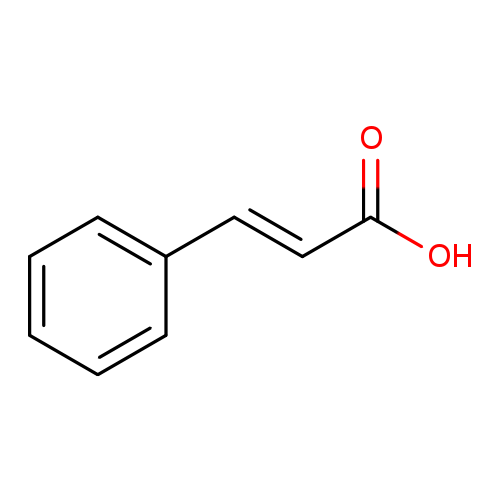
Cinnamic acid has the formula C6H5CHCHCOOH and is an odorless white crystalline acid, which is slightly soluble in water. It has a melting point of 133 degree centigrade and a boiling point of 300 degree centigrade.
Contaminant Sources
  • EAFUS Chemicals
  • FooDB Chemicals
  • STOFF IDENT Compounds
  • T3DB toxins
  • ToxCast & Tox21 Chemicals
Contaminant Type
  • Ester
  • Food Toxin
  • Household Toxin
  • Metabolite
  • Natural Compound
  • Organic Compound
  • Plant Toxin
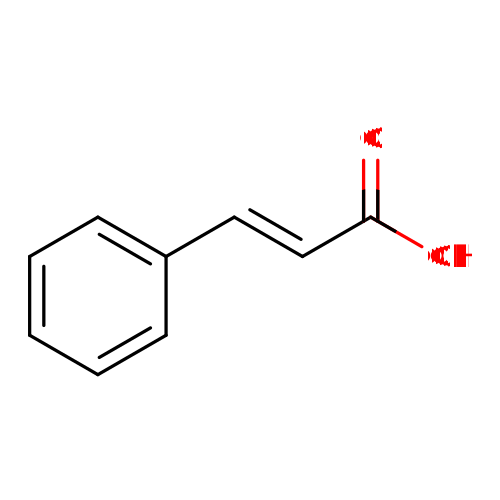
Chemical Structure
Synonyms
ValueSource
(2E)-3-Phenyl-2-propenoic acidChEBI
(2E)-3-Phenylacrylic acidChEBI
(e)-3-Phenyl-2-propenoic acidChEBI
(e)-CinnamateChEBI
(e)-Cinnamic acidChEBI
Benzeneacrylic acidChEBI
PHENYLETHYLENECARBOXYLIC ACIDChEBI
trans-3-Phenylacrylic acidChEBI
trans-beta-CarboxystyreneChEBI
trans-CinnamateChEBI
trans-ZimtsaeureChEBI
(2E)-3-Phenyl-2-propenoateGenerator
(2E)-3-PhenylacrylateGenerator
(e)-3-Phenyl-2-propenoateGenerator
BenzeneacrylateGenerator
PHENYLETHYLENECARBOXYLateGenerator
trans-3-PhenylacrylateGenerator
trans-b-CarboxystyreneGenerator
trans-Β-carboxystyreneGenerator
(2E)-2-Phenyl-2-propenoateHMDB
(2E)-2-Phenyl-2-propenoic acidHMDB
(e)-3-PhenylacrylateHMDB
(e)-3-Phenylacrylic acidHMDB
(e)-3-Phenylprop-2-enoateHMDB
(e)-3-Phenylprop-2-enoic acidHMDB
trans-3-Phenyl-2-propenoateHMDB
trans-3-Phenyl-2-propenoic acidHMDB
Cinnamic acid, 14C-labeled CPDHMDB
Cinnamic acid, 2-(14)C-labeled CPDHMDB
Cinnamic acid, 3-(14)C-labeled CPDHMDB
Cinnamic acid, (Z)-isomerHMDB
Cinnamic acid, 2-(13)C-labeled CPDHMDB
Cinnamic acid, 3H-labeled CPD (e)-isomerHMDB
Cinnamic acid, 3H-labeled CPD (Z)-isomerHMDB
Cinnamic acid, ion(1-)-(e)-isomerHMDB
Cinnamic acid, sodium saltHMDB
Cinnamic acid, sodium salt(e)-isomerHMDB
Cinnamic acid, sodium salt(Z)-isomerHMDB
Cinnamic acid, (trans)-(e)-isomerHMDB
Cinnamic acid, 14C-labeled CPD (e)-isomerHMDB
Cinnamic acid, ion(1-)HMDB
Cinnamic acid, nickel (+2) saltHMDB
Cinnamic acid, potassium saltHMDB
Cinnamic acid, zinc salt(e)-isomerHMDB
Cinnamic acid, 13C-labeled CPDHMDB
Cinnamic acidHMDB
(2E)-3-Phenylprop-2-enoic acidHMDB
(2E)-Cinnamic acidHMDB
3-Phenyl-(e)-2-propenoic acidHMDB
3-Phenyl-2-propenoic acidHMDB
3-Phenylacrylic acidHMDB
Phenylacrylic acidHMDB
beta-Phenylacrylic acidHMDB
Β-phenylacrylic acidHMDB
trans-Cinnamic acidHMDB
Chemical FormulaC9H8O2
Average Molecular Mass148.159 g/mol
Monoisotopic Mass148.052 g/mol
CAS Registry Number140-10-3
IUPAC Name(2E)-3-phenylprop-2-enoic acid
Traditional Namecinnamic acid
SMILESOC(=O)\C=C\C1=CC=CC=C1
InChI IdentifierInChI=1S/C9H8O2/c10-9(11)7-6-8-4-2-1-3-5-8/h1-7H,(H,10,11)/b7-6+
InChI KeyWBYWAXJHAXSJNI-VOTSOKGWSA-N
Chemical Taxonomy
Description Belongs to the class of organic compounds known as cinnamic acids. These are organic aromatic compounds containing a benzene and a carboxylic acid group forming 3-phenylprop-2-enoic acid.
KingdomOrganic compounds
Super ClassPhenylpropanoids and polyketides
ClassCinnamic acids and derivatives
Sub ClassCinnamic acids
Direct ParentCinnamic acids
Alternative Parents
Substituents
  • Cinnamic acid
  • Styrene
  • Benzenoid
  • Monocyclic benzene moiety
  • Monocarboxylic acid or derivatives
  • Carboxylic acid
  • Carboxylic acid derivative
  • Organic oxygen compound
  • Organic oxide
  • Hydrocarbon derivative
  • Organooxygen compound
  • Carbonyl group
  • Aromatic homomonocyclic compound
Molecular FrameworkAromatic homomonocyclic compounds
External Descriptors
Biological Properties
StatusDetected and Not Quantified
OriginExogenous
Cellular Locations
  • Membrane
Biofluid LocationsNot Available
Tissue LocationsNot Available
PathwaysNot Available
ApplicationsNot Available
Biological RolesNot Available
Chemical RolesNot Available
Physical Properties
StateSolid
AppearanceWhite powder.
Experimental Properties
PropertyValue
Melting Point133 °C
Boiling Point300°C (572°F)
Solubility0.546 mg/mL
Predicted Properties
PropertyValueSource
Water Solubility0.62 g/LALOGPS
logP2.38ALOGPS
logP2.14ChemAxon
logS-2.4ALOGPS
pKa (Strongest Acidic)4.51ChemAxon
Physiological Charge-1ChemAxon
Hydrogen Acceptor Count2ChemAxon
Hydrogen Donor Count1ChemAxon
Polar Surface Area37.3 ŲChemAxon
Rotatable Bond Count2ChemAxon
Refractivity43.06 m³·mol⁻¹ChemAxon
Polarizability15.43 ųChemAxon
Number of Rings1ChemAxon
BioavailabilityYesChemAxon
Rule of FiveYesChemAxon
Ghose FilterNoChemAxon
Veber's RuleYesChemAxon
MDDR-like RuleNoChemAxon
Spectra
Spectra
Toxicity Profile
Route of ExposureNot Available
Mechanism of ToxicityNot Available
MetabolismNot Available
Toxicity ValuesNot Available
Lethal DoseNot Available
Carcinogenicity (IARC Classification)No indication of carcinogenicity to humans (not listed by IARC).
Uses/SourcesNot Available
Minimum Risk LevelNot Available
Health EffectsNot Available
SymptomsNot Available
TreatmentNot Available
Concentrations
Not Available
External Links
DrugBank IDNot Available
HMDB IDHMDB0000930
FooDB IDFDB012052
Phenol Explorer ID549
KNApSAcK IDC00000170
BiGG IDNot Available
BioCyc IDCPD-674
METLIN ID5880
PDB IDNot Available
Wikipedia LinkCinnamic_acid
Chemspider ID392447
ChEBI ID35697
PubChem Compound ID444539
Kegg Compound IDC10438
YMDB IDYMDB01324
ECMDB IDECMDB00930
References
Synthesis ReferenceZhu, Min; Shentu, Chao; Zhou, Zhong Shi. Microwave-assisted base-free synthesis of trans-cinnamic acids using hypervalent iodonium salts. Chinese Chemical Letters (2007), 18(3), 272-274.
MSDSLink
General References
1. https://www.ncbi.nlm.nih.gov/pubmed/?term=17439666
2. https://www.ncbi.nlm.nih.gov/pubmed/?term=21973101
3. Zhu, Min; Shentu, Chao; Zhou, Zhong Shi. Microwave-assisted base-free synthesis of trans-cinnamic acids using hypervalent iodonium salts. Chinese Chemical Letters (2007), 18(3), 272-274.
4. Blanquet S, Meunier JP, Minekus M, Marol-Bonnin S, Alric M: Recombinant Saccharomyces cerevisiae expressing P450 in artificial digestive systems: a model for biodetoxication in the human digestive environment. Appl Environ Microbiol. 2003 May;69(5):2884-92.
5. Boulat O, Gradwohl M, Matos V, Guignard JP, Bachmann C: Organic acids in the second morning urine in a healthy Swiss paediatric population. Clin Chem Lab Med. 2003 Dec;41(12):1642-58.
6. Sarkissian CN, Shao Z, Blain F, Peevers R, Su H, Heft R, Chang TM, Scriver CR: A different approach to treatment of phenylketonuria: phenylalanine degradation with recombinant phenylalanine ammonia lyase. Proc Natl Acad Sci U S A. 1999 Mar 2;96(5):2339-44.
7. Wahl HG, Hong Q, Stube D, Maier ME, Haring HU, Liebich HM: Simultaneous analysis of the di(2-ethylhexyl)phthalate metabolites 2-ethylhexanoic acid, 2-ethyl-3-hydroxyhexanoic acid and 2-ethyl-3-oxohexanoic acid in urine by gas chromatography-mass spectrometry. J Chromatogr B Biomed Sci Appl. 2001 Jul 15;758(2):213-9.
8. Larue C, Munnich A, Charpentier C, Saudubray JM, Frezal J, Remy MH, Rivat C: An extracorporeal hollow-fiber reactor for phenylketonuria using immobilized phenylalanine ammonia lyase. Dev Pharmacol Ther. 1986;9(2):73-81.
9. Olivera ER, Carnicero D, Jodra R, Minambres B, Garcia B, Abraham GA, Gallardo A, Roman JS, Garcia JL, Naharro G, Luengo JM: Genetically engineered Pseudomonas: a factory of new bioplastics with broad applications. Environ Microbiol. 2001 Oct;3(10):612-8.
10. Lee HS, Beon MS, Kim MK: Selective growth inhibitor toward human intestinal bacteria derived from Pulsatilla cernua root. J Agric Food Chem. 2001 Oct;49(10):4656-61.
11. Douros JD, Frankenfeld JW: Effects of Culture Conditions on Production of trans-Cinnamic Acid from Alkylbenzenes by Soil Microorganisms. Appl Microbiol. 1968 Feb;16(2):320-5.