Hexachlorophene (CED0007361)

Record Information
Version1.0
Creation Date2016-05-19 01:31:42 UTC
Update Date2026-08-19 03:10:57 UTC
SynCED IDCED0007361
Secondary Accession Numbers
  • CHEM003991
Identification
Common NameHexachlorophene
ClassSmall Molecule
Description
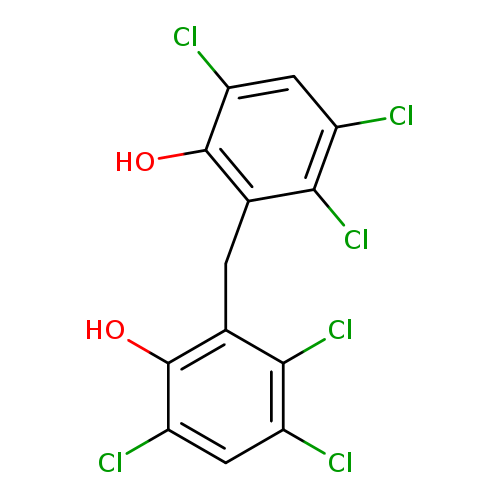
Hexachlorophene is an organic compound with the formula C13H6Cl6O2 and an average molecular weight of 406.90 g/mol. Hexachlorophene belongs to the diphenylmethanes, a subclass of benzene and substituted derivatives within the organic compounds. The compound is found in or released from 29 recorded sources. Within the category of healthcare, pharmaceuticals, and veterinary products, it is used in antiseptics and disinfectants. It is associated with food, food processing, and cookware, specifically in food preservation, processing meats, processing fish, and fermentation processes for beer. Its presence is also recorded in household cleaning and consumer products, including soap detergents, bleaching agents, perfumes within detergents and soaps, cigar cigarettes, and non electric simulated smoking devices. Additionally, it is found in electrical and electronic equipment, such as antennas, amplifiers, coils, auxiliary devices, and conductors or conductive bodies characterised by the conductive materials, among 12 other sources. The recorded route of exposure for this compound is topical. Hexachlorophene interacts with four recorded protein targets. It acts as an inhibitor of Quinone-dependent D-lactate dehydrogenase (dld) and targets Glutamate dehydrogenase 1, mitochondrial (GLUD1), the Estrogen receptor (ESR1), and Succinate dehydrogenase [ubiquinone] cytochrome b small subunit, mitochondrial (SDHD).
Contaminant Type
  • Human Neurotoxin
Chemical Structure
Synonyms
ValueSource
2,2',3,3',5,5'-Hexachloro-6,6'-dihydroxydiphenylmethaneChEBI
2,2'-Dihydroxy-3,3',5,5',6,6'-hexachlorodiphenylmethaneChEBI
2,2'-Dihydroxy-3,5,6,3',5',6'-hexachlorodiphenylmethaneChEBI
2,2'-Methanediylbis(3,4,6-trichlorophenol)ChEBI
AcigenaChEBI
AlmedermChEBI
ArmohexChEBI
Bis(2-hydroxy-3,5,6-trichlorophenyl)methaneChEBI
Bis(3,5,6-trichloro-2-hydroxyphenyl)methaneChEBI
DistodinChEBI
EsaclorofeneChEBI
ExofeneChEBI
GamophenChEBI
GamopheneChEBI
Germa-medicaChEBI
Hexa-germChEBI
HexabalmChEBI
HexachlorophenumChEBI
HexaclorofenoChEBI
HexafenChEBI
HexascrubChEBI
HexideChEBI
NabacChEBI
Phiso-scrubChEBI
PhisodanChEBI
Septi-softChEBI
SeptisolChEBI
SeptofenChEBI
Solu-heksChEBI
Soy-domeChEBI
Staphene OChEBI
Ster-zacChEBI
SteralChEBI
SteraskinChEBI
Surgi-cenChEBI
Surgi-cinChEBI
SurofeneChEBI
TersasepticChEBI
TurgexChEBI
PhisohexKegg
HexachlorophaneHMDB
Chemical FormulaC13H6Cl6O2
Average Molecular Mass406.904 g/mol
Monoisotopic Mass403.850 g/mol
CAS Registry Number70-30-4
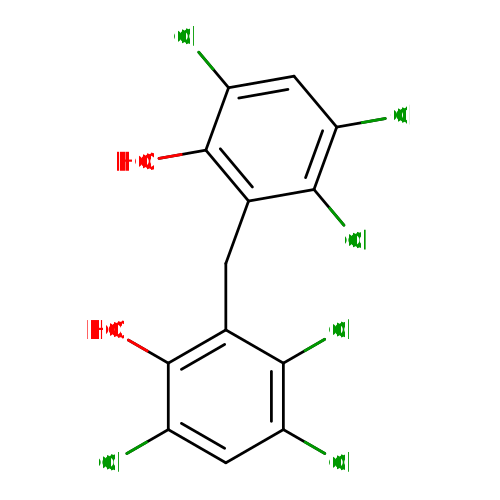
IUPAC Name3,4,6-trichloro-2-[(2,3,5-trichloro-6-hydroxyphenyl)methyl]phenol
Traditional Namepre-op
SMILESOC1=C(CC2=C(O)C(Cl)=CC(Cl)=C2Cl)C(Cl)=C(Cl)C=C1Cl
InChI IdentifierInChI=1S/C13H6Cl6O2/c14-6-2-8(16)12(20)4(10(6)18)1-5-11(19)7(15)3-9(17)13(5)21/h2-3,20-21H,1H2
InChI KeyACGUYXCXAPNIKK-UHFFFAOYSA-N
Chemical Taxonomy
Description Belongs to the class of organic compounds known as diphenylmethanes. Diphenylmethanes are compounds containing a diphenylmethane moiety, which consists of a methane wherein two hydrogen atoms are replaced by two phenyl groups.
KingdomOrganic compounds
Super ClassBenzenoids
ClassBenzene and substituted derivatives
Sub ClassDiphenylmethanes
Direct ParentDiphenylmethanes
Alternative Parents
Substituents
  • Diphenylmethane
  • 4-halophenol
  • 3-halophenol
  • 2-halophenol
  • 3-chlorophenol
  • 2-chlorophenol
  • 4-chlorophenol
  • Chlorobenzene
  • Halobenzene
  • Phenol
  • Aryl halide
  • Aryl chloride
  • Organic oxygen compound
  • Organohalogen compound
  • Organochloride
  • Organooxygen compound
  • Hydrocarbon derivative
  • Aromatic homomonocyclic compound
Molecular FrameworkAromatic homomonocyclic compounds
External Descriptors
Biological Properties
StatusDetected and Not Quantified
OriginNot Available
Cellular LocationsNot Available
Biofluid LocationsNot Available
Tissue LocationsNot Available
ApplicationsNot Available
Biological Roles
Chemical RolesNot Available
Organoleptic EffectsNot Available
Physical Properties
StateNot Available
AppearanceNot Available
Experimental Properties
PropertyValue
Melting PointNot Available
Boiling PointNot Available
SolubilityNot Available
Predicted Properties
PropertyValueSource
Water Solubility0.00043 g/LALOGPS
logP6.77ALOGPS
logP7.08ChemAxon
logS-6ALOGPS
pKa (Strongest Acidic)5.15ChemAxon
pKa (Strongest Basic)-7.4ChemAxon
Physiological Charge-1ChemAxon
Hydrogen Acceptor Count2ChemAxon
Hydrogen Donor Count2ChemAxon
Polar Surface Area40.46 ŲChemAxon
Rotatable Bond Count2ChemAxon
Refractivity88.59 m³·mol⁻¹ChemAxon
Polarizability34.07 ųChemAxon
Number of Rings2ChemAxon
BioavailabilityYesChemAxon
Rule of FiveNoChemAxon
Ghose FilterNoChemAxon
Veber's RuleNoChemAxon
MDDR-like RuleNoChemAxon
Spectra
Spectra
Spectrum TypeDescriptionSplash KeyDeposition DateView
Predicted GC-MSPredicted GC-MS Spectrumsplash10-0600-0129300000-cb3b814466eba79fbe7cNot AvailableView Spectrum
Predicted GC-MSPredicted GC-MS Spectrumsplash10-00di-9010240000-a29226851efcc2b57335Not AvailableView Spectrum
Predicted GC-MSPredicted GC-MS SpectrumNot AvailableNot AvailableView Spectrum
LC-MS/MSLC-MS/MS Spectrumsplash10-0udl-0902800000-eab954bdd46ef95ea0e6Not AvailableView Spectrum
LC-MS/MSLC-MS/MS Spectrumsplash10-0006-0903000000-af7e51011b8ac55a0b9cNot AvailableView Spectrum
LC-MS/MSLC-MS/MS Spectrumsplash10-0006-0903000000-b5db9f67cdd739d85570Not AvailableView Spectrum
LC-MS/MSLC-MS/MS Spectrumsplash10-0udi-0102900000-3f1c09b0da5bdeca4986Not AvailableView Spectrum
LC-MS/MSLC-MS/MS Spectrumsplash10-0006-0900000000-2de6711b3225e7d9d197Not AvailableView Spectrum
LC-MS/MSLC-MS/MS Spectrumsplash10-052f-0900000000-ede1ae14950bd65d2d7dNot AvailableView Spectrum
LC-MS/MSLC-MS/MS Spectrumsplash10-0a4i-0900000000-2bf64f17df28192e8bbdNot AvailableView Spectrum
LC-MS/MSLC-MS/MS Spectrumsplash10-0a4i-0900000000-9c30a2d14a2059e70b22Not AvailableView Spectrum
LC-MS/MSLC-MS/MS Spectrumsplash10-0udl-0902800000-fbcab58d9b98e7e36a01Not AvailableView Spectrum
Predicted LC-MS/MSPredicted LC-MS/MS Spectrumsplash10-0pb9-0090500000-3520ed20e62597b8f86aNot AvailableView Spectrum
Predicted LC-MS/MSPredicted LC-MS/MS Spectrumsplash10-0zfr-0061900000-ce0a152491abb1f33f79Not AvailableView Spectrum
Predicted LC-MS/MSPredicted LC-MS/MS Spectrumsplash10-0a6r-0490000000-a0ce3a9ffe8b9e5d889dNot AvailableView Spectrum
Predicted LC-MS/MSPredicted LC-MS/MS Spectrumsplash10-0udi-0100900000-e3ab4b6eea7a1952773bNot AvailableView Spectrum
Predicted LC-MS/MSPredicted LC-MS/MS Spectrumsplash10-0udi-0302900000-25a6b74c90eb83e75b14Not AvailableView Spectrum
Predicted LC-MS/MSPredicted LC-MS/MS Spectrumsplash10-00l6-0619000000-fbd33033de48509636efNot AvailableView Spectrum
Predicted LC-MS/MSPredicted LC-MS/MS Spectrumsplash10-0udi-0000900000-cd1e170283951f42dd65Not AvailableView Spectrum
Predicted LC-MS/MSPredicted LC-MS/MS Spectrumsplash10-0zmi-0297300000-f2530c82106732c49670Not AvailableView Spectrum
Predicted LC-MS/MSPredicted LC-MS/MS Spectrumsplash10-0udi-0000900000-a8c4b840b6e64e3ef8dbNot AvailableView Spectrum
Predicted LC-MS/MSPredicted LC-MS/MS Spectrumsplash10-0udi-1102900000-c659b5c5d58a53730f40Not AvailableView Spectrum
Predicted LC-MS/MSPredicted LC-MS/MS Spectrumsplash10-001l-9720000000-e35bd296f45503dfe475Not AvailableView Spectrum
Toxicity Profile
Toxicity Values
Toxicity ValueOrganismDose DescriptorRoute of ExposurePredicted or ExperimentalToxicity RatingReference
127.0 Log mg/kg [70:230]RatLD50oralpredictedNot AvailableNot Available
Toxicity / Toxin ClassNot Available
Mechanism of ToxicityNot Available
Carcinogenicity (IARC Classification)Not Available
Minimum Risk LevelNot Available
SymptomsNot Available
TreatmentNot Available
Health Effects
Health EffectRelationshipDirectionDescriptionReference
Toxic encephalopathyAssociated With?Not AvailableNot AvailablePMC9793094 , PMC3974611
CardiotoxicityAssociated With?increaseNot AvailablePMC10898275
Exposure Sources
Source IDSourceSectorReference
CEDs000010Insecticides?Insecticides are synthetic chemicals designed to control or eliminate insect pests that threaten crops and other agricultural products.Agriculture & land managementPubChem
CEDs000233Brushes?Brushes used in personal care and cosmetics can be a source of synthetic chemical contamination due to the materials and coatings used in their manufacturing.Personal care & cosmeticsPubChem
CEDs000312Antiseptics and disinfectants?Antiseptics and disinfectants are synthetic chemicals widely used to eliminate or inhibit the growth of microorganisms on living tissues and inanimate surfaces, respectively.Healthcare, pharmaceuticals & veterinary productsNot Available
CEDs000505Amplifiers?Amplifiers, commonly used in various electronic devices to enhance signal strength, can be a source of synthetic chemical contamination due to the materials and processes involved in their production and disposal.Electrical & Electronic EquipmentPubChem
CEDs000506Antennas?Antennas, commonly used in communication technologies, can be a source of synthetic chemical contamination through the materials and coatings used in their construction.Electrical & Electronic EquipmentPubChem
CEDs000507Auxiliary Devices?Auxiliary devices, such as capacitors, transformers, and circuit breakers, are integral components in various electronic systems.Electrical & Electronic EquipmentPubChem
CEDs000508Coils?Coils are components used in various electrical and electronic applications, such as transformers, inductors, and motors.Electrical & Electronic EquipmentPubChem
CEDs000511Conductors Or Conductive Bodies Characterised By The Conductive Materials?Conductors, or conductive bodies, are materials that allow the flow of electrical current, typically made from metals such as copper, aluminum, or silver.Electrical & Electronic EquipmentPubChem
CEDs000516Electric Hearing Aids?Electric hearing aids are small electronic devices designed to amplify sound for individuals with hearing loss.Electrical & Electronic EquipmentPubChem
CEDs000517Electric Switches?Electric switches, integral components in numerous devices, can be a source of synthetic chemical contamination due to the materials and manufacturing processes involved in their production.Electrical & Electronic EquipmentPubChem
CEDs000518Electrically Stimulated Smoking Devices?Electrically stimulated smoking devices, commonly known as e-cigarettes or vape pens, utilize electrical components to heat a liquid solution, often containing nicotine, flavorings, and other additives, to produce an aerosol for inhalation.Electrical & Electronic EquipmentPubChem
CEDs000519Electrodes?Electrodes, used in various electrical and electronic applications, can be a source of synthetic chemical contamination due to the materials from which they are constructed and the processes involved in their manufacturing.Electrical & Electronic EquipmentPubChem
CEDs000521Fixed Capacitors And Their Manufacture?Fixed capacitors are passive electronic components used to store and release electrical energy, playing a critical role in various circuits.Electrical & Electronic EquipmentPubChem
CEDs000524Hybrid Capacitors?Hybrid capacitors are energy storage devices that combine the properties of electrolytic and supercapacitors, utilizing a combination of electrochemical principles to achieve higher energy density and power density.Electrical & Electronic EquipmentPubChem
CEDs000527Magnets?Magnets, commonly used in various electrical and electronic applications, can be a source of synthetic chemical contamination due to the materials used in their production.Electrical & Electronic EquipmentPubChem
CEDs000530Radio Transmission Systems?Radio transmission systems utilize a variety of synthetic chemicals in their manufacturing and maintenance processes.Electrical & Electronic EquipmentPubChem
CEDs000531Relays?Relays are electromechanical switches used to control circuits and manage electrical loads.Electrical & Electronic EquipmentPubChem
CEDs000535Superconducting Magnets And Superconducting Coils?Superconducting magnets and coils are utilized in various applications that require strong magnetic fields, such as magnetic resonance imaging (MRI) and particle accelerators.Electrical & Electronic EquipmentPubChem
CEDs000537Television Systems?Television systems can be a source of synthetic chemical contamination due to the various materials and components used in their manufacture and operation.Electrical & Electronic EquipmentPubChem
CEDs000539Video Games?Video games, through their production and disposal processes, can be a source of synthetic chemical contamination.Electrical & Electronic EquipmentPubChem
CEDs000544Fermentation Processes For Beer?Fermentation processes for beer involve the conversion of sugars into alcohol and carbon dioxide by yeast.Food, food processing & cookwarePubChem
CEDs000545Food Preservation?Food preservation often involves the use of synthetic chemicals, such as preservatives, flavor enhancers, and color additives, to extend shelf life and enhance the sensory qualities of food products.Food, food processing & cookwarePubChem
CEDs000551Processing Fish?Processing fish can lead to synthetic chemical contamination through various stages of production and preservation.Food, food processing & cookwarePubChem
CEDs000552Processing Meats?Processing meats can lead to synthetic chemical contamination primarily through the use of additives and preservatives.Food, food processing & cookwarePubChem
CEDs000555Bleaching Agents?Bleaching agents are chemical substances used to whiten or lighten materials, often employed in various cleaning products for their stain removal and disinfecting properties.Household cleaning & consumer productsPubChem
CEDs000556Cigar Cigarettes?Cigar cigarettes are a source of synthetic chemical contamination due to the combustion of various tobacco blends and additives.Household cleaning & consumer productsPubChem
CEDs000559Non Electric Simulated Smoking Devices?Non-electric simulated smoking devices, often designed to mimic the experience of smoking without combustion, can be sources of synthetic chemical contamination due to the materials and chemicals used in their construction and operation.Household cleaning & consumer productsPubChem
CEDs000561Perfumes Within Detergents And Soaps?Perfumes within detergents and soaps are synthetic fragrance compounds added to enhance the sensory experience of cleaning products.Household cleaning & consumer productsPubChem
CEDs000563Soap Detergents?Soap detergents are synthetic surfactants designed to enhance the cleaning efficacy of water by reducing surface tension, allowing for better interaction with dirt and grease.Household cleaning & consumer productsPubChem
CEDs000564Soap Dispensers?Soap dispensers, commonly used for dispensing liquid soaps and sanitizers, can become a source of synthetic chemical contamination due to the materials used in their construction and the products they dispense.Household cleaning & consumer productsPubChem
CEDs000569Tobacco Smoke Filters?Tobacco smoke filters are designed to reduce the inhalation of harmful substances in cigarette smoke, including tar and other particulate matter.Household cleaning & consumer productsPubChem
CEDs000580Manufacture Preparation Of Tobacco Products?The manufacture and preparation of tobacco products involve various processes that can result in the introduction of synthetic chemicals into the environment.Industrial manufacturing & chemical processingPubChem
CEDs000581Paper Making Machines?Paper making machines utilize various synthetic chemicals throughout the production process, including additives, coatings, and bleaching agents.Industrial manufacturing & chemical processingPubChem
CEDs000583Anchoring Equipment?Anchoring equipment, commonly used in marine applications, can be a source of synthetic chemical contamination due to the materials and coatings utilized in their manufacturing.Marine, shipping & aquaculturePubChem
CEDs000584Buoys?Buoys, often used for navigation and marine monitoring, can be sources of synthetic chemical contamination due to the materials and coatings employed in their construction.Marine, shipping & aquaculturePubChem
CEDs000596Acaricides?Acaricides are synthetic chemicals specifically designed to target and control mite populations that can damage crops and plants.Agriculture & land managementPubChem
CEDs000597Chemosterilants?Chemosterilants are synthetic chemicals designed to induce sterility in target pest populations, thereby controlling their reproduction and mitigating damage to crops.Agriculture & land managementPubChem
CEDs000600Herbicides And Algicides?Herbicides and algicides are synthetic chemicals primarily used to control unwanted plants and algae in various environments.Agriculture & land managementPubChem
CEDs000602Molluscicides?Molluscicides are synthetic chemicals specifically designed to control and eliminate mollusks, such as snails and slugs, which can be detrimental to crops and agricultural productivity.Agriculture & land managementPubChem
CEDs000603Nematocides?Nematocides are synthetic chemicals specifically designed to control nematodes, which are microscopic roundworms that can cause significant damage to crops and plants.Agriculture & land managementPubChem
CEDs000604Pest Attractants?Pest attractants are synthetic chemicals designed to lure specific pests for monitoring or control purposes.Agriculture & land managementPubChem
CEDs000605Pest Repellants?Pest repellents, often formulated from synthetic chemicals, are widely used to protect crops from insect infestations and other pests.Agriculture & land managementPubChem
CEDs000606Plant Growth Regulators?Plant Growth Regulators (PGRs) are synthetic chemicals designed to influence the growth and development of plants.Agriculture & land managementPubChem
CEDs000607Rodenticides(1)?Rodenticides are synthetic chemicals specifically formulated to control rodent populations, serving as a crucial tool in managing pests that can damage crops and spread diseases.Agriculture & land managementPubChem
CEDs000608Rodenticides?Rodenticides are chemical substances specifically designed to control rodent populations by causing death through various mechanisms, including anticoagulation or neurotoxicity.Agriculture & land managementPubChem
CEDs000609Aftershave?Aftershave is a grooming product typically used to soothe and protect the skin following shaving.Personal care & cosmeticsPubChem
CEDs000610Aftersun Products?Aftersun products are designed to soothe and hydrate the skin after sun exposure, often containing various synthetic chemicals such as emollients, preservatives, and fragrances.Personal care & cosmeticsPubChem
CEDs000611Anti Perspirants Or Body Deoderants?Antiperspirants and body deodorants commonly contain synthetic chemicals such as aluminum compounds, parabens, and synthetic fragrances.Personal care & cosmeticsPubChem
CEDs000612Body Washing Or Cleaning Implements?Body washing or cleaning implements, such as synthetic sponges, loofahs, and washcloths, can be sources of synthetic chemical contamination due to the materials used in their production.Personal care & cosmeticsPubChem
CEDs000613Depilatories?Depilatories are products designed to remove unwanted hair through the application of synthetic chemicals that break down the protein structure of hair, facilitating its removal.Personal care & cosmeticsPubChem
CEDs000614Essential Oils Or Perfumes?Essential oils and perfumes are complex mixtures of volatile compounds derived from natural or synthetic sources, commonly used for their aromatic properties.Personal care & cosmeticsPubChem
CEDs000615Eye Makeup Products?Eye makeup products, including mascaras, eyeliners, and eyeshadows, often contain a variety of synthetic chemicals such as pigments, preservatives, and film-forming agents.Personal care & cosmeticsPubChem
CEDs000616Face Mask Cosmetics?Face mask cosmetics often contain a variety of synthetic chemicals, including preservatives, emulsifiers, and fragrances, which can contribute to chemical contamination.Personal care & cosmeticsPubChem
CEDs000617Lip Care Products?Lip care products, including lipsticks, balms, and glosses, often contain a variety of synthetic chemicals such as parabens, phthalates, and synthetic fragrances.Personal care & cosmeticsPubChem
CEDs000618Lip Makeup Products?Lip makeup products, such as lipsticks, lip glosses, and lip liners, often contain a variety of synthetic chemicals, including pigments, preservatives, and emollients.Personal care & cosmeticsPubChem
CEDs000619Manicure Pedicure?Manicure and pedicure procedures often involve the use of various synthetic chemicals, including solvents, nail polishes, and nail adhesives.Personal care & cosmeticsPubChem
CEDs000632Apparel?Apparel production often involves the use of various synthetic chemicals, including dyes, finishing agents, and preservatives.Textiles, leather & furnishingsPubChem
CEDs000642Footwear?Footwear production often involves the use of various synthetic chemicals, such as adhesives, dyes, and treatments, which can contribute to environmental contamination.Textiles, leather & furnishingsPubChem
CEDs000643Headwear?Headwear made from synthetic materials often incorporates chemicals used in the manufacturing and finishing processes, such as dyes, flame retardants, and water repellents.Textiles, leather & furnishingsPubChem
CEDs000650Purses Luggage Hand Bags?Purses, luggage, and handbags are often manufactured using synthetic materials such as polyvinyl chloride (PVC), polyurethane, and various types of nylon.Textiles, leather & furnishingsPubChem
CEDs000651Purses Money Bags Wallets?Purses, money bags, and wallets are often manufactured using synthetic materials, including plastics, polyurethanes, and various treated fabrics.Textiles, leather & furnishingsPubChem
CEDs000657Surface Finishing Of Leather?Surface finishing of leather often involves the use of various synthetic chemicals, including dyes, resins, and finishing agents.Textiles, leather & furnishingsPubChem
CEDs000662Yarns Or Threads?Yarns or threads used in textiles can be a source of synthetic chemical contamination due to the production processes and treatments they undergo.Textiles, leather & furnishingsPubChem
CEDs000663Sanitary Equipment?Sanitary equipment, including toilets, sinks, and drainage systems, can serve as conduits for synthetic chemical contamination.Wastewater, sanitation & biosolidsPubChem
CEDs000671Airplanes And Helicopters?Airplanes and helicopters are significant sources of synthetic chemical contamination primarily through the use of aviation fuels, lubricants, and de-icing agents.Aviation & AerospacePubChem
CEDs000678Nitrogenous Fertilisers?Nitrogenous fertilizers are synthetic chemical compounds primarily used to enhance plant growth by supplying essential nitrogen, a crucial nutrient for photosynthesis and protein synthesis.Agriculture & land managementPubChem
CEDs000679Phosphatic Fertilisers?Phosphatic fertilizers are synthetic chemical products primarily composed of phosphorus, which is essential for plant growth.Agriculture & land managementPubChem
CEDs000684Cements?Cements are a composite material primarily used as a binding agent in construction applications, formed by the calcination of limestone and clay minerals at high temperatures.Building & ConstructionPubChem
CEDs000685Ceramics?Ceramics can be a source of synthetic chemical contamination through various additives and processing agents used in their production.Building & ConstructionPubChem
CEDs000686Clay Wares?Clay wares are ceramic products made from natural clay, often utilized in various construction applications such as tiles, bricks, and sanitary ware.Building & ConstructionPubChem
CEDs000688Glass Coatings?Glass coatings are synthetic chemical formulations applied to glass surfaces to enhance properties such as durability, UV resistance, and aesthetic appeal.Building & ConstructionPubChem
CEDs000692Silica Free Oxide Glass?Silica Free Oxide Glass is a type of glass that is produced using alternative materials to traditional silica-based formulations.Building & ConstructionPubChem
CEDs000693Silica Glass?Silica glass, primarily composed of silicon dioxide (SiO2), is widely used in various applications, including windows, glass facades, and insulation materials.Building & ConstructionPubChem
CEDs000696Nanotechnology?Nanotechnology involves the manipulation of materials at the molecular or atomic level, typically within the range of 1 to 100 nanometers.Industrial manufacturing & chemical processingPubChem
CEDs000705Bookbinding?Bookbinding involves the use of various synthetic chemicals, including adhesives, inks, and coatings, which can contribute to environmental contamination.Paper, pulp & fiber productsPubChem
CEDs000727Printing Machines Or Presses?Printing machines or presses commonly utilize synthetic chemicals such as inks, solvents, and cleaning agents.Paper, pulp & fiber productsPubChem
CEDs000730Contact Lens Cases?Contact lens cases are small containers designed to store contact lenses in a sterile environment, typically made from various synthetic materials including plastics such as polypropylene or polycarbonate.Healthcare, pharmaceuticals & veterinary productsPubChem
CEDs000734Coating Compositions?Coating compositions, which include paints, sealants, and varnishes, are formulated with a variety of synthetic chemicals such as solvents, resins, pigments, and additives.Building & ConstructionPubChem
CEDs000735Explosives?Explosives are chemical compounds or mixtures designed to undergo rapid decomposition, releasing energy in the form of gas and heat.Defense & military infrastructurePubChem
CEDs000738Cooling Circuit Water?Cooling circuit water is utilized in various industrial processes to absorb and dissipate heat generated during operations.Industrial manufacturing & chemical processingPubChem
CEDs000739Inks?Inks are complex mixtures composed of pigments or dyes, solvents, resins, and additives used primarily for printing and writing applications.Paper, pulp & fiber productsPubChem
CEDs000740Paper?Paper production involves the processing of wood fibers and the use of various chemicals, which can lead to synthetic chemical contamination.Paper, pulp & fiber productsPubChem
CEDs000741Pigment Pastes?Pigment pastes are concentrated dispersions of pigments used to impart color and properties to materials.Paper, pulp & fiber productsPubChem
CEDs000742Leather Tanning?Leather tanning is a process that transforms raw animal hides into durable leather through the application of various chemicals, including chromium salts, aldehydes, and vegetable tannins.Textiles, leather & furnishingsPubChem
CEDs000743Sludge Treatment?Sludge treatment involves the processing of waste materials generated from wastewater treatment plants, which often contain a variety of organic and inorganic substances.Wastewater, sanitation & biosolidsPubChem
CEDs000744Water, Wastewater, & Sewage Treatment?Water, wastewater, and sewage treatment processes are critical for managing and mitigating pollutants in water systems.Wastewater, sanitation & biosolidsPubChem
CEDs01153Breast MilkFood, food processing & cookwarePMC3974611
CEDs02845CosmeticsPersonal care & cosmeticsPMC11001171 , PMC11721023
CEDs02847Personal Care ProductsPersonal care & cosmeticsPMC9793094 , PMC9793094
CEDs03170SoapsHousehold cleaning & consumer productsPMC4704616
Pathways
2 pathwaysPathway Source: PathBank
Targets
StructureProteinUniProt IDOrganismRelationshipDetails
Mitogen-activated protein kinase 1 structureClick to view 3D structureMitogen-activated protein kinase 1P28482HumansPredicted (SEA)
Prediction Confidence Score
0.4
Applicability Domain
1.0
Statistical Significance
0.0138
Supporting Reference Compounds
763
E-value
107.432
Alpha-2A adrenergic receptor structureClick to view 3D structureAlpha-2A adrenergic receptorP08913HumansPredicted (SEA)
Prediction Confidence Score
0.4
Applicability Domain
1.0
Statistical Significance
0.0058
Supporting Reference Compounds
487
E-value
44.919
Alpha-2C adrenergic receptor structureClick to view 3D structureAlpha-2C adrenergic receptorP18825HumansPredicted (SEA)
Prediction Confidence Score
0.4
Applicability Domain
1.0
Statistical Significance
0.0046
Supporting Reference Compounds
386
E-value
35.9663
5-hydroxytryptamine receptor 2B structureClick to view 3D structure5-hydroxytryptamine receptor 2BP41595HumansPredicted (SEA)
Prediction Confidence Score
0.4
Applicability Domain
1.0
Statistical Significance
0.0086
Supporting Reference Compounds
686
E-value
66.8725
5-hydroxytryptamine receptor 2C structureClick to view 3D structure5-hydroxytryptamine receptor 2CP28335HumansPredicted (SEA)
Prediction Confidence Score
0.392
Applicability Domain
1.0
Statistical Significance
0.0139
Supporting Reference Compounds
823
E-value
108.288
N-acyl-phosphatidylethanolamine-hydrolyzing phospholipase D structureClick to view 3D structureN-acyl-phosphatidylethanolamine-hydrolyzing phospholipase DQ6IQ20HumansPredicted (SEA)
Prediction Confidence Score
0.381
Applicability Domain
1.0
Statistical Significance
4.00e-05
Supporting Reference Compounds
3
E-value
0.311397
Adenosine receptor A3 structureClick to view 3D structureAdenosine receptor A3P0DMS8HumansPredicted (SEA)
Prediction Confidence Score
0.377
Applicability Domain
1.0
Statistical Significance
0.0093
Supporting Reference Compounds
391
E-value
72.2441
Click to view 3D structureThromboxane-A synthaseP24557HumansPredicted (SEA)
Prediction Confidence Score
0.377
Applicability Domain
1.0
Statistical Significance
4.10e-04
Supporting Reference Compounds
66
E-value
3.19182
Mitogen-activated protein kinase 14 structureClick to view 3D structureMitogen-activated protein kinase 14Q16539HumansPredicted (SEA)
Prediction Confidence Score
0.377
Applicability Domain
1.0
Statistical Significance
0.0212
Supporting Reference Compounds
668
E-value
164.962
Substance-K receptor structureClick to view 3D structureSubstance-K receptorP21452HumansPredicted (SEA)
Prediction Confidence Score
0.375
Applicability Domain
1.0
Statistical Significance
0.006
Supporting Reference Compounds
118
E-value
46.7874
Click to view 3D structureStreptokinase AP10520Streptococcus pyogenes serotype M1Predicted (SEA)
Prediction Confidence Score
0.373
Applicability Domain
1.0
Statistical Significance
0.0029
Supporting Reference Compounds
425
E-value
22.8877
Epidermal growth factor receptor structureClick to view 3D structureEpidermal growth factor receptorP00533HumansPredicted (SEA)
Prediction Confidence Score
0.372
Applicability Domain
1.0
Statistical Significance
0.0424
Supporting Reference Compounds
1301
E-value
329.847
Sodium-dependent serotonin transporter structureClick to view 3D structureSodium-dependent serotonin transporterP31645HumansPredicted (SEA)
Prediction Confidence Score
0.371
Applicability Domain
1.0
Statistical Significance
0.0154
Supporting Reference Compounds
593
E-value
119.81
Estrogen receptor beta structureClick to view 3D structureEstrogen receptor betaQ92731HumansPredicted (SEA)
Prediction Confidence Score
0.369
Applicability Domain
1.0
Statistical Significance
0.0028
Supporting Reference Compounds
174
E-value
21.9535
Tyrosine-protein kinase Lck structureClick to view 3D structureTyrosine-protein kinase LckP06239HumansPredicted (SEA)
Prediction Confidence Score
0.367
Applicability Domain
1.0
Statistical Significance
0.0425
Supporting Reference Compounds
1130
E-value
331.015
Estrogen receptor structureClick to view 3D structureEstrogen receptorP03372HumansPredicted (SEA)
Prediction Confidence Score
0.365
Applicability Domain
1.0
Statistical Significance
0.0046
Supporting Reference Compounds
201
E-value
35.9663
Receptor tyrosine-protein kinase erbB-2 structureClick to view 3D structureReceptor tyrosine-protein kinase erbB-2P04626HumansPredicted (SEA)
Prediction Confidence Score
0.365
Applicability Domain
1.0
Statistical Significance
0.0265
Supporting Reference Compounds
674
E-value
206.067
Click to view 3D structureCalpain-2 catalytic subunitP43367Sus scrofaPredicted (SEA)
Prediction Confidence Score
0.364
Applicability Domain
1.0
Statistical Significance
9.70e-04
Supporting Reference Compounds
63
E-value
7.55137
Click to view 3D structureEnvelope glycoprotein gp160Q6QLK5Human immunodeficiency virus 1Predicted (SEA)
Prediction Confidence Score
0.361
Applicability Domain
1.0
Statistical Significance
2.00e-05
Supporting Reference Compounds
40
E-value
0.155698
Adenosine receptor A2a structureClick to view 3D structureAdenosine receptor A2aP29274HumansPredicted (SEA)
Prediction Confidence Score
0.354
Applicability Domain
1.0
Statistical Significance
0.0115
Supporting Reference Compounds
303
E-value
89.9158
Click to view 3D structureATP-dependent molecular chaperone HSP82C4YTQ8Candida albicans (strain WO-1) (Yeast)Predicted (SEA)
Prediction Confidence Score
0.351
Applicability Domain
1.0
Statistical Significance
0.002
Supporting Reference Compounds
205
E-value
15.4141
Prostaglandin G/H synthase 2 structureClick to view 3D structureProstaglandin G/H synthase 2P35354HumansPredicted (SEA)
Prediction Confidence Score
0.348
Applicability Domain
1.0
Statistical Significance
0.0055
Supporting Reference Compounds
201
E-value
42.5835
Protein RecA structureClick to view 3D structureProtein RecAP9WHJ3Mycobacterium tuberculosisPredicted (SEA)
Prediction Confidence Score
0.342
Applicability Domain
1.0
Statistical Significance
0.0025
Supporting Reference Compounds
296
E-value
19.8516
Tyrosine-protein kinase Fyn structureClick to view 3D structureTyrosine-protein kinase FynP06241HumansPredicted (SEA)
Prediction Confidence Score
0.335
Applicability Domain
1.0
Statistical Significance
0.046
Supporting Reference Compounds
707
E-value
358.418
Acetylcholinesterase structureClick to view 3D structureAcetylcholinesteraseP22303HumansPredicted (SEA)
Prediction Confidence Score
0.333
Applicability Domain
1.0
Statistical Significance
0.0208
Supporting Reference Compounds
406
E-value
161.926
Concentrations
Not Available
External Links
DrugBank IDDB00756
HMDB IDHMDB0014894
FooDB IDNot Available
Phenol Explorer IDNot Available
KNApSAcK IDNot Available
BiGG IDNot Available
BioCyc IDNot Available
METLIN IDNot Available
PDB IDNot Available
Wikipedia LinkHexachlorophene
Chemspider ID3472
ChEBI ID5693
PubChem Compound ID3598
Kegg Compound IDC08039
YMDB IDNot Available
ECMDB IDNot Available
References
Synthesis ReferenceNot Available
MSDSNot Available
General ReferencesNot Available