Record Information
Version1.0
Creation Date2016-05-19 01:59:52 UTC
Update Date2026-04-06 04:27:39 UTC
Accession NumberCHEM005263
Identification
Common NameDL-CYSTINE
ClassSmall Molecule
Description
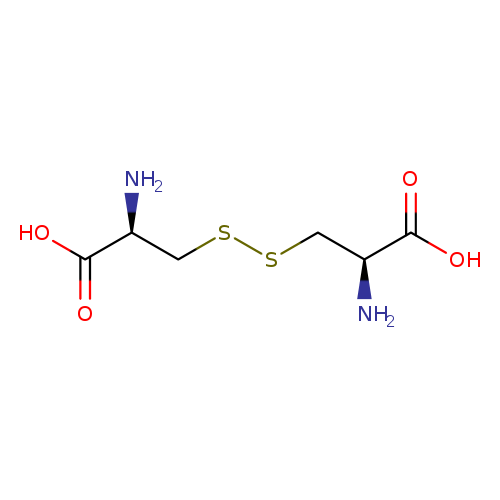
A covalently linked dimeric nonessential amino acid formed by the oxidation of cysteine. Two molecules of cysteine are joined together by a disulfide bridge to form cystine.
Contaminant Sources
  • EAFUS Chemicals
  • FooDB Chemicals
  • HPV EPA Chemicals
Contaminant TypeNot Available
Chemical Structure
Synonyms
ValueSource
(R,R)-3,3'-Dithiobis(2-aminopropanoic acid)ChEBI
(R-(R*,r*))-3,3'-dithiobis(2-aminopropanoic acid)ChEBI
3,3'-Dithiobis-L-alanineChEBI
beta,Beta'-diamino-beta,beta'-dicarboxydiethyl disulfideChEBI
beta,Beta'-dithiodialanineChEBI
Bis(beta-amino-beta-carboxyethyl) disulfideChEBI
e921ChEBI
L-alpha-Diamino-beta-dithiolactic acidChEBI
L-DicysteineChEBI
Oxidized L-cysteineChEBI
(R,R)-3,3'-Dithiobis(2-aminopropanoate)Generator
(R-(R*,r*))-3,3'-dithiobis(2-aminopropanoate)Generator
b,Beta'-diamino-b,beta'-dicarboxydiethyl disulfideGenerator
b,Beta'-diamino-b,beta'-dicarboxydiethyl disulphideGenerator
beta,Beta'-diamino-beta,beta'-dicarboxydiethyl disulphideGenerator
Β,beta'-diamino-β,beta'-dicarboxydiethyl disulfideGenerator
Β,beta'-diamino-β,beta'-dicarboxydiethyl disulphideGenerator
b,Beta'-dithiodialanineGenerator
Β,beta'-dithiodialanineGenerator
Bis(b-amino-b-carboxyethyl) disulfideGenerator
Bis(b-amino-b-carboxyethyl) disulphideGenerator
Bis(beta-amino-beta-carboxyethyl) disulphideGenerator
Bis(β-amino-β-carboxyethyl) disulfideGenerator
Bis(β-amino-β-carboxyethyl) disulphideGenerator
L-a-Diamino-b-dithiolactateGenerator
L-a-Diamino-b-dithiolactic acidGenerator
L-alpha-Diamino-beta-dithiolactateGenerator
L-Α-diamino-β-dithiolactateGenerator
L-Α-diamino-β-dithiolactic acidGenerator
(-)-CystineHMDB
(R-(R*,r*))-3,3'-dithiobisHMDB
2-Amino-3-(2-amino-2-carboxy-ethyl)disulfanyl-propanoateHMDB
2-Amino-3-(2-amino-2-carboxy-ethyl)disulfanyl-propanoic acidHMDB
2-Amino-3-[(2-amino-2-carboxyethyl)dithio]propanoateHMDB
2-Amino-3-[(2-amino-2-carboxyethyl)dithio]propanoic acidHMDB
3,3'-DithiobisHMDB
3,3'-Dithiobis[2-amino-[R-(r*,r*)]-propanoateHMDB
3,3'-Dithiobis[2-amino-[R-(r*,r*)]-propanoic acidHMDB
3,3'-DithiodialanineHMDB
b,B'-diamino-b,b'-dicarboxydiethyl disulfideHMDB
b,B'-dithiodialanineHMDB
beta,Beta'-dithiobisalanineHMDB
Bis(b-amino-beta-carboxyethyl) disulfideHMDB
Cysteine disulfideHMDB
CystinHMDB
CystineHMDB
Cystine acidHMDB
D(+)-3,3'-Dithiobis(2-aminopropanoateHMDB
D(+)-3,3'-Dithiobis(2-aminopropanoic acidHMDB
DicysteineHMDB
GelucystineHMDB
L-(-)-CystineHMDB
L-Cysteine disulfideHMDB
L-CystinHMDB
[R-(R*,r*)]-3,3'-dithiobisHMDB
L CystineHMDB
Copper cystinateHMDB
L-CystineKEGG
Chemical FormulaC6H12N2O4S2
Average Molecular Mass240.300 g/mol
Monoisotopic Mass240.024 g/mol
CAS Registry Number923-32-0
IUPAC Name(2R)-2-amino-3-{[(2R)-2-amino-2-carboxyethyl]disulfanyl}propanoic acid
Traditional NameL-cystine
SMILESNC(CSSCC(N)C(O)=O)C(O)=O
InChI IdentifierInChI=1S/C6H12N2O4S2/c7-3(5(9)10)1-13-14-2-4(8)6(11)12/h3-4H,1-2,7-8H2,(H,9,10)(H,11,12)
InChI KeyLEVWYRKDKASIDU-UHFFFAOYSA-N
Chemical Taxonomy
Description Belongs to the class of organic compounds known as l-cysteine-s-conjugates. L-cysteine-S-conjugates are compounds containing L-cysteine where the thio-group is conjugated.
KingdomOrganic compounds
Super ClassOrganic acids and derivatives
ClassCarboxylic acids and derivatives
Sub ClassAmino acids, peptides, and analogues
Direct ParentL-cysteine-S-conjugates
Alternative Parents
Substituents
  • L-cysteine-s-conjugate
  • Alpha-amino acid
  • L-alpha-amino acid
  • Dicarboxylic acid or derivatives
  • Organic disulfide
  • Dialkyldisulfide
  • Amino acid
  • Sulfenyl compound
  • Carboxylic acid
  • Organopnictogen compound
  • Organic nitrogen compound
  • Primary amine
  • Organosulfur compound
  • Organooxygen compound
  • Organonitrogen compound
  • Primary aliphatic amine
  • Organic oxygen compound
  • Carbonyl group
  • Hydrocarbon derivative
  • Amine
  • Organic oxide
  • Aliphatic acyclic compound
Molecular FrameworkAliphatic acyclic compounds
External Descriptors
Biological Properties
StatusDetected and Not Quantified
OriginNot Available
Cellular LocationsNot Available
Biofluid LocationsNot Available
Tissue LocationsNot Available
PathwaysNot Available
ApplicationsNot Available
Biological RolesNot Available
Chemical RolesNot Available
Physical Properties
StateNot Available
AppearanceNot Available
Experimental Properties
PropertyValue
Melting PointNot Available
Boiling PointNot Available
SolubilityNot Available
Predicted Properties
PropertyValueSource
Water Solubility16.8 g/LALOGPS
logP-3.2ALOGPS
logP-5.9ChemAxon
logS-1.2ALOGPS
pKa (Strongest Acidic)1.56ChemAxon
pKa (Strongest Basic)9.34ChemAxon
Physiological Charge0ChemAxon
Hydrogen Acceptor Count6ChemAxon
Hydrogen Donor Count4ChemAxon
Polar Surface Area126.64 ŲChemAxon
Rotatable Bond Count7ChemAxon
Refractivity54.87 m³·mol⁻¹ChemAxon
Polarizability22.77 ųChemAxon
Number of Rings0ChemAxon
BioavailabilityYesChemAxon
Rule of FiveYesChemAxon
Ghose FilterNoChemAxon
Veber's RuleNoChemAxon
MDDR-like RuleNoChemAxon
Spectra
Spectra
Toxicity Profile
Route of ExposureNot Available
Mechanism of ToxicityNot Available
MetabolismNot Available
Toxicity ValuesNot Available
Lethal DoseNot Available
Carcinogenicity (IARC Classification)Not Available
Uses/SourcesNot Available
Minimum Risk LevelNot Available
Health EffectsNot Available
SymptomsNot Available
TreatmentNot Available
Concentrations
Not Available
External Links
DrugBank IDDB00138
HMDB IDHMDB0000192
FooDB IDFDB012672
Phenol Explorer IDNot Available
KNApSAcK IDC00001352
BiGG ID35134
BioCyc IDNot Available
METLIN ID5207
PDB IDNot Available
Wikipedia LinkCystine
Chemspider ID60997
ChEBI ID16283
PubChem Compound ID67678
Kegg Compound IDC00491
YMDB IDYMDB00861
ECMDB IDECMDB00192
References
Synthesis ReferenceNot Available
MSDSNot Available
General References
1. Grossi, Loris; Montevecchi, Pier Carlo. S-Nitrosocysteine and Cystine from Reaction of Cysteine with Nitrous Acid. A Kinetic Investigation. Journal of Organic Chemistry (2002), 67(24), 8625-8630.
2. Melzer N, Wittenburg D, Hartwig S, Jakubowski S, Kesting U, Willmitzer L, Lisec J, Reinsch N, Repsilber D: Investigating associations between milk metabolite profiles and milk traits of Holstein cows. J Dairy Sci. 2013 Mar;96(3):1521-34. doi: 10.3168/jds.2012-5743.
3. Mung D, Li L: Development of Chemical Isotope Labeling LC-MS for Milk Metabolomics: Comprehensive and Quantitative Profiling of the Amine/Phenol Submetabolome. Anal Chem. 2017 Apr 18;89(8):4435-4443. doi: 10.1021/acs.analchem.6b03737. Epub 2017 Mar 28.
4. Mung D, Li L: Applying quantitative metabolomics based on chemical isotope labeling LC-MS for detecting potential milk adulterant in human milk. Anal Chim Acta. 2018 Feb 25;1001:78-85. doi: 10.1016/j.aca.2017.11.019. Epub 2017 Nov 14.
5. Fooddata+, The Technical University of Denmark (DTU): https://frida.fooddata.dk/QueryFood.php?fn=milk&lang=en
6. Grossi, Loris; Montevecchi, Pier Carlo. S-Nitrosocysteine and Cystine from Reaction of Cysteine with Nitrous Acid. A Kinetic Investigation. Journal of Organic Chemistry (2002), 67(24), 8625-8630.
7. Rumpold H, Mascher K, Untergasser G, Plas E, Hermann M, Berger P: Trans-differentiation of prostatic stromal cells leads to decreased glycoprotein hormone alpha production. J Clin Endocrinol Metab. 2002 Nov;87(11):5297-303.
8. Alexander S, Ison C: Evaluation of commercial kits for the identification of Neisseria gonorrhoeae. J Med Microbiol. 2005 Sep;54(Pt 9):827-31.
9. Rainesalo S, Keranen T, Palmio J, Peltola J, Oja SS, Saransaari P: Plasma and cerebrospinal fluid amino acids in epileptic patients. Neurochem Res. 2004 Jan;29(1):319-24.
10. Terada T, Maeda H, Okamoto K, Nishinaka T, Mizoguchi T, Nishihara T: Modulation of glutathione S-transferase activity by a thiol/disulfide exchange reaction and involvement of thioltransferase. Arch Biochem Biophys. 1993 Jan;300(1):495-500.
11. Sonies BC, Almajid P, Kleta R, Bernardini I, Gahl WA: Swallowing dysfunction in 101 patients with nephropathic cystinosis: benefit of long-term cysteamine therapy. Medicine (Baltimore). 2005 May;84(3):137-46.
12. Mogil'naia GM, Shubich MG: [Comparison of the histochemical bases of epidermis differentiation in vertebrates]. Arkh Anat Gistol Embriol. 1976 Mar;70(3):46-52.
13. Peters T, Thaete C, Wolf S, Popp A, Sedlmeier R, Grosse J, Nehls MC, Russ A, Schlueter V: A mouse model for cystinuria type I. Hum Mol Genet. 2003 Sep 1;12(17):2109-20.
14. Park M, Helip-Wooley A, Thoene J: Lysosomal cystine storage augments apoptosis in cultured human fibroblasts and renal tubular epithelial cells. J Am Soc Nephrol. 2002 Dec;13(12):2878-87.
15. Rossi S, Herrine SK, Navarro VJ: Cystinosis as a cause of noncirrhotic portal hypertension. Dig Dis Sci. 2005 Jul;50(7):1372-5.
16. Sakhaee K: Pathogenesis and medical management of cystinuria. Semin Nephrol. 1996 Sep;16(5):435-47.
17. Orakzai N, Hanbury DC, Farrington K: Screening for biochemical abnormalities in urolithiasis patients. J Ayub Med Coll Abbottabad. 2004 Apr-Jun;16(2):60-3.
18. Shoemaker JD, Elliott WH: Automated screening of urine samples for carbohydrates, organic and amino acids after treatment with urease. J Chromatogr. 1991 Jan 2;562(1-2):125-38.
19. Mitchell BF, Chibbar R: Synthesis and metabolism of oxytocin in late gestation in human decidua. Adv Exp Med Biol. 1995;395:365-80.
20. Behr T, Becker W, Hannappel E, Goldenberg DM, Wolf F: Targeting of liver metastases of colorectal cancer with IgG, F(ab')2, and Fab' anti-carcinoembryonic antigen antibodies labeled with 99mTc: the role of metabolism and kinetics. Cancer Res. 1995 Dec 1;55(23 Suppl):5777s-5785s.
21. Engelborghs S, Marescau B, De Deyn PP: Amino acids and biogenic amines in cerebrospinal fluid of patients with Parkinson's disease. Neurochem Res. 2003 Aug;28(8):1145-50.
22. Coe FL, Evan A, Worcester E: Kidney stone disease. J Clin Invest. 2005 Oct;115(10):2598-608.
23. Kubilus J, MacDonald MJ, Baden HP: Epidermal proteins of cultured human and bovine keratinocytes. Biochim Biophys Acta. 1979 Jun 19;578(2):484-92.
24. Tezuka T, Takahashi M: The cystine-rich envelope protein from human epidermal stratum corneum cells. J Invest Dermatol. 1987 Jan;88(1):47-51.
25. Worcester EM, Coe FL, Evan AP, Parks JH: Reduced renal function and benefits of treatment in cystinuria vs other forms of nephrolithiasis. BJU Int. 2006 Jun;97(6):1285-90.
26. Allen JW, Shanker G, Tan KH, Aschner M: The consequences of methylmercury exposure on interactive functions between astrocytes and neurons. Neurotoxicology. 2002 Dec;23(6):755-9.
27. Elshenawy S, Pinney SE, Stuart T, Doulias PT, Zura G, Parry S, Elovitz MA, Bennett MJ, Bansal A, Strauss JF 3rd, Ischiropoulos H, Simmons RA: The Metabolomic Signature of the Placenta in Spontaneous Preterm Birth. Int J Mol Sci. 2020 Feb 4;21(3). pii: ijms21031043. doi: 10.3390/ijms21031043.
28. https://www.ncbi.nlm.nih.gov/pubmed/?term=14726201
29. https://www.ncbi.nlm.nih.gov/pubmed/?term=24264736
30. https://www.ncbi.nlm.nih.gov/pubmed/?term=24327171