SynCED
Browse
Browse Contaminants
Browse By Sources
Browse Taxonomy
Search
ChemQuery Structure Search
Molecular Weight Search
Text Query
Molecular Formula Search
Downloads
About
About SynCED
Other Databases
Documentation
Statistics
Wishart Research Group
TMIC Wishart Node
Contact Us
Chemicals
Sources
DIASTASE FROM ASPERGILLUS ORYZAE (CHEM005317)
Identification
Taxonomy
Biological Properties
Physical Properties
Toxicity Profile
Spectra
Concentrations
Links
References
XML
Record Information
Version
1.0
Creation Date
2016-05-19 02:00:32 UTC
Update Date
2026-04-17 19:34:50 UTC
Accession Number
CHEM005317
Identification
Common Name
DIASTASE FROM ASPERGILLUS ORYZAE
Class
Small Molecule
Description
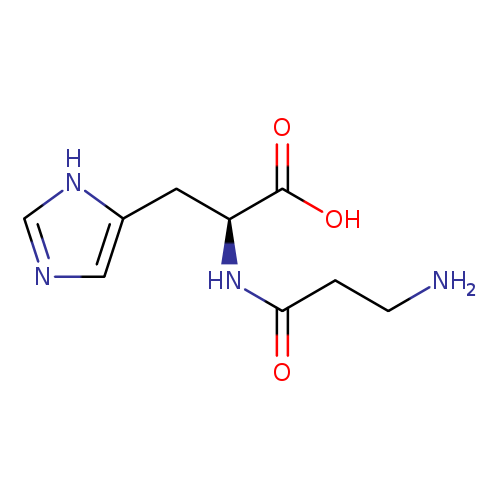
A dipeptide that is the N-(beta-alanyl) derivative of L-histidine.
Read more
Contaminant Sources
EAFUS Chemicals
FooDB Chemicals
Contaminant Type
Not Available
Chemical Structure
MOL
SDF
PDB
SMILES
InChI
×
Structure for CHEM005317: DIASTASE FROM ASPERGILLUS ORYZAE
Synonyms
Value
Source
Nalpha-(beta-alanyl)-L-histidine
ChEBI
Nalpha-(b-alanyl)-L-histidine
Generator
Nalpha-(β-alanyl)-L-histidine
Generator
b-Alanyl-L-histidine
HMDB
b-Alanylhistidine
HMDB
beta-Alanyl-L-histidine
HMDB
beta-Alanylhistidine
HMDB
Ignotine
HMDB
Karnozin
HMDB
Karnozzn
HMDB
L-Carnosine
HMDB
N-(3-Aminopropanoyl)histidine
HMDB
N-(b-Alanyl)-L-histidine
HMDB
N-b-Alanyl-L-histidine
HMDB
N-beta-Alanyl-L-histidine
HMDB
Sevitin
HMDB
Carnosine, (D-his)-isomer
HMDB
Hydrochloride, carnosine
HMDB
L Carnosine
HMDB
Carnosine hydrochloride
HMDB
beta Alanylhistidine
HMDB
Chemical Formula
C
9
H
14
N
4
O
3
Average Molecular Mass
226.233 g/mol
Monoisotopic Mass
226.107 g/mol
CAS Registry Number
9001-19-8
IUPAC Name
(2S)-2-(3-aminopropanamido)-3-(1H-imidazol-5-yl)propanoic acid
Traditional Name
β-alanyl-L-histidine
SMILES
NCCC(=O)NC(CC1=CNC=N1)C(O)=O
InChI Identifier
InChI=1S/C9H14N4O3/c10-2-1-8(14)13-7(9(15)16)3-6-4-11-5-12-6/h4-5,7H,1-3,10H2,(H,11,12)(H,13,14)(H,15,16)
InChI Key
CQOVPNPJLQNMDC-UHFFFAOYSA-N
Chemical Taxonomy
Description
Belongs to the class of organic compounds known as hybrid peptides. Hybrid peptides are compounds containing at least two different types of amino acids (alpha, beta, gamma, delta) linked to each other through a peptide bond.
Kingdom
Organic compounds
Super Class
Organic acids and derivatives
Class
Peptidomimetics
Sub Class
Hybrid peptides
Direct Parent
Hybrid peptides
Alternative Parents
Histidine and derivatives
N-acyl-L-alpha-amino acids
Beta amino acids and derivatives
Imidazolyl carboxylic acids and derivatives
Heteroaromatic compounds
Secondary carboxylic acid amides
Amino acids
Monocarboxylic acids and derivatives
Carboxylic acids
Azacyclic compounds
Organopnictogen compounds
Organic oxides
Monoalkylamines
Hydrocarbon derivatives
Carbonyl compounds
Substituents
Hybrid peptide
Histidine or derivatives
N-acyl-alpha-amino acid
N-acyl-alpha amino acid or derivatives
N-acyl-l-alpha-amino acid
Beta amino acid or derivatives
Alpha-amino acid or derivatives
Imidazolyl carboxylic acid derivative
Azole
Heteroaromatic compound
Imidazole
Amino acid
Amino acid or derivatives
Secondary carboxylic acid amide
Carboxamide group
Azacycle
Organoheterocyclic compound
Carboxylic acid derivative
Carboxylic acid
Monocarboxylic acid or derivatives
Organopnictogen compound
Primary aliphatic amine
Organic nitrogen compound
Amine
Organonitrogen compound
Organooxygen compound
Carbonyl group
Primary amine
Hydrocarbon derivative
Organic oxygen compound
Organic oxide
Aromatic heteromonocyclic compound
Molecular Framework
Aromatic heteromonocyclic compounds
External Descriptors
dipeptide (
CHEBI:15727
)
Biological Properties
Status
Detected and Not Quantified
Origin
Not Available
Cellular Locations
Not Available
Biofluid Locations
Not Available
Tissue Locations
Not Available
Pathways
Not Available
Applications
Not Available
Biological Roles
Not Available
Chemical Roles
Not Available
Physical Properties
State
Not Available
Appearance
Not Available
Experimental Properties
Property
Value
Melting Point
Not Available
Boiling Point
Not Available
Solubility
Not Available
Predicted Properties
Property
Value
Source
Water Solubility
11.1 g/L
ALOGPS
logP
-3
ALOGPS
logP
-4.5
ChemAxon
logS
-1.3
ALOGPS
pKa (Strongest Acidic)
3.37
ChemAxon
pKa (Strongest Basic)
9.13
ChemAxon
Physiological Charge
1
ChemAxon
Hydrogen Acceptor Count
5
ChemAxon
Hydrogen Donor Count
4
ChemAxon
Polar Surface Area
121.1 Ų
ChemAxon
Rotatable Bond Count
6
ChemAxon
Refractivity
55.56 m³·mol⁻¹
ChemAxon
Polarizability
22.37 ų
ChemAxon
Number of Rings
1
ChemAxon
Bioavailability
Yes
ChemAxon
Rule of Five
Yes
ChemAxon
Ghose Filter
No
ChemAxon
Veber's Rule
No
ChemAxon
MDDR-like Rule
No
ChemAxon
Spectra
Spectra
Toxicity Profile
Route of Exposure
Not Available
Mechanism of Toxicity
Not Available
Metabolism
Not Available
Toxicity Values
Not Available
Lethal Dose
Not Available
Carcinogenicity (
IARC Classification
)
Not Available
Uses/Sources
Not Available
Minimum Risk Level
Not Available
Health Effects
Not Available
Symptoms
Not Available
Treatment
Not Available
Concentrations
Not Available
External Links
DrugBank ID
DB11695
HMDB ID
HMDB0000033
FooDB ID
FDB012937
Phenol Explorer ID
Not Available
KNApSAcK ID
Not Available
BiGG ID
1800369
BioCyc ID
CARNOSINE
METLIN ID
38
PDB ID
Not Available
Wikipedia Link
Carnosine
Chemspider ID
388363
ChEBI ID
15727
PubChem Compound ID
439224
Kegg Compound ID
C00386
YMDB ID
YMDB01555
ECMDB ID
ECMDB00033
References
Synthesis Reference
Not Available
MSDS
Not Available
General References
1
.
https://www.ncbi.nlm.nih.gov/pubmed/?term=16804013
2
.
https://www.ncbi.nlm.nih.gov/pubmed/?term=18019400
3
.
https://www.ncbi.nlm.nih.gov/pubmed/?term=18076890
4
.
https://www.ncbi.nlm.nih.gov/pubmed/?term=18773880
5
.
https://www.ncbi.nlm.nih.gov/pubmed/?term=24398899
6
.
Vezenkov, L.; Yanachkov, O. Synthesis of carnosine by trimethylsilyl protection. Dokladi na Bulgarskata Akademiya na Naukite (1991), 44(8), 53-6
7
.
Melzer N, Wittenburg D, Hartwig S, Jakubowski S, Kesting U, Willmitzer L, Lisec J, Reinsch N, Repsilber D: Investigating associations between milk metabolite profiles and milk traits of Holstein cows. J Dairy Sci. 2013 Mar;96(3):1521-34. doi: 10.3168/jds.2012-5743.
8
.
A. Foroutan et al. The Chemical Composition of Commercial Cow's Milk (in preparation)
9
.
Vezenkov, L.; Yanachkov, O. Synthesis of carnosine by trimethylsilyl protection. Dokladi na Bulgarskata Akademiya na Naukite (1991), 44(8), 53-6
10
.
Park YJ, Volpe SL, Decker EA: Quantitation of carnosine in humans plasma after dietary consumption of beef. J Agric Food Chem. 2005 Jun 15;53(12):4736-9.
11
.
Guiotto A, Calderan A, Ruzza P, Borin G: Carnosine and carnosine-related antioxidants: a review. Curr Med Chem. 2005;12(20):2293-315.
12
.
Hipkiss AR, Preston JE, Himsworth DT, Worthington VC, Keown M, Michaelis J, Lawrence J, Mateen A, Allende L, Eagles PA, Abbott NJ: Pluripotent protective effects of carnosine, a naturally occurring dipeptide. Ann N Y Acad Sci. 1998 Nov 20;854:37-53.
13
.
Guiotto A, Calderan A, Ruzza P, Osler A, Rubini C, Jo DG, Mattson MP, Borin G: Synthesis and evaluation of neuroprotective alpha,beta-unsaturated aldehyde scavenger histidyl-containing analogues of carnosine. J Med Chem. 2005 Sep 22;48(19):6156-61.
14
.
Hipkiss AR, Brownson C: Carnosine reacts with protein carbonyl groups: another possible role for the anti-ageing peptide? Biogerontology. 2000;1(3):217-23.
15
.
Furst P: Amino acid metabolism in uremia. J Am Coll Nutr. 1989 Aug;8(4):310-23.
16
.
Lee YT, Hsu CC, Lin MH, Liu KS, Yin MC: Histidine and carnosine delay diabetic deterioration in mice and protect human low density lipoprotein against oxidation and glycation. Eur J Pharmacol. 2005 Apr 18;513(1-2):145-50. Epub 2005 Apr 2.
17
.
Hipkiss AR, Brownson C, Bertani MF, Ruiz E, Ferro A: Reaction of carnosine with aged proteins: another protective process? Ann N Y Acad Sci. 2002 Apr;959:285-94.
18
.
Mannion AF, Jakeman PM, Dunnett M, Harris RC, Willan PL: Carnosine and anserine concentrations in the quadriceps femoris muscle of healthy humans. Eur J Appl Physiol Occup Physiol. 1992;64(1):47-50.
19
.
Hipkiss AR, Brownson C, Carrier MJ: Carnosine, the anti-ageing, anti-oxidant dipeptide, may react with protein carbonyl groups. Mech Ageing Dev. 2001 Sep 15;122(13):1431-45.
20
.
Suzuki Y, Ito O, Mukai N, Takahashi H, Takamatsu K: High level of skeletal muscle carnosine contributes to the latter half of exercise performance during 30-s maximal cycle ergometer sprinting. Jpn J Physiol. 2002 Apr;52(2):199-205.
21
.
Kang JH, Kim KS, Choi SY, Kwon HY, Won MH, Kang TC: Protection by carnosine-related dipeptides against hydrogen peroxide-mediated ceruloplasmin modification. Mol Cells. 2002 Feb 28;13(1):107-12.
22
.
Willi SM, Zhang Y, Hill JB, Phelan MC, Michaelis RC, Holden KR: A deletion in the long arm of chromosome 18 in a child with serum carnosinase deficiency. Pediatr Res. 1997 Feb;41(2):210-3.
23
.
Tallon MJ, Harris RC, Boobis LH, Fallowfield JL, Wise JA: The carnosine content of vastus lateralis is elevated in resistance-trained bodybuilders. J Strength Cond Res. 2005 Nov;19(4):725-9.
24
.
Mozdzan M, Szemraj J, Rysz J, Nowak D: Antioxidant properties of carnosine re-evaluated with oxidizing systems involving iron and copper ions. Basic Clin Pharmacol Toxicol. 2005 May;96(5):352-60.
25
.
Jackson MC, Lenney JF: The distribution of carnosine and related dipeptides in rat and human tissues. Inflamm Res. 1996 Mar;45(3):132-5.
26
.
Hipkiss AR: Would carnosine or a carnivorous diet help suppress aging and associated pathologies? Ann N Y Acad Sci. 2006 May;1067:369-74.
27
.
Guney Y, Turkcu UO, Hicsonmez A, Andrieu MN, Guney HZ, Bilgihan A, Kurtman C: Carnosine may reduce lung injury caused by radiation therapy. Med Hypotheses. 2006;66(5):957-9. Epub 2006 Jan 10.