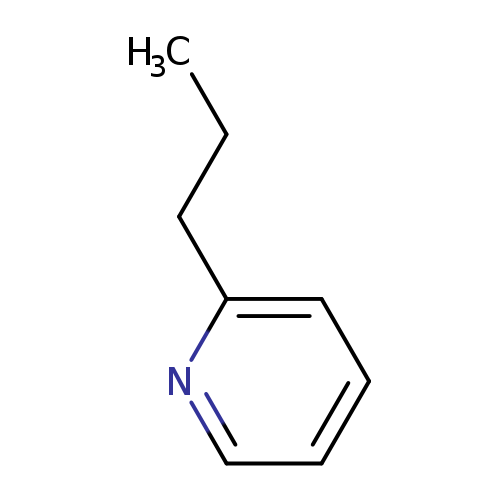
2-PROPYLPYRIDINE (CED0027022)

Record Information
Version1.0
Creation Date2016-05-19 02:24:34 UTC
Update Date2026-08-24 12:07:45 UTC
SynCED IDCED0027022
Secondary Accession Numbers
  • CHEM007353
Identification
Common Name2-PROPYLPYRIDINE
ClassSmall Molecule
Description
2-PROPYLPYRIDINE is an organic compound with the formula C8H11N and an average molecular weight of 121.18 g/mol. 2-PROPYLPYRIDINE belongs to the pyridines and derivatives, a class of organoheterocyclic compounds within the organic compounds. In industrial applications, the substance serves as a nutrient and a flavouring.
Contaminant TypeNot Available
Chemical Structure
Synonyms
ValueSource
2-Propyl-pyridineHMDB
1-(2-Pyridyl)propaneHMDB
1-Propyl-pyridineHMDB
2-N-PropylpyridineHMDB
ConyrinHMDB
ConyrineHMDB
PYRIDINE, 1-propylHMDB
Chemical FormulaC8H11N
Average Molecular Mass121.180 g/mol
Monoisotopic Mass121.089 g/mol
CAS Registry Number622-39-9
IUPAC Name2-propylpyridine
Traditional Namepropazin
SMILESCCCC1=CC=CC=N1
InChI IdentifierInChI=1S/C8H11N/c1-2-5-8-6-3-4-7-9-8/h3-4,6-7H,2,5H2,1H3
InChI KeyOIALIKXMLIAOSN-UHFFFAOYSA-N
Chemical Taxonomy
Description Belongs to the class of organic compounds known as pyridines and derivatives. Pyridines and derivatives are compounds containing a pyridine ring, which is a six-member aromatic heterocycle which consists of one nitrogen atom and five carbon atoms.
KingdomOrganic compounds
Super ClassOrganoheterocyclic compounds
ClassPyridines and derivatives
Sub ClassNot Available
Direct ParentPyridines and derivatives
Alternative Parents
Substituents
  • Pyridine
  • Heteroaromatic compound
  • Azacycle
  • Organic nitrogen compound
  • Organopnictogen compound
  • Hydrocarbon derivative
  • Organonitrogen compound
  • Aromatic heteromonocyclic compound
Molecular FrameworkAromatic heteromonocyclic compounds
External DescriptorsNot Available
Biological Properties
StatusDetected and Not Quantified
OriginNot Available
Cellular LocationsNot Available
Biofluid LocationsNot Available
Tissue LocationsNot Available
ApplicationsNot Available
Biological RolesNot Available
Chemical RolesNot Available
Organoleptic EffectsNot Available
Physical Properties
StateNot Available
AppearanceNot Available
Experimental Properties
PropertyValue
Melting PointNot Available
Boiling PointNot Available
SolubilityNot Available
Predicted Properties
PropertyValueSource
Water Solubility30.3 g/LALOGPS
logP2.41ALOGPS
logP2.03ChemAxon
logS-0.6ALOGPS
pKa (Strongest Basic)5.6ChemAxon
Physiological Charge0ChemAxon
Hydrogen Acceptor Count1ChemAxon
Hydrogen Donor Count0ChemAxon
Polar Surface Area12.89 ŲChemAxon
Rotatable Bond Count2ChemAxon
Refractivity37.72 m³·mol⁻¹ChemAxon
Polarizability14.4 ųChemAxon
Number of Rings1ChemAxon
BioavailabilityYesChemAxon
Rule of FiveYesChemAxon
Ghose FilterNoChemAxon
Veber's RuleYesChemAxon
MDDR-like RuleNoChemAxon
Spectra
Spectra
Spectrum TypeDescriptionSplash KeyDeposition DateView
GC-MSGC-MS Spectrumsplash10-002f-9100000000-bb436ec56de430e8e083Not AvailableView Spectrum
GC-MSGC-MS Spectrumsplash10-0006-9200000000-b313f35a38191d1cb5a4Not AvailableView Spectrum
GC-MSGC-MS Spectrumsplash10-002f-9100000000-bb436ec56de430e8e083Not AvailableView Spectrum
GC-MSGC-MS Spectrumsplash10-0006-9200000000-b313f35a38191d1cb5a4Not AvailableView Spectrum
Predicted GC-MSPredicted GC-MS Spectrumsplash10-0006-9200000000-658bec2bc677569e764eNot AvailableView Spectrum
Predicted GC-MSPredicted GC-MS SpectrumNot AvailableNot AvailableView Spectrum
LC-MS/MSLC-MS/MS Spectrumsplash10-00di-0900000000-03290763d971604e5baeNot AvailableView Spectrum
LC-MS/MSLC-MS/MS Spectrumsplash10-00di-1900000000-8ca270844e74986f7ff2Not AvailableView Spectrum
LC-MS/MSLC-MS/MS Spectrumsplash10-00dl-6900000000-cfa6c9120472749b338dNot AvailableView Spectrum
LC-MS/MSLC-MS/MS Spectrumsplash10-0006-9300000000-0ed1e251b7e53aa8f916Not AvailableView Spectrum
LC-MS/MSLC-MS/MS Spectrumsplash10-0006-9000000000-eecb5a1de73efb4c8970Not AvailableView Spectrum
LC-MS/MSLC-MS/MS Spectrumsplash10-0006-9000000000-1d10d6e487120f1b4422Not AvailableView Spectrum
LC-MS/MSLC-MS/MS Spectrumsplash10-0006-9000000000-096908e3a499d18d3ba5Not AvailableView Spectrum
LC-MS/MSLC-MS/MS Spectrumsplash10-0006-9000000000-205c2863f5de7f6b1e7dNot AvailableView Spectrum
Predicted LC-MS/MSPredicted LC-MS/MS Spectrumsplash10-00di-0900000000-3667f58350bc82fa60b8Not AvailableView Spectrum
Predicted LC-MS/MSPredicted LC-MS/MS Spectrumsplash10-00di-3900000000-2fe31a391096176a7d2bNot AvailableView Spectrum
Predicted LC-MS/MSPredicted LC-MS/MS Spectrumsplash10-0f6x-9000000000-db60b5f87770cfef05e9Not AvailableView Spectrum
Predicted LC-MS/MSPredicted LC-MS/MS Spectrumsplash10-00di-0900000000-09f338d275b810976441Not AvailableView Spectrum
Predicted LC-MS/MSPredicted LC-MS/MS Spectrumsplash10-00di-1900000000-cf3d9233a3a326d1d3cdNot AvailableView Spectrum
Predicted LC-MS/MSPredicted LC-MS/MS Spectrumsplash10-0ufr-9200000000-62826fc8fcf92b4e1090Not AvailableView Spectrum
Predicted LC-MS/MSPredicted LC-MS/MS Spectrumsplash10-00di-2900000000-8f85e2485b238c6e442bNot AvailableView Spectrum
Predicted LC-MS/MSPredicted LC-MS/MS Spectrumsplash10-006x-9200000000-6dc1ffff8a4d876236d8Not AvailableView Spectrum
Predicted LC-MS/MSPredicted LC-MS/MS Spectrumsplash10-0fbc-9000000000-8df2125b2d53ad1ac31eNot AvailableView Spectrum
Predicted LC-MS/MSPredicted LC-MS/MS Spectrumsplash10-00di-0900000000-300e5678301fe5e998c4Not AvailableView Spectrum
Predicted LC-MS/MSPredicted LC-MS/MS Spectrumsplash10-00di-3900000000-9e67057b42c6f6137f1fNot AvailableView Spectrum
Predicted LC-MS/MSPredicted LC-MS/MS Spectrumsplash10-01r6-9000000000-160651b01ff8cb63215bNot AvailableView Spectrum
1D NMR1H NMR Spectrum (1D, D2O, predicted)Not AvailableNot AvailableView Spectrum
1D NMR13C NMR Spectrum (1D, D2O, predicted)Not AvailableNot AvailableView Spectrum
Toxicity Profile
Toxicity Values
Toxicity ValueOrganismDose DescriptorRoute of ExposurePredicted or ExperimentalToxicity RatingReference
243.0 Log mg/kg [140:430]RatLD50oralpredictedNot AvailableNot Available
Toxicity / Toxin ClassNot Available
Mechanism of ToxicityNot Available
Carcinogenicity (IARC Classification)Not Available
Minimum Risk LevelNot Available
SymptomsNot Available
TreatmentNot Available
Health Effects
Health EffectRelationshipDirectionDescriptionReference
Exposure Sources
Source IDSourceSectorReference
CEDs000010Insecticides?Insecticides are synthetic chemicals designed to control or eliminate insect pests that threaten crops and other agricultural products.Agriculture & land managementPubChem
CEDs000511Conductors Or Conductive Bodies Characterised By The Conductive Materials?Conductors, or conductive bodies, are materials that allow the flow of electrical current, typically made from metals such as copper, aluminum, or silver.Electrical & Electronic EquipmentPubChem
CEDs000519Electrodes?Electrodes, used in various electrical and electronic applications, can be a source of synthetic chemical contamination due to the materials from which they are constructed and the processes involved in their manufacturing.Electrical & Electronic EquipmentPubChem
CEDs000521Fixed Capacitors And Their Manufacture?Fixed capacitors are passive electronic components used to store and release electrical energy, playing a critical role in various circuits.Electrical & Electronic EquipmentPubChem
CEDs000524Hybrid Capacitors?Hybrid capacitors are energy storage devices that combine the properties of electrolytic and supercapacitors, utilizing a combination of electrochemical principles to achieve higher energy density and power density.Electrical & Electronic EquipmentPubChem
CEDs000545Food Preservation?Food preservation often involves the use of synthetic chemicals, such as preservatives, flavor enhancers, and color additives, to extend shelf life and enhance the sensory qualities of food products.Food, food processing & cookwarePubChem
CEDs000561Perfumes Within Detergents And Soaps?Perfumes within detergents and soaps are synthetic fragrance compounds added to enhance the sensory experience of cleaning products.Household cleaning & consumer productsPubChem
CEDs000580Manufacture Preparation Of Tobacco Products?The manufacture and preparation of tobacco products involve various processes that can result in the introduction of synthetic chemicals into the environment.Industrial manufacturing & chemical processingPubChem
CEDs000600Herbicides And Algicides?Herbicides and algicides are synthetic chemicals primarily used to control unwanted plants and algae in various environments.Agriculture & land managementPubChem
CEDs000609Aftershave?Aftershave is a grooming product typically used to soothe and protect the skin following shaving.Personal care & cosmeticsPubChem
CEDs000610Aftersun Products?Aftersun products are designed to soothe and hydrate the skin after sun exposure, often containing various synthetic chemicals such as emollients, preservatives, and fragrances.Personal care & cosmeticsPubChem
CEDs000611Anti Perspirants Or Body Deoderants?Antiperspirants and body deodorants commonly contain synthetic chemicals such as aluminum compounds, parabens, and synthetic fragrances.Personal care & cosmeticsPubChem
CEDs000614Essential Oils Or Perfumes?Essential oils and perfumes are complex mixtures of volatile compounds derived from natural or synthetic sources, commonly used for their aromatic properties.Personal care & cosmeticsPubChem
CEDs000634Buckles?Buckles, commonly used as fasteners in clothing, accessories, and furniture, can be a source of synthetic chemical contamination due to the materials and coatings employed in their production.Textiles, leather & furnishingsPubChem
CEDs000685Ceramics?Ceramics can be a source of synthetic chemical contamination through various additives and processing agents used in their production.Building & ConstructionPubChem
CEDs000696Nanotechnology?Nanotechnology involves the manipulation of materials at the molecular or atomic level, typically within the range of 1 to 100 nanometers.Industrial manufacturing & chemical processingPubChem
CEDs000739Inks?Inks are complex mixtures composed of pigments or dyes, solvents, resins, and additives used primarily for printing and writing applications.Paper, pulp & fiber productsPubChem
CEDs000740Paper?Paper production involves the processing of wood fibers and the use of various chemicals, which can lead to synthetic chemical contamination.Paper, pulp & fiber productsPubChem
CEDs000744Water, Wastewater, & Sewage Treatment?Water, wastewater, and sewage treatment processes are critical for managing and mitigating pollutants in water systems.Wastewater, sanitation & biosolidsPubChem
CEDs01413Cat FoodFood, food processing & cookwarePMC13408589
Pathways
0 pathwaysPathway Source: PathBank

No pathways found

No metabolic pathways have been associated with this synthetic chemical

Targets
StructureProteinUniProt IDOrganismRelationshipDetails
Click to view 3D structureSigma non-opioid intracellular receptor 1Q9R0C9Rattus norvegicusPredicted (SEA)
Prediction Confidence Score
0.353
Applicability Domain
0.405
Statistical Significance
0.0075
Supporting Reference Compounds
207
E-value
58.3869
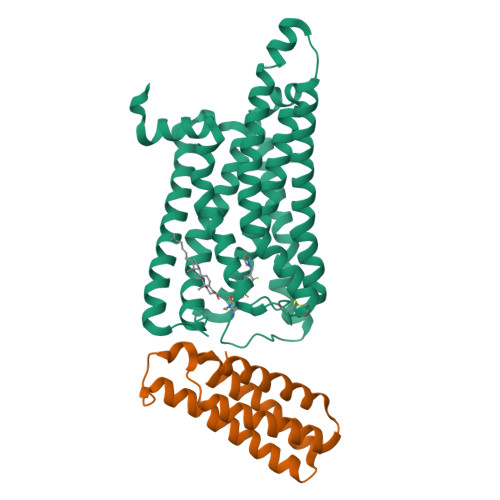
Muscarinic acetylcholine receptor M2 structureClick to view 3D structureMuscarinic acetylcholine receptor M2P08172HumansPredicted (SEA)
Prediction Confidence Score
0.353
Applicability Domain
0.405
Statistical Significance
0.0067
Supporting Reference Compounds
373
E-value
52.159
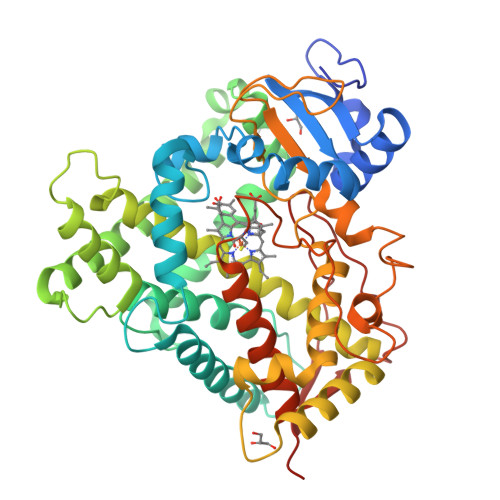
Cytochrome P450 2C19 structureClick to view 3D structureCytochrome P450 2C19P33261HumansPredicted (SEA)
Prediction Confidence Score
0.342
Applicability Domain
0.389
Statistical Significance
0.025
Supporting Reference Compounds
825
E-value
194.467
Muscarinic acetylcholine receptor M4 structureClick to view 3D structureMuscarinic acetylcholine receptor M4P08173HumansPredicted (SEA)
Prediction Confidence Score
0.339
Applicability Domain
0.405
Statistical Significance
0.0071
Supporting Reference Compounds
297
E-value
55.5843
D(2) dopamine receptor structureClick to view 3D structureD(2) dopamine receptorP14416HumansPredicted (SEA)
Prediction Confidence Score
0.322
Applicability Domain
0.5
Statistical Significance
0.0593
Supporting Reference Compounds
1103
E-value
462.035
Click to view 3D structureG protein-activated inward rectifier potassium channel 1P48549HumansPredicted (SEA)
Prediction Confidence Score
0.318
Applicability Domain
0.318
Statistical Significance
2.00e-05
Supporting Reference Compounds
1
E-value
0.155698
Cytochrome P450 3A4 structureClick to view 3D structureCytochrome P450 3A4P08684HumansPredicted (SEA)
Prediction Confidence Score
0.317
Applicability Domain
0.35
Statistical Significance
0.1113
Supporting Reference Compounds
1538
E-value
866.773
Histamine H3 receptor structureClick to view 3D structureHistamine H3 receptorQ9Y5N1HumansPredicted (SEA)
Prediction Confidence Score
0.308
Applicability Domain
0.5
Statistical Significance
0.0253
Supporting Reference Compounds
294
E-value
197.348
Muscarinic acetylcholine receptor M5 structureClick to view 3D structureMuscarinic acetylcholine receptor M5P08912HumansPredicted (SEA)
Prediction Confidence Score
0.308
Applicability Domain
0.39
Statistical Significance
0.0149
Supporting Reference Compounds
266
E-value
115.917
Muscarinic acetylcholine receptor M3 structureClick to view 3D structureMuscarinic acetylcholine receptor M3P20309HumansPredicted (SEA)
Prediction Confidence Score
0.308
Applicability Domain
0.39
Statistical Significance
0.0171
Supporting Reference Compounds
310
E-value
133.434
Sodium-dependent serotonin transporter structureClick to view 3D structureSodium-dependent serotonin transporterP31645HumansPredicted (SEA)
Prediction Confidence Score
0.306
Applicability Domain
0.5
Statistical Significance
0.0444
Supporting Reference Compounds
593
E-value
345.651
Cytochrome P450 1A2 structureClick to view 3D structureCytochrome P450 1A2P05177HumansPredicted (SEA)
Prediction Confidence Score
0.305
Applicability Domain
0.389
Statistical Significance
0.0618
Supporting Reference Compounds
793
E-value
481.42
Click to view 3D structureATP-dependent molecular chaperone HSP82C4YTQ8Candida albicans (strain WO-1) (Yeast)Predicted (SEA)
Prediction Confidence Score
0.301
Applicability Domain
0.378
Statistical Significance
0.0082
Supporting Reference Compounds
205
E-value
64.0699
Sodium-dependent dopamine transporter structureClick to view 3D structureSodium-dependent dopamine transporterQ01959HumansPredicted (SEA)
Prediction Confidence Score
0.296
Applicability Domain
0.39
Statistical Significance
0.044
Supporting Reference Compounds
506
E-value
342.77
Kappa-type opioid receptor structureClick to view 3D structureKappa-type opioid receptorP41145HumansPredicted (SEA)
Prediction Confidence Score
0.294
Applicability Domain
0.405
Statistical Significance
0.072
Supporting Reference Compounds
532
E-value
560.281
Cytochrome P450 2D6 structureClick to view 3D structureCytochrome P450 2D6P10635HumansPredicted (SEA)
Prediction Confidence Score
0.293
Applicability Domain
0.35
Statistical Significance
0.1321
Supporting Reference Compounds
1130
E-value
1028.39
Thiamine transporter 1 structureClick to view 3D structureThiamine transporter 1O60779HumansPredicted (SEA)
Prediction Confidence Score
0.292
Applicability Domain
0.292 Low confidence
Statistical Significance
1.00e-05
Supporting Reference Compounds
1
E-value
0.0778492
5-hydroxytryptamine receptor 6 structureClick to view 3D structure5-hydroxytryptamine receptor 6P50406HumansPredicted (SEA)
Prediction Confidence Score
0.286
Applicability Domain
0.39
Statistical Significance
0.0622
Supporting Reference Compounds
536
E-value
484.3
Click to view 3D structureNonstructural protein 1Q194T2Influenza A virusPredicted (SEA)
Prediction Confidence Score
0.286
Applicability Domain
0.345
Statistical Significance
0.005
Supporting Reference Compounds
104
E-value
38.9246
Mu-type opioid receptor structureClick to view 3D structureMu-type opioid receptorP35372HumansPredicted (SEA)
Prediction Confidence Score
0.285
Applicability Domain
0.405
Statistical Significance
0.0927
Supporting Reference Compounds
527
E-value
721.662
Alpha-2B adrenergic receptor structureClick to view 3D structureAlpha-2B adrenergic receptorP18089HumansPredicted (SEA)
Prediction Confidence Score
0.284
Applicability Domain
0.347
Statistical Significance
0.0422
Supporting Reference Compounds
340
E-value
328.368
Cytochrome P450 2C8 structureClick to view 3D structureCytochrome P450 2C8P10632HumansPredicted (SEA)
Prediction Confidence Score
0.283
Applicability Domain
0.35
Statistical Significance
0.0314
Supporting Reference Compounds
305
E-value
244.836
Click to view 3D structureHistamine H1 receptorP31389Cavia porcellusPredicted (SEA)
Prediction Confidence Score
0.283
Applicability Domain
0.348
Statistical Significance
0.0223
Supporting Reference Compounds
101
E-value
173.915
Click to view 3D structurePotassium voltage-gated channel subfamily A member 5P22460HumansPredicted (SEA)
Prediction Confidence Score
0.281
Applicability Domain
0.318
Statistical Significance
0.0016
Supporting Reference Compounds
37
E-value
12.7673
Click to view 3D structureSignal transducer and transcription activator 6P52633Mus musculusPredicted (SEA)
Prediction Confidence Score
0.279
Applicability Domain
0.279 Low confidence
Statistical Significance
5.70e-04
Supporting Reference Compounds
1
E-value
4.43741
Concentrations
Not Available
External Links
DrugBank IDNot Available
HMDB IDHMDB0032497
FooDB IDFDB010145
Phenol Explorer IDNot Available
KNApSAcK IDNot Available
BiGG IDNot Available
BioCyc IDNot Available
METLIN IDNot Available
PDB IDNot Available
Wikipedia LinkNot Available
Chemspider ID62530
ChEBI IDNot Available
PubChem Compound ID69320
Kegg Compound IDNot Available
YMDB IDNot Available
ECMDB IDNot Available
References
Synthesis ReferenceNot Available
MSDSNot Available
General ReferencesNot Available