Some data may have been extracted from scientific literature using a pipeline that uses large language models (LLMs). Source articles are cited where applicable to help verify the extracted relationships.
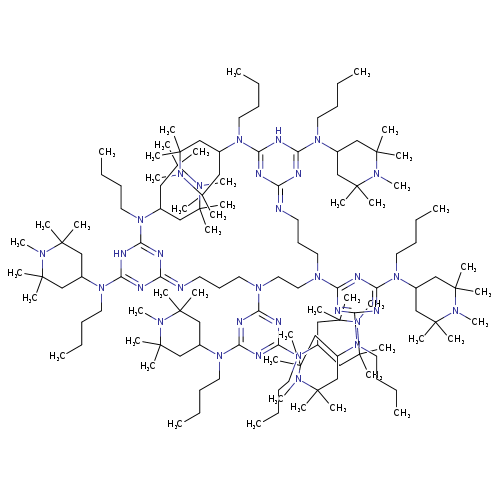
1,3,5-Triazine-2,4,6-triamine, N,N'''-1,2-ethanediylbis[N-[3-[[4,6-bis[butyl(1,2,2,6,6-pentamethyl-4-piperidinyl)amino]-1,3,5-triazin-2-yl]amino]propyl]-N',N''-dibutyl-N',N''-bis(1,2,2,6,6-pentamethyl belongs to the amines, a subclass of organonitrogen compounds within the organic compounds. With an average molecular weight of 2,286 g/mol, 1,3,5-Triazine-2,4,6-triamine, N,N'''-1,2-ethanediylbis[N-[3-[[4,6-bis[butyl(1,2,2,6,6-pentamethyl-4-piperidinyl)amino]-1,3,5-triazin-2-yl]amino]propyl]-N',N''-dibutyl-N',N''-bis(1,2,2,6,6-pentamethyl is a heavy molecule. Its chemical formula is C132H250N32.
In industrial applications, this compound serves as a heat stabilizer, stabilizing agent, UV stabilizer, and antioxidant. It has been identified in three recorded sources: power cables within electrical and electronic equipment, drinking water and water supply, and the processing of meats within food, food processing and cookware. The recorded exposure route for this substance is oral.
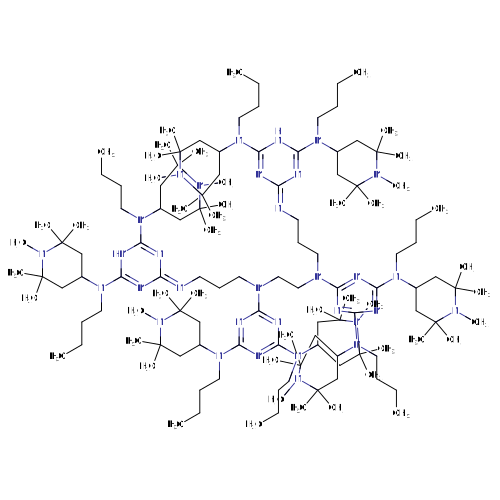
Structure for CHEM009196: 1,3,5-Triazine-2,4,6-triamine, N,N'''-1,2-ethanediylbis[N-[3-[[4,6-bis[butyl(1,2,2,6,6-pentamethyl-4-piperidinyl)amino]-1,3,5-triazin-2-yl]amino]propyl]-N',N''-dibutyl-N',N''-bis(1,2,2,6,6-pentamethyl
Belongs to the class of organic compounds known as dialkylarylamines. These are aliphatic aromatic amines in which the amino group is linked to two aliphatic chains and one aromatic group.
Drinking water?Drinking water can be a medium for synthetic chemical contamination, often originating from various industrial processes and agricultural practices.
Electrodes?Electrodes, used in various electrical and electronic applications, can be a source of synthetic chemical contamination due to the materials from which they are constructed and the processes involved in their manufacturing.
Power Cables?Power cables are used to transmit electrical energy and are typically composed of conductive materials, insulation, and protective coatings.
Food Preservation?Food preservation often involves the use of synthetic chemicals, such as preservatives, flavor enhancers, and color additives, to extend shelf life and enhance the sensory qualities of food products.
Aftersun Products?Aftersun products are designed to soothe and hydrate the skin after sun exposure, often containing various synthetic chemicals such as emollients, preservatives, and fragrances.
Footwear?Footwear production often involves the use of various synthetic chemicals, such as adhesives, dyes, and treatments, which can contribute to environmental contamination.
Headwear?Headwear made from synthetic materials often incorporates chemicals used in the manufacturing and finishing processes, such as dyes, flame retardants, and water repellents.
Yarns Or Threads?Yarns or threads used in textiles can be a source of synthetic chemical contamination due to the production processes and treatments they undergo.
Glass Coatings?Glass coatings are synthetic chemical formulations applied to glass surfaces to enhance properties such as durability, UV resistance, and aesthetic appeal.
Nanotechnology?Nanotechnology involves the manipulation of materials at the molecular or atomic level, typically within the range of 1 to 100 nanometers.
Water, Wastewater, & Sewage Treatment?Water, wastewater, and sewage treatment processes are critical for managing and mitigating pollutants in water systems.