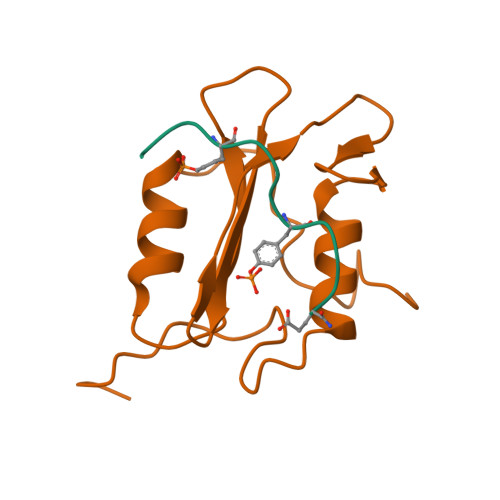
Glycine, N-methyl-N-[(9Z)-1-oxo-9-octadecenyl]- (CED0152803)

Record Information
Version1.0
Creation Date2016-05-19 03:02:32 UTC
Update Date2026-04-16 21:17:52 UTC
SynCED IDCED0152803
Secondary Accession Numbers
  • CHEM009307
Identification
Common NameGlycine, N-methyl-N-[(9Z)-1-oxo-9-octadecenyl]-
ClassSmall Molecule
Description
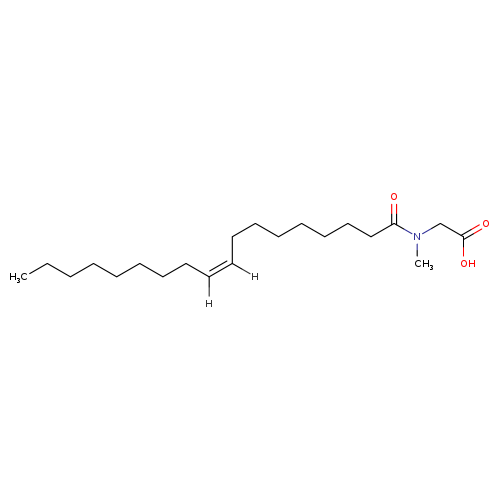
Glycine, N-methyl-N-[(9Z)-1-oxo-9-octadecenyl]- is an organic compound with the formula C21H39NO3 and an average molecular weight of 353.55 g/mol. Glycine, N-methyl-N-[(9Z)-1-oxo-9-octadecenyl]- belongs to the amino acids, peptides, and analogues, a subclass of carboxylic acids and derivatives within the organic compounds. In industrial applications, this compound is utilized as a surfactant, an anti-static agent, and a cleaning agent. It also serves as a softener and conditioner. The substance has been recorded in two specific sources: food contact materials used in food, food processing and cookware, and drinking water from drinking water and water supply. Recorded exposure routes for this compound include oral, inhalation, and touch.
Contaminant TypeNot Available
Chemical Structure
Synonyms
ValueSource
2-[(9Z)-N-Methyloctadec-9-enamido]acetateGenerator
Chemical FormulaC21H39NO3
Average Molecular Mass353.547 g/mol
Monoisotopic Mass353.293 g/mol
CAS Registry Number110-25-8
IUPAC Name2-[(9Z)-N-methyloctadec-9-enamido]acetic acid
Traditional Name[(9Z)-N-methyloctadec-9-enamido]acetic acid
SMILES[H]\C(CCCCCCCC)=C(/[H])CCCCCCCC(=O)N(C)CC(O)=O
InChI IdentifierInChI=1S/C21H39NO3/c1-3-4-5-6-7-8-9-10-11-12-13-14-15-16-17-18-20(23)22(2)19-21(24)25/h10-11H,3-9,12-19H2,1-2H3,(H,24,25)/b11-10-
InChI KeyDIOYAVUHUXAUPX-KHPPLWFESA-N
Chemical Taxonomy
Description Belongs to the class of organic compounds known as n-acyl-alpha amino acids. N-acyl-alpha amino acids are compounds containing an alpha amino acid which bears an acyl group at its terminal nitrogen atom.
KingdomOrganic compounds
Super ClassOrganic acids and derivatives
ClassCarboxylic acids and derivatives
Sub ClassAmino acids, peptides, and analogues
Direct ParentN-acyl-alpha amino acids
Alternative Parents
Substituents
  • N-acyl-alpha-amino acid
  • N-acyl-amine
  • Tertiary carboxylic acid amide
  • Carboxamide group
  • Monocarboxylic acid or derivatives
  • Carboxylic acid
  • Organic nitrogen compound
  • Organic oxygen compound
  • Organopnictogen compound
  • Organic oxide
  • Hydrocarbon derivative
  • Organooxygen compound
  • Organonitrogen compound
  • Carbonyl group
  • Aliphatic acyclic compound
Molecular FrameworkAliphatic acyclic compounds
External DescriptorsNot Available
Biological Properties
StatusDetected and Not Quantified
OriginNot Available
Cellular LocationsNot Available
Biofluid LocationsNot Available
Tissue LocationsNot Available
ApplicationsNot Available
Biological RolesNot Available
Chemical RolesNot Available
Organoleptic EffectsNot Available
Physical Properties
StateNot Available
AppearanceNot Available
Experimental Properties
PropertyValue
Melting PointNot Available
Boiling PointNot Available
SolubilityNot Available
Predicted Properties
PropertyValueSource
Water Solubility0.00021 g/LALOGPS
logP6.78ALOGPS
logP5.9ChemAxon
logS-6.2ALOGPS
pKa (Strongest Acidic)4.12ChemAxon
pKa (Strongest Basic)-1.4ChemAxon
Physiological Charge-1ChemAxon
Hydrogen Acceptor Count3ChemAxon
Hydrogen Donor Count1ChemAxon
Polar Surface Area57.61 ŲChemAxon
Rotatable Bond Count17ChemAxon
Refractivity105.1 m³·mol⁻¹ChemAxon
Polarizability44.36 ųChemAxon
Number of Rings0ChemAxon
BioavailabilityNoChemAxon
Rule of FiveNoChemAxon
Ghose FilterNoChemAxon
Veber's RuleNoChemAxon
MDDR-like RuleNoChemAxon
Spectra
Spectra
Spectrum TypeDescriptionSplash KeyDeposition DateView
Predicted LC-MS/MSPredicted LC-MS/MS Spectrumsplash10-0udi-3019000000-451ed3bc826ccc5fa5baNot AvailableView Spectrum
Predicted LC-MS/MSPredicted LC-MS/MS Spectrumsplash10-0006-9222000000-36eb42a55374871f6fafNot AvailableView Spectrum
Predicted LC-MS/MSPredicted LC-MS/MS Spectrumsplash10-006x-9310000000-2d2fde758a4291183671Not AvailableView Spectrum
Predicted LC-MS/MSPredicted LC-MS/MS Spectrumsplash10-0udi-0009000000-d2d5419df3868bf8cd5dNot AvailableView Spectrum
Predicted LC-MS/MSPredicted LC-MS/MS Spectrumsplash10-0zfr-3039000000-0e77b31bf82197a16832Not AvailableView Spectrum
Predicted LC-MS/MSPredicted LC-MS/MS Spectrumsplash10-022l-9210000000-f8710f23ad2598fe093aNot AvailableView Spectrum
Toxicity Profile
Toxicity Values
Toxicity ValueOrganismDose DescriptorRoute of ExposurePredicted or ExperimentalToxicity RatingReference
3339.0 Log mg/kg [1900:5900]RatLD50oralpredictedNot AvailableNot Available
Toxicity / Toxin ClassNot Available
Mechanism of ToxicityNot Available
Carcinogenicity (IARC Classification)Not Available
Minimum Risk LevelNot Available
SymptomsNot Available
TreatmentNot Available
Health Effects
Health EffectRelationshipDirectionDescriptionReference
Exposure Sources
Source IDSourceSectorReference
CEDs000010Insecticides?Insecticides are synthetic chemicals designed to control or eliminate insect pests that threaten crops and other agricultural products.Agriculture & land managementPubChem
CEDs000115Drinking water?Drinking water can be a medium for synthetic chemical contamination, often originating from various industrial processes and agricultural practices.Drinking water & water supplyNot Available
CEDs000233Brushes?Brushes used in personal care and cosmetics can be a source of synthetic chemical contamination due to the materials and coatings used in their manufacturing.Personal care & cosmeticsPubChem
CEDs000490Personal care & cosmeticsNot Available
CEDs000494Food contact materials?Food contact materials refer to substances and products that are intended to come into contact with food during processing, packaging, or preparation.Food, food processing & cookwareNot Available
CEDs000511Conductors Or Conductive Bodies Characterised By The Conductive Materials?Conductors, or conductive bodies, are materials that allow the flow of electrical current, typically made from metals such as copper, aluminum, or silver.Electrical & Electronic EquipmentPubChem
CEDs000517Electric Switches?Electric switches, integral components in numerous devices, can be a source of synthetic chemical contamination due to the materials and manufacturing processes involved in their production.Electrical & Electronic EquipmentPubChem
CEDs000519Electrodes?Electrodes, used in various electrical and electronic applications, can be a source of synthetic chemical contamination due to the materials from which they are constructed and the processes involved in their manufacturing.Electrical & Electronic EquipmentPubChem
CEDs000521Fixed Capacitors And Their Manufacture?Fixed capacitors are passive electronic components used to store and release electrical energy, playing a critical role in various circuits.Electrical & Electronic EquipmentPubChem
CEDs000545Food Preservation?Food preservation often involves the use of synthetic chemicals, such as preservatives, flavor enhancers, and color additives, to extend shelf life and enhance the sensory qualities of food products.Food, food processing & cookwarePubChem
CEDs000555Bleaching Agents?Bleaching agents are chemical substances used to whiten or lighten materials, often employed in various cleaning products for their stain removal and disinfecting properties.Household cleaning & consumer productsPubChem
CEDs000561Perfumes Within Detergents And Soaps?Perfumes within detergents and soaps are synthetic fragrance compounds added to enhance the sensory experience of cleaning products.Household cleaning & consumer productsPubChem
CEDs000563Soap Detergents?Soap detergents are synthetic surfactants designed to enhance the cleaning efficacy of water by reducing surface tension, allowing for better interaction with dirt and grease.Household cleaning & consumer productsPubChem
CEDs000600Herbicides And Algicides?Herbicides and algicides are synthetic chemicals primarily used to control unwanted plants and algae in various environments.Agriculture & land managementPubChem
CEDs000606Plant Growth Regulators?Plant Growth Regulators (PGRs) are synthetic chemicals designed to influence the growth and development of plants.Agriculture & land managementPubChem
CEDs000609Aftershave?Aftershave is a grooming product typically used to soothe and protect the skin following shaving.Personal care & cosmeticsPubChem
CEDs000610Aftersun Products?Aftersun products are designed to soothe and hydrate the skin after sun exposure, often containing various synthetic chemicals such as emollients, preservatives, and fragrances.Personal care & cosmeticsPubChem
CEDs000611Anti Perspirants Or Body Deoderants?Antiperspirants and body deodorants commonly contain synthetic chemicals such as aluminum compounds, parabens, and synthetic fragrances.Personal care & cosmeticsPubChem
CEDs000613Depilatories?Depilatories are products designed to remove unwanted hair through the application of synthetic chemicals that break down the protein structure of hair, facilitating its removal.Personal care & cosmeticsPubChem
CEDs000614Essential Oils Or Perfumes?Essential oils and perfumes are complex mixtures of volatile compounds derived from natural or synthetic sources, commonly used for their aromatic properties.Personal care & cosmeticsPubChem
CEDs000615Eye Makeup Products?Eye makeup products, including mascaras, eyeliners, and eyeshadows, often contain a variety of synthetic chemicals such as pigments, preservatives, and film-forming agents.Personal care & cosmeticsPubChem
CEDs000618Lip Makeup Products?Lip makeup products, such as lipsticks, lip glosses, and lip liners, often contain a variety of synthetic chemicals, including pigments, preservatives, and emollients.Personal care & cosmeticsPubChem
CEDs000638Decorating Textiles?Decorating textiles often involves the use of synthetic chemicals such as dyes, finishes, and coatings.Textiles, leather & furnishingsPubChem
CEDs000652Ropes?Ropes manufactured from synthetic fibers, such as polypropylene, nylon, and polyester, are widely used in various applications, including marine, construction, and outdoor activities.Textiles, leather & furnishingsPubChem
CEDs000657Surface Finishing Of Leather?Surface finishing of leather often involves the use of various synthetic chemicals, including dyes, resins, and finishing agents.Textiles, leather & furnishingsPubChem
CEDs000669PFAS Fire Fighting Foam?PFAS fire fighting foam refers to a class of synthetic foams containing per- and polyfluoroalkyl substances (PFAS), which are designed to suppress flammable liquid fires.Fire suppression systems & agentsPubChem
CEDs000678Nitrogenous Fertilisers?Nitrogenous fertilizers are synthetic chemical compounds primarily used to enhance plant growth by supplying essential nitrogen, a crucial nutrient for photosynthesis and protein synthesis.Agriculture & land managementPubChem
CEDs000685Ceramics?Ceramics can be a source of synthetic chemical contamination through various additives and processing agents used in their production.Building & ConstructionPubChem
CEDs000686Clay Wares?Clay wares are ceramic products made from natural clay, often utilized in various construction applications such as tiles, bricks, and sanitary ware.Building & ConstructionPubChem
CEDs000688Glass Coatings?Glass coatings are synthetic chemical formulations applied to glass surfaces to enhance properties such as durability, UV resistance, and aesthetic appeal.Building & ConstructionPubChem
CEDs000696Nanotechnology?Nanotechnology involves the manipulation of materials at the molecular or atomic level, typically within the range of 1 to 100 nanometers.Industrial manufacturing & chemical processingPubChem
CEDs000727Printing Machines Or Presses?Printing machines or presses commonly utilize synthetic chemicals such as inks, solvents, and cleaning agents.Paper, pulp & fiber productsPubChem
CEDs000734Coating Compositions?Coating compositions, which include paints, sealants, and varnishes, are formulated with a variety of synthetic chemicals such as solvents, resins, pigments, and additives.Building & ConstructionPubChem
CEDs000738Cooling Circuit Water?Cooling circuit water is utilized in various industrial processes to absorb and dissipate heat generated during operations.Industrial manufacturing & chemical processingPubChem
CEDs000739Inks?Inks are complex mixtures composed of pigments or dyes, solvents, resins, and additives used primarily for printing and writing applications.Paper, pulp & fiber productsPubChem
CEDs000740Paper?Paper production involves the processing of wood fibers and the use of various chemicals, which can lead to synthetic chemical contamination.Paper, pulp & fiber productsPubChem
CEDs000741Pigment Pastes?Pigment pastes are concentrated dispersions of pigments used to impart color and properties to materials.Paper, pulp & fiber productsPubChem
CEDs000742Leather Tanning?Leather tanning is a process that transforms raw animal hides into durable leather through the application of various chemicals, including chromium salts, aldehydes, and vegetable tannins.Textiles, leather & furnishingsPubChem
CEDs000744Water, Wastewater, & Sewage Treatment?Water, wastewater, and sewage treatment processes are critical for managing and mitigating pollutants in water systems.Wastewater, sanitation & biosolidsPubChem
Pathways
0 pathwaysPathway Source: PathBank

No pathways found

No metabolic pathways have been associated with this synthetic chemical

Targets
StructureProteinUniProt IDOrganismRelationshipDetails
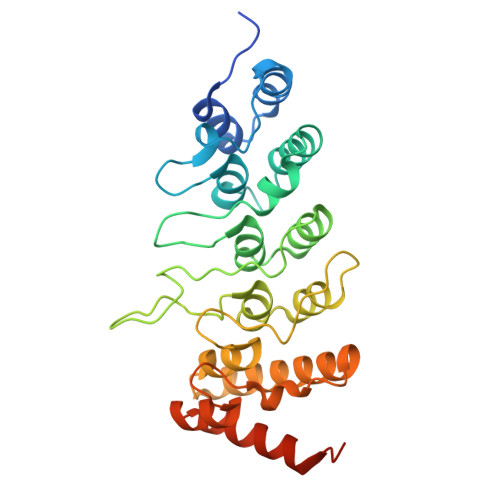
Peroxisome proliferator-activated receptor gamma structureClick to view 3D structurePeroxisome proliferator-activated receptor gammaP37231HumansPredicted (SEA)
Prediction Confidence Score
0.591
Applicability Domain
0.636
Statistical Significance
2.30e-04
Supporting Reference Compounds
192
E-value
1.79053
Peroxisome proliferator-activated receptor alpha structureClick to view 3D structurePeroxisome proliferator-activated receptor alphaQ07869HumansPredicted (SEA)
Prediction Confidence Score
0.591
Applicability Domain
0.636
Statistical Significance
3.10e-04
Supporting Reference Compounds
127
E-value
2.41333
Peroxisome proliferator-activated receptor delta structureClick to view 3D structurePeroxisome proliferator-activated receptor deltaQ03181HumansPredicted (SEA)
Prediction Confidence Score
0.591
Applicability Domain
0.636
Statistical Significance
2.70e-04
Supporting Reference Compounds
89
E-value
2.10193
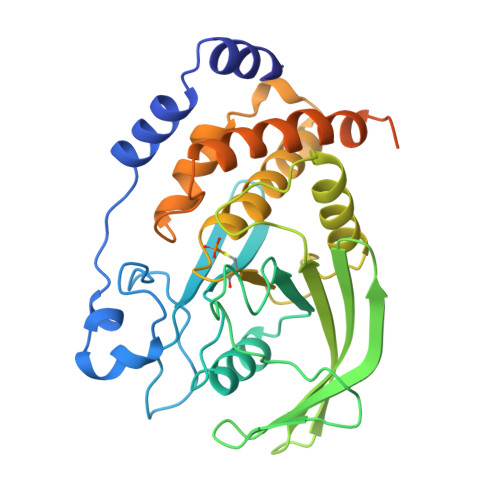
Tyrosine-protein phosphatase non-receptor type 1 structureClick to view 3D structureTyrosine-protein phosphatase non-receptor type 1P18031HumansPredicted (SEA)
Prediction Confidence Score
0.527
Applicability Domain
0.636
Statistical Significance
5.50e-04
Supporting Reference Compounds
197
E-value
4.28171
Transient receptor potential cation channel subfamily V member 2 structureClick to view 3D structureTransient receptor potential cation channel subfamily V member 2Q9WUD2Rattus norvegicusPredicted (SEA)
Prediction Confidence Score
0.52
Applicability Domain
0.636
Statistical Significance
2.80e-04
Supporting Reference Compounds
21
E-value
2.17978
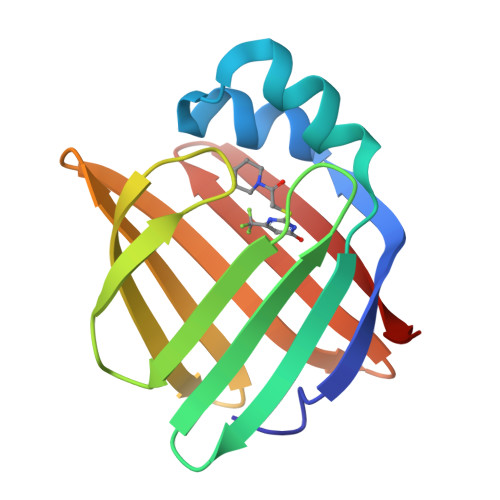
Fatty acid-binding protein, adipocyte structureClick to view 3D structureFatty acid-binding protein, adipocyteP15090HumansPredicted (SEA)
Prediction Confidence Score
0.463
Applicability Domain
0.636
Statistical Significance
1.20e-04
Supporting Reference Compounds
19
E-value
0.934191
Click to view 3D structureCannabinoid receptor 1P20272Rattus norvegicusPredicted (SEA)
Prediction Confidence Score
0.456
Applicability Domain
0.543
Statistical Significance
0.0014
Supporting Reference Compounds
83
E-value
10.821
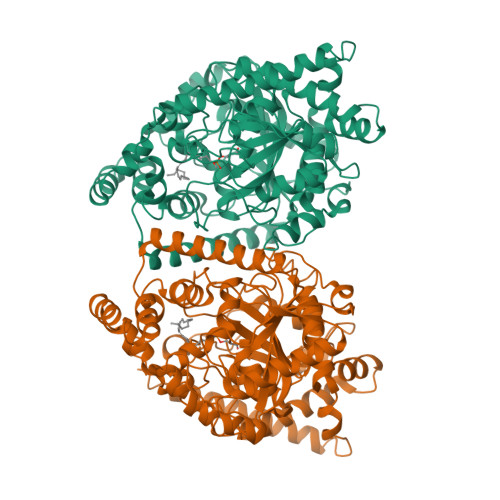
Click to view 3D structureFatty-acid amide hydrolase 1O00519HumansPredicted (SEA)
Prediction Confidence Score
0.45
Applicability Domain
0.636
Statistical Significance
0.0013
Supporting Reference Compounds
106
E-value
10.2761
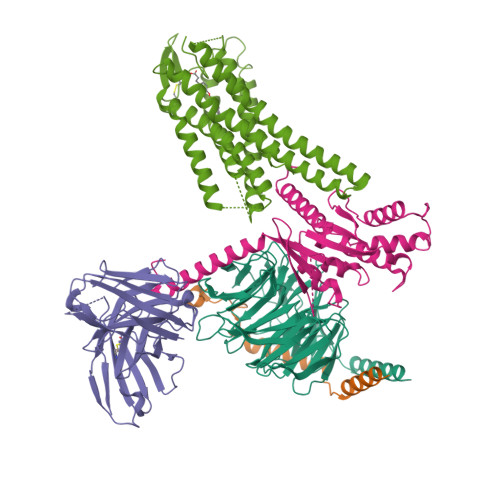
Cannabinoid receptor 1 structureClick to view 3D structureCannabinoid receptor 1P21554HumansPredicted (SEA)
Prediction Confidence Score
0.429
Applicability Domain
0.452
Statistical Significance
0.0024
Supporting Reference Compounds
200
E-value
18.7617
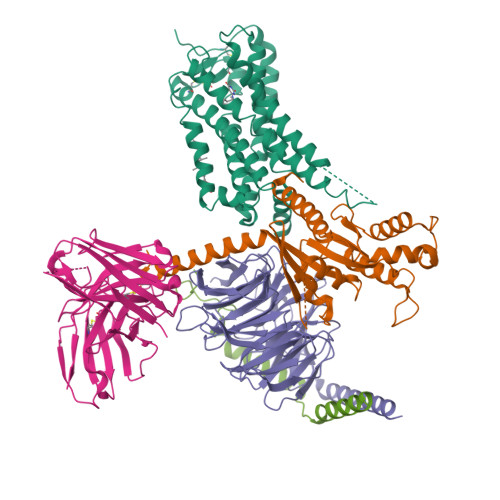
Cannabinoid receptor 2 structureClick to view 3D structureCannabinoid receptor 2P34972HumansPredicted (SEA)
Prediction Confidence Score
0.419
Applicability Domain
0.452
Statistical Significance
0.0023
Supporting Reference Compounds
175
E-value
17.8275
Transient receptor potential cation channel subfamily V member 1 structureClick to view 3D structureTransient receptor potential cation channel subfamily V member 1Q8NER1HumansPredicted (SEA)
Prediction Confidence Score
0.408
Applicability Domain
0.452
Statistical Significance
0.0013
Supporting Reference Compounds
104
E-value
10.5096
Free fatty acid receptor 4 structureClick to view 3D structureFree fatty acid receptor 4Q5NUL3HumansPredicted (SEA)
Prediction Confidence Score
0.403
Applicability Domain
0.583
Statistical Significance
6.80e-04
Supporting Reference Compounds
63
E-value
5.29375
Free fatty acid receptor 1 structureClick to view 3D structureFree fatty acid receptor 1O14842HumansPredicted (SEA)
Prediction Confidence Score
0.402
Applicability Domain
0.583
Statistical Significance
0.0013
Supporting Reference Compounds
56
E-value
9.88685
Click to view 3D structureEsteraseA3QR02Chilo suppressalisPredicted (SEA)
Prediction Confidence Score
0.381
Applicability Domain
0.381
Statistical Significance
9.00e-05
Supporting Reference Compounds
1
E-value
0.700643
Fatty-acid amide hydrolase 1 structureClick to view 3D structureFatty-acid amide hydrolase 1P97612Rattus norvegicusPredicted (SEA)
Prediction Confidence Score
0.373
Applicability Domain
0.422
Statistical Significance
0.0023
Supporting Reference Compounds
102
E-value
18.2946
Click to view 3D structureLysophosphatidic acid receptor 4Q8BLG2Mus musculusPredicted (SEA)
Prediction Confidence Score
0.373
Applicability Domain
0.373
Statistical Significance
3.60e-04
Supporting Reference Compounds
1
E-value
2.80257
Click to view 3D structureOxoeicosanoid receptor 1Q8TDS5HumansPredicted (SEA)
Prediction Confidence Score
0.369
Applicability Domain
0.583
Statistical Significance
1.90e-04
Supporting Reference Compounds
4
E-value
1.47914
Click to view 3D structureLysophosphatidic acid receptor 3Q9UBY5HumansPredicted (SEA)
Prediction Confidence Score
0.364
Applicability Domain
0.373
Statistical Significance
4.90e-04
Supporting Reference Compounds
21
E-value
3.81461
Click to view 3D structureCannabinoid receptor 2P47936Mus musculusPredicted (SEA)
Prediction Confidence Score
0.362
Applicability Domain
0.37
Statistical Significance
0.0017
Supporting Reference Compounds
39
E-value
13.3122
Click to view 3D structureHistone deacetylase 11Q96DB2HumansPredicted (SEA)
Prediction Confidence Score
0.356
Applicability Domain
0.455
Statistical Significance
0.0056
Supporting Reference Compounds
149
E-value
43.5177
G-protein coupled receptor 84 structureClick to view 3D structureG-protein coupled receptor 84Q9NQS5HumansPredicted (SEA)
Prediction Confidence Score
0.353
Applicability Domain
0.455
Statistical Significance
6.60e-04
Supporting Reference Compounds
15
E-value
5.13805
Click to view 3D structureCannabinoid receptor 2Q9QZN9Rattus norvegicusPredicted (SEA)
Prediction Confidence Score
0.351
Applicability Domain
0.37
Statistical Significance
5.40e-04
Supporting Reference Compounds
20
E-value
4.20386
Click to view 3D structureCannabinoid receptor 1P47746Mus musculusPredicted (SEA)
Prediction Confidence Score
0.349
Applicability Domain
0.37
Statistical Significance
0.0015
Supporting Reference Compounds
42
E-value
11.5995
1-phosphatidylinositol 4,5-bisphosphate phosphodiesterase gamma-1 structureClick to view 3D structure1-phosphatidylinositol 4,5-bisphosphate phosphodiesterase gamma-1P08487Bos taurusPredicted (SEA)
Prediction Confidence Score
0.344
Applicability Domain
0.36
Statistical Significance
2.80e-04
Supporting Reference Compounds
3
E-value
2.17978
Lysophosphatidic acid receptor 2 structureClick to view 3D structureLysophosphatidic acid receptor 2Q9HBW0HumansPredicted (SEA)
Prediction Confidence Score
0.344
Applicability Domain
0.373
Statistical Significance
5.70e-04
Supporting Reference Compounds
30
E-value
4.43741
Concentrations
Not Available
External Links
DrugBank IDNot Available
HMDB IDNot Available
FooDB IDNot Available
Phenol Explorer IDNot Available
KNApSAcK IDNot Available
BiGG IDNot Available
BioCyc IDNot Available
METLIN IDNot Available
PDB IDNot Available
Wikipedia LinkNot Available
Chemspider IDNot Available
ChEBI IDNot Available
PubChem Compound ID6912870
Kegg Compound IDNot Available
YMDB IDNot Available
ECMDB IDNot Available
References
Synthesis ReferenceNot Available
MSDSNot Available
General ReferencesNot Available