Some data may have been extracted from scientific literature using a pipeline that uses large language models (LLMs). Source articles are cited where applicable to help verify the extracted relationships.
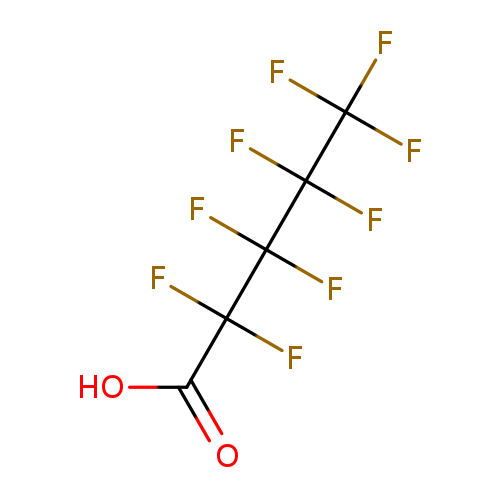
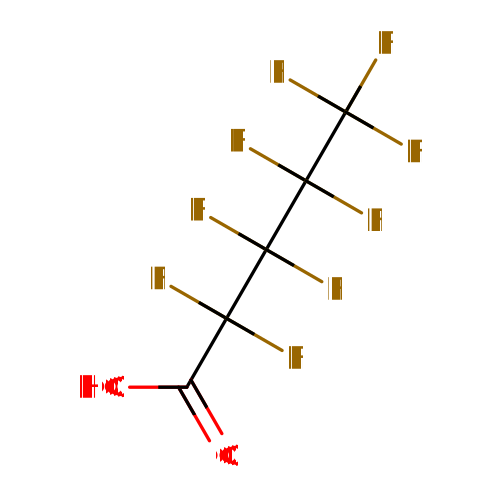
Pentanoic acid, 2,2,3,3,4,4,5,5,5-nonafluoro- is an organic compound with the chemical formula C5HF9O2 and an average molecular weight of 264.05 g/mol. Pentanoic acid, 2,2,3,3,4,4,5,5,5-nonafluoro- belongs to the alkyl fluorides, a subclass of alkyl halides within the organic compounds.
The compound is found in or released from 17 recorded sources across multiple sectors. Within the electrical and electronic equipment sector, it is associated with batteries, capacitors, printed circuit boards, wires and cables, cell phones, and three other sources. It is present in food packaging and food contact materials related to food, food processing, and cookware. In the textiles, leather, and furnishings sector, it is found in carpets, rugs, and synthetic textiles. Other recorded sources include lubricants from the energy, oil, and gas sector, medical devices from the healthcare, pharmaceuticals, and veterinary products sector, and indoor air from air, dust, and atmospheric transport, along with two additional sectors. Recorded exposure routes for this compound include oral, inhalation, and touch.
Belongs to the class of organic compounds known as perfluoroalkyl carboxylic acid and derivatives. These are organic compounds containing an alkyl chain attached to the C-alpha of a carboxylic acid group (or a derivative thereof), where all hydrogens of the alkyl chain are replaced by fluorine atoms.
Soil?Soil serves as a critical medium for plant growth and sustains various ecological functions; however, it can become a reservoir for synthetic chemical contamination.
Indoor air?Indoor air can be a significant reservoir for synthetic chemical contaminants, which often originate from various sources within enclosed environments.
Groundwater?Groundwater serves as a vital resource for drinking water and agricultural irrigation but is increasingly susceptible to contamination from synthetic chemicals.
Stormwater runoff?Stormwater runoff refers to the flow of rainwater or melted snow that does not soak into the ground and instead collects pollutants as it travels over impervious surfaces such as roads and parking lots.
Drinking water?Drinking water can be a medium for synthetic chemical contamination, often originating from various industrial processes and agricultural practices.
Printed circuit boards?Printed circuit boards (PCBs) are essential components in the manufacturing of electronic devices, serving as the backbone for electrical connections and circuit pathways.
Semiconductors?Semiconductors are materials that possess electrical conductivity between that of conductors and insulators, making them essential for various electronic applications, including transistors, diodes, and integrated circuits.
Lubricants?Lubricants are synthetic or petroleum-derived substances used to reduce friction between surfaces in machinery and equipment, enhancing operational efficiency and longevity.
Food packaging?Food packaging often utilizes synthetic chemicals, such as plastics and coatings, to enhance durability, moisture resistance, and shelf life.
Medical devices?Medical devices often incorporate synthetic chemicals in their manufacturing processes, which can contribute to contamination in healthcare settings.
Carpets and Rugs?Carpets and rugs are commonly manufactured using synthetic fibers such as nylon, polyester, and polypropylene, which can be derived from petrochemical sources.
Synthetic textiles?Synthetic textiles are materials derived from man-made fibers, such as polyester, nylon, and acrylic, which are produced through chemical processes involving petrochemicals.
Effluent?Effluent refers to liquid waste or sewage that is discharged into the environment, typically resulting from industrial processes, municipal wastewater treatment, or agricultural runoff.
Cell phones?Cell phones contain a variety of synthetic chemicals and materials, including plastics, metals, and glass, which can contribute to environmental contamination.
Capacitors?Capacitors are electronic components that store and release electrical energy, often using dielectric materials that can include synthetic chemicals.
Food contact materials?Food contact materials refer to substances and products that are intended to come into contact with food during processing, packaging, or preparation.
Conductors Or Conductive Bodies Characterised By The Conductive Materials?Conductors, or conductive bodies, are materials that allow the flow of electrical current, typically made from metals such as copper, aluminum, or silver.
Electrodes?Electrodes, used in various electrical and electronic applications, can be a source of synthetic chemical contamination due to the materials from which they are constructed and the processes involved in their manufacturing.
Hybrid Capacitors?Hybrid capacitors are energy storage devices that combine the properties of electrolytic and supercapacitors, utilizing a combination of electrochemical principles to achieve higher energy density and power density.
Superconducting Magnets And Superconducting Coils?Superconducting magnets and coils are utilized in various applications that require strong magnetic fields, such as magnetic resonance imaging (MRI) and particle accelerators.
Superconductive Or Hyperconductive Conductors Cables Or Transmission Lines?Superconductive or hyperconductive conductors, including cables and transmission lines, are materials that exhibit zero electrical resistance under specific conditions, typically at low temperatures.
Bleaching Agents?Bleaching agents are chemical substances used to whiten or lighten materials, often employed in various cleaning products for their stain removal and disinfecting properties.
Aftersun Products?Aftersun products are designed to soothe and hydrate the skin after sun exposure, often containing various synthetic chemicals such as emollients, preservatives, and fragrances.
Buckles?Buckles, commonly used as fasteners in clothing, accessories, and furniture, can be a source of synthetic chemical contamination due to the materials and coatings employed in their production.
Footwear?Footwear production often involves the use of various synthetic chemicals, such as adhesives, dyes, and treatments, which can contribute to environmental contamination.
Glass Coatings?Glass coatings are synthetic chemical formulations applied to glass surfaces to enhance properties such as durability, UV resistance, and aesthetic appeal.
Nanotechnology?Nanotechnology involves the manipulation of materials at the molecular or atomic level, typically within the range of 1 to 100 nanometers.
Coating Compositions?Coating compositions, which include paints, sealants, and varnishes, are formulated with a variety of synthetic chemicals such as solvents, resins, pigments, and additives.
Sludge Treatment?Sludge treatment involves the processing of waste materials generated from wastewater treatment plants, which often contain a variety of organic and inorganic substances.
Water, Wastewater, & Sewage Treatment?Water, wastewater, and sewage treatment processes are critical for managing and mitigating pollutants in water systems.