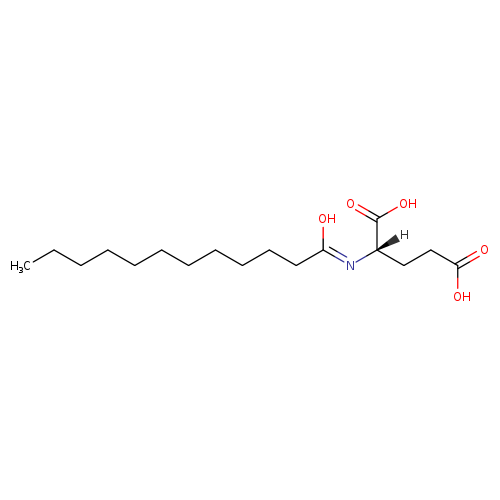
(2S)-2-(Dodecanoylamino)pentanedioic acid (CED0165564)

Record Information
Version1.0
Creation Date2016-05-19 03:46:35 UTC
Update Date2026-03-26 20:52:14 UTC
SynCED IDCED0165564
Secondary Accession Numbers
  • CHEM011894
Identification
Common Name(2S)-2-(Dodecanoylamino)pentanedioic acid
ClassSmall Molecule
Description
(2S)-2-(Dodecanoylamino)pentanedioic acid belongs to the amino acids, peptides, and analogues, a subclass of carboxylic acids and derivatives within the organic compounds. This organic acid and derivative has the chemical formula C17H31NO5 and an average molecular weight of 329.44 g/mol. Industrially, the compound is utilized as a softener and conditioner. It has been recorded as being found in or released from household cleaning and consumer products, specifically soap dispensers.
Contaminant TypeNot Available
Chemical Structure
Synonyms
ValueSource
N-Lauroyl-L-glutamateGenerator
N-Dodecanoylglutamic acid, disodium saltMeSH
N-Dodecanoylglutamic acid, potassium saltMeSH
N-Dodecanoylglutamic acid, monopotassium saltMeSH
SDGluMeSH
Sodium N-dodecanoyl-L-glutamateMeSH
N-Lauroylglutamic acidMeSH
N-Dodecanoylglutamic acid, ammonium saltMeSH
N-Dodecanoylglutamic acid, monosodium saltMeSH
N-Dodecanoylglutamic acid, (L)-isomerMeSH
Sodium N-lauroyl-L-glutamateMeSH
N-Dodecanoyl-L-glutamic acidMeSH
N-Dodecanoylglutamic acidMeSH
N-Dodecanoylglutamic acid, sodium saltMeSH
N-Dodecanoylglutamic acid, monolithium saltMeSH
N-Dodecanoylglutamic acid, calcium salt (2:1)MeSH
N-Dodecanoylglutamic acid, sodium salt (2:3)MeSH
N-Dodecanoylglutamic acid, (DL)-isomer, sodium saltMeSH
(2S)-2-[(1-Hydroxydodecylidene)amino]pentanedioateGenerator
Chemical FormulaC17H31NO5
Average Molecular Mass329.437 g/mol
Monoisotopic Mass329.220 g/mol
CAS Registry Number3397-65-7
IUPAC Name(2S)-2-[(1-hydroxydodecylidene)amino]pentanedioic acid
Traditional Name(2S)-2-[(1-hydroxydodecylidene)amino]pentanedioic acid
SMILES[H][C@@](CCC(O)=O)(N=C(O)CCCCCCCCCCC)C(O)=O
InChI IdentifierInChI=1S/C17H31NO5/c1-2-3-4-5-6-7-8-9-10-11-15(19)18-14(17(22)23)12-13-16(20)21/h14H,2-13H2,1H3,(H,18,19)(H,20,21)(H,22,23)/t14-/m0/s1
InChI KeyAVBJHQDHVYGQLS-AWEZNQCLSA-N
Chemical Taxonomy
Description Belongs to the class of organic compounds known as glutamic acid and derivatives. Glutamic acid and derivatives are compounds containing glutamic acid or a derivative thereof resulting from reaction of glutamic acid at the amino group or the carboxy group, or from the replacement of any hydrogen of glycine by a heteroatom.
KingdomOrganic compounds
Super ClassOrganic acids and derivatives
ClassCarboxylic acids and derivatives
Sub ClassAmino acids, peptides, and analogues
Direct ParentGlutamic acid and derivatives
Alternative Parents
Substituents
  • Glutamic acid or derivatives
  • N-acyl-l-alpha-amino acid
  • N-acyl-alpha-amino acid
  • N-acyl-alpha amino acid or derivatives
  • Dicarboxylic acid or derivatives
  • Fatty amide
  • N-acyl-amine
  • Fatty acyl
  • Fatty acid
  • Carboxamide group
  • Secondary carboxylic acid amide
  • Carboxylic acid
  • Carbonyl group
  • Organonitrogen compound
  • Organooxygen compound
  • Hydrocarbon derivative
  • Organic oxide
  • Organopnictogen compound
  • Organic oxygen compound
  • Organic nitrogen compound
  • Aliphatic acyclic compound
Molecular FrameworkAliphatic acyclic compounds
External DescriptorsNot Available
Biological Properties
StatusDetected and Not Quantified
OriginNot Available
Cellular LocationsNot Available
Biofluid LocationsNot Available
Tissue LocationsNot Available
ApplicationsNot Available
Biological RolesNot Available
Chemical RolesNot Available
Organoleptic EffectsNot Available
Physical Properties
StateNot Available
AppearanceNot Available
Experimental Properties
PropertyValue
Melting PointNot Available
Boiling PointNot Available
SolubilityNot Available
Predicted Properties
PropertyValueSource
Water Solubility0.025 g/LALOGPS
logP3.04ALOGPS
logP4.41ChemAxon
logS-4.1ALOGPS
pKa (Strongest Acidic)3.65ChemAxon
pKa (Strongest Basic)1.42ChemAxon
Physiological Charge-2ChemAxon
Hydrogen Acceptor Count6ChemAxon
Hydrogen Donor Count3ChemAxon
Polar Surface Area107.19 ŲChemAxon
Rotatable Bond Count15ChemAxon
Refractivity87.29 m³·mol⁻¹ChemAxon
Polarizability37.94 ųChemAxon
Number of Rings0ChemAxon
BioavailabilityYesChemAxon
Rule of FiveYesChemAxon
Ghose FilterYesChemAxon
Veber's RuleNoChemAxon
MDDR-like RuleNoChemAxon
Spectra
Spectra
Spectrum TypeDescriptionSplash KeyDeposition DateView
Predicted LC-MS/MSPredicted LC-MS/MS Spectrumsplash10-01q9-0967000000-ddbe40edd9df4d3628b5Not AvailableView Spectrum
Predicted LC-MS/MSPredicted LC-MS/MS Spectrumsplash10-0ue9-1930000000-7aa9414c830ff2b78aebNot AvailableView Spectrum
Predicted LC-MS/MSPredicted LC-MS/MS Spectrumsplash10-0udi-6910000000-54f38445bec60fe063e4Not AvailableView Spectrum
Predicted LC-MS/MSPredicted LC-MS/MS Spectrumsplash10-0059-0349000000-689ce3a33b1574f33e2eNot AvailableView Spectrum
Predicted LC-MS/MSPredicted LC-MS/MS Spectrumsplash10-003s-1963000000-55706520b3bb329094c3Not AvailableView Spectrum
Predicted LC-MS/MSPredicted LC-MS/MS Spectrumsplash10-0006-8900000000-5a159346a9daa6c673acNot AvailableView Spectrum
Toxicity Profile
Toxicity Values
Toxicity ValueOrganismDose DescriptorRoute of ExposurePredicted or ExperimentalToxicity RatingReference
3741.0 Log mg/kg [2100:6700]RatLD50oralpredictedNot AvailableNot Available
Toxicity / Toxin ClassNot Available
Mechanism of ToxicityNot Available
Carcinogenicity (IARC Classification)Not Available
Minimum Risk LevelNot Available
SymptomsNot Available
TreatmentNot Available
Health Effects
Health EffectRelationshipDirectionDescriptionReference
Exposure Sources
Source IDSourceSectorReference
CEDs000010Insecticides?Insecticides are synthetic chemicals designed to control or eliminate insect pests that threaten crops and other agricultural products.Agriculture & land managementPubChem
CEDs000233Brushes?Brushes used in personal care and cosmetics can be a source of synthetic chemical contamination due to the materials and coatings used in their manufacturing.Personal care & cosmeticsPubChem
CEDs000490Personal care & cosmeticsNot Available
CEDs000511Conductors Or Conductive Bodies Characterised By The Conductive Materials?Conductors, or conductive bodies, are materials that allow the flow of electrical current, typically made from metals such as copper, aluminum, or silver.Electrical & Electronic EquipmentPubChem
CEDs000519Electrodes?Electrodes, used in various electrical and electronic applications, can be a source of synthetic chemical contamination due to the materials from which they are constructed and the processes involved in their manufacturing.Electrical & Electronic EquipmentPubChem
CEDs000521Fixed Capacitors And Their Manufacture?Fixed capacitors are passive electronic components used to store and release electrical energy, playing a critical role in various circuits.Electrical & Electronic EquipmentPubChem
CEDs000545Food Preservation?Food preservation often involves the use of synthetic chemicals, such as preservatives, flavor enhancers, and color additives, to extend shelf life and enhance the sensory qualities of food products.Food, food processing & cookwarePubChem
CEDs000555Bleaching Agents?Bleaching agents are chemical substances used to whiten or lighten materials, often employed in various cleaning products for their stain removal and disinfecting properties.Household cleaning & consumer productsPubChem
CEDs000561Perfumes Within Detergents And Soaps?Perfumes within detergents and soaps are synthetic fragrance compounds added to enhance the sensory experience of cleaning products.Household cleaning & consumer productsPubChem
CEDs000563Soap Detergents?Soap detergents are synthetic surfactants designed to enhance the cleaning efficacy of water by reducing surface tension, allowing for better interaction with dirt and grease.Household cleaning & consumer productsPubChem
CEDs000564Soap Dispensers?Soap dispensers, commonly used for dispensing liquid soaps and sanitizers, can become a source of synthetic chemical contamination due to the materials used in their construction and the products they dispense.Household cleaning & consumer productsPubChem
CEDs000600Herbicides And Algicides?Herbicides and algicides are synthetic chemicals primarily used to control unwanted plants and algae in various environments.Agriculture & land managementPubChem
CEDs000604Pest Attractants?Pest attractants are synthetic chemicals designed to lure specific pests for monitoring or control purposes.Agriculture & land managementPubChem
CEDs000605Pest Repellants?Pest repellents, often formulated from synthetic chemicals, are widely used to protect crops from insect infestations and other pests.Agriculture & land managementPubChem
CEDs000606Plant Growth Regulators?Plant Growth Regulators (PGRs) are synthetic chemicals designed to influence the growth and development of plants.Agriculture & land managementPubChem
CEDs000609Aftershave?Aftershave is a grooming product typically used to soothe and protect the skin following shaving.Personal care & cosmeticsPubChem
CEDs000610Aftersun Products?Aftersun products are designed to soothe and hydrate the skin after sun exposure, often containing various synthetic chemicals such as emollients, preservatives, and fragrances.Personal care & cosmeticsPubChem
CEDs000611Anti Perspirants Or Body Deoderants?Antiperspirants and body deodorants commonly contain synthetic chemicals such as aluminum compounds, parabens, and synthetic fragrances.Personal care & cosmeticsPubChem
CEDs000612Body Washing Or Cleaning Implements?Body washing or cleaning implements, such as synthetic sponges, loofahs, and washcloths, can be sources of synthetic chemical contamination due to the materials used in their production.Personal care & cosmeticsPubChem
CEDs000613Depilatories?Depilatories are products designed to remove unwanted hair through the application of synthetic chemicals that break down the protein structure of hair, facilitating its removal.Personal care & cosmeticsPubChem
CEDs000614Essential Oils Or Perfumes?Essential oils and perfumes are complex mixtures of volatile compounds derived from natural or synthetic sources, commonly used for their aromatic properties.Personal care & cosmeticsPubChem
CEDs000615Eye Makeup Products?Eye makeup products, including mascaras, eyeliners, and eyeshadows, often contain a variety of synthetic chemicals such as pigments, preservatives, and film-forming agents.Personal care & cosmeticsPubChem
CEDs000617Lip Care Products?Lip care products, including lipsticks, balms, and glosses, often contain a variety of synthetic chemicals such as parabens, phthalates, and synthetic fragrances.Personal care & cosmeticsPubChem
CEDs000618Lip Makeup Products?Lip makeup products, such as lipsticks, lip glosses, and lip liners, often contain a variety of synthetic chemicals, including pigments, preservatives, and emollients.Personal care & cosmeticsPubChem
CEDs000630Toys?Toys, particularly those made from synthetic materials such as plastics, can be a source of chemical contamination due to the presence of various additives and compounds used in their production.Recreation & sports surfacesPubChem
CEDs000632Apparel?Apparel production often involves the use of various synthetic chemicals, including dyes, finishing agents, and preservatives.Textiles, leather & furnishingsPubChem
CEDs000639Degreasing Leather?Degreasing leather involves the removal of natural fats and oils from animal hides to prepare them for tanning and finishing processes.Textiles, leather & furnishingsPubChem
CEDs000662Yarns Or Threads?Yarns or threads used in textiles can be a source of synthetic chemical contamination due to the production processes and treatments they undergo.Textiles, leather & furnishingsPubChem
CEDs000669PFAS Fire Fighting Foam?PFAS fire fighting foam refers to a class of synthetic foams containing per- and polyfluoroalkyl substances (PFAS), which are designed to suppress flammable liquid fires.Fire suppression systems & agentsPubChem
CEDs000678Nitrogenous Fertilisers?Nitrogenous fertilizers are synthetic chemical compounds primarily used to enhance plant growth by supplying essential nitrogen, a crucial nutrient for photosynthesis and protein synthesis.Agriculture & land managementPubChem
CEDs000679Phosphatic Fertilisers?Phosphatic fertilizers are synthetic chemical products primarily composed of phosphorus, which is essential for plant growth.Agriculture & land managementPubChem
CEDs000684Cements?Cements are a composite material primarily used as a binding agent in construction applications, formed by the calcination of limestone and clay minerals at high temperatures.Building & ConstructionPubChem
CEDs000685Ceramics?Ceramics can be a source of synthetic chemical contamination through various additives and processing agents used in their production.Building & ConstructionPubChem
CEDs000688Glass Coatings?Glass coatings are synthetic chemical formulations applied to glass surfaces to enhance properties such as durability, UV resistance, and aesthetic appeal.Building & ConstructionPubChem
CEDs000693Silica Glass?Silica glass, primarily composed of silicon dioxide (SiO2), is widely used in various applications, including windows, glass facades, and insulation materials.Building & ConstructionPubChem
CEDs000696Nanotechnology?Nanotechnology involves the manipulation of materials at the molecular or atomic level, typically within the range of 1 to 100 nanometers.Industrial manufacturing & chemical processingPubChem
CEDs000716Erasers?Erasers, commonly used in writing and drawing applications, are often made from synthetic rubber or thermoplastic materials, which can contain various additives such as plasticizers, fillers, and colorants.Paper, pulp & fiber productsPubChem
CEDs000725Pencils?Pencils, primarily composed of graphite encased in wood or synthetic materials, can contribute to synthetic chemical contamination through their manufacturing and disposal processes.Paper, pulp & fiber productsPubChem
CEDs000726Pens?Pens, commonly utilized for writing and marking, can be a source of synthetic chemical contamination primarily due to the materials used in their manufacturing.Paper, pulp & fiber productsPubChem
CEDs000734Coating Compositions?Coating compositions, which include paints, sealants, and varnishes, are formulated with a variety of synthetic chemicals such as solvents, resins, pigments, and additives.Building & ConstructionPubChem
CEDs000739Inks?Inks are complex mixtures composed of pigments or dyes, solvents, resins, and additives used primarily for printing and writing applications.Paper, pulp & fiber productsPubChem
CEDs000740Paper?Paper production involves the processing of wood fibers and the use of various chemicals, which can lead to synthetic chemical contamination.Paper, pulp & fiber productsPubChem
CEDs000741Pigment Pastes?Pigment pastes are concentrated dispersions of pigments used to impart color and properties to materials.Paper, pulp & fiber productsPubChem
CEDs000743Sludge Treatment?Sludge treatment involves the processing of waste materials generated from wastewater treatment plants, which often contain a variety of organic and inorganic substances.Wastewater, sanitation & biosolidsPubChem
CEDs000744Water, Wastewater, & Sewage Treatment?Water, wastewater, and sewage treatment processes are critical for managing and mitigating pollutants in water systems.Wastewater, sanitation & biosolidsPubChem
Pathways
0 pathwaysPathway Source: PathBank

No pathways found

No metabolic pathways have been associated with this synthetic chemical

Targets
StructureProteinUniProt IDOrganismRelationshipDetails
Tyrosine-protein phosphatase non-receptor type 1 structureClick to view 3D structureTyrosine-protein phosphatase non-receptor type 1P18031HumansPredicted (SEA)
Prediction Confidence Score
0.483
Applicability Domain
0.516
Statistical Significance
8.40e-04
Supporting Reference Compounds
197
E-value
6.53933
Peroxisome proliferator-activated receptor alpha structureClick to view 3D structurePeroxisome proliferator-activated receptor alphaQ07869HumansPredicted (SEA)
Prediction Confidence Score
0.483
Applicability Domain
0.516
Statistical Significance
0.0011
Supporting Reference Compounds
127
E-value
8.71911
Peroxisome proliferator-activated receptor delta structureClick to view 3D structurePeroxisome proliferator-activated receptor deltaQ03181HumansPredicted (SEA)
Prediction Confidence Score
0.461
Applicability Domain
0.516
Statistical Significance
0.001
Supporting Reference Compounds
89
E-value
7.94062
Peroxisome proliferator-activated receptor gamma structureClick to view 3D structurePeroxisome proliferator-activated receptor gammaP37231HumansPredicted (SEA)
Prediction Confidence Score
0.436
Applicability Domain
0.516
Statistical Significance
0.0021
Supporting Reference Compounds
192
E-value
16.6597
Transient receptor potential cation channel subfamily V member 2 structureClick to view 3D structureTransient receptor potential cation channel subfamily V member 2Q9WUD2Rattus norvegicusPredicted (SEA)
Prediction Confidence Score
0.426
Applicability Domain
0.516
Statistical Significance
7.40e-04
Supporting Reference Compounds
21
E-value
5.76084
G-protein coupled receptor 84 structureClick to view 3D structureG-protein coupled receptor 84Q9NQS5HumansPredicted (SEA)
Prediction Confidence Score
0.391
Applicability Domain
0.516
Statistical Significance
4.30e-04
Supporting Reference Compounds
15
E-value
3.34752
Click to view 3D structureHistone deacetylase 11Q96DB2HumansPredicted (SEA)
Prediction Confidence Score
0.39
Applicability Domain
0.516
Statistical Significance
0.0028
Supporting Reference Compounds
149
E-value
22.187
Click to view 3D structurePutative inactive group IIC secretory phospholipase A2Q5R387HumansPredicted (SEA)
Prediction Confidence Score
0.383
Applicability Domain
0.383
Statistical Significance
6.00e-05
Supporting Reference Compounds
1
E-value
0.467095
Click to view 3D structureCAI-1 autoinducer sensor kinase/phosphatase CqsSQ9KM66Vibrio cholerae serotype O1 (strain ATCC 39315 / El Tor Inaba N16961)Predicted (SEA)
Prediction Confidence Score
0.368
Applicability Domain
0.368
Statistical Significance
1.80e-04
Supporting Reference Compounds
1
E-value
1.40129
Fatty acid-binding protein, adipocyte structureClick to view 3D structureFatty acid-binding protein, adipocyteP15090HumansPredicted (SEA)
Prediction Confidence Score
0.361
Applicability Domain
0.516
Statistical Significance
4.40e-04
Supporting Reference Compounds
19
E-value
3.42537
Free fatty acid receptor 1 structureClick to view 3D structureFree fatty acid receptor 1O14842HumansPredicted (SEA)
Prediction Confidence Score
0.354
Applicability Domain
0.516
Statistical Significance
0.0028
Supporting Reference Compounds
56
E-value
21.9535
Click to view 3D structureFatty-acid amide hydrolase 1O00519HumansPredicted (SEA)
Prediction Confidence Score
0.329
Applicability Domain
0.432
Statistical Significance
0.0076
Supporting Reference Compounds
106
E-value
59.0097
Toll-like receptor 2 structureClick to view 3D structureToll-like receptor 2O60603HumansPredicted (SEA)
Prediction Confidence Score
0.327
Applicability Domain
0.516
Statistical Significance
2.10e-04
Supporting Reference Compounds
9
E-value
1.63483
Phospholipase A2, membrane associated structureClick to view 3D structurePhospholipase A2, membrane associatedP14555HumansPredicted (SEA)
Prediction Confidence Score
0.324
Applicability Domain
0.395
Statistical Significance
8.10e-04
Supporting Reference Compounds
49
E-value
6.30579
Free fatty acid receptor 4 structureClick to view 3D structureFree fatty acid receptor 4Q5NUL3HumansPredicted (SEA)
Prediction Confidence Score
0.323
Applicability Domain
0.516
Statistical Significance
0.0029
Supporting Reference Compounds
63
E-value
22.4984
Click to view 3D structureUDP-N-acetylmuramoyl-tripeptide--D-alanyl-D-alanine ligaseQ5HMD9Staphylococcus epidermidis (strain ATCC 35984 / RP62A)Predicted (SEA)
Prediction Confidence Score
0.319
Applicability Domain
0.319
Statistical Significance
2.20e-04
Supporting Reference Compounds
1
E-value
1.71268
Click to view 3D structureNuclear receptor subfamily 4 group A member 2Q07917Rattus norvegicusPredicted (SEA)
Prediction Confidence Score
0.314
Applicability Domain
0.321
Statistical Significance
1.90e-04
Supporting Reference Compounds
3
E-value
1.47914
Click to view 3D structureN-acetylaspartylglutamate synthase AQ8IXN7HumansPredicted (SEA)
Prediction Confidence Score
0.308
Applicability Domain
0.308
Statistical Significance
5.80e-04
Supporting Reference Compounds
1
E-value
4.51525
Click to view 3D structurePhospholipase A2, membrane associatedP31482Mus musculusPredicted (SEA)
Prediction Confidence Score
0.307
Applicability Domain
0.395
Statistical Significance
5.20e-04
Supporting Reference Compounds
11
E-value
4.04816
Click to view 3D structurePhospholipase A2 group VP39877HumansPredicted (SEA)
Prediction Confidence Score
0.307
Applicability Domain
0.395
Statistical Significance
5.70e-04
Supporting Reference Compounds
19
E-value
4.43741
Gamma-glutamyl hydrolase structureClick to view 3D structureGamma-glutamyl hydrolaseQ92820HumansPredicted (SEA)
Prediction Confidence Score
0.302
Applicability Domain
0.302
Statistical Significance
2.50e-04
Supporting Reference Compounds
1
E-value
1.94623
Click to view 3D structureAlkaline ceramidase 2Q5QJU3HumansPredicted (SEA)
Prediction Confidence Score
0.3
Applicability Domain
0.3
Statistical Significance
0.0023
Supporting Reference Compounds
1
E-value
18.2946
Click to view 3D structureCytochrome P450 4A4P10611Oryctolagus cuniculusPredicted (SEA)
Prediction Confidence Score
0.295
Applicability Domain
0.295 Low confidence
Statistical Significance
1.50e-04
Supporting Reference Compounds
1
E-value
1.16774
Betaine--homocysteine S-methyltransferase 1 structureClick to view 3D structureBetaine--homocysteine S-methyltransferase 1Q93088HumansPredicted (SEA)
Prediction Confidence Score
0.295
Applicability Domain
0.295 Low confidence
Statistical Significance
3.90e-04
Supporting Reference Compounds
1
E-value
3.03612
Juvenile hormone esterase structureClick to view 3D structureJuvenile hormone esteraseQ9GPG0Manduca sextaPredicted (SEA)
Prediction Confidence Score
0.293
Applicability Domain
0.342
Statistical Significance
3.70e-04
Supporting Reference Compounds
2
E-value
2.88042
Concentrations
Not Available
External Links
DrugBank IDNot Available
HMDB IDNot Available
FooDB IDNot Available
Phenol Explorer IDNot Available
KNApSAcK IDNot Available
BiGG IDNot Available
BioCyc IDNot Available
METLIN IDNot Available
PDB IDNot Available
Wikipedia LinkNot Available
Chemspider IDNot Available
ChEBI IDNot Available
PubChem Compound ID93133
Kegg Compound IDNot Available
YMDB IDNot Available
ECMDB IDNot Available
References
Synthesis ReferenceNot Available
MSDSNot Available
General ReferencesNot Available