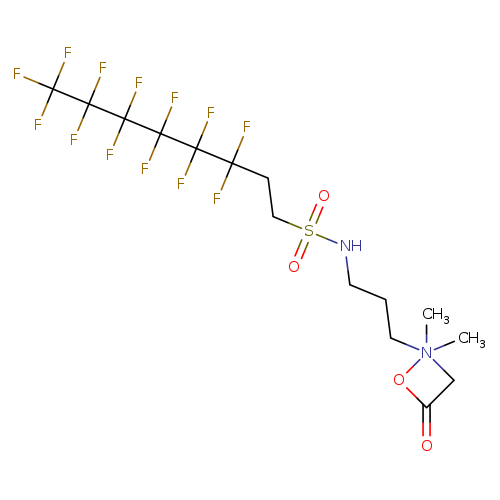
Carboxymethyl-dimethyl-[3-(3,3,4,4,5,5,6,6,7,7,8,8,8-tridecafluorooctylsulfonylamino)propyl]azanium (CED0180185)

Record Information
Version1.0
Creation Date2016-05-19 03:46:55 UTC
Update Date2026-08-19 11:10:08 UTC
SynCED IDCED0180185
Secondary Accession Numbers
  • CHEM011925
Identification
Common NameCarboxymethyl-dimethyl-[3-(3,3,4,4,5,5,6,6,7,7,8,8,8-tridecafluorooctylsulfonylamino)propyl]azanium
ClassSmall Molecule
Description
Carboxymethyl-dimethyl-[3-(3,3,4,4,5,5,6,6,7,7,8,8,8-tridecafluorooctylsulfonylamino)propyl]azanium belongs to the amino acids, peptides, and analogues, a subclass of carboxylic acids and derivatives within the organic compounds. With an average molecular weight of 570.37 g/mol, Carboxymethyl-dimethyl-[3-(3,3,4,4,5,5,6,6,7,7,8,8,8-tridecafluorooctylsulfonylamino)propyl]azanium is a heavy molecule. It is characterized by the chemical formula C15H19F13N2O4S. This compound has been found in or released from 13 recorded sources across several sectors. In electrical and electronic equipment, it is associated with batteries, capacitors, printed circuit boards, wires and cables, and cell phones. Within the textiles, leather and furnishings sector, it is found in carpets, rugs, and synthetic textiles. Other identified sources include lubricants from both industrial manufacturing and chemical processing as well as the energy, oil and gas sectors. Additionally, it is found in food packaging from the food, food processing and cookware sector, and in medical devices from the healthcare, pharmaceuticals and veterinary products sector. Recorded exposure routes for this compound include oral, inhalation, and touch.
Contaminant Type
  • PFAS
Chemical Structure
Synonyms
ValueSource
N-[3-(2,2-Dimethyl-4-oxo-1,2-oxazetidin-2-yl)propyl]-3,3,4,4,5,5,6,6,7,7,8,8,8-tridecafluorooctane-1-sulphonamideGenerator
N-[3-(2,2-Dimethyl-4-oxo-1,2λ⁵-oxazetidin-2-yl)propyl]-3,3,4,4,5,5,6,6,7,7,8,8,8-tridecafluorooctane-1-sulphonamideGenerator
Chemical FormulaC15H19F13N2O4S
Average Molecular Mass570.370 g/mol
Monoisotopic Mass570.086 g/mol
CAS Registry Number34455-29-3
IUPAC NameN-[3-(2,2-dimethyl-4-oxo-1,2lambda5-oxazetidin-2-yl)propyl]-3,3,4,4,5,5,6,6,7,7,8,8,8-tridecafluorooctane-1-sulfonamide
Traditional NameN-[3-(2,2-dimethyl-4-oxo-1,2lambda5-oxazetidin-2-yl)propyl]-3,3,4,4,5,5,6,6,7,7,8,8,8-tridecafluorooctane-1-sulfonamide
SMILESC[N]1(C)(CCCNS(=O)(=O)CCC(F)(F)C(F)(F)C(F)(F)C(F)(F)C(F)(F)C(F)(F)F)CC(=O)O1
InChI IdentifierInChI=1S/C15H19F13N2O4S/c1-30(2,8-9(31)34-30)6-3-5-29-35(32,33)7-4-10(16,17)11(18,19)12(20,21)13(22,23)14(24,25)15(26,27)28/h29H,3-8H2,1-2H3
InChI KeyMZJOCCVVAZFVNE-UHFFFAOYSA-N
Chemical Taxonomy
Description Belongs to the class of organic compounds known as alpha amino acids and derivatives. These are amino acids in which the amino group is attached to the carbon atom immediately adjacent to the carboxylate group (alpha carbon), or a derivative thereof.
KingdomOrganic compounds
Super ClassOrganic acids and derivatives
ClassCarboxylic acids and derivatives
Sub ClassAmino acids, peptides, and analogues
Direct ParentAlpha amino acids and derivatives
Alternative Parents
Substituents
  • Alpha-amino acid or derivatives
  • Organic sulfonic acid amide
  • Organosulfonic acid amide
  • Organic sulfonic acid or derivatives
  • Organosulfonic acid or derivatives
  • Sulfonyl
  • Aminosulfonyl compound
  • Carboxylic acid salt
  • Monocarboxylic acid or derivatives
  • Oxacycle
  • Azacycle
  • Organoheterocyclic compound
  • Hydrocarbon derivative
  • Organic oxide
  • Organopnictogen compound
  • Organosulfur compound
  • Organooxygen compound
  • Organonitrogen compound
  • Organofluoride
  • Organohalogen compound
  • Organic oxygen compound
  • Carbonyl group
  • Alkyl fluoride
  • Alkyl halide
  • Organic nitrogen compound
  • Organic salt
  • Aliphatic heteromonocyclic compound
Molecular FrameworkAliphatic heteromonocyclic compounds
External DescriptorsNot Available
Biological Properties
StatusDetected and Not Quantified
OriginNot Available
Cellular LocationsNot Available
Biofluid LocationsNot Available
Tissue LocationsNot Available
ApplicationsNot Available
Biological RolesNot Available
Chemical RolesNot Available
Organoleptic EffectsNot Available
Physical Properties
StateNot Available
AppearanceNot Available
Experimental Properties
PropertyValue
Melting PointNot Available
Boiling PointNot Available
SolubilityNot Available
Predicted Properties
PropertyValueSource
Water Solubility0.051 g/LALOGPS
logP2.64ALOGPS
logS-4ALOGPS
Hydrogen Acceptor Count0ChemAxon
Hydrogen Donor Count0ChemAxon
Polar Surface Area72.47 ŲChemAxon
Rotatable Bond Count12ChemAxon
Refractivity100.28 m³·mol⁻¹ChemAxon
Polarizability39.64 ųChemAxon
Number of Rings1ChemAxon
BioavailabilityNoChemAxon
Rule of FiveNoChemAxon
Ghose FilterNoChemAxon
Veber's RuleNoChemAxon
MDDR-like RuleNoChemAxon
Spectra
SpectraNot Available
Toxicity Profile
Toxicity ValuesNot Available
Toxicity / Toxin ClassNot Available
Mechanism of ToxicityNot Available
Carcinogenicity (IARC Classification)Not Available
Minimum Risk LevelNot Available
SymptomsNot Available
TreatmentNot Available
Health Effects
Health EffectRelationshipDirectionDescriptionReference
Exposure Sources
Source IDSourceSectorReference
CEDs000007Pesticides?Pesticides are synthetic chemicals designed to prevent, destroy, or control pests that threaten crops and agricultural productivity.Agriculture & land managementNot Available
CEDs000013Soil?Soil serves as a critical medium for plant growth and sustains various ecological functions; however, it can become a reservoir for synthetic chemical contamination.Agriculture & land managementPMC11562953 , PMC10601079
CEDs000050Groundwater?Groundwater serves as a vital resource for drinking water and agricultural irrigation but is increasingly susceptible to contamination from synthetic chemicals.Aquatic systems & sedimentsPMC11866920 , PMC10601079
CEDs000051Surface water?Surface water can serve as a significant vector for the introduction of synthetic chemical contaminants into aquatic ecosystems.Aquatic systems & sedimentsPMC11905281
CEDs000120Wires and cables?Wires and cables are integral components in the transmission of electrical power and signals.Electrical & Electronic EquipmentNot Available
CEDs000121Printed circuit boards?Printed circuit boards (PCBs) are essential components in the manufacturing of electronic devices, serving as the backbone for electrical connections and circuit pathways.Electrical & Electronic EquipmentNot Available
CEDs000125Batteries?Batteries are devices that store and release electrical energy through electrochemical reactions.Electrical & Electronic EquipmentNot Available
CEDs000130Semiconductors?Semiconductors are materials that possess electrical conductivity between that of conductors and insulators, making them essential for various electronic applications, including transistors, diodes, and integrated circuits.Electrical & Electronic EquipmentNot Available
CEDs000138Lubricants?Lubricants are synthetic or petroleum-derived substances used to reduce friction between surfaces in machinery and equipment, enhancing operational efficiency and longevity.Energy, oil & gasNot Available
CEDs000147Food packaging?Food packaging often utilizes synthetic chemicals, such as plastics and coatings, to enhance durability, moisture resistance, and shelf life.Food, food processing & cookwareNot Available
CEDs000174Lubricants?Lubricants are synthetic or petroleum-based substances used to reduce friction and wear between moving parts in machinery and equipment.Industrial manufacturing & chemical processingNot Available
CEDs000233Brushes?Brushes used in personal care and cosmetics can be a source of synthetic chemical contamination due to the materials and coatings used in their manufacturing.Personal care & cosmeticsPubChem
CEDs000234Medical devices?Medical devices often incorporate synthetic chemicals in their manufacturing processes, which can contribute to contamination in healthcare settings.Healthcare, pharmaceuticals & veterinary productsNot Available
CEDs000451Carpets and Rugs?Carpets and rugs are commonly manufactured using synthetic fibers such as nylon, polyester, and polypropylene, which can be derived from petrochemical sources.Textiles, leather & furnishingsNot Available
CEDs000454Synthetic textiles?Synthetic textiles are materials derived from man-made fibers, such as polyester, nylon, and acrylic, which are produced through chemical processes involving petrochemicals.Textiles, leather & furnishingsNot Available
CEDs000479Effluent?Effluent refers to liquid waste or sewage that is discharged into the environment, typically resulting from industrial processes, municipal wastewater treatment, or agricultural runoff.Wastewater, sanitation & biosolidsPMC12994560
CEDs000490Personal care & cosmeticsNot Available
CEDs000492Cell phones?Cell phones contain a variety of synthetic chemicals and materials, including plastics, metals, and glass, which can contribute to environmental contamination.Electrical & Electronic EquipmentNot Available
CEDs000493Capacitors?Capacitors are electronic components that store and release electrical energy, often using dielectric materials that can include synthetic chemicals.Electrical & Electronic EquipmentNot Available
CEDs000744Water, Wastewater, & Sewage Treatment?Water, wastewater, and sewage treatment processes are critical for managing and mitigating pollutants in water systems.Wastewater, sanitation & biosolidsPubChem
CEDs02255WaterAquatic systems & sedimentsPMC7661421
CEDs02264SedimentAquatic systems & sedimentsPMC13335835
CEDs02305Groundwater SamplesAquatic systems & sedimentsPMC8745034
CEDs02306Synthetic SeawaterAquatic systems & sedimentsPMC11866920
CEDs02397PondAquatic systems & sedimentsPMC11905281
CEDs03009Waste WaterWastewater, sanitation & biosolidsPMC11562953
CEDs03043WWTPsWastewater, sanitation & biosolidsPMC13335835
CEDs03438AFFFFire suppression systems & agentsPMC7661421
CEDs03439Firefighting FoamsFire suppression systems & agentsPMC11905281
CEDs03443Aqueous Film-forming FoamsFire suppression systems & agentsPMC7661421
Pathways
0 pathwaysPathway Source: PathBank

No pathways found

No metabolic pathways have been associated with this synthetic chemical

Targets
StructureProteinUniProt IDOrganismRelationshipDetails
No targets found for this compound.
Concentrations
Not Available
External Links
DrugBank IDNot Available
HMDB IDNot Available
FooDB IDNot Available
Phenol Explorer IDNot Available
KNApSAcK IDNot Available
BiGG IDNot Available
BioCyc IDNot Available
METLIN IDNot Available
PDB IDNot Available
Wikipedia LinkNot Available
Chemspider IDNot Available
ChEBI IDNot Available
PubChem Compound IDNot Available
Kegg Compound IDNot Available
YMDB IDNot Available
ECMDB IDNot Available
References
Synthesis ReferenceNot Available
MSDSNot Available
General ReferencesNot Available