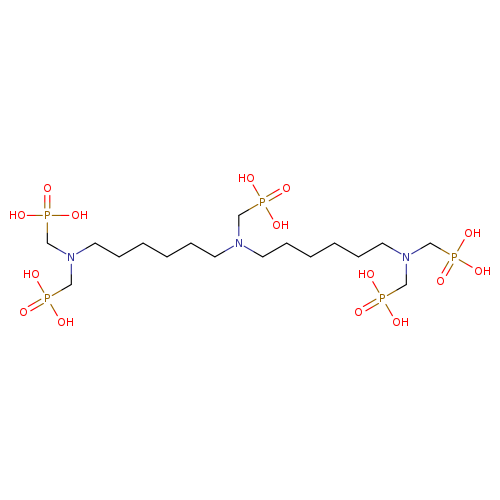
Phosphonic acid, [[(phosphonomethyl)imino]bis[6,1-hexanediylnitrilobis(methylene)]]tetrakis- (CED0043154)

Record Information
Version1.0
Creation Date2016-05-19 03:47:07 UTC
Update Date2026-08-19 22:34:35 UTC
SynCED IDCED0043154
Secondary Accession Numbers
  • CHEM011939
Identification
Common NamePhosphonic acid, [[(phosphonomethyl)imino]bis[6,1-hexanediylnitrilobis(methylene)]]tetrakis-
ClassSmall Molecule
Description
Phosphonic acid, [[(phosphonomethyl)imino]bis[6,1-hexanediylnitrilobis(methylene)]]tetrakis- belongs to the organic phosphonic acids, a subclass of organic phosphonic acids and derivatives within the organic compounds. With an average molecular weight of 685.41 g/mol, Phosphonic acid, [[(phosphonomethyl)imino]bis[6,1-hexanediylnitrilobis(methylene)]]tetrakis- is a heavy molecule. It is identified by the chemical formula C17H44N3O15P5. This compound has been found in or released from 19 recorded sources. Within drinking water and water supply, it is present in tap water, bottled water, desalinated water, and drinking water. It occurs in aquatic systems and sediments, including seawater, freshwater, groundwater, and surface water. In the sector of wastewater, sanitation, and biosolids, the compound is detected in industrial wastewater, mine wastewater, wastewater treatment effluent, and unspecified wastewater. Additionally, it is found in appliances, HVAC, and refrigerants, specifically in water heaters and water coolers. In marine, shipping, and aquaculture sectors, it is present in bilge water and ballast water. It is also found in irrigation water used in agriculture and land management, as well as two other sectors. Recorded routes of exposure for this compound include oral, inhalation, and touch.
Contaminant Type
  • PMT
Chemical Structure
Synonyms
ValueSource
({[6-({6-[bis(phosphonomethyl)amino]hexyl}(phosphonomethyl)amino)hexyl](phosphonomethyl)amino}methyl)phosphonateGenerator
Chemical FormulaC17H44N3O15P5
Average Molecular Mass685.414 g/mol
Monoisotopic Mass685.146 g/mol
CAS Registry Number34690-00-1
IUPAC Name({[6-({6-[bis(phosphonomethyl)amino]hexyl}(phosphonomethyl)amino)hexyl](phosphonomethyl)amino}methyl)phosphonic acid
Traditional Name{[6-({6-[bis(phosphonomethyl)amino]hexyl}(phosphonomethyl)amino)hexyl](phosphonomethyl)amino}methylphosphonic acid
SMILESOP(O)(=O)CN(CCCCCCN(CP(O)(O)=O)CP(O)(O)=O)CCCCCCN(CP(O)(O)=O)CP(O)(O)=O
InChI IdentifierInChI=1S/C17H44N3O15P5/c21-36(22,23)13-18(9-5-1-3-7-11-19(14-37(24,25)26)15-38(27,28)29)10-6-2-4-8-12-20(16-39(30,31)32)17-40(33,34)35/h1-17H2,(H2,21,22,23)(H2,24,25,26)(H2,27,28,29)(H2,30,31,32)(H2,33,34,35)
InChI KeyYWMWZKYVGNWJPU-UHFFFAOYSA-N
Chemical Taxonomy
Description Belongs to the class of organic compounds known as organic phosphonic acids. These are organic compounds containing phosphonic acid.
KingdomOrganic compounds
Super ClassOrganic acids and derivatives
ClassOrganic phosphonic acids and derivatives
Sub ClassOrganic phosphonic acids
Direct ParentOrganic phosphonic acids
Alternative Parents
Substituents
  • Organophosphonic acid
  • Organic nitrogen compound
  • Organic oxygen compound
  • Organopnictogen compound
  • Organic oxide
  • Hydrocarbon derivative
  • Organophosphorus compound
  • Organonitrogen compound
  • Aliphatic acyclic compound
Molecular FrameworkAliphatic acyclic compounds
External DescriptorsNot Available
Biological Properties
StatusDetected and Not Quantified
OriginNot Available
Cellular LocationsNot Available
Biofluid LocationsNot Available
Tissue LocationsNot Available
ApplicationsNot Available
Biological RolesNot Available
Chemical RolesNot Available
Organoleptic EffectsNot Available
Physical Properties
StateNot Available
AppearanceNot Available
Experimental Properties
PropertyValue
Melting PointNot Available
Boiling PointNot Available
SolubilityNot Available
Predicted Properties
PropertyValueSource
Water Solubility8.24 g/LALOGPS
logP0.08ALOGPS
logP-2.6ChemAxon
logS-1.9ALOGPS
pKa (Strongest Acidic)0.96ChemAxon
Physiological Charge-6ChemAxon
Hydrogen Acceptor Count18ChemAxon
Hydrogen Donor Count10ChemAxon
Polar Surface Area297.37 ŲChemAxon
Rotatable Bond Count24ChemAxon
Refractivity146.33 m³·mol⁻¹ChemAxon
Polarizability60.65 ųChemAxon
Number of Rings0ChemAxon
BioavailabilityNoChemAxon
Rule of FiveNoChemAxon
Ghose FilterNoChemAxon
Veber's RuleNoChemAxon
MDDR-like RuleNoChemAxon
Spectra
Spectra
Spectrum TypeDescriptionSplash KeyDeposition DateView
Predicted LC-MS/MSPredicted LC-MS/MS Spectrumsplash10-000i-0000019000-8eecdfc98c76f54da5f6Not AvailableView Spectrum
Predicted LC-MS/MSPredicted LC-MS/MS Spectrumsplash10-01q3-6224498000-84f41c66d1bdd1322bcfNot AvailableView Spectrum
Predicted LC-MS/MSPredicted LC-MS/MS Spectrumsplash10-000b-0386910000-be5053d02bf2faed5a51Not AvailableView Spectrum
Predicted LC-MS/MSPredicted LC-MS/MS Spectrumsplash10-001i-2000019000-6bb500d28f382df97388Not AvailableView Spectrum
Predicted LC-MS/MSPredicted LC-MS/MS Spectrumsplash10-00vl-8000198000-4b18f74a61d974b7c976Not AvailableView Spectrum
Predicted LC-MS/MSPredicted LC-MS/MS Spectrumsplash10-004j-9000010000-4e75491efd97b37da970Not AvailableView Spectrum
Toxicity Profile
Toxicity Values
Toxicity ValueOrganismDose DescriptorRoute of ExposurePredicted or ExperimentalToxicity RatingReference
3572.0 Log mg/kg [2000:6400]RatLD50oralpredictedNot AvailableNot Available
Toxicity / Toxin ClassNot Available
Mechanism of ToxicityNot Available
Carcinogenicity (IARC Classification)Not Available
Minimum Risk LevelNot Available
SymptomsNot Available
TreatmentNot Available
Health Effects
Health EffectRelationshipDirectionDescriptionReference
Exposure Sources
Source IDSourceSectorReference
CEDs000003Irrigation water?Irrigation water can serve as a vector for synthetic chemical contamination due to its potential exposure to agricultural inputs such as fertilizers, pesticides, and herbicides.Agriculture & land managementNot Available
CEDs000027Water Coolers?Water coolers can be a source of synthetic chemical contamination due to various materials used in their construction and operation.Appliances, HVAC & refrigerantsNot Available
CEDs000043Water heaters?Water heaters can be a source of synthetic chemical contamination primarily through the materials and coatings used in their construction.Appliances, HVAC & refrigerantsNot Available
CEDs000050Groundwater?Groundwater serves as a vital resource for drinking water and agricultural irrigation but is increasingly susceptible to contamination from synthetic chemicals.Aquatic systems & sedimentsNot Available
CEDs000051Surface water?Surface water can serve as a significant vector for the introduction of synthetic chemical contaminants into aquatic ecosystems.Aquatic systems & sedimentsNot Available
CEDs000052Seawater?Seawater can serve as a significant reservoir for synthetic chemical contamination due to various industrial activities, including shipping, oil drilling, and coastal manufacturing.Aquatic systems & sedimentsNot Available
CEDs000053Freshwater?Freshwater bodies, including rivers, lakes, and reservoirs, can serve as significant sources of synthetic chemical contamination due to various anthropogenic activities.Aquatic systems & sedimentsNot Available
CEDs000070Stormwater runoff?Stormwater runoff refers to the flow of rainwater or melted snow that does not soak into the ground and instead collects pollutants as it travels over impervious surfaces such as roads and parking lots.Automotive & urban infrastructureNot Available
CEDs000088Waterproofing sprays?Waterproofing sprays are synthetic chemical formulations designed to create a protective barrier against moisture on various surfaces, including fabrics, wood, and masonry.Building & ConstructionNot Available
CEDs000115Drinking water?Drinking water can be a medium for synthetic chemical contamination, often originating from various industrial processes and agricultural practices.Drinking water & water supplyNot Available
CEDs000116Tap water?Tap water can be a potential source of synthetic chemical contamination due to various industrial processes and agricultural runoff.Drinking water & water supplyNot Available
CEDs000117Bottled water?Bottled water, while perceived as a safe and convenient alternative to tap water, can be a source of synthetic chemical contamination.Drinking water & water supplyNot Available
CEDs000118Desalinated water?Desalinated water, produced through processes such as reverse osmosis or distillation, is increasingly utilized to meet freshwater demands in various regions.Drinking water & water supplyNot Available
CEDs000181Ballast water?Ballast water, taken on by ships to maintain stability and balance, often contains a diverse array of microorganisms, including bacteria, viruses, and plankton.Marine, shipping & aquacultureNot Available
CEDs000182Bilge water?Bilge water is a byproduct generated from the accumulation of water in the lowest part of a ship's hull, which may include a mixture of seawater, oil, fuel residues, and various contaminants.Marine, shipping & aquacultureNot Available
CEDs000468Industrial wastewater?Industrial wastewater is a byproduct generated during various manufacturing and processing activities, which often contains a complex mixture of organic and inorganic synthetic chemicals.Wastewater, sanitation & biosolidsNot Available
CEDs000470Wastewater treatment effluent?Wastewater treatment effluent is the liquid byproduct discharged from the treatment processes designed to remove contaminants from wastewater.Wastewater, sanitation & biosolidsNot Available
CEDs000475Mine wastewater?Mine wastewater refers to the liquid waste generated during the extraction and processing of minerals.Wastewater, sanitation & biosolidsNot Available
CEDs000477Wastewater, unspecified?Wastewater refers to water that has been adversely affected in quality by anthropogenic influence, typically through domestic, industrial, or agricultural activities.Wastewater, sanitation & biosolidsNot Available
CEDs000519Electrodes?Electrodes, used in various electrical and electronic applications, can be a source of synthetic chemical contamination due to the materials from which they are constructed and the processes involved in their manufacturing.Electrical & Electronic EquipmentPubChem
CEDs000545Food Preservation?Food preservation often involves the use of synthetic chemicals, such as preservatives, flavor enhancers, and color additives, to extend shelf life and enhance the sensory qualities of food products.Food, food processing & cookwarePubChem
CEDs000555Bleaching Agents?Bleaching agents are chemical substances used to whiten or lighten materials, often employed in various cleaning products for their stain removal and disinfecting properties.Household cleaning & consumer productsPubChem
CEDs000561Perfumes Within Detergents And Soaps?Perfumes within detergents and soaps are synthetic fragrance compounds added to enhance the sensory experience of cleaning products.Household cleaning & consumer productsPubChem
CEDs000563Soap Detergents?Soap detergents are synthetic surfactants designed to enhance the cleaning efficacy of water by reducing surface tension, allowing for better interaction with dirt and grease.Household cleaning & consumer productsPubChem
CEDs000579Manufacture Of Iron Or Steel?The manufacture of iron or steel involves various processes, including smelting, refining, and alloying, which can result in the release of synthetic chemicals and contaminants.Industrial manufacturing & chemical processingPubChem
CEDs000611Anti Perspirants Or Body Deoderants?Antiperspirants and body deodorants commonly contain synthetic chemicals such as aluminum compounds, parabens, and synthetic fragrances.Personal care & cosmeticsPubChem
CEDs000662Yarns Or Threads?Yarns or threads used in textiles can be a source of synthetic chemical contamination due to the production processes and treatments they undergo.Textiles, leather & furnishingsPubChem
CEDs000679Phosphatic Fertilisers?Phosphatic fertilizers are synthetic chemical products primarily composed of phosphorus, which is essential for plant growth.Agriculture & land managementPubChem
CEDs000696Nanotechnology?Nanotechnology involves the manipulation of materials at the molecular or atomic level, typically within the range of 1 to 100 nanometers.Industrial manufacturing & chemical processingPubChem
CEDs000734Coating Compositions?Coating compositions, which include paints, sealants, and varnishes, are formulated with a variety of synthetic chemicals such as solvents, resins, pigments, and additives.Building & ConstructionPubChem
CEDs000735Explosives?Explosives are chemical compounds or mixtures designed to undergo rapid decomposition, releasing energy in the form of gas and heat.Defense & military infrastructurePubChem
CEDs000738Cooling Circuit Water?Cooling circuit water is utilized in various industrial processes to absorb and dissipate heat generated during operations.Industrial manufacturing & chemical processingPubChem
CEDs000739Inks?Inks are complex mixtures composed of pigments or dyes, solvents, resins, and additives used primarily for printing and writing applications.Paper, pulp & fiber productsPubChem
CEDs000740Paper?Paper production involves the processing of wood fibers and the use of various chemicals, which can lead to synthetic chemical contamination.Paper, pulp & fiber productsPubChem
CEDs000743Sludge Treatment?Sludge treatment involves the processing of waste materials generated from wastewater treatment plants, which often contain a variety of organic and inorganic substances.Wastewater, sanitation & biosolidsPubChem
CEDs000744Water, Wastewater, & Sewage Treatment?Water, wastewater, and sewage treatment processes are critical for managing and mitigating pollutants in water systems.Wastewater, sanitation & biosolidsPubChem
Pathways
0 pathwaysPathway Source: PathBank

No pathways found

No metabolic pathways have been associated with this synthetic chemical

Targets
StructureProteinUniProt IDOrganismRelationshipDetails
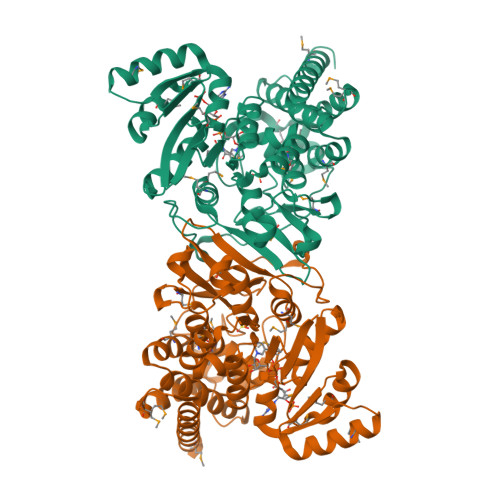
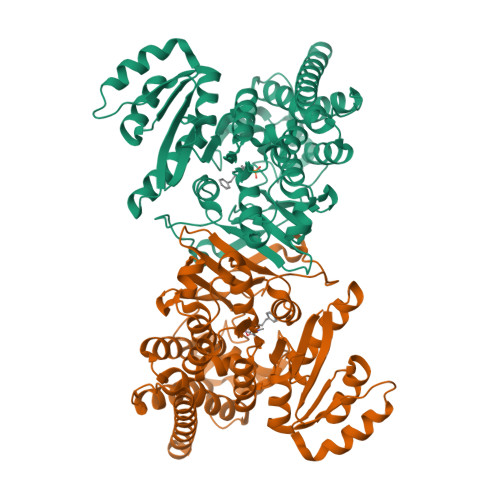
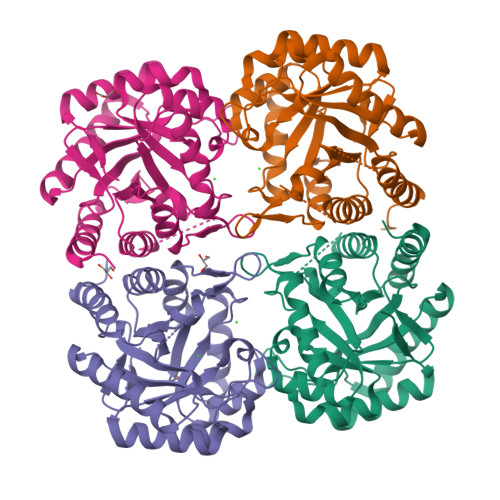
Click to view 3D structure1-deoxy-D-xylulose 5-phosphate reductoisomerase, chloroplasticQ9XFS9Arabidopsis thalianaPredicted (SEA)
Prediction Confidence Score
0.323
Applicability Domain
0.323
Statistical Significance
7.00e-05
Supporting Reference Compounds
1
E-value
0.544945
Click to view 3D structure1-deoxy-D-xylulose 5-phosphate reductoisomeraseQ55663Synechocystis sp. (strain PCC 6803 / Kazusa)Predicted (SEA)
Prediction Confidence Score
0.323
Applicability Domain
0.323
Statistical Significance
7.00e-05
Supporting Reference Compounds
1
E-value
0.544945
Click to view 3D structure1-deoxy-D-xylulose 5-phosphate reductoisomeraseA0QVH7Mycobacterium smegmatis (strain ATCC 700084 / mc(2)155)Predicted (SEA)
Prediction Confidence Score
0.289
Applicability Domain
0.323
Statistical Significance
8.00e-05
Supporting Reference Compounds
4
E-value
0.622794
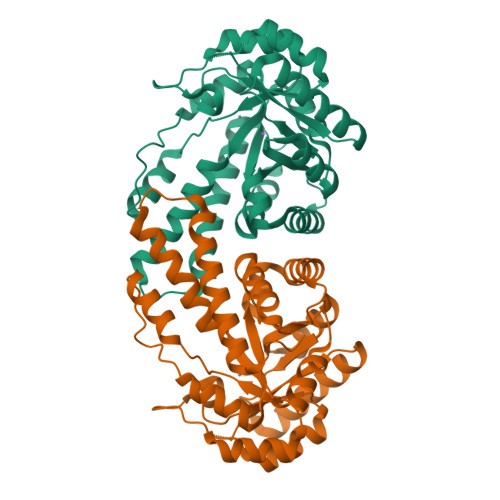
1-deoxy-D-xylulose 5-phosphate reductoisomerase structureClick to view 3D structure1-deoxy-D-xylulose 5-phosphate reductoisomeraseP45568Escherichia coli (strain K12)Predicted (SEA)
Prediction Confidence Score
0.283
Applicability Domain
0.323
Statistical Significance
1.40e-04
Supporting Reference Compounds
11
E-value
1.08989
1-deoxy-D-xylulose 5-phosphate reductoisomerase structureClick to view 3D structure1-deoxy-D-xylulose 5-phosphate reductoisomeraseP9WNS1Mycobacterium tuberculosisPredicted (SEA)
Prediction Confidence Score
0.277
Applicability Domain
0.323
Statistical Significance
1.30e-04
Supporting Reference Compounds
10
E-value
1.01204
Click to view 3D structureFructose-bisphosphate aldolase class IIA0A380PJR2Yersinia pestisPredicted (SEA)
Prediction Confidence Score
0.27
Applicability Domain
0.27 Low confidence
Statistical Significance
8.00e-05
Supporting Reference Compounds
1
E-value
0.622794
Fructose-bisphosphate aldolase structureClick to view 3D structureFructose-bisphosphate aldolaseP56109Helicobacter pylori (strain ATCC 700392 / 26695) (Campylobacterpylori)Predicted (SEA)
Prediction Confidence Score
0.257
Applicability Domain
0.27 Low confidence
Statistical Significance
1.00e-04
Supporting Reference Compounds
2
E-value
0.778492
1-deoxy-D-xylulose 5-phosphate reductoisomerase, apicoplastic structureClick to view 3D structure1-deoxy-D-xylulose 5-phosphate reductoisomerase, apicoplasticQ8IKG4Plasmodium falciparum (isolate 3D7)Predicted (SEA)
Prediction Confidence Score
0.252
Applicability Domain
0.323
Statistical Significance
1.10e-04
Supporting Reference Compounds
8
E-value
0.856341
Geranylgeranyl pyrophosphate synthase structureClick to view 3D structureGeranylgeranyl pyrophosphate synthaseO95749HumansPredicted (SEA)
Prediction Confidence Score
0.248
Applicability Domain
0.273 Low confidence
Statistical Significance
0.0013
Supporting Reference Compounds
15
E-value
10.1204
Click to view 3D structureFarnesyl pyrophosphate synthaseQ0GKD7Leishmania donovaniPredicted (SEA)
Prediction Confidence Score
0.248
Applicability Domain
0.273 Low confidence
Statistical Significance
0.0012
Supporting Reference Compounds
14
E-value
9.34191
Farnesyl pyrophosphate synthase structureClick to view 3D structureFarnesyl pyrophosphate synthaseP14324HumansPredicted (SEA)
Prediction Confidence Score
0.248
Applicability Domain
0.27 Low confidence
Statistical Significance
0.0019
Supporting Reference Compounds
22
E-value
15.0249
Click to view 3D structure1-deoxy-D-xylulose 5-phosphate reductoisomeraseW8T2T2Escherichia coliPredicted (SEA)
Prediction Confidence Score
0.245
Applicability Domain
0.323
Statistical Significance
1.00e-04
Supporting Reference Compounds
6
E-value
0.778492
Click to view 3D structurePhospho-2-dehydro-3-deoxyheptonate aldolaseC3TIE2Escherichia coliPredicted (SEA)
Prediction Confidence Score
0.243
Applicability Domain
0.243 Low confidence
Statistical Significance
8.00e-05
Supporting Reference Compounds
1
E-value
0.622794
Fructose-bisphosphate aldolase structureClick to view 3D structureFructose-bisphosphate aldolaseQ9URB4Candida albicans (strain SC5314 / ATCC MYA-2876) (Yeast)Predicted (SEA)
Prediction Confidence Score
0.241
Applicability Domain
0.27 Low confidence
Statistical Significance
2.00e-04
Supporting Reference Compounds
3
E-value
1.55698
Beta-lactamase VIM-1 structureClick to view 3D structureBeta-lactamase VIM-1Q9XAY4Pseudomonas aeruginosaPredicted (SEA)
Prediction Confidence Score
0.222
Applicability Domain
0.222 Low confidence
Statistical Significance
3.40e-04
Supporting Reference Compounds
1
E-value
2.64687
Mandelate racemase structureClick to view 3D structureMandelate racemaseP11444Pseudomonas putidaPredicted (SEA)
Prediction Confidence Score
0.219
Applicability Domain
0.219 Low confidence
Statistical Significance
0.0039
Supporting Reference Compounds
1
E-value
30.7504
Click to view 3D structureFarnesyl synthetase, putativeQ964Q8Trypanosoma cruziPredicted (SEA)
Prediction Confidence Score
0.215
Applicability Domain
0.25 Low confidence
Statistical Significance
0.0014
Supporting Reference Compounds
2
E-value
10.8989
Click to view 3D structureFarnesyl diphosphate synthaseQ197X6Toxoplasma gondiiPredicted (SEA)
Prediction Confidence Score
0.213
Applicability Domain
0.25 Low confidence
Statistical Significance
1.00e-03
Supporting Reference Compounds
4
E-value
7.78492
Farnesyl diphosphate synthase structureClick to view 3D structureFarnesyl diphosphate synthaseQ8WS26Trypanosoma cruziPredicted (SEA)
Prediction Confidence Score
0.213
Applicability Domain
0.25 Low confidence
Statistical Significance
6.60e-04
Supporting Reference Compounds
5
E-value
5.13805
Phosphoheptose isomerase structureClick to view 3D structurePhosphoheptose isomeraseQ93UJ2Burkholderia pseudomallei (strain K96243)Predicted (SEA)
Prediction Confidence Score
0.211
Applicability Domain
0.211 Low confidence
Statistical Significance
2.20e-04
Supporting Reference Compounds
1
E-value
1.71268
Phosphoglycerate kinase structureClick to view 3D structurePhosphoglycerate kinaseP00560Saccharomyces cerevisiae S288cPredicted (SEA)
Prediction Confidence Score
0.206
Applicability Domain
0.206 Low confidence
Statistical Significance
2.30e-04
Supporting Reference Compounds
1
E-value
1.79053
2-dehydro-3-deoxyphosphooctonate aldolase structureClick to view 3D structure2-dehydro-3-deoxyphosphooctonate aldolaseQ9JZ55Neisseria meningitidis serogroup B (strain MC58)Predicted (SEA)
Prediction Confidence Score
0.2
Applicability Domain
0.2 Low confidence
Statistical Significance
0.0011
Supporting Reference Compounds
1
E-value
8.40772
Ornithine transcarbamylase, mitochondrial structureClick to view 3D structureOrnithine transcarbamylase, mitochondrialP00480HumansPredicted (SEA)
Prediction Confidence Score
0.195
Applicability Domain
0.195 Low confidence
Statistical Significance
0.0039
Supporting Reference Compounds
1
E-value
30.2055
Click to view 3D structure1-deoxy-D-xylulose-5-phosphate synthaseB7UJP3Escherichia coli O127:H6 (strain E2348/69 / EPEC)Predicted (SEA)
Prediction Confidence Score
0.194
Applicability Domain
0.2 Low confidence
Statistical Significance
0.0014
Supporting Reference Compounds
2
E-value
10.7432
Click to view 3D structureType IV secretion-like conjugative transfer relaxase protein TraIB1LRJ1Escherichia coli (strain SMS-3-5 / SECEC)Predicted (SEA)
Prediction Confidence Score
0.192
Applicability Domain
0.192 Low confidence
Statistical Significance
1.40e-04
Supporting Reference Compounds
1
E-value
1.08989
Concentrations
Not Available
External Links
DrugBank IDNot Available
HMDB IDNot Available
FooDB IDNot Available
Phenol Explorer IDNot Available
KNApSAcK IDNot Available
BiGG IDNot Available
BioCyc IDNot Available
METLIN IDNot Available
PDB IDNot Available
Wikipedia LinkNot Available
Chemspider IDNot Available
ChEBI IDNot Available
PubChem Compound ID118717
Kegg Compound IDNot Available
YMDB IDNot Available
ECMDB IDNot Available
References
Synthesis ReferenceNot Available
MSDSNot Available
General ReferencesNot Available