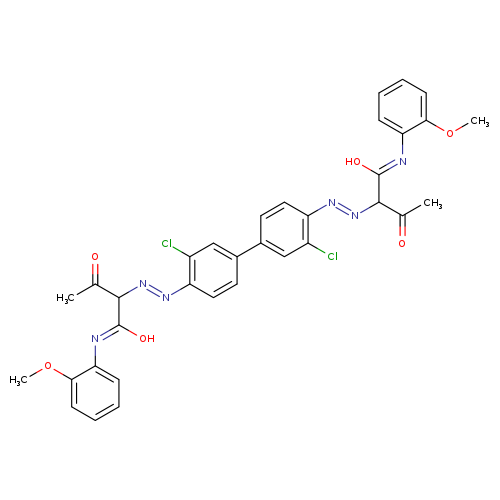
Butanamide, 2,2'-[(3,3'-dichloro[1,1'-biphenyl]-4,4'-diyl)bis(azo)]bis[N-(2-methoxyphenyl)-3-oxo- (CED0166967)

Record Information
Version1.0
Creation Date2016-05-19 03:55:00 UTC
Update Date2026-08-22 11:25:23 UTC
SynCED IDCED0166967
Secondary Accession Numbers
  • CHEM012409
Identification
Common NameButanamide, 2,2'-[(3,3'-dichloro[1,1'-biphenyl]-4,4'-diyl)bis(azo)]bis[N-(2-methoxyphenyl)-3-oxo-
ClassSmall Molecule
Description
Butanamide, 2,2'-[(3,3'-dichloro[1,1'-biphenyl]-4,4'-diyl)bis(azo)]bis[N-(2-methoxyphenyl)-3-oxo- belongs to the biphenyls and derivatives, a subclass of benzene and substituted derivatives within the organic compounds. With an average molecular weight of 689.55 g/mol, Butanamide, 2,2'-[(3,3'-dichloro[1,1'-biphenyl]-4,4'-diyl)bis(azo)]bis[N-(2-methoxyphenyl)-3-oxo- is a heavy molecule. This compound, which has the chemical formula C34H30Cl2N6O6, is utilized as an industrial pigment. The compound has been identified in 19 recorded sources across various environmental and industrial sectors. In drinking water and water supply, it is found in tap water, bottled water, desalinated water, and general drinking water. It is present in aquatic systems and sediments, including freshwater, seawater, surface water, and groundwater. Within wastewater, sanitation, and biosolids, it appears in wastewater, unspecified wastewater, mine wastewater, and wastewater treatment effluent. Additionally, it is found in appliances, HVAC, and refrigerants such as water heaters and water coolers, as well as in marine, shipping, and aquaculture sources including bilge water and ballast water. It has also been recorded in irrigation water used for agriculture and land management, among two other sectors. Exposure routes for this substance include touch, oral, and inhalation.
Contaminant Type
  • PMT
Chemical Structure
Synonyms
ValueSource
2-{2-[3,3'-dichloro-4'-(2-{1-[(2-methoxyphenyl)-C-hydroxycarbonimidoyl]-2-oxopropyl}diazen-1-yl)-[1,1'-biphenyl]-4-yl]diazen-1-yl}-N-(2-methoxyphenyl)-3-oxobutanimidateGenerator
Chemical FormulaC34H30Cl2N6O6
Average Molecular Mass689.550 g/mol
Monoisotopic Mass688.160 g/mol
CAS Registry Number4531-49-1
IUPAC Name2-{2-[3,3'-dichloro-4'-(2-{1-[(2-methoxyphenyl)-C-hydroxycarbonimidoyl]-2-oxopropyl}diazen-1-yl)-[1,1'-biphenyl]-4-yl]diazen-1-yl}-N-(2-methoxyphenyl)-3-oxobutanimidic acid
Traditional Name2-{2-[3,3'-dichloro-4'-(2-{1-[(2-methoxyphenyl)-C-hydroxycarbonimidoyl]-2-oxopropyl}diazen-1-yl)-[1,1'-biphenyl]-4-yl]diazen-1-yl}-N-(2-methoxyphenyl)-3-oxobutanimidic acid
SMILESCOC1=CC=CC=C1N=C(O)C(N=NC1=C(Cl)C=C(C=C1)C1=CC(Cl)=C(C=C1)N=NC(C(C)=O)C(O)=NC1=CC=CC=C1OC)C(C)=O
InChI IdentifierInChI=1S/C34H30Cl2N6O6/c1-19(43)31(33(45)37-27-9-5-7-11-29(27)47-3)41-39-25-15-13-21(17-23(25)35)22-14-16-26(24(36)18-22)40-42-32(20(2)44)34(46)38-28-10-6-8-12-30(28)48-4/h5-18,31-32H,1-4H3,(H,37,45)(H,38,46)
InChI KeyVTGOEJALMFECDQ-UHFFFAOYSA-N
Chemical Taxonomy
Description Belongs to the class of organic compounds known as 3,3'-disubstituted benzidines. These are organic compounds containing a benzidine skeleton, which is substituted only at the 3- and 3'-positions.
KingdomOrganic compounds
Super ClassBenzenoids
ClassBenzene and substituted derivatives
Sub ClassBiphenyls and derivatives
Direct Parent3,3'-disubstituted benzidines
Alternative Parents
Substituents
  • 3,3'-disubstituted benzidine
  • Polychlorinated biphenyl
  • Chlorinated biphenyl
  • Methoxyaniline
  • Phenoxy compound
  • Anisole
  • Methoxybenzene
  • Phenol ether
  • Alkyl aryl ether
  • Chlorobenzene
  • Halobenzene
  • Aryl chloride
  • Aryl halide
  • Beta-hydroxy ketone
  • Azo compound
  • Ketone
  • Organic 1,3-dipolar compound
  • Carboximidic acid
  • Carboximidic acid derivative
  • Propargyl-type 1,3-dipolar organic compound
  • Ether
  • Organopnictogen compound
  • Organic oxygen compound
  • Carbonyl group
  • Organic nitrogen compound
  • Hydrocarbon derivative
  • Organooxygen compound
  • Organic oxide
  • Organonitrogen compound
  • Organochloride
  • Organohalogen compound
  • Aromatic homomonocyclic compound
Molecular FrameworkAromatic homomonocyclic compounds
External DescriptorsNot Available
Biological Properties
StatusDetected and Not Quantified
OriginNot Available
Cellular LocationsNot Available
Biofluid LocationsNot Available
Tissue LocationsNot Available
ApplicationsNot Available
Biological RolesNot Available
Chemical RolesNot Available
Organoleptic EffectsNot Available
Physical Properties
StateNot Available
AppearanceNot Available
Experimental Properties
PropertyValue
Melting PointNot Available
Boiling PointNot Available
SolubilityNot Available
Predicted Properties
PropertyValueSource
Water Solubility0.0013 g/LALOGPS
logP6.34ALOGPS
logP9.07ChemAxon
logS-5.7ALOGPS
pKa (Strongest Acidic)1.44ChemAxon
pKa (Strongest Basic)-0.5ChemAxon
Physiological Charge0ChemAxon
Hydrogen Acceptor Count12ChemAxon
Hydrogen Donor Count2ChemAxon
Polar Surface Area167.22 ŲChemAxon
Rotatable Bond Count13ChemAxon
Refractivity188.08 m³·mol⁻¹ChemAxon
Polarizability70.49 ųChemAxon
Number of Rings4ChemAxon
BioavailabilityNoChemAxon
Rule of FiveNoChemAxon
Ghose FilterNoChemAxon
Veber's RuleNoChemAxon
MDDR-like RuleYesChemAxon
Spectra
Spectra
Spectrum TypeDescriptionSplash KeyDeposition DateView
Predicted LC-MS/MSPredicted LC-MS/MS Spectrumsplash10-00dr-0720109000-2c46eb55650207299543Not AvailableView Spectrum
Predicted LC-MS/MSPredicted LC-MS/MS Spectrumsplash10-00di-0900001000-824a13aaae8fb1d33d4aNot AvailableView Spectrum
Predicted LC-MS/MSPredicted LC-MS/MS Spectrumsplash10-00di-4900000000-6b87ee4737808176a142Not AvailableView Spectrum
Predicted LC-MS/MSPredicted LC-MS/MS Spectrumsplash10-00ri-0192636000-0dc5ca5ef91661e73a0eNot AvailableView Spectrum
Predicted LC-MS/MSPredicted LC-MS/MS Spectrumsplash10-007a-0434889000-61d3585e7f69e5721bd3Not AvailableView Spectrum
Predicted LC-MS/MSPredicted LC-MS/MS Spectrumsplash10-02os-3892300000-b7a48b2768d32b7b6e27Not AvailableView Spectrum
Toxicity Profile
Toxicity Values
Toxicity ValueOrganismDose DescriptorRoute of ExposurePredicted or ExperimentalToxicity RatingReference
3972.0 Log mg/kg [2200:7100]RatLD50oralpredictedNot AvailableNot Available
Toxicity / Toxin ClassNot Available
Mechanism of ToxicityNot Available
Carcinogenicity (IARC Classification)Not Available
Minimum Risk LevelNot Available
SymptomsNot Available
TreatmentNot Available
Health Effects
Health EffectRelationshipDirectionDescriptionReference
Exposure Sources
Source IDSourceSectorReference
CEDs000003Irrigation water?Irrigation water can serve as a vector for synthetic chemical contamination due to its potential exposure to agricultural inputs such as fertilizers, pesticides, and herbicides.Agriculture & land managementNot Available
CEDs000027Water Coolers?Water coolers can be a source of synthetic chemical contamination due to various materials used in their construction and operation.Appliances, HVAC & refrigerantsNot Available
CEDs000043Water heaters?Water heaters can be a source of synthetic chemical contamination primarily through the materials and coatings used in their construction.Appliances, HVAC & refrigerantsNot Available
CEDs000050Groundwater?Groundwater serves as a vital resource for drinking water and agricultural irrigation but is increasingly susceptible to contamination from synthetic chemicals.Aquatic systems & sedimentsNot Available
CEDs000051Surface water?Surface water can serve as a significant vector for the introduction of synthetic chemical contaminants into aquatic ecosystems.Aquatic systems & sedimentsNot Available
CEDs000052Seawater?Seawater can serve as a significant reservoir for synthetic chemical contamination due to various industrial activities, including shipping, oil drilling, and coastal manufacturing.Aquatic systems & sedimentsNot Available
CEDs000053Freshwater?Freshwater bodies, including rivers, lakes, and reservoirs, can serve as significant sources of synthetic chemical contamination due to various anthropogenic activities.Aquatic systems & sedimentsNot Available
CEDs000070Stormwater runoff?Stormwater runoff refers to the flow of rainwater or melted snow that does not soak into the ground and instead collects pollutants as it travels over impervious surfaces such as roads and parking lots.Automotive & urban infrastructureNot Available
CEDs000088Waterproofing sprays?Waterproofing sprays are synthetic chemical formulations designed to create a protective barrier against moisture on various surfaces, including fabrics, wood, and masonry.Building & ConstructionNot Available
CEDs000115Drinking water?Drinking water can be a medium for synthetic chemical contamination, often originating from various industrial processes and agricultural practices.Drinking water & water supplyNot Available
CEDs000116Tap water?Tap water can be a potential source of synthetic chemical contamination due to various industrial processes and agricultural runoff.Drinking water & water supplyNot Available
CEDs000117Bottled water?Bottled water, while perceived as a safe and convenient alternative to tap water, can be a source of synthetic chemical contamination.Drinking water & water supplyNot Available
CEDs000118Desalinated water?Desalinated water, produced through processes such as reverse osmosis or distillation, is increasingly utilized to meet freshwater demands in various regions.Drinking water & water supplyNot Available
CEDs000181Ballast water?Ballast water, taken on by ships to maintain stability and balance, often contains a diverse array of microorganisms, including bacteria, viruses, and plankton.Marine, shipping & aquacultureNot Available
CEDs000182Bilge water?Bilge water is a byproduct generated from the accumulation of water in the lowest part of a ship's hull, which may include a mixture of seawater, oil, fuel residues, and various contaminants.Marine, shipping & aquacultureNot Available
CEDs000468Industrial wastewater?Industrial wastewater is a byproduct generated during various manufacturing and processing activities, which often contains a complex mixture of organic and inorganic synthetic chemicals.Wastewater, sanitation & biosolidsNot Available
CEDs000470Wastewater treatment effluent?Wastewater treatment effluent is the liquid byproduct discharged from the treatment processes designed to remove contaminants from wastewater.Wastewater, sanitation & biosolidsNot Available
CEDs000475Mine wastewater?Mine wastewater refers to the liquid waste generated during the extraction and processing of minerals.Wastewater, sanitation & biosolidsNot Available
CEDs000477Wastewater, unspecified?Wastewater refers to water that has been adversely affected in quality by anthropogenic influence, typically through domestic, industrial, or agricultural activities.Wastewater, sanitation & biosolidsNot Available
CEDs000563Soap Detergents?Soap detergents are synthetic surfactants designed to enhance the cleaning efficacy of water by reducing surface tension, allowing for better interaction with dirt and grease.Household cleaning & consumer productsPubChem
CEDs000615Eye Makeup Products?Eye makeup products, including mascaras, eyeliners, and eyeshadows, often contain a variety of synthetic chemicals such as pigments, preservatives, and film-forming agents.Personal care & cosmeticsPubChem
CEDs000618Lip Makeup Products?Lip makeup products, such as lipsticks, lip glosses, and lip liners, often contain a variety of synthetic chemicals, including pigments, preservatives, and emollients.Personal care & cosmeticsPubChem
CEDs000657Surface Finishing Of Leather?Surface finishing of leather often involves the use of various synthetic chemicals, including dyes, resins, and finishing agents.Textiles, leather & furnishingsPubChem
CEDs000696Nanotechnology?Nanotechnology involves the manipulation of materials at the molecular or atomic level, typically within the range of 1 to 100 nanometers.Industrial manufacturing & chemical processingPubChem
CEDs000726Pens?Pens, commonly utilized for writing and marking, can be a source of synthetic chemical contamination primarily due to the materials used in their manufacturing.Paper, pulp & fiber productsPubChem
CEDs000739Inks?Inks are complex mixtures composed of pigments or dyes, solvents, resins, and additives used primarily for printing and writing applications.Paper, pulp & fiber productsPubChem
CEDs000740Paper?Paper production involves the processing of wood fibers and the use of various chemicals, which can lead to synthetic chemical contamination.Paper, pulp & fiber productsPubChem
CEDs000741Pigment Pastes?Pigment pastes are concentrated dispersions of pigments used to impart color and properties to materials.Paper, pulp & fiber productsPubChem
Pathways
0 pathwaysPathway Source: PathBank

No pathways found

No metabolic pathways have been associated with this synthetic chemical

Targets
StructureProteinUniProt IDOrganismRelationshipDetails
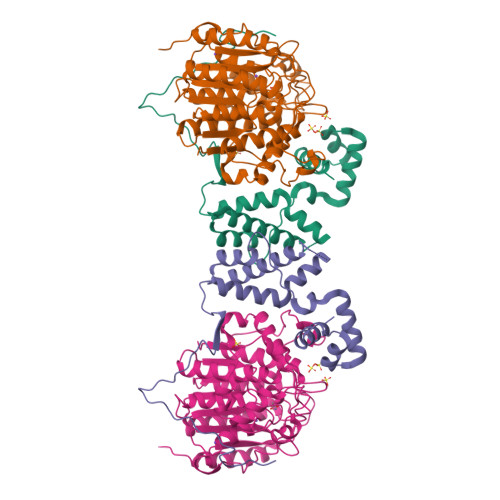
Transcription factor EB structureClick to view 3D structureTranscription factor EBP19484HumansPredicted (SEA)
Prediction Confidence Score
0.263
Applicability Domain
0.263 Low confidence
Statistical Significance
0.0033
Supporting Reference Compounds
1
E-value
25.9238
Click to view 3D structureComplement factor DP32038Rattus norvegicusPredicted (SEA)
Prediction Confidence Score
0.263
Applicability Domain
0.263 Low confidence
Statistical Significance
0.0014
Supporting Reference Compounds
1
E-value
10.9767
Substance-P receptor structureClick to view 3D structureSubstance-P receptorP25103HumansPredicted (SEA)
Prediction Confidence Score
0.26
Applicability Domain
0.28 Low confidence
Statistical Significance
0.0646
Supporting Reference Compounds
122
E-value
502.984
Neuromedin-K receptor structureClick to view 3D structureNeuromedin-K receptorP29371HumansPredicted (SEA)
Prediction Confidence Score
0.26
Applicability Domain
0.28 Low confidence
Statistical Significance
0.0477
Supporting Reference Compounds
57
E-value
371.107
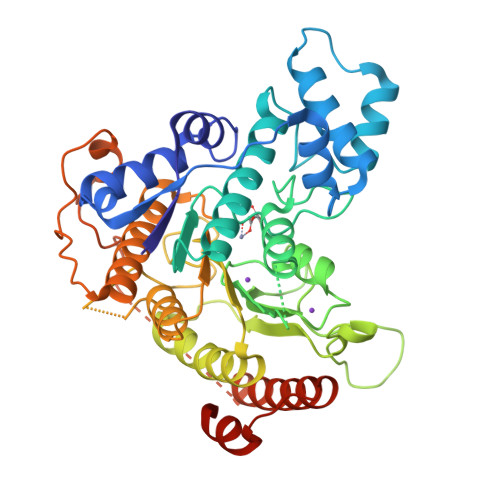
Protein deacetylase HDAC6 structureClick to view 3D structureProtein deacetylase HDAC6Q9UBN7HumansPredicted (SEA)
Prediction Confidence Score
0.257
Applicability Domain
0.277 Low confidence
Statistical Significance
0.2207
Supporting Reference Compounds
553
E-value
1717.98
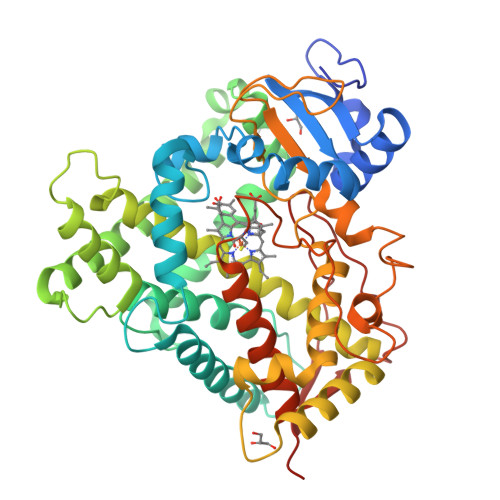
Cytochrome P450 2C9 structureClick to view 3D structureCytochrome P450 2C9P11712HumansPredicted (SEA)
Prediction Confidence Score
0.256
Applicability Domain
0.28 Low confidence
Statistical Significance
0.4414
Supporting Reference Compounds
1245
E-value
3435.95
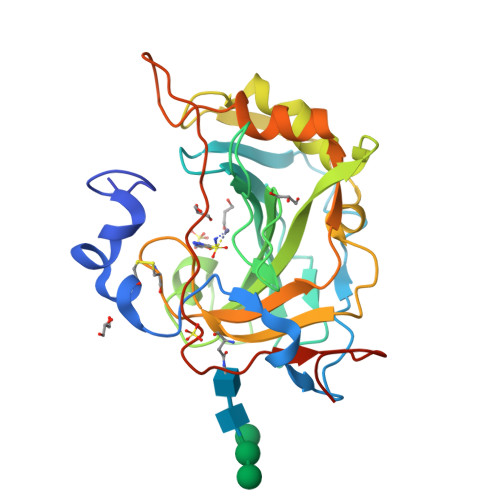
Carbonic anhydrase 12 structureClick to view 3D structureCarbonic anhydrase 12O43570HumansPredicted (SEA)
Prediction Confidence Score
0.254
Applicability Domain
0.278 Low confidence
Statistical Significance
0.1059
Supporting Reference Compounds
332
E-value
824.501
Carbonic anhydrase 9 structureClick to view 3D structureCarbonic anhydrase 9Q16790HumansPredicted (SEA)
Prediction Confidence Score
0.254
Applicability Domain
0.278 Low confidence
Statistical Significance
0.1199
Supporting Reference Compounds
372
E-value
933.412
Carbonic anhydrase 14 structureClick to view 3D structureCarbonic anhydrase 14Q9ULX7HumansPredicted (SEA)
Prediction Confidence Score
0.254
Applicability Domain
0.278 Low confidence
Statistical Significance
0.056
Supporting Reference Compounds
172
E-value
436.189
Click to view 3D structureNeuromedin-K receptorP16177Rattus norvegicusPredicted (SEA)
Prediction Confidence Score
0.253
Applicability Domain
0.28 Low confidence
Statistical Significance
0.0354
Supporting Reference Compounds
31
E-value
275.275
Histone deacetylase 1 structureClick to view 3D structureHistone deacetylase 1Q13547HumansPredicted (SEA)
Prediction Confidence Score
0.252
Applicability Domain
0.266 Low confidence
Statistical Significance
0.2425
Supporting Reference Compounds
497
E-value
1888.23
Induced myeloid leukemia cell differentiation protein Mcl-1 structureClick to view 3D structureInduced myeloid leukemia cell differentiation protein Mcl-1Q07820HumansPredicted (SEA)
Prediction Confidence Score
0.251
Applicability Domain
0.311
Statistical Significance
0.0977
Supporting Reference Compounds
343
E-value
760.431
Click to view 3D structureStreptokinase AP10520Streptococcus pyogenes serotype M1Predicted (SEA)
Prediction Confidence Score
0.251
Applicability Domain
0.297 Low confidence
Statistical Significance
0.1297
Supporting Reference Compounds
425
E-value
1010.09
Click to view 3D structureHeat shock factor protein 1P38532Mus musculusPredicted (SEA)
Prediction Confidence Score
0.249
Applicability Domain
0.297 Low confidence
Statistical Significance
0.0727
Supporting Reference Compounds
166
E-value
565.886
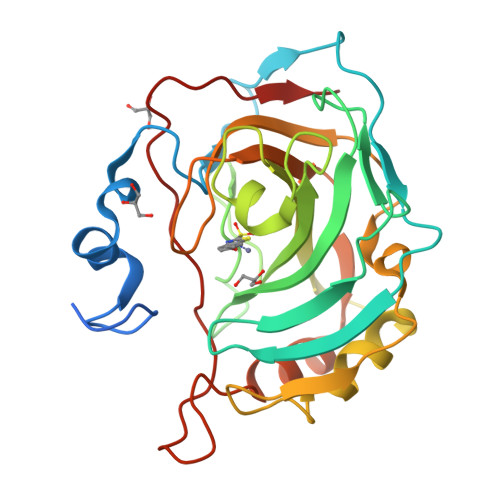
Carbonic anhydrase 2 structureClick to view 3D structureCarbonic anhydrase 2P00918HumansPredicted (SEA)
Prediction Confidence Score
0.249
Applicability Domain
0.278 Low confidence
Statistical Significance
0.1719
Supporting Reference Compounds
472
E-value
1338.62
Carbonic anhydrase 1 structureClick to view 3D structureCarbonic anhydrase 1P00915HumansPredicted (SEA)
Prediction Confidence Score
0.248
Applicability Domain
0.278 Low confidence
Statistical Significance
0.1465
Supporting Reference Compounds
407
E-value
1140.57
Carbonic anhydrase 7 structureClick to view 3D structureCarbonic anhydrase 7P43166HumansPredicted (SEA)
Prediction Confidence Score
0.246
Applicability Domain
0.278 Low confidence
Statistical Significance
0.0962
Supporting Reference Compounds
242
E-value
749.143
Histone deacetylase 8 structureClick to view 3D structureHistone deacetylase 8A5H660Schistosoma mansoniPredicted (SEA)
Prediction Confidence Score
0.244
Applicability Domain
0.284 Low confidence
Statistical Significance
0.0244
Supporting Reference Compounds
17
E-value
189.719
Histone deacetylase 8 structureClick to view 3D structureHistone deacetylase 8Q9BY41HumansPredicted (SEA)
Prediction Confidence Score
0.244
Applicability Domain
0.266 Low confidence
Statistical Significance
0.2117
Supporting Reference Compounds
317
E-value
1648.07
Cytochrome P450 1A2 structureClick to view 3D structureCytochrome P450 1A2P05177HumansPredicted (SEA)
Prediction Confidence Score
0.244
Applicability Domain
0.277 Low confidence
Statistical Significance
0.4236
Supporting Reference Compounds
793
E-value
3297.54
Cytochrome P450 3A4 structureClick to view 3D structureCytochrome P450 3A4P08684HumansPredicted (SEA)
Prediction Confidence Score
0.243
Applicability Domain
0.28 Low confidence
Statistical Significance
0.6407
Supporting Reference Compounds
1538
E-value
4987.64
Click to view 3D structureD(2) dopamine receptorP61169RatPredicted (SEA)
Prediction Confidence Score
0.242
Applicability Domain
0.247 Low confidence
Statistical Significance
0.2128
Supporting Reference Compounds
528
E-value
1656.48
D(4) dopamine receptor structureClick to view 3D structureD(4) dopamine receptorP21917HumansPredicted (SEA)
Prediction Confidence Score
0.241
Applicability Domain
0.247 Low confidence
Statistical Significance
0.2614
Supporting Reference Compounds
524
E-value
2035.06
Cytochrome P450 2C19 structureClick to view 3D structureCytochrome P450 2C19P33261HumansPredicted (SEA)
Prediction Confidence Score
0.241
Applicability Domain
0.263 Low confidence
Statistical Significance
0.4806
Supporting Reference Compounds
825
E-value
3741.43
Cytochrome P450 2D6 structureClick to view 3D structureCytochrome P450 2D6P10635HumansPredicted (SEA)
Prediction Confidence Score
0.239
Applicability Domain
0.28 Low confidence
Statistical Significance
0.5857
Supporting Reference Compounds
1130
E-value
4559.32
Concentrations
Not Available
External Links
DrugBank IDNot Available
HMDB IDNot Available
FooDB IDNot Available
Phenol Explorer IDNot Available
KNApSAcK IDNot Available
BiGG IDNot Available
BioCyc IDNot Available
METLIN IDNot Available
PDB IDNot Available
Wikipedia LinkNot Available
Chemspider IDNot Available
ChEBI IDNot Available
PubChem Compound ID91539
Kegg Compound IDNot Available
YMDB IDNot Available
ECMDB IDNot Available
References
Synthesis ReferenceNot Available
MSDSNot Available
General ReferencesNot Available