Acridine orange (CED0001980)

Record Information
Version1.0
Creation Date2016-05-20 16:13:14 UTC
Update Date2026-08-19 20:14:56 UTC
SynCED IDCED0001980
Secondary Accession Numbers
  • CHEM016069
Identification
Common NameAcridine orange
ClassSmall Molecule
Description
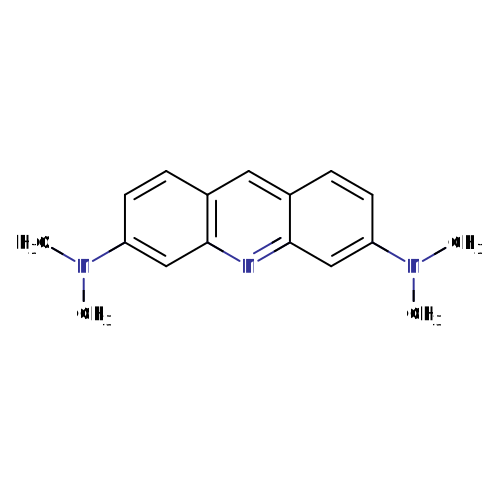
Acridine orange is an organic compound with the chemical formula C17H19N3 and an average molecular weight of 265.36 g/mol. Acridine orange belongs to the benzoquinolines, a subclass of quinolines and derivatives within the organic compounds. This organoheterocyclic compound serves as a biological indicator (PMC6535878 ). It has been identified in or released from seven recorded sources across various sectors. Within electrical and electronic equipment, it is associated with television systems, electric switches, discharge lamps, and amplifiers. In the context of food, food processing, and cookware, it is linked to the preparation of malt and fermentation processes for beer. Additionally, it is found in household cleaning and consumer products, specifically within cigar cigarettes.
Contaminant TypeNot Available
Chemical Structure
Synonyms
ValueSource
3,6-Bis(dimethylamino)acridineChEBI
3,6-Di(dimethylamino)acridineChEBI
Acridine orangeChEBI
Acridine orange baseChEBI
Brilliant acridine orange eChEBI
C.I. 46005bChEBI
C.I. solvent orange 15ChEBI
N,N,N',n'-tetramethyl-3,6-acridinediamineChEBI
Solvent orange 15ChEBI
Acridine diamine, tetramethylMeSH
Basic orange 3RnMeSH
C.I. basic orange 14MeSH
Orange base, acridineMeSH
Base, acridine orangeMeSH
N,N,N',n'-tetramethyl-3,6-acridinediamine hydrochlorideMeSH
Orange 3Rn, basicMeSH
Orange, acridineMeSH
Orange, rhodulineMeSH
Rhoduline orangeMeSH
Diamine, tetramethyl acridineMeSH
Tetramethyl acridine diamineMeSH
EuchrysineMeSH
Chemical FormulaC17H19N3
Average Molecular Mass265.360 g/mol
Monoisotopic Mass265.158 g/mol
CAS Registry Number494-38-2
IUPAC NameN3,N3,N6,N6-tetramethylacridine-3,6-diamine
Traditional Nameacridine orange
SMILESCN(C)C1=CC2=NC3=C(C=CC(=C3)N(C)C)C=C2C=C1
InChI IdentifierInChI=1S/C17H19N3/c1-19(2)14-7-5-12-9-13-6-8-15(20(3)4)11-17(13)18-16(12)10-14/h5-11H,1-4H3
InChI KeyDPKHZNPWBDQZCN-UHFFFAOYSA-N
Chemical Taxonomy
Description Belongs to the class of organic compounds known as acridines. These are organic compounds containing the acridine moiety, a linear tricyclic heterocycle which consists of two benzene rings joined by a pyridine ring.
KingdomOrganic compounds
Super ClassOrganoheterocyclic compounds
ClassQuinolines and derivatives
Sub ClassBenzoquinolines
Direct ParentAcridines
Alternative Parents
Substituents
  • Acridine
  • Aminoquinoline
  • Dialkylarylamine
  • Tertiary aliphatic/aromatic amine
  • Benzenoid
  • Pyridine
  • Heteroaromatic compound
  • Tertiary amine
  • Azacycle
  • Organic nitrogen compound
  • Organopnictogen compound
  • Hydrocarbon derivative
  • Organonitrogen compound
  • Amine
  • Aromatic heteropolycyclic compound
Molecular FrameworkAromatic heteropolycyclic compounds
External Descriptors
Biological Properties
StatusDetected and Not Quantified
OriginNot Available
Cellular LocationsNot Available
Biofluid LocationsNot Available
Tissue LocationsNot Available
ApplicationsNot Available
Biological Roles
Chemical RolesNot Available
Organoleptic Effects
  • red colour ?
  • orange colour ?
  • green colour ?
Physical Properties
StateNot Available
AppearanceNot Available
Experimental Properties
PropertyValue
Melting PointNot Available
Boiling PointNot Available
SolubilityNot Available
Predicted Properties
PropertyValueSource
Water Solubility0.11 g/LALOGPS
logP4.37ALOGPS
logP3.72ChemAxon
logS-3.4ALOGPS
pKa (Strongest Basic)8.17ChemAxon
Physiological Charge1ChemAxon
Hydrogen Acceptor Count3ChemAxon
Hydrogen Donor Count0ChemAxon
Polar Surface Area19.37 ŲChemAxon
Rotatable Bond Count2ChemAxon
Refractivity84.91 m³·mol⁻¹ChemAxon
Polarizability31.79 ųChemAxon
Number of Rings3ChemAxon
BioavailabilityYesChemAxon
Rule of FiveYesChemAxon
Ghose FilterYesChemAxon
Veber's RuleYesChemAxon
MDDR-like RuleNoChemAxon
Spectra
Spectra
Spectrum TypeDescriptionSplash KeyDeposition DateView
Predicted GC-MSPredicted GC-MS Spectrumsplash10-02ta-0490000000-b7a8d71677d5c76c63ceNot AvailableView Spectrum
Predicted GC-MSPredicted GC-MS SpectrumNot AvailableNot AvailableView Spectrum
Predicted LC-MS/MSPredicted LC-MS/MS Spectrumsplash10-014i-0090000000-2f0810585573991c88e9Not AvailableView Spectrum
Predicted LC-MS/MSPredicted LC-MS/MS Spectrumsplash10-014i-0090000000-ba30af201da1d7db1e96Not AvailableView Spectrum
Predicted LC-MS/MSPredicted LC-MS/MS Spectrumsplash10-0gb9-0090000000-ca336db5bc3cc4d67ef1Not AvailableView Spectrum
Predicted LC-MS/MSPredicted LC-MS/MS Spectrumsplash10-03di-0090000000-35fa5183816b1ea5153eNot AvailableView Spectrum
Predicted LC-MS/MSPredicted LC-MS/MS Spectrumsplash10-03di-0090000000-aa454d77c0ee0149fcf5Not AvailableView Spectrum
Predicted LC-MS/MSPredicted LC-MS/MS Spectrumsplash10-03dj-0090000000-51ee3146d2ca9d3fe714Not AvailableView Spectrum
Toxicity Profile
Toxicity Values
Toxicity ValueOrganismDose DescriptorRoute of ExposurePredicted or ExperimentalToxicity RatingReference
272.0 Log mg/kg [150:480]RatLD50oralpredictedNot AvailableNot Available
Toxicity / Toxin ClassNot Available
Mechanism of ToxicityNot Available
Carcinogenicity (IARC Classification)Not Available
Minimum Risk LevelNot Available
SymptomsNot Available
TreatmentNot Available
Health Effects
Health EffectRelationshipDirectionDescriptionReference
Exposure Sources
Source IDSourceSectorReference
CEDs000233Brushes?Brushes used in personal care and cosmetics can be a source of synthetic chemical contamination due to the materials and coatings used in their manufacturing.Personal care & cosmeticsPubChem
CEDs000505Amplifiers?Amplifiers, commonly used in various electronic devices to enhance signal strength, can be a source of synthetic chemical contamination due to the materials and processes involved in their production and disposal.Electrical & Electronic EquipmentPubChem
CEDs000511Conductors Or Conductive Bodies Characterised By The Conductive Materials?Conductors, or conductive bodies, are materials that allow the flow of electrical current, typically made from metals such as copper, aluminum, or silver.Electrical & Electronic EquipmentPubChem
CEDs000514Discharge Lamps?Discharge lamps, including fluorescent and high-intensity discharge (HID) lamps, are commonly used for lighting applications due to their energy efficiency and brightness.Electrical & Electronic EquipmentPubChem
CEDs000517Electric Switches?Electric switches, integral components in numerous devices, can be a source of synthetic chemical contamination due to the materials and manufacturing processes involved in their production.Electrical & Electronic EquipmentPubChem
CEDs000518Electrically Stimulated Smoking Devices?Electrically stimulated smoking devices, commonly known as e-cigarettes or vape pens, utilize electrical components to heat a liquid solution, often containing nicotine, flavorings, and other additives, to produce an aerosol for inhalation.Electrical & Electronic EquipmentPubChem
CEDs000519Electrodes?Electrodes, used in various electrical and electronic applications, can be a source of synthetic chemical contamination due to the materials from which they are constructed and the processes involved in their manufacturing.Electrical & Electronic EquipmentPubChem
CEDs000521Fixed Capacitors And Their Manufacture?Fixed capacitors are passive electronic components used to store and release electrical energy, playing a critical role in various circuits.Electrical & Electronic EquipmentPubChem
CEDs000524Hybrid Capacitors?Hybrid capacitors are energy storage devices that combine the properties of electrolytic and supercapacitors, utilizing a combination of electrochemical principles to achieve higher energy density and power density.Electrical & Electronic EquipmentPubChem
CEDs000537Television Systems?Television systems can be a source of synthetic chemical contamination due to the various materials and components used in their manufacture and operation.Electrical & Electronic EquipmentPubChem
CEDs000544Fermentation Processes For Beer?Fermentation processes for beer involve the conversion of sugars into alcohol and carbon dioxide by yeast.Food, food processing & cookwarePubChem
CEDs000545Food Preservation?Food preservation often involves the use of synthetic chemicals, such as preservatives, flavor enhancers, and color additives, to extend shelf life and enhance the sensory qualities of food products.Food, food processing & cookwarePubChem
CEDs000547Preparation Of Malt?Malt preparation involves the germination and drying of cereal grains, primarily barley, to produce malt for brewing and food products.Food, food processing & cookwarePubChem
CEDs000555Bleaching Agents?Bleaching agents are chemical substances used to whiten or lighten materials, often employed in various cleaning products for their stain removal and disinfecting properties.Household cleaning & consumer productsPubChem
CEDs000556Cigar Cigarettes?Cigar cigarettes are a source of synthetic chemical contamination due to the combustion of various tobacco blends and additives.Household cleaning & consumer productsPubChem
CEDs000561Perfumes Within Detergents And Soaps?Perfumes within detergents and soaps are synthetic fragrance compounds added to enhance the sensory experience of cleaning products.Household cleaning & consumer productsPubChem
CEDs000563Soap Detergents?Soap detergents are synthetic surfactants designed to enhance the cleaning efficacy of water by reducing surface tension, allowing for better interaction with dirt and grease.Household cleaning & consumer productsPubChem
CEDs000569Tobacco Smoke Filters?Tobacco smoke filters are designed to reduce the inhalation of harmful substances in cigarette smoke, including tar and other particulate matter.Household cleaning & consumer productsPubChem
CEDs000580Manufacture Preparation Of Tobacco Products?The manufacture and preparation of tobacco products involve various processes that can result in the introduction of synthetic chemicals into the environment.Industrial manufacturing & chemical processingPubChem
CEDs000581Paper Making Machines?Paper making machines utilize various synthetic chemicals throughout the production process, including additives, coatings, and bleaching agents.Industrial manufacturing & chemical processingPubChem
CEDs000583Anchoring Equipment?Anchoring equipment, commonly used in marine applications, can be a source of synthetic chemical contamination due to the materials and coatings utilized in their manufacturing.Marine, shipping & aquaculturePubChem
CEDs000592Marine Propulsion Or Steering?Marine propulsion and steering systems often rely on various synthetic chemicals, including lubricants, fuels, and hydraulic fluids.Marine, shipping & aquaculturePubChem
CEDs000609Aftershave?Aftershave is a grooming product typically used to soothe and protect the skin following shaving.Personal care & cosmeticsPubChem
CEDs000610Aftersun Products?Aftersun products are designed to soothe and hydrate the skin after sun exposure, often containing various synthetic chemicals such as emollients, preservatives, and fragrances.Personal care & cosmeticsPubChem
CEDs000611Anti Perspirants Or Body Deoderants?Antiperspirants and body deodorants commonly contain synthetic chemicals such as aluminum compounds, parabens, and synthetic fragrances.Personal care & cosmeticsPubChem
CEDs000613Depilatories?Depilatories are products designed to remove unwanted hair through the application of synthetic chemicals that break down the protein structure of hair, facilitating its removal.Personal care & cosmeticsPubChem
CEDs000614Essential Oils Or Perfumes?Essential oils and perfumes are complex mixtures of volatile compounds derived from natural or synthetic sources, commonly used for their aromatic properties.Personal care & cosmeticsPubChem
CEDs000615Eye Makeup Products?Eye makeup products, including mascaras, eyeliners, and eyeshadows, often contain a variety of synthetic chemicals such as pigments, preservatives, and film-forming agents.Personal care & cosmeticsPubChem
CEDs000618Lip Makeup Products?Lip makeup products, such as lipsticks, lip glosses, and lip liners, often contain a variety of synthetic chemicals, including pigments, preservatives, and emollients.Personal care & cosmeticsPubChem
CEDs000619Manicure Pedicure?Manicure and pedicure procedures often involve the use of various synthetic chemicals, including solvents, nail polishes, and nail adhesives.Personal care & cosmeticsPubChem
CEDs000631Anthraquinone Dyes?Anthraquinone dyes are a class of synthetic organic compounds characterized by their vibrant colors and stability, making them widely used in various applications, particularly in coloring textiles and leather.Textiles, leather & furnishingsPubChem
CEDs000632Apparel?Apparel production often involves the use of various synthetic chemicals, including dyes, finishing agents, and preservatives.Textiles, leather & furnishingsPubChem
CEDs000633Azo Dyes?Azo dyes are synthetic organic compounds characterized by the presence of one or more azo groups (-N=N-), which are widely used for coloring textiles, leather, and furnishings.Textiles, leather & furnishingsPubChem
CEDs000638Decorating Textiles?Decorating textiles often involves the use of synthetic chemicals such as dyes, finishes, and coatings.Textiles, leather & furnishingsPubChem
CEDs000643Headwear?Headwear made from synthetic materials often incorporates chemicals used in the manufacturing and finishing processes, such as dyes, flame retardants, and water repellents.Textiles, leather & furnishingsPubChem
CEDs000650Purses Luggage Hand Bags?Purses, luggage, and handbags are often manufactured using synthetic materials such as polyvinyl chloride (PVC), polyurethane, and various types of nylon.Textiles, leather & furnishingsPubChem
CEDs000657Surface Finishing Of Leather?Surface finishing of leather often involves the use of various synthetic chemicals, including dyes, resins, and finishing agents.Textiles, leather & furnishingsPubChem
CEDs000659Transfer Printing?Transfer printing is a process used to apply designs and patterns onto various substrates, commonly utilizing synthetic dyes and inks that can contain hazardous chemicals.Textiles, leather & furnishingsPubChem
CEDs000685Ceramics?Ceramics can be a source of synthetic chemical contamination through various additives and processing agents used in their production.Building & ConstructionPubChem
CEDs000688Glass Coatings?Glass coatings are synthetic chemical formulations applied to glass surfaces to enhance properties such as durability, UV resistance, and aesthetic appeal.Building & ConstructionPubChem
CEDs000692Silica Free Oxide Glass?Silica Free Oxide Glass is a type of glass that is produced using alternative materials to traditional silica-based formulations.Building & ConstructionPubChem
CEDs000693Silica Glass?Silica glass, primarily composed of silicon dioxide (SiO2), is widely used in various applications, including windows, glass facades, and insulation materials.Building & ConstructionPubChem
CEDs000696Nanotechnology?Nanotechnology involves the manipulation of materials at the molecular or atomic level, typically within the range of 1 to 100 nanometers.Industrial manufacturing & chemical processingPubChem
CEDs000726Pens?Pens, commonly utilized for writing and marking, can be a source of synthetic chemical contamination primarily due to the materials used in their manufacturing.Paper, pulp & fiber productsPubChem
CEDs000730Contact Lens Cases?Contact lens cases are small containers designed to store contact lenses in a sterile environment, typically made from various synthetic materials including plastics such as polypropylene or polycarbonate.Healthcare, pharmaceuticals & veterinary productsPubChem
CEDs000734Coating Compositions?Coating compositions, which include paints, sealants, and varnishes, are formulated with a variety of synthetic chemicals such as solvents, resins, pigments, and additives.Building & ConstructionPubChem
CEDs000735Explosives?Explosives are chemical compounds or mixtures designed to undergo rapid decomposition, releasing energy in the form of gas and heat.Defense & military infrastructurePubChem
CEDs000738Cooling Circuit Water?Cooling circuit water is utilized in various industrial processes to absorb and dissipate heat generated during operations.Industrial manufacturing & chemical processingPubChem
CEDs000739Inks?Inks are complex mixtures composed of pigments or dyes, solvents, resins, and additives used primarily for printing and writing applications.Paper, pulp & fiber productsPubChem
CEDs000740Paper?Paper production involves the processing of wood fibers and the use of various chemicals, which can lead to synthetic chemical contamination.Paper, pulp & fiber productsPubChem
CEDs000741Pigment Pastes?Pigment pastes are concentrated dispersions of pigments used to impart color and properties to materials.Paper, pulp & fiber productsPubChem
CEDs000743Sludge Treatment?Sludge treatment involves the processing of waste materials generated from wastewater treatment plants, which often contain a variety of organic and inorganic substances.Wastewater, sanitation & biosolidsPubChem
CEDs000744Water, Wastewater, & Sewage Treatment?Water, wastewater, and sewage treatment processes are critical for managing and mitigating pollutants in water systems.Wastewater, sanitation & biosolidsPubChem
CEDs01882RubberIndustrial manufacturing & chemical processingPMC7182930
CEDs01931Olfactory BulbIndustrial manufacturing & chemical processingPMC6077977
CEDs01959Rubber CompoundsIndustrial manufacturing & chemical processingPMC13294964
CEDs01969Natural RubberIndustrial manufacturing & chemical processingPMC13294964
CEDs02255WaterAquatic systems & sedimentsPMC7732738 , PMC11458682
Pathways
0 pathwaysPathway Source: PathBank

No pathways found

No metabolic pathways have been associated with this synthetic chemical

Targets
StructureProteinUniProt IDOrganismRelationshipDetails
Amyloid-beta precursor protein structureClick to view 3D structureAmyloid-beta precursor proteinP05067HumansPredicted (SEA)
Prediction Confidence Score
0.365
Applicability Domain
0.552
Statistical Significance
0.0048
Supporting Reference Compounds
109
E-value
37.1341
Amine oxidase [flavin-containing] A structureClick to view 3D structureAmine oxidase [flavin-containing] AP21397HumansPredicted (SEA)
Prediction Confidence Score
0.33
Applicability Domain
0.552
Statistical Significance
0.0105
Supporting Reference Compounds
241
E-value
81.8974
Microtubule-associated protein tau structureClick to view 3D structureMicrotubule-associated protein tauP10636HumansPredicted (SEA)
Prediction Confidence Score
0.324
Applicability Domain
0.552
Statistical Significance
5.90e-04
Supporting Reference Compounds
26
E-value
4.5931
Click to view 3D structureGlutathione reductaseO15770Plasmodium falciparum 3D7Predicted (SEA)
Prediction Confidence Score
0.312
Applicability Domain
0.552
Statistical Significance
2.00e-05
Supporting Reference Compounds
2
E-value
0.155698
Click to view 3D structureDickkopf-related protein 1O54908Mus musculusPredicted (SEA)
Prediction Confidence Score
0.306
Applicability Domain
0.306
Statistical Significance
7.00e-05
Supporting Reference Compounds
1
E-value
0.544945
Luciferin 4-monooxygenase structureClick to view 3D structureLuciferin 4-monooxygenaseP08659Photinus pyralisPredicted (SEA)
Prediction Confidence Score
0.293
Applicability Domain
0.333
Statistical Significance
0.0129
Supporting Reference Compounds
114
E-value
100.425
Click to view 3D structurePatatin-like phospholipase domain-containing protein 2Q8BJ56Mus musculusPredicted (SEA)
Prediction Confidence Score
0.277
Applicability Domain
0.293 Low confidence
Statistical Significance
0.002
Supporting Reference Compounds
2
E-value
15.492
Low-density lipoprotein receptor-related protein 6 structureClick to view 3D structureLow-density lipoprotein receptor-related protein 6O75581HumansPredicted (SEA)
Prediction Confidence Score
0.274
Applicability Domain
0.306
Statistical Significance
8.00e-05
Supporting Reference Compounds
2
E-value
0.622794
Synaptojanin-1 structureClick to view 3D structureSynaptojanin-1O43426HumansPredicted (SEA)
Prediction Confidence Score
0.269
Applicability Domain
0.269 Low confidence
Statistical Significance
7.00e-05
Supporting Reference Compounds
1
E-value
0.544945
Deoxyribonuclease-1 structureClick to view 3D structureDeoxyribonuclease-1P24855HumansPredicted (SEA)
Prediction Confidence Score
0.263
Applicability Domain
0.263 Low confidence
Statistical Significance
1.30e-04
Supporting Reference Compounds
1
E-value
1.01204
Protein deacetylase HDAC6 structureClick to view 3D structureProtein deacetylase HDAC6Q9UBN7HumansPredicted (SEA)
Prediction Confidence Score
0.258
Applicability Domain
0.293 Low confidence
Statistical Significance
0.2162
Supporting Reference Compounds
553
E-value
1683.26
Click to view 3D structureATP-dependent molecular chaperone HSP82C4YTQ8Candida albicans (strain WO-1) (Yeast)Predicted (SEA)
Prediction Confidence Score
0.245
Applicability Domain
0.279 Low confidence
Statistical Significance
0.0807
Supporting Reference Compounds
205
E-value
628.165
Click to view 3D structureNonstructural protein 1Q194T2Influenza A virusPredicted (SEA)
Prediction Confidence Score
0.24
Applicability Domain
0.255 Low confidence
Statistical Significance
0.0271
Supporting Reference Compounds
104
E-value
211.049
Amine oxidase [flavin-containing] B structureClick to view 3D structureAmine oxidase [flavin-containing] BP27338HumansPredicted (SEA)
Prediction Confidence Score
0.238
Applicability Domain
0.366
Statistical Significance
0.1913
Supporting Reference Compounds
315
E-value
1489.26
Platelet-derived growth factor receptor beta structureClick to view 3D structurePlatelet-derived growth factor receptor betaP09619HumansPredicted (SEA)
Prediction Confidence Score
0.235
Applicability Domain
0.245 Low confidence
Statistical Significance
0.4028
Supporting Reference Compounds
597
E-value
3136.16
Vascular endothelial growth factor receptor 2 structureClick to view 3D structureVascular endothelial growth factor receptor 2P35968HumansPredicted (SEA)
Prediction Confidence Score
0.234
Applicability Domain
0.245 Low confidence
Statistical Significance
0.6065
Supporting Reference Compounds
1660
E-value
4721.63
Aurora kinase A structureClick to view 3D structureAurora kinase AO14965HumansPredicted (SEA)
Prediction Confidence Score
0.232
Applicability Domain
0.288 Low confidence
Statistical Significance
0.5318
Supporting Reference Compounds
996
E-value
4140.1
Macrophage colony-stimulating factor 1 receptor structureClick to view 3D structureMacrophage colony-stimulating factor 1 receptorP07333HumansPredicted (SEA)
Prediction Confidence Score
0.232
Applicability Domain
0.288 Low confidence
Statistical Significance
0.5071
Supporting Reference Compounds
833
E-value
3947.81
Aurora kinase B structureClick to view 3D structureAurora kinase BQ96GD4HumansPredicted (SEA)
Prediction Confidence Score
0.232
Applicability Domain
0.288 Low confidence
Statistical Significance
0.5468
Supporting Reference Compounds
1017
E-value
4256.48
Tyrosine-protein kinase JAK2 structureClick to view 3D structureTyrosine-protein kinase JAK2O60674HumansPredicted (SEA)
Prediction Confidence Score
0.232
Applicability Domain
0.263 Low confidence
Statistical Significance
0.5644
Supporting Reference Compounds
1022
E-value
4393.81
Histone deacetylase 1 structureClick to view 3D structureHistone deacetylase 1Q13547HumansPredicted (SEA)
Prediction Confidence Score
0.232
Applicability Domain
0.256 Low confidence
Statistical Significance
0.3982
Supporting Reference Compounds
497
E-value
3100.11
Acetylcholinesterase structureClick to view 3D structureAcetylcholinesteraseP22303HumansPredicted (SEA)
Prediction Confidence Score
0.231
Applicability Domain
0.279 Low confidence
Statistical Significance
0.2982
Supporting Reference Compounds
406
E-value
2321.31
Epidermal growth factor receptor structureClick to view 3D structureEpidermal growth factor receptorP00533HumansPredicted (SEA)
Prediction Confidence Score
0.23
Applicability Domain
0.263 Low confidence
Statistical Significance
0.6179
Supporting Reference Compounds
1301
E-value
4810.3
Receptor-type tyrosine-protein kinase FLT3 structureClick to view 3D structureReceptor-type tyrosine-protein kinase FLT3P36888HumansPredicted (SEA)
Prediction Confidence Score
0.226
Applicability Domain
0.255 Low confidence
Statistical Significance
0.6404
Supporting Reference Compounds
1274
E-value
4985.85
Cytochrome P450 2A6 structureClick to view 3D structureCytochrome P450 2A6P11509HumansPredicted (SEA)
Prediction Confidence Score
0.225
Applicability Domain
0.345
Statistical Significance
0.0201
Supporting Reference Compounds
68
E-value
156.321
Concentrations
Not Available
External Links
DrugBank IDNot Available
HMDB IDHMDB0260299
FooDB IDNot Available
Phenol Explorer IDNot Available
KNApSAcK IDNot Available
BiGG IDNot Available
BioCyc IDNot Available
METLIN IDNot Available
PDB IDNot Available
Wikipedia LinkAcridine_orange
Chemspider ID56136
ChEBI ID87346
PubChem Compound IDNot Available
Kegg Compound IDC19315
YMDB IDNot Available
ECMDB IDNot Available
References
Synthesis ReferenceNot Available
MSDSNot Available
General ReferencesNot Available