1,9-Decadiene (CED0019643)

Record Information
Version1.0
Creation Date2016-05-22 03:35:27 UTC
Update Date2026-08-18 02:22:28 UTC
SynCED IDCED0019643
Secondary Accession Numbers
  • CHEM016514
Identification
Common Name1,9-Decadiene
ClassSmall Molecule
Description
1,9-Decadiene is an organic compound with the chemical formula C10H18 and an average molecular weight of 138.25 g/mol. 1,9-Decadiene belongs to the olefins, a subclass of unsaturated hydrocarbons within the organic compounds. This substance is found in or released from nine recorded sources. Within the category of electrical and electronic equipment, it is associated with antennas, discharge lamps, hybrid capacitors, and power cables. In the context of food, food processing, and cookware, it is linked to the processing of meats, fermentation processes for beer, and the preparation of wine or sparkling wine. Additionally, it is found in household cleaning and consumer products, specifically soap detergents and bleaching agents. Regarding plastics, 1,9-Decadiene is present in high impact polystyrene. It is utilized in the production of several types of plastics, including polystyrene, expanded polystyrene, polypropylene, low-density polyethylene, and high-density polyethylene.
Contaminant TypeNot Available
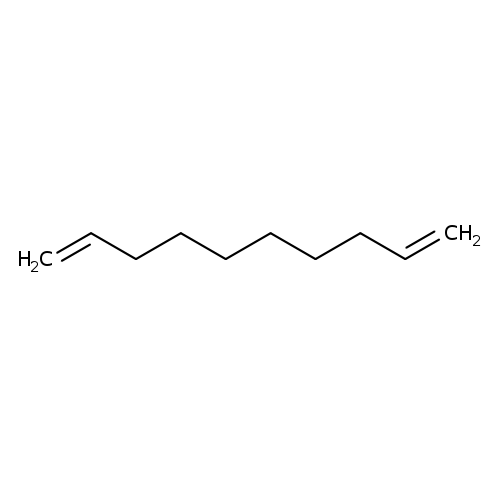
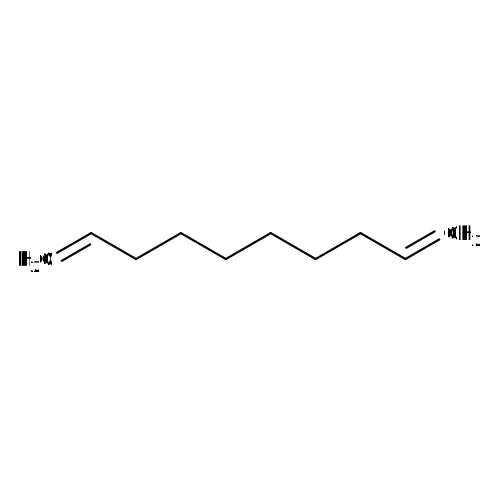
Chemical Structure
Synonyms
ValueSource
Deca-19-dieneHMDB
1,9-DecadieneMeSH
Chemical FormulaC10H18
Average Molecular Mass138.254 g/mol
Monoisotopic Mass138.141 g/mol
CAS Registry Number1647-16-1
IUPAC Namedeca-1,9-diene
Traditional Name1,9-decadiene
SMILESC=CCCCCCCC=C
InChI IdentifierInChI=1S/C10H18/c1-3-5-7-9-10-8-6-4-2/h3-4H,1-2,5-10H2
InChI KeyNLDGJRWPPOSWLC-UHFFFAOYSA-N
Chemical Taxonomy
Description Belongs to the class of organic compounds known as alkadienes. These are acyclic hydrocarbons that contain exactly two carbon-to-carbon double bonds.
KingdomOrganic compounds
Super ClassHydrocarbons
ClassUnsaturated hydrocarbons
Sub ClassOlefins
Direct ParentAlkadienes
Alternative Parents
Substituents
  • Alkadiene
  • Unsaturated aliphatic hydrocarbon
  • Aliphatic acyclic compound
Molecular FrameworkAliphatic acyclic compounds
External DescriptorsNot Available
Biological Properties
StatusDetected and Not Quantified
OriginNot Available
Cellular LocationsNot Available
Biofluid LocationsNot Available
Tissue LocationsNot Available
ApplicationsNot Available
Biological RolesNot Available
Chemical RolesNot Available
Organoleptic EffectsNot Available
Physical Properties
StateNot Available
AppearanceNot Available
Experimental Properties
PropertyValue
Melting PointNot Available
Boiling PointNot Available
SolubilityNot Available
Predicted Properties
PropertyValueSource
Water Solubility0.0032 g/LALOGPS
logP5.03ALOGPS
logP4.3ChemAxon
logS-4.6ALOGPS
Physiological Charge0ChemAxon
Hydrogen Acceptor Count0ChemAxon
Hydrogen Donor Count0ChemAxon
Polar Surface Area0 ŲChemAxon
Rotatable Bond Count7ChemAxon
Refractivity47.9 m³·mol⁻¹ChemAxon
Polarizability18.72 ųChemAxon
Number of Rings0ChemAxon
BioavailabilityYesChemAxon
Rule of FiveYesChemAxon
Ghose FilterNoChemAxon
Veber's RuleYesChemAxon
MDDR-like RuleNoChemAxon
Spectra
Spectra
Spectrum TypeDescriptionSplash KeyDeposition DateView
Predicted GC-MSPredicted GC-MS Spectrumsplash10-05p6-9100000000-43f7b0fd4acddc7e50e1Not AvailableView Spectrum
Predicted GC-MSPredicted GC-MS SpectrumNot AvailableNot AvailableView Spectrum
Predicted LC-MS/MSPredicted LC-MS/MS Spectrumsplash10-000i-0900000000-4d5d811b56ed55f265bcNot AvailableView Spectrum
Predicted LC-MS/MSPredicted LC-MS/MS Spectrumsplash10-000i-6900000000-ef856228a7c3d3bc05d7Not AvailableView Spectrum
Predicted LC-MS/MSPredicted LC-MS/MS Spectrumsplash10-0k96-9000000000-396851bba6a2faca9900Not AvailableView Spectrum
Predicted LC-MS/MSPredicted LC-MS/MS Spectrumsplash10-000i-0900000000-d449c55611d192409c3aNot AvailableView Spectrum
Predicted LC-MS/MSPredicted LC-MS/MS Spectrumsplash10-000i-0900000000-baa106a8f474c7a14fe1Not AvailableView Spectrum
Predicted LC-MS/MSPredicted LC-MS/MS Spectrumsplash10-000i-9500000000-d7c57de5d5d3d617fcd0Not AvailableView Spectrum
Predicted LC-MS/MSPredicted LC-MS/MS Spectrumsplash10-067i-9000000000-4da13a6a326dfc19a8edNot AvailableView Spectrum
Predicted LC-MS/MSPredicted LC-MS/MS Spectrumsplash10-066r-9000000000-94fde26871a7c927e39fNot AvailableView Spectrum
Predicted LC-MS/MSPredicted LC-MS/MS Spectrumsplash10-0aou-9000000000-dba5a7e3ac10b496307bNot AvailableView Spectrum
Predicted LC-MS/MSPredicted LC-MS/MS Spectrumsplash10-000i-0900000000-005b492eed114057487dNot AvailableView Spectrum
Predicted LC-MS/MSPredicted LC-MS/MS Spectrumsplash10-000i-0900000000-0ffa5a228e1bbc16c17aNot AvailableView Spectrum
Predicted LC-MS/MSPredicted LC-MS/MS Spectrumsplash10-014i-9000000000-0a1a402ea6b86d9d0c3bNot AvailableView Spectrum
Toxicity Profile
Toxicity Values
Toxicity ValueOrganismDose DescriptorRoute of ExposurePredicted or ExperimentalToxicity RatingReference
8949.0 Log mg/kg [5000:16000]RatLD50oralpredictedNot AvailableNot Available
Toxicity / Toxin ClassNot Available
Mechanism of ToxicityNot Available
Carcinogenicity (IARC Classification)Not Available
Minimum Risk LevelNot Available
SymptomsNot Available
TreatmentNot Available
Health Effects
Health EffectRelationshipDirectionDescriptionReference
Exposure Sources
Source IDSourceSectorReference
CEDs000506Antennas?Antennas, commonly used in communication technologies, can be a source of synthetic chemical contamination through the materials and coatings used in their construction.Electrical & Electronic EquipmentPubChem
CEDs000511Conductors Or Conductive Bodies Characterised By The Conductive Materials?Conductors, or conductive bodies, are materials that allow the flow of electrical current, typically made from metals such as copper, aluminum, or silver.Electrical & Electronic EquipmentPubChem
CEDs000514Discharge Lamps?Discharge lamps, including fluorescent and high-intensity discharge (HID) lamps, are commonly used for lighting applications due to their energy efficiency and brightness.Electrical & Electronic EquipmentPubChem
CEDs000519Electrodes?Electrodes, used in various electrical and electronic applications, can be a source of synthetic chemical contamination due to the materials from which they are constructed and the processes involved in their manufacturing.Electrical & Electronic EquipmentPubChem
CEDs000524Hybrid Capacitors?Hybrid capacitors are energy storage devices that combine the properties of electrolytic and supercapacitors, utilizing a combination of electrochemical principles to achieve higher energy density and power density.Electrical & Electronic EquipmentPubChem
CEDs000529Power Cables?Power cables are used to transmit electrical energy and are typically composed of conductive materials, insulation, and protective coatings.Electrical & Electronic EquipmentPubChem
CEDs000544Fermentation Processes For Beer?Fermentation processes for beer involve the conversion of sugars into alcohol and carbon dioxide by yeast.Food, food processing & cookwarePubChem
CEDs000545Food Preservation?Food preservation often involves the use of synthetic chemicals, such as preservatives, flavor enhancers, and color additives, to extend shelf life and enhance the sensory qualities of food products.Food, food processing & cookwarePubChem
CEDs000549Preparation Of Wine Or Sparkling Wine?The preparation of wine or sparkling wine involves various stages, including fermentation, aging, and bottling, which can introduce potential sources of synthetic chemical contamination.Food, food processing & cookwarePubChem
CEDs000552Processing Meats?Processing meats can lead to synthetic chemical contamination primarily through the use of additives and preservatives.Food, food processing & cookwarePubChem
CEDs000555Bleaching Agents?Bleaching agents are chemical substances used to whiten or lighten materials, often employed in various cleaning products for their stain removal and disinfecting properties.Household cleaning & consumer productsPubChem
CEDs000561Perfumes Within Detergents And Soaps?Perfumes within detergents and soaps are synthetic fragrance compounds added to enhance the sensory experience of cleaning products.Household cleaning & consumer productsPubChem
CEDs000563Soap Detergents?Soap detergents are synthetic surfactants designed to enhance the cleaning efficacy of water by reducing surface tension, allowing for better interaction with dirt and grease.Household cleaning & consumer productsPubChem
CEDs000609Aftershave?Aftershave is a grooming product typically used to soothe and protect the skin following shaving.Personal care & cosmeticsPubChem
CEDs000610Aftersun Products?Aftersun products are designed to soothe and hydrate the skin after sun exposure, often containing various synthetic chemicals such as emollients, preservatives, and fragrances.Personal care & cosmeticsPubChem
CEDs000611Anti Perspirants Or Body Deoderants?Antiperspirants and body deodorants commonly contain synthetic chemicals such as aluminum compounds, parabens, and synthetic fragrances.Personal care & cosmeticsPubChem
CEDs000612Body Washing Or Cleaning Implements?Body washing or cleaning implements, such as synthetic sponges, loofahs, and washcloths, can be sources of synthetic chemical contamination due to the materials used in their production.Personal care & cosmeticsPubChem
CEDs000613Depilatories?Depilatories are products designed to remove unwanted hair through the application of synthetic chemicals that break down the protein structure of hair, facilitating its removal.Personal care & cosmeticsPubChem
CEDs000614Essential Oils Or Perfumes?Essential oils and perfumes are complex mixtures of volatile compounds derived from natural or synthetic sources, commonly used for their aromatic properties.Personal care & cosmeticsPubChem
CEDs000615Eye Makeup Products?Eye makeup products, including mascaras, eyeliners, and eyeshadows, often contain a variety of synthetic chemicals such as pigments, preservatives, and film-forming agents.Personal care & cosmeticsPubChem
CEDs000617Lip Care Products?Lip care products, including lipsticks, balms, and glosses, often contain a variety of synthetic chemicals such as parabens, phthalates, and synthetic fragrances.Personal care & cosmeticsPubChem
CEDs000618Lip Makeup Products?Lip makeup products, such as lipsticks, lip glosses, and lip liners, often contain a variety of synthetic chemicals, including pigments, preservatives, and emollients.Personal care & cosmeticsPubChem
CEDs000632Apparel?Apparel production often involves the use of various synthetic chemicals, including dyes, finishing agents, and preservatives.Textiles, leather & furnishingsPubChem
CEDs000642Footwear?Footwear production often involves the use of various synthetic chemicals, such as adhesives, dyes, and treatments, which can contribute to environmental contamination.Textiles, leather & furnishingsPubChem
CEDs000662Yarns Or Threads?Yarns or threads used in textiles can be a source of synthetic chemical contamination due to the production processes and treatments they undergo.Textiles, leather & furnishingsPubChem
CEDs000671Airplanes And Helicopters?Airplanes and helicopters are significant sources of synthetic chemical contamination primarily through the use of aviation fuels, lubricants, and de-icing agents.Aviation & AerospacePubChem
CEDs000685Ceramics?Ceramics can be a source of synthetic chemical contamination through various additives and processing agents used in their production.Building & ConstructionPubChem
CEDs000691Non Oxide Glass?Non-oxide glass refers to a category of glasses primarily composed of materials other than silicon dioxide, such as boron oxide or phosphorous oxide.Building & ConstructionPubChem
CEDs000692Silica Free Oxide Glass?Silica Free Oxide Glass is a type of glass that is produced using alternative materials to traditional silica-based formulations.Building & ConstructionPubChem
CEDs000696Nanotechnology?Nanotechnology involves the manipulation of materials at the molecular or atomic level, typically within the range of 1 to 100 nanometers.Industrial manufacturing & chemical processingPubChem
CEDs000735Explosives?Explosives are chemical compounds or mixtures designed to undergo rapid decomposition, releasing energy in the form of gas and heat.Defense & military infrastructurePubChem
CEDs000739Inks?Inks are complex mixtures composed of pigments or dyes, solvents, resins, and additives used primarily for printing and writing applications.Paper, pulp & fiber productsPubChem
CEDs000740Paper?Paper production involves the processing of wood fibers and the use of various chemicals, which can lead to synthetic chemical contamination.Paper, pulp & fiber productsPubChem
CEDs000741Pigment Pastes?Pigment pastes are concentrated dispersions of pigments used to impart color and properties to materials.Paper, pulp & fiber productsPubChem
CEDs000743Sludge Treatment?Sludge treatment involves the processing of waste materials generated from wastewater treatment plants, which often contain a variety of organic and inorganic substances.Wastewater, sanitation & biosolidsPubChem
CEDs000744Water, Wastewater, & Sewage Treatment?Water, wastewater, and sewage treatment processes are critical for managing and mitigating pollutants in water systems.Wastewater, sanitation & biosolidsPubChem
CEDs01798BottlePackagingPMC7023581
Pathways
0 pathwaysPathway Source: PathBank

No pathways found

No metabolic pathways have been associated with this synthetic chemical

Targets
StructureProteinUniProt IDOrganismRelationshipDetails
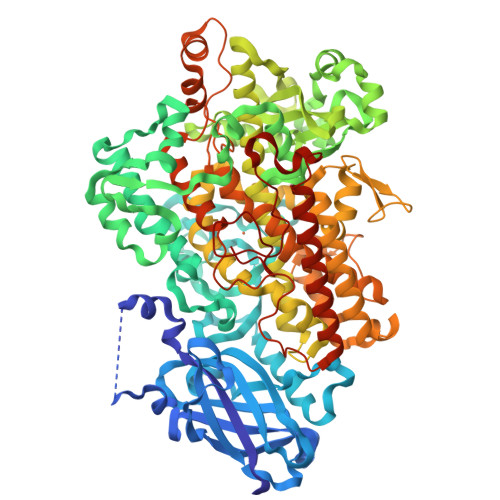
Seed linoleate 9S-lipoxygenase structureClick to view 3D structureSeed linoleate 9S-lipoxygenaseP24095Glycine maxPredicted (SEA)
Prediction Confidence Score
0.391
Applicability Domain
0.391
Statistical Significance
4.00e-05
Supporting Reference Compounds
1
E-value
0.311397
Peroxisome proliferator-activated receptor gamma structureClick to view 3D structurePeroxisome proliferator-activated receptor gammaP37231HumansPredicted (SEA)
Prediction Confidence Score
0.21
Applicability Domain
0.235 Low confidence
Statistical Significance
0.3831
Supporting Reference Compounds
192
E-value
2982.64
Peroxisome proliferator-activated receptor alpha structureClick to view 3D structurePeroxisome proliferator-activated receptor alphaQ07869HumansPredicted (SEA)
Prediction Confidence Score
0.202
Applicability Domain
0.214 Low confidence
Statistical Significance
0.3789
Supporting Reference Compounds
127
E-value
2949.47
Click to view 3D structureMitochondrial 2-oxodicarboxylate carrierQ9BQT8HumansPredicted (SEA)
Prediction Confidence Score
0.2
Applicability Domain
0.2 Low confidence
Statistical Significance
2.00e-05
Supporting Reference Compounds
1
E-value
0.155698
Peroxisome proliferator-activated receptor delta structureClick to view 3D structurePeroxisome proliferator-activated receptor deltaQ03181HumansPredicted (SEA)
Prediction Confidence Score
0.197
Applicability Domain
0.214 Low confidence
Statistical Significance
0.3609
Supporting Reference Compounds
89
E-value
2809.73
Click to view 3D structureCytochrome P450 2C23P24470Rattus norvegicusPredicted (SEA)
Prediction Confidence Score
0.194
Applicability Domain
0.194 Low confidence
Statistical Significance
0.0028
Supporting Reference Compounds
1
E-value
21.4864
Transient receptor potential cation channel subfamily A member 1 structureClick to view 3D structureTransient receptor potential cation channel subfamily A member 1O75762HumansPredicted (SEA)
Prediction Confidence Score
0.191
Applicability Domain
0.263 Low confidence
Statistical Significance
0.2871
Supporting Reference Compounds
70
E-value
2235.44
Click to view 3D structureEsteraseA3QR02Chilo suppressalisPredicted (SEA)
Prediction Confidence Score
0.188
Applicability Domain
0.188 Low confidence
Statistical Significance
0.002
Supporting Reference Compounds
1
E-value
15.4141
Transient receptor potential cation channel subfamily V member 2 structureClick to view 3D structureTransient receptor potential cation channel subfamily V member 2Q9WUD2Rattus norvegicusPredicted (SEA)
Prediction Confidence Score
0.184
Applicability Domain
0.214 Low confidence
Statistical Significance
0.0263
Supporting Reference Compounds
21
E-value
204.899
Cannabinoid receptor 1 structureClick to view 3D structureCannabinoid receptor 1P21554HumansPredicted (SEA)
Prediction Confidence Score
0.17
Applicability Domain
0.189 Low confidence
Statistical Significance
0.8946
Supporting Reference Compounds
200
E-value
6964.24
Click to view 3D structureCannabinoid receptor 1P20272Rattus norvegicusPredicted (SEA)
Prediction Confidence Score
0.17
Applicability Domain
0.214 Low confidence
Statistical Significance
0.5378
Supporting Reference Compounds
83
E-value
4186.42
Peroxisomal N(1)-acetyl-spermine/spermidine oxidase structureClick to view 3D structurePeroxisomal N(1)-acetyl-spermine/spermidine oxidaseQ8C0L6Mus musculusPredicted (SEA)
Prediction Confidence Score
0.169
Applicability Domain
0.179 Low confidence
Statistical Significance
2.20e-04
Supporting Reference Compounds
2
E-value
1.71268
Mu-type opioid receptor structureClick to view 3D structureMu-type opioid receptorP42866Mus musculusPredicted (SEA)
Prediction Confidence Score
0.169
Applicability Domain
0.208 Low confidence
Statistical Significance
0.4681
Supporting Reference Compounds
107
E-value
3643.81
Cannabinoid receptor 2 structureClick to view 3D structureCannabinoid receptor 2P34972HumansPredicted (SEA)
Prediction Confidence Score
0.166
Applicability Domain
0.189 Low confidence
Statistical Significance
0.8968
Supporting Reference Compounds
175
E-value
6981.36
Click to view 3D structureCannabinoid receptor 1P47746Mus musculusPredicted (SEA)
Prediction Confidence Score
0.165
Applicability Domain
0.189 Low confidence
Statistical Significance
0.3701
Supporting Reference Compounds
42
E-value
2881.59
Dipeptidase 1 structureClick to view 3D structureDipeptidase 1P22412Sus scrofaPredicted (SEA)
Prediction Confidence Score
0.162
Applicability Domain
0.162 Low confidence
Statistical Significance
0.0039
Supporting Reference Compounds
1
E-value
30.6726
All-trans-retinol dehydrogenase [NAD(+)] ADH7 structureClick to view 3D structureAll-trans-retinol dehydrogenase [NAD(+)] ADH7P40394HumansPredicted (SEA)
Prediction Confidence Score
0.16
Applicability Domain
0.16 Low confidence
Statistical Significance
0.009
Supporting Reference Compounds
1
E-value
70.0643
Click to view 3D structureFatty-acid amide hydrolase 1O00519HumansPredicted (SEA)
Prediction Confidence Score
0.159
Applicability Domain
0.214 Low confidence
Statistical Significance
0.8679
Supporting Reference Compounds
106
E-value
6756.38
Tyrosine-protein phosphatase non-receptor type 1 structureClick to view 3D structureTyrosine-protein phosphatase non-receptor type 1P18031HumansPredicted (SEA)
Prediction Confidence Score
0.158
Applicability Domain
0.214 Low confidence
Statistical Significance
0.806
Supporting Reference Compounds
197
E-value
6274.96
Delta-type opioid receptor structureClick to view 3D structureDelta-type opioid receptorP32300Mus musculusPredicted (SEA)
Prediction Confidence Score
0.154
Applicability Domain
0.235 Low confidence
Statistical Significance
0.7144
Supporting Reference Compounds
166
E-value
5561.7
Transient receptor potential cation channel subfamily V member 1 structureClick to view 3D structureTransient receptor potential cation channel subfamily V member 1Q8NER1HumansPredicted (SEA)
Prediction Confidence Score
0.151
Applicability Domain
0.171 Low confidence
Statistical Significance
0.928
Supporting Reference Compounds
104
E-value
7224.64
1-phosphatidylinositol 4,5-bisphosphate phosphodiesterase gamma-1 structureClick to view 3D structure1-phosphatidylinositol 4,5-bisphosphate phosphodiesterase gamma-1P08487Bos taurusPredicted (SEA)
Prediction Confidence Score
0.149
Applicability Domain
0.162 Low confidence
Statistical Significance
0.072
Supporting Reference Compounds
3
E-value
560.281
Fatty acid-binding protein, adipocyte structureClick to view 3D structureFatty acid-binding protein, adipocyteP15090HumansPredicted (SEA)
Prediction Confidence Score
0.148
Applicability Domain
0.214 Low confidence
Statistical Significance
0.5394
Supporting Reference Compounds
19
E-value
4199.19
Click to view 3D structureCannabinoid receptor 2P47936Mus musculusPredicted (SEA)
Prediction Confidence Score
0.146
Applicability Domain
0.189 Low confidence
Statistical Significance
0.6781
Supporting Reference Compounds
39
E-value
5279.03
Click to view 3D structureLysophosphatidic acid receptor 3Q9UBY5HumansPredicted (SEA)
Prediction Confidence Score
0.145
Applicability Domain
0.188 Low confidence
Statistical Significance
0.3958
Supporting Reference Compounds
21
E-value
3081.66
Concentrations
Not Available
External Links
DrugBank IDNot Available
HMDB IDHMDB0244254
FooDB IDNot Available
Phenol Explorer IDNot Available
KNApSAcK IDNot Available
BiGG IDNot Available
BioCyc IDNot Available
METLIN IDNot Available
PDB IDNot Available
Wikipedia LinkNot Available
Chemspider ID14692
ChEBI IDNot Available
PubChem Compound ID15439
Kegg Compound IDNot Available
YMDB IDNot Available
ECMDB IDNot Available
References
Synthesis ReferenceNot Available
MSDSNot Available
General ReferencesNot Available