Record Information
Version1.0
Creation Date2016-05-22 04:30:05 UTC
Update Date2026-08-22 19:37:33 UTC
Accession NumberCHEM017623
Identification
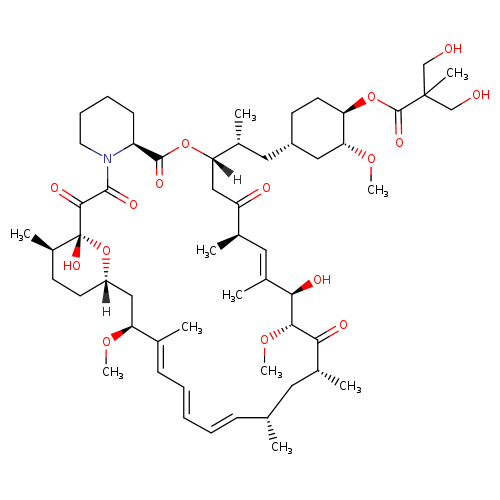
Common NameTemsirolimus
ClassSmall Molecule
Description
Temsirolimus is a derivative of sirolimus used in the treatment of renal cell carcinoma (RCC). It was developed by Wyeth Pharmaceuticals under the trade name Torisel. Temsirolimus was approved by the FDA in late May 2007 as well as the European Medicines Agency (EMEA) on November 2007.
Contaminant Sources
  • HMDB Contaminants - Urine
  • STOFF IDENT Compounds
  • ToxCast & Tox21 Chemicals
Contaminant TypeNot Available
Chemical Structure
Synonyms
ValueSource
CCI 779Kegg
42-[3-Hydroxy-2-(hydroxymethyl)-2-methylpropanoate]rapamycinKegg
ToriselKegg
42-[3-Hydroxy-2-(hydroxymethyl)-2-methylpropanoic acid]rapamycinGenerator
CCI-779HMDB
Wyeth brand OF temsirolimusHMDB
Rapamycin, 42-(3-hydroxy-2-(hydroxymethyl)-2-methylpropanoate)HMDB
Chemical FormulaC56H87NO16
Average Molecular Mass1030.287 g/mol
Monoisotopic Mass1029.602 g/mol
CAS Registry Number162635-04-3
IUPAC Name(1R,2R,4S)-4-[(2R)-2-[(1R,9S,12S,15R,16E,18R,19R,21R,23S,24E,26E,28E,30S,32S,35R)-1,18-dihydroxy-19,30-dimethoxy-15,17,21,23,29,35-hexamethyl-2,3,10,14,20-pentaoxo-11,36-dioxa-4-azatricyclo[30.3.1.0⁴,⁹]hexatriaconta-16,24,26,28-tetraen-12-yl]propyl]-2-methoxycyclohexyl 3-hydroxy-2-(hydroxymethyl)-2-methylpropanoate
Traditional Nametemsirolimus
SMILESOCC(C)(CO)C(=O)O[C@@H]1CC[C@@H](C[C@@H](C)[C@]2([H])CC(=O)[C@H](C)\C=C(C)\[C@@H](O)[C@@H](OC)C(=O)[C@H](C)C[C@H](C)\C=C\C=C\C=C(C)\[C@@H](OC)C[C@]3([H])CC[C@@H](C)[C@@](O)(O3)C(=O)C(=O)N3CCCC[C@H]3C(=O)O2)C[C@H]1OC
InChI IdentifierInChI=1S/C56H87NO16/c1-33-17-13-12-14-18-34(2)45(68-9)29-41-22-20-39(7)56(67,73-41)51(63)52(64)57-24-16-15-19-42(57)53(65)71-46(30-43(60)35(3)26-38(6)49(62)50(70-11)48(61)37(5)25-33)36(4)27-40-21-23-44(47(28-40)69-10)72-54(66)55(8,31-58)32-59/h12-14,17-18,26,33,35-37,39-42,44-47,49-50,58-59,62,67H,15-16,19-25,27-32H2,1-11H3/b14-12+,17-13+,34-18+,38-26+/t33-,35-,36-,37-,39-,40+,41+,42+,44-,45+,46+,47-,49-,50+,56-/m1/s1
InChI KeyCBPNZQVSJQDFBE-FUXHJELOSA-N
Chemical Taxonomy
Description Belongs to the class of organic compounds known as macrolide lactams. These are cyclic polyketides containing both a cyclic amide and a cyclic ester group.
KingdomOrganic compounds
Super ClassPhenylpropanoids and polyketides
ClassMacrolide lactams
Sub ClassNot Available
Direct ParentMacrolide lactams
Alternative Parents
Substituents
  • Macrolide lactam
  • Alpha-amino acid ester
  • Macrolide
  • Alpha-amino acid or derivatives
  • Beta-hydroxy acid
  • Dicarboxylic acid or derivatives
  • Hydroxy acid
  • Oxane
  • Piperidine
  • Tertiary carboxylic acid amide
  • Carboxamide group
  • Carboxylic acid ester
  • Hemiacetal
  • Ketone
  • Lactam
  • Lactone
  • Cyclic ketone
  • Secondary alcohol
  • Carboxylic acid derivative
  • Organoheterocyclic compound
  • Azacycle
  • Oxacycle
  • Dialkyl ether
  • Ether
  • Carbonyl group
  • Organic oxide
  • Organic nitrogen compound
  • Hydrocarbon derivative
  • Organic oxygen compound
  • Organonitrogen compound
  • Organooxygen compound
  • Organopnictogen compound
  • Alcohol
  • Primary alcohol
  • Aliphatic heteropolycyclic compound
Molecular FrameworkAliphatic heteropolycyclic compounds
External Descriptors
Biological Properties
StatusDetected and Not Quantified
OriginNot Available
Cellular LocationsNot Available
Biofluid LocationsNot Available
Tissue LocationsNot Available
PathwaysNot Available
ApplicationsNot Available
Biological RolesNot Available
Chemical RolesNot Available
Physical Properties
StateNot Available
AppearanceNot Available
Experimental Properties
PropertyValue
Melting PointNot Available
Boiling PointNot Available
SolubilityNot Available
Predicted Properties
PropertyValueSource
Water Solubility0.0024 g/LALOGPS
logP4.39ALOGPS
logP7.13ChemAxon
logS-5.6ALOGPS
pKa (Strongest Acidic)9.96ChemAxon
pKa (Strongest Basic)-2.9ChemAxon
Physiological Charge0ChemAxon
Hydrogen Acceptor Count14ChemAxon
Hydrogen Donor Count4ChemAxon
Polar Surface Area241.96 ŲChemAxon
Rotatable Bond Count11ChemAxon
Refractivity277.07 m³·mol⁻¹ChemAxon
Polarizability112.71 ųChemAxon
Number of Rings4ChemAxon
BioavailabilityNoChemAxon
Rule of FiveNoChemAxon
Ghose FilterNoChemAxon
Veber's RuleNoChemAxon
MDDR-like RuleYesChemAxon
Spectra
Spectra
Toxicity Profile
Route of ExposureNot Available
Mechanism of ToxicityNot Available
MetabolismNot Available
Toxicity ValuesNot Available
Lethal DoseNot Available
Carcinogenicity (IARC Classification)Not Available
Uses/SourcesNot Available
Minimum Risk LevelNot Available
Health EffectsNot Available
SymptomsNot Available
TreatmentNot Available
Concentrations
Not Available
External Links
DrugBank IDDB06287
HMDB IDHMDB0015632
FooDB IDNot Available
Phenol Explorer IDNot Available
KNApSAcK IDNot Available
BiGG IDNot Available
BioCyc IDNot Available
METLIN IDNot Available
PDB IDNot Available
Wikipedia LinkTemsirolimus
Chemspider ID21468899
ChEBI ID775133
PubChem Compound ID6918289
Kegg Compound IDC15182
YMDB IDNot Available
ECMDB IDNot Available
References
Synthesis ReferenceNot Available
MSDSNot Available
General References
1. Boni J, Leister C, Burns J, Cincotta M, Hug B, Moore L: Pharmacokinetic profile of temsirolimus with concomitant administration of cytochrome p450-inducing medications. J Clin Pharmacol. 2007 Nov;47(11):1430-9. Epub 2007 Oct 3.
2. Mounier N, Vignot S, Spano JP: [Update on clinical activity of CCI779 (temsirolimus), mTOR inhibitor]. Bull Cancer. 2006 Nov;93(11):1139-43.
3. Shuuin T, Karashima H: [Mammalian target of rapamycin, its mode of action and clinical response in metastatic clear cell carcinoma]. Gan To Kagaku Ryoho. 2009 Jul;36(7):1076-9.
4. Wyeth Pharmaceuticals Inc. Torisel® (temsirolimus) injection prescribing information. Philadelphia, PA: 2010 Sep.