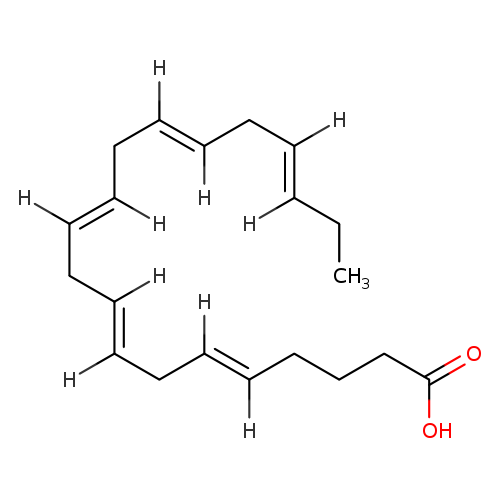
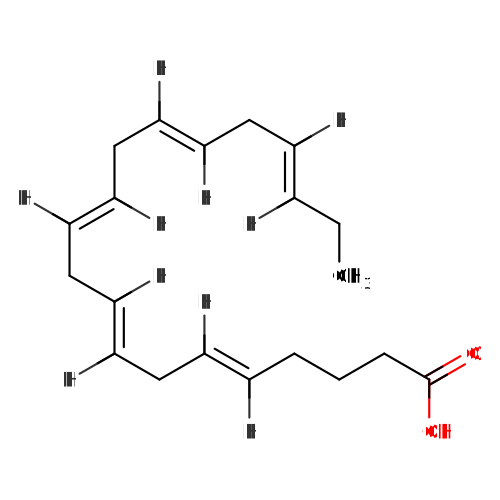
Eicosapentaenoic acid (C20H30O2) is a compound with an average molecular weight of 302.45 g/mol. Eicosapentaenoic acid belongs to the fatty acids and conjugates, a subclass of fatty acyls within the organic compounds. Industrially, it is used as a softener and conditioner.
The compound is found in or released from 21 recorded sources. These include electrical and electronic equipment such as antennas, amplifiers, magnets, emergency protective devices, and cores yokes or armatures, among four others. Within the food, food processing and cookware category, it is associated with food contact materials, the preparation of malt, vinegar, wine or sparkling wine, and molasses and the treatment of molasses, among three others. In household cleaning and consumer products, it is found in tobacco product cases, other smoking requisites, and non-electric simulated smoking devices. Additionally, it is found in building and construction materials specifically relating to fencing. Recorded exposure routes for the compound include oral, inhalation, and touch.
Eicosapentaenoic acid interacts with 12 recorded protein targets. It acts as an activator, agonist, or agonist for certain proteins and serves as a regulator, inducer, inhibitor, or substrate for Prostaglandin G/H synthase 1 (PTGS1), Prostaglandin G/H synthase 2 (PTGS2), Free fatty acid receptor 1 (FFAR1), and Acyl-CoA (8-3)-desaturase (FADS1), along with eight other proteins.
Belongs to the class of organic compounds known as long-chain fatty acids. These are fatty acids with an aliphatic tail that contains between 13 and 21 carbon atoms.