5-Nitroisophthalic acid (CED0019627)

Record Information
Version1.0
Creation Date2016-05-22 04:34:17 UTC
Update Date2026-08-24 21:15:44 UTC
SynCED IDCED0019627
Secondary Accession Numbers
  • CHEM017717
Identification
Common Name5-Nitroisophthalic acid
ClassSmall Molecule
Description
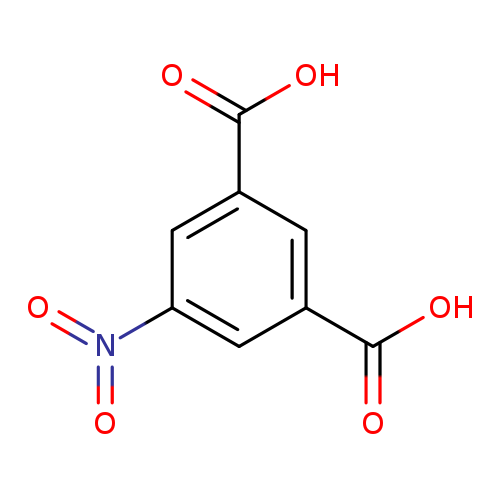
5-Nitroisophthalic acid (C8H5NO6) is an organic compound with an average molecular weight of 211.13 g/mol. 5-Nitroisophthalic acid belongs to the benzoic acids and derivatives, a subclass of benzene and substituted derivatives within the organic compounds. This compound is identified as being found in or released from seven recorded sources. These sources include drinking water and water supply, specifically drinking water, as well as food, food processing, and cookware in the context of food preservation. It is also associated with household cleaning and consumer products, specifically cigar cigarettes. Additionally, it is found in electrical and electronic equipment, including electric switches, electrically stimulated smoking devices, hybrid capacitors, and conductors or conductive bodies characterised by the conductive materials. The recorded route of exposure for 5-nitroisophthalic acid is oral.
Contaminant TypeNot Available
Chemical Structure
Synonyms
ValueSource
5-Nitrobenzene-1,3-dicarboxylateGenerator
5-Nitroisophthalic acidChEMBL
5-NitroisophthalateGenerator
Chemical FormulaC8H5NO6
Average Molecular Mass211.129 g/mol
Monoisotopic Mass211.012 g/mol
CAS Registry Number618-88-2
IUPAC Name5-nitrobenzene-1,3-dicarboxylic acid
Traditional Name5-nitrobenzene-1,3-dicarboxylic acid
SMILESOC(=O)C1=CC(=CC(=C1)C(O)=O)N(=O)=O
InChI IdentifierInChI=1S/C8H5NO6/c10-7(11)4-1-5(8(12)13)3-6(2-4)9(14)15/h1-3H,(H,10,11)(H,12,13)
InChI KeyNBDAHKQJXVLAID-UHFFFAOYSA-N
Chemical Taxonomy
Description Belongs to the class of organic compounds known as nitrobenzoic acids and derivatives. Nitrobenzoic acids and derivatives are compounds containing a nitrobenzoic acid moiety, which consists of a benzene ring bearing both a carboxylic acid group and a nitro group on two different ring carbon atoms.
KingdomOrganic compounds
Super ClassBenzenoids
ClassBenzene and substituted derivatives
Sub ClassBenzoic acids and derivatives
Direct ParentNitrobenzoic acids and derivatives
Alternative Parents
Substituents
  • Meta_phthalic_acid
  • Nitrobenzoate
  • Benzoic acid
  • Nitrobenzene
  • Nitroaromatic compound
  • Benzoyl
  • Dicarboxylic acid or derivatives
  • C-nitro compound
  • Organic nitro compound
  • Allyl-type 1,3-dipolar organic compound
  • Organic oxoazanium
  • Carboxylic acid
  • Carboxylic acid derivative
  • Propargyl-type 1,3-dipolar organic compound
  • Organic 1,3-dipolar compound
  • Organooxygen compound
  • Organonitrogen compound
  • Organic nitrogen compound
  • Hydrocarbon derivative
  • Organic oxide
  • Organopnictogen compound
  • Organic oxygen compound
  • Aromatic homomonocyclic compound
Molecular FrameworkAromatic homomonocyclic compounds
External DescriptorsNot Available
Biological Properties
StatusDetected and Not Quantified
OriginNot Available
Cellular LocationsNot Available
Biofluid LocationsNot Available
Tissue LocationsNot Available
ApplicationsNot Available
Biological RolesNot Available
Chemical RolesNot Available
Organoleptic EffectsNot Available
Physical Properties
StateNot Available
AppearanceNot Available
Experimental Properties
PropertyValue
Melting PointNot Available
Boiling PointNot Available
SolubilityNot Available
Predicted Properties
PropertyValueSource
Water Solubility0.35 g/LALOGPS
logP0.95ALOGPS
logP1.23ChemAxon
logS-2.8ALOGPS
pKa (Strongest Acidic)3.16ChemAxon
Physiological Charge-2ChemAxon
Hydrogen Acceptor Count6ChemAxon
Hydrogen Donor Count2ChemAxon
Polar Surface Area120.42 ŲChemAxon
Rotatable Bond Count3ChemAxon
Refractivity47.9 m³·mol⁻¹ChemAxon
Polarizability17.56 ųChemAxon
Number of Rings1ChemAxon
BioavailabilityYesChemAxon
Rule of FiveYesChemAxon
Ghose FilterYesChemAxon
Veber's RuleNoChemAxon
MDDR-like RuleNoChemAxon
Spectra
Spectra
Spectrum TypeDescriptionSplash KeyDeposition DateView
Predicted LC-MS/MSPredicted LC-MS/MS Spectrumsplash10-03di-0090000000-d4ff43d98d755b2f09acNot AvailableView Spectrum
Predicted LC-MS/MSPredicted LC-MS/MS Spectrumsplash10-0a4r-0890000000-c9ed187ade3dc5e43f71Not AvailableView Spectrum
Predicted LC-MS/MSPredicted LC-MS/MS Spectrumsplash10-053i-1920000000-412b1a04d264be80ba14Not AvailableView Spectrum
Predicted LC-MS/MSPredicted LC-MS/MS Spectrumsplash10-03di-0090000000-5f6b441d146a59b47baaNot AvailableView Spectrum
Predicted LC-MS/MSPredicted LC-MS/MS Spectrumsplash10-03di-0090000000-65ffa814f832d03fd6ccNot AvailableView Spectrum
Predicted LC-MS/MSPredicted LC-MS/MS Spectrumsplash10-0gvp-5930000000-ab7fd79c47ddbfccc404Not AvailableView Spectrum
Toxicity Profile
Toxicity Values
Toxicity ValueOrganismDose DescriptorRoute of ExposurePredicted or ExperimentalToxicity RatingReference
2292.0 Log mg/kg [1300:4100]RatLD50oralpredictedNot AvailableNot Available
Toxicity / Toxin ClassNot Available
Mechanism of ToxicityNot Available
Carcinogenicity (IARC Classification)Not Available
Minimum Risk LevelNot Available
SymptomsNot Available
TreatmentNot Available
Health Effects
Health EffectRelationshipDirectionDescriptionReference
Exposure Sources
Source IDSourceSectorReference
CEDs000115Drinking water?Drinking water can be a medium for synthetic chemical contamination, often originating from various industrial processes and agricultural practices.Drinking water & water supplyNot Available
CEDs000511Conductors Or Conductive Bodies Characterised By The Conductive Materials?Conductors, or conductive bodies, are materials that allow the flow of electrical current, typically made from metals such as copper, aluminum, or silver.Electrical & Electronic EquipmentPubChem
CEDs000517Electric Switches?Electric switches, integral components in numerous devices, can be a source of synthetic chemical contamination due to the materials and manufacturing processes involved in their production.Electrical & Electronic EquipmentPubChem
CEDs000518Electrically Stimulated Smoking Devices?Electrically stimulated smoking devices, commonly known as e-cigarettes or vape pens, utilize electrical components to heat a liquid solution, often containing nicotine, flavorings, and other additives, to produce an aerosol for inhalation.Electrical & Electronic EquipmentPubChem
CEDs000519Electrodes?Electrodes, used in various electrical and electronic applications, can be a source of synthetic chemical contamination due to the materials from which they are constructed and the processes involved in their manufacturing.Electrical & Electronic EquipmentPubChem
CEDs000524Hybrid Capacitors?Hybrid capacitors are energy storage devices that combine the properties of electrolytic and supercapacitors, utilizing a combination of electrochemical principles to achieve higher energy density and power density.Electrical & Electronic EquipmentPubChem
CEDs000545Food Preservation?Food preservation often involves the use of synthetic chemicals, such as preservatives, flavor enhancers, and color additives, to extend shelf life and enhance the sensory qualities of food products.Food, food processing & cookwarePubChem
CEDs000556Cigar Cigarettes?Cigar cigarettes are a source of synthetic chemical contamination due to the combustion of various tobacco blends and additives.Household cleaning & consumer productsPubChem
CEDs000580Manufacture Preparation Of Tobacco Products?The manufacture and preparation of tobacco products involve various processes that can result in the introduction of synthetic chemicals into the environment.Industrial manufacturing & chemical processingPubChem
CEDs000582Aircraft Carriers?Aircraft carriers are large naval vessels that serve as floating airbases, equipped with various systems that utilize synthetic chemicals.Marine, shipping & aquaculturePubChem
CEDs000611Anti Perspirants Or Body Deoderants?Antiperspirants and body deodorants commonly contain synthetic chemicals such as aluminum compounds, parabens, and synthetic fragrances.Personal care & cosmeticsPubChem
CEDs000633Azo Dyes?Azo dyes are synthetic organic compounds characterized by the presence of one or more azo groups (-N=N-), which are widely used for coloring textiles, leather, and furnishings.Textiles, leather & furnishingsPubChem
CEDs000678Nitrogenous Fertilisers?Nitrogenous fertilizers are synthetic chemical compounds primarily used to enhance plant growth by supplying essential nitrogen, a crucial nutrient for photosynthesis and protein synthesis.Agriculture & land managementPubChem
CEDs000696Nanotechnology?Nanotechnology involves the manipulation of materials at the molecular or atomic level, typically within the range of 1 to 100 nanometers.Industrial manufacturing & chemical processingPubChem
CEDs000734Coating Compositions?Coating compositions, which include paints, sealants, and varnishes, are formulated with a variety of synthetic chemicals such as solvents, resins, pigments, and additives.Building & ConstructionPubChem
CEDs000735Explosives?Explosives are chemical compounds or mixtures designed to undergo rapid decomposition, releasing energy in the form of gas and heat.Defense & military infrastructurePubChem
CEDs000739Inks?Inks are complex mixtures composed of pigments or dyes, solvents, resins, and additives used primarily for printing and writing applications.Paper, pulp & fiber productsPubChem
CEDs000740Paper?Paper production involves the processing of wood fibers and the use of various chemicals, which can lead to synthetic chemical contamination.Paper, pulp & fiber productsPubChem
CEDs000741Pigment Pastes?Pigment pastes are concentrated dispersions of pigments used to impart color and properties to materials.Paper, pulp & fiber productsPubChem
CEDs000743Sludge Treatment?Sludge treatment involves the processing of waste materials generated from wastewater treatment plants, which often contain a variety of organic and inorganic substances.Wastewater, sanitation & biosolidsPubChem
CEDs000744Water, Wastewater, & Sewage Treatment?Water, wastewater, and sewage treatment processes are critical for managing and mitigating pollutants in water systems.Wastewater, sanitation & biosolidsPubChem
Pathways
0 pathwaysPathway Source: PathBank

No pathways found

No metabolic pathways have been associated with this synthetic chemical

Targets
StructureProteinUniProt IDOrganismRelationshipDetails
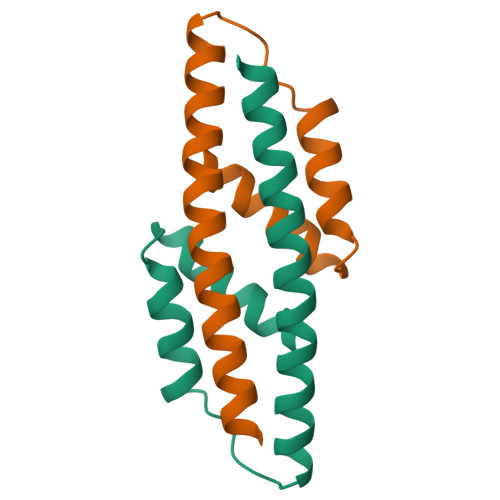
Endolysin structureClick to view 3D structureEndolysinP00720Enterobacteria phage T4Predicted (SEA)
Prediction Confidence Score
0.393
Applicability Domain
0.393
Statistical Significance
8.00e-05
Supporting Reference Compounds
1
E-value
0.622794
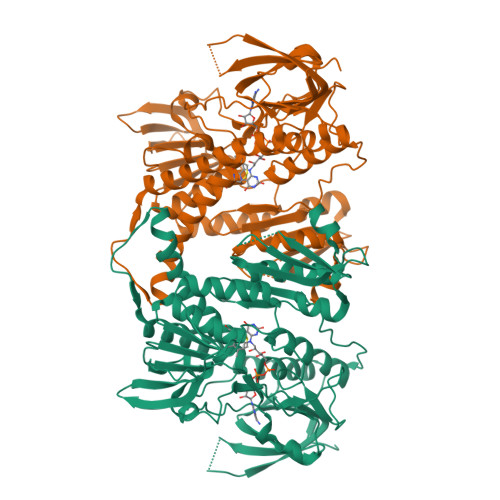
Carbonic anhydrase 9 structureClick to view 3D structureCarbonic anhydrase 9Q16790HumansPredicted (SEA)
Prediction Confidence Score
0.366
Applicability Domain
0.423
Statistical Significance
0.0097
Supporting Reference Compounds
372
E-value
75.6694
Carbonic anhydrase 2 structureClick to view 3D structureCarbonic anhydrase 2P00918HumansPredicted (SEA)
Prediction Confidence Score
0.366
Applicability Domain
0.423
Statistical Significance
0.0128
Supporting Reference Compounds
472
E-value
99.7249
Carbonic anhydrase 12 structureClick to view 3D structureCarbonic anhydrase 12O43570HumansPredicted (SEA)
Prediction Confidence Score
0.366
Applicability Domain
0.423
Statistical Significance
0.0094
Supporting Reference Compounds
332
E-value
73.4897
Carbonic anhydrase 1 structureClick to view 3D structureCarbonic anhydrase 1P00915HumansPredicted (SEA)
Prediction Confidence Score
0.366
Applicability Domain
0.423
Statistical Significance
0.0111
Supporting Reference Compounds
407
E-value
86.1791
Carbonic anhydrase 7 structureClick to view 3D structureCarbonic anhydrase 7P43166HumansPredicted (SEA)
Prediction Confidence Score
0.366
Applicability Domain
0.423
Statistical Significance
0.0063
Supporting Reference Compounds
242
E-value
49.3564
Carbonic anhydrase 14 structureClick to view 3D structureCarbonic anhydrase 14Q9ULX7HumansPredicted (SEA)
Prediction Confidence Score
0.366
Applicability Domain
0.423
Statistical Significance
0.0044
Supporting Reference Compounds
172
E-value
34.5651
Carbonic anhydrase 6 structureClick to view 3D structureCarbonic anhydrase 6P23280HumansPredicted (SEA)
Prediction Confidence Score
0.346
Applicability Domain
0.407
Statistical Significance
0.0047
Supporting Reference Compounds
151
E-value
36.7448
Click to view 3D structureCarbonic anhydrase 5A, mitochondrialP35218HumansPredicted (SEA)
Prediction Confidence Score
0.34
Applicability Domain
0.407
Statistical Significance
0.0074
Supporting Reference Compounds
165
E-value
57.4527
Aldo-keto reductase family 1 member C2 structureClick to view 3D structureAldo-keto reductase family 1 member C2P52895HumansPredicted (SEA)
Prediction Confidence Score
0.333
Applicability Domain
0.459
Statistical Significance
0.0021
Supporting Reference Compounds
40
E-value
16.2705
Aldo-keto reductase family 1 member C3 structureClick to view 3D structureAldo-keto reductase family 1 member C3P42330HumansPredicted (SEA)
Prediction Confidence Score
0.331
Applicability Domain
0.459
Statistical Significance
0.0027
Supporting Reference Compounds
57
E-value
20.9414
Click to view 3D structureCarbonic anhydraseQ2PCB5Dicentrarchus labraxPredicted (SEA)
Prediction Confidence Score
0.325
Applicability Domain
0.423
Statistical Significance
1.30e-04
Supporting Reference Compounds
9
E-value
1.01204
Thioredoxin reductase structureClick to view 3D structureThioredoxin reductaseP61076Plasmodium falciparum 3D7Predicted (SEA)
Prediction Confidence Score
0.324
Applicability Domain
0.324
Statistical Significance
6.00e-05
Supporting Reference Compounds
1
E-value
0.467095
Carbonic anhydrase 4 structureClick to view 3D structureCarbonic anhydrase 4P22748HumansPredicted (SEA)
Prediction Confidence Score
0.321
Applicability Domain
0.407
Statistical Significance
0.0094
Supporting Reference Compounds
193
E-value
73.5675
Click to view 3D structureATP-dependent molecular chaperone HSP82C4YTQ8Candida albicans (strain WO-1) (Yeast)Predicted (SEA)
Prediction Confidence Score
0.307
Applicability Domain
0.333
Statistical Significance
0.0065
Supporting Reference Compounds
205
E-value
50.9134
Click to view 3D structureCarbonic anhydrase 5B, mitochondrialQ9Y2D0HumansPredicted (SEA)
Prediction Confidence Score
0.307
Applicability Domain
0.407
Statistical Significance
0.011
Supporting Reference Compounds
157
E-value
85.9455
Catechol O-methyltransferase structureClick to view 3D structureCatechol O-methyltransferaseP22734Rattus norvegicusPredicted (SEA)
Prediction Confidence Score
0.305
Applicability Domain
0.419
Statistical Significance
6.00e-04
Supporting Reference Compounds
15
E-value
4.67095
Click to view 3D structureCarbonic anhydrase 13Q9D6N1Mus musculusPredicted (SEA)
Prediction Confidence Score
0.305
Applicability Domain
0.407
Statistical Significance
0.006
Supporting Reference Compounds
70
E-value
46.3981
Tyrosine-protein phosphatase non-receptor type 22 structureClick to view 3D structureTyrosine-protein phosphatase non-receptor type 22Q9Y2R2HumansPredicted (SEA)
Prediction Confidence Score
0.303
Applicability Domain
0.45
Statistical Significance
0.0016
Supporting Reference Compounds
78
E-value
12.1445
Click to view 3D structureD-aspartate oxidaseQ922Z0Mus musculusPredicted (SEA)
Prediction Confidence Score
0.303
Applicability Domain
0.303
Statistical Significance
9.00e-05
Supporting Reference Compounds
1
E-value
0.700643
Click to view 3D structureD-aspartate oxidaseD3ZDM7Rattus norvegicusPredicted (SEA)
Prediction Confidence Score
0.303
Applicability Domain
0.303
Statistical Significance
9.00e-05
Supporting Reference Compounds
1
E-value
0.700643
Fatty acid synthase structureClick to view 3D structureFatty acid synthaseP49327HumansPredicted (SEA)
Prediction Confidence Score
0.301
Applicability Domain
0.333
Statistical Significance
0.0045
Supporting Reference Compounds
117
E-value
34.7208
Carbonic anhydrase 3 structureClick to view 3D structureCarbonic anhydrase 3P07451HumansPredicted (SEA)
Prediction Confidence Score
0.296
Applicability Domain
0.407
Statistical Significance
0.0055
Supporting Reference Compounds
64
E-value
42.7392
Click to view 3D structureStreptokinase AP10520Streptococcus pyogenes serotype M1Predicted (SEA)
Prediction Confidence Score
0.292
Applicability Domain
0.333
Statistical Significance
0.0278
Supporting Reference Compounds
425
E-value
216.577
Intracellular chorismate mutase structureClick to view 3D structureIntracellular chorismate mutaseP9WIC1Mycobacterium tuberculosisPredicted (SEA)
Prediction Confidence Score
0.291
Applicability Domain
0.291 Low confidence
Statistical Significance
2.20e-04
Supporting Reference Compounds
1
E-value
1.71268
Concentrations
Not Available
External Links
DrugBank IDNot Available
HMDB IDNot Available
FooDB IDNot Available
Phenol Explorer IDNot Available
KNApSAcK IDNot Available
BiGG IDNot Available
BioCyc IDNot Available
METLIN IDNot Available
PDB IDNot Available
Wikipedia LinkNot Available
Chemspider IDNot Available
ChEBI IDNot Available
PubChem Compound ID12069
Kegg Compound IDNot Available
YMDB IDNot Available
ECMDB IDNot Available
References
Synthesis ReferenceNot Available
MSDSNot Available
General ReferencesNot Available