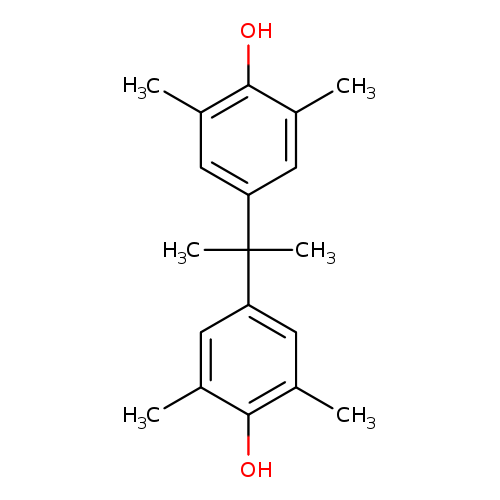
4,4'-Propane-2,2-diylbis(2,6-dimethylphenol) (CED0128109)

Record Information
Version1.0
Creation Date2016-05-22 06:26:59 UTC
Update Date2026-08-20 03:53:01 UTC
SynCED IDCED0128109
Secondary Accession Numbers
  • CHEM019751
Identification
Common Name4,4'-Propane-2,2-diylbis(2,6-dimethylphenol)
ClassSmall Molecule
Description
4,4'-Propane-2,2-diylbis(2,6-dimethylphenol) is an organic compound with the chemical formula C19H24O2 and an average molecular weight of 284.40 g/mol. 4,4'-Propane-2,2-diylbis(2,6-dimethylphenol) belongs to the diphenylmethanes, a subclass of benzene and substituted derivatives within the organic compounds. The substance is found in or released from 10 recorded sources. Within the category of electrical and electronic equipment, it is associated with antennas, cores yokes or armatures, emergency protective devices, magnets, and power cables, among one other source. In the context of food, food processing and cookware, it is linked to food contact materials and the processing of fish. Additionally, the compound is found in building and construction materials, specifically floors, as well as in household items such as coins. Recorded exposure routes for this compound include inhalation, oral ingestion, and touch.
Contaminant Type
  • Phenolic Antioxidant
Chemical Structure
SynonymsNot Available
Chemical FormulaC19H24O2
Average Molecular Mass284.399 g/mol
Monoisotopic Mass284.178 g/mol
CAS Registry Number5613-46-7
IUPAC Name4-[2-(4-hydroxy-3,5-dimethylphenyl)propan-2-yl]-2,6-dimethylphenol
Traditional Name4-[2-(4-hydroxy-3,5-dimethylphenyl)propan-2-yl]-2,6-dimethylphenol
SMILESCC1=CC(=CC(C)=C1O)C(C)(C)C1=CC(C)=C(O)C(C)=C1
InChI IdentifierInChI=1S/C19H24O2/c1-11-7-15(8-12(2)17(11)20)19(5,6)16-9-13(3)18(21)14(4)10-16/h7-10,20-21H,1-6H3
InChI KeyODJUOZPKKHIEOZ-UHFFFAOYSA-N
Chemical Taxonomy
Description Belongs to the class of organic compounds known as bisphenols. These are methylenediphenols, HOC6H4CH2C6H4OH, commonly p,p-methylenediphenol, and their substitution products (generally derived from condensation of two equivalent amounts of a phenol with an aldehyde or ketone).
KingdomOrganic compounds
Super ClassBenzenoids
ClassBenzene and substituted derivatives
Sub ClassDiphenylmethanes
Direct ParentBisphenols
Alternative Parents
Substituents
  • Bisphenol
  • Phenylpropane
  • M-xylene
  • Xylene
  • O-cresol
  • Phenol
  • Organic oxygen compound
  • Hydrocarbon derivative
  • Organooxygen compound
  • Aromatic homomonocyclic compound
Molecular FrameworkAromatic homomonocyclic compounds
External DescriptorsNot Available
Biological Properties
StatusDetected and Not Quantified
OriginNot Available
Cellular LocationsNot Available
Biofluid LocationsNot Available
Tissue LocationsNot Available
ApplicationsNot Available
Biological Roles
Chemical RolesNot Available
Organoleptic EffectsNot Available
Physical Properties
StateNot Available
AppearanceNot Available
Experimental Properties
PropertyValue
Melting PointNot Available
Boiling PointNot Available
SolubilityNot Available
Predicted Properties
PropertyValueSource
Water Solubility0.0036 g/LALOGPS
logP4.98ALOGPS
logP6.1ChemAxon
logS-4.9ALOGPS
pKa (Strongest Acidic)10.49ChemAxon
pKa (Strongest Basic)-5.4ChemAxon
Physiological Charge0ChemAxon
Hydrogen Acceptor Count2ChemAxon
Hydrogen Donor Count2ChemAxon
Polar Surface Area40.46 ŲChemAxon
Rotatable Bond Count2ChemAxon
Refractivity99.44 m³·mol⁻¹ChemAxon
Polarizability33.65 ųChemAxon
Number of Rings2ChemAxon
BioavailabilityYesChemAxon
Rule of FiveNoChemAxon
Ghose FilterNoChemAxon
Veber's RuleNoChemAxon
MDDR-like RuleNoChemAxon
Spectra
Spectra
Spectrum TypeDescriptionSplash KeyDeposition DateView
Predicted LC-MS/MSPredicted LC-MS/MS Spectrumsplash10-000i-0090000000-91a8634093db4d980a80Not AvailableView Spectrum
Predicted LC-MS/MSPredicted LC-MS/MS Spectrumsplash10-000i-0290000000-cd274b266c757377dd40Not AvailableView Spectrum
Predicted LC-MS/MSPredicted LC-MS/MS Spectrumsplash10-02ti-1980000000-87e9b294f649c2bb18d2Not AvailableView Spectrum
Predicted LC-MS/MSPredicted LC-MS/MS Spectrumsplash10-001i-0090000000-546dc1be94ddd524d658Not AvailableView Spectrum
Predicted LC-MS/MSPredicted LC-MS/MS Spectrumsplash10-001i-0090000000-ba139b7d3c96e9a73ca5Not AvailableView Spectrum
Predicted LC-MS/MSPredicted LC-MS/MS Spectrumsplash10-060r-0960000000-a767335358dbab6e1772Not AvailableView Spectrum
Toxicity Profile
Toxicity Values
Toxicity ValueOrganismDose DescriptorRoute of ExposurePredicted or ExperimentalToxicity RatingReference
2283.0 Log mg/kg [1300:4100]RatLD50oralpredictedNot AvailableNot Available
Toxicity / Toxin ClassNot Available
Mechanism of ToxicityNot Available
Carcinogenicity (IARC Classification)Not Available
Minimum Risk LevelNot Available
SymptomsNot Available
TreatmentNot Available
Health Effects
Health EffectRelationshipDirectionDescriptionReference
Exposure Sources
Source IDSourceSectorReference
CEDs000491Industrial manufacturing & chemical processingNot Available
CEDs000494Food contact materials?Food contact materials refer to substances and products that are intended to come into contact with food during processing, packaging, or preparation.Food, food processing & cookwareNot Available
CEDs000497Floors?Floors in built environments can be a significant source of synthetic chemical contamination due to the materials and finishes used in their construction.Building & ConstructionPubChem
CEDs000506Antennas?Antennas, commonly used in communication technologies, can be a source of synthetic chemical contamination through the materials and coatings used in their construction.Electrical & Electronic EquipmentPubChem
CEDs000511Conductors Or Conductive Bodies Characterised By The Conductive Materials?Conductors, or conductive bodies, are materials that allow the flow of electrical current, typically made from metals such as copper, aluminum, or silver.Electrical & Electronic EquipmentPubChem
CEDs000513Cores Yokes Or Armatures?Cores, yokes, or armatures are components commonly found in electrical devices, used to facilitate the magnetic and electrical functions within motors, transformers, and generators.Electrical & Electronic EquipmentPubChem
CEDs000517Electric Switches?Electric switches, integral components in numerous devices, can be a source of synthetic chemical contamination due to the materials and manufacturing processes involved in their production.Electrical & Electronic EquipmentPubChem
CEDs000519Electrodes?Electrodes, used in various electrical and electronic applications, can be a source of synthetic chemical contamination due to the materials from which they are constructed and the processes involved in their manufacturing.Electrical & Electronic EquipmentPubChem
CEDs000520Emergency Protective Devices?Emergency protective devices, such as circuit breakers and surge protectors, are essential components in electrical systems designed to prevent damage from overcurrent and surges.Electrical & Electronic EquipmentPubChem
CEDs000521Fixed Capacitors And Their Manufacture?Fixed capacitors are passive electronic components used to store and release electrical energy, playing a critical role in various circuits.Electrical & Electronic EquipmentPubChem
CEDs000524Hybrid Capacitors?Hybrid capacitors are energy storage devices that combine the properties of electrolytic and supercapacitors, utilizing a combination of electrochemical principles to achieve higher energy density and power density.Electrical & Electronic EquipmentPubChem
CEDs000527Magnets?Magnets, commonly used in various electrical and electronic applications, can be a source of synthetic chemical contamination due to the materials used in their production.Electrical & Electronic EquipmentPubChem
CEDs000529Power Cables?Power cables are used to transmit electrical energy and are typically composed of conductive materials, insulation, and protective coatings.Electrical & Electronic EquipmentPubChem
CEDs000530Radio Transmission Systems?Radio transmission systems utilize a variety of synthetic chemicals in their manufacturing and maintenance processes.Electrical & Electronic EquipmentPubChem
CEDs000551Processing Fish?Processing fish can lead to synthetic chemical contamination through various stages of production and preservation.Food, food processing & cookwarePubChem
CEDs000561Perfumes Within Detergents And Soaps?Perfumes within detergents and soaps are synthetic fragrance compounds added to enhance the sensory experience of cleaning products.Household cleaning & consumer productsPubChem
CEDs000563Soap Detergents?Soap detergents are synthetic surfactants designed to enhance the cleaning efficacy of water by reducing surface tension, allowing for better interaction with dirt and grease.Household cleaning & consumer productsPubChem
CEDs000571Coins?Coins can serve as a source of synthetic chemical contamination due to their production processes and the materials used in their composition.Household itemsPubChem
CEDs000581Paper Making Machines?Paper making machines utilize various synthetic chemicals throughout the production process, including additives, coatings, and bleaching agents.Industrial manufacturing & chemical processingPubChem
CEDs000611Anti Perspirants Or Body Deoderants?Antiperspirants and body deodorants commonly contain synthetic chemicals such as aluminum compounds, parabens, and synthetic fragrances.Personal care & cosmeticsPubChem
CEDs000617Lip Care Products?Lip care products, including lipsticks, balms, and glosses, often contain a variety of synthetic chemicals such as parabens, phthalates, and synthetic fragrances.Personal care & cosmeticsPubChem
CEDs000618Lip Makeup Products?Lip makeup products, such as lipsticks, lip glosses, and lip liners, often contain a variety of synthetic chemicals, including pigments, preservatives, and emollients.Personal care & cosmeticsPubChem
CEDs000630Toys?Toys, particularly those made from synthetic materials such as plastics, can be a source of chemical contamination due to the presence of various additives and compounds used in their production.Recreation & sports surfacesPubChem
CEDs000632Apparel?Apparel production often involves the use of various synthetic chemicals, including dyes, finishing agents, and preservatives.Textiles, leather & furnishingsPubChem
CEDs000642Footwear?Footwear production often involves the use of various synthetic chemicals, such as adhesives, dyes, and treatments, which can contribute to environmental contamination.Textiles, leather & furnishingsPubChem
CEDs000650Purses Luggage Hand Bags?Purses, luggage, and handbags are often manufactured using synthetic materials such as polyvinyl chloride (PVC), polyurethane, and various types of nylon.Textiles, leather & furnishingsPubChem
CEDs000652Ropes?Ropes manufactured from synthetic fibers, such as polypropylene, nylon, and polyester, are widely used in various applications, including marine, construction, and outdoor activities.Textiles, leather & furnishingsPubChem
CEDs000654Sleeve Links?Sleeve links are components typically used in the manufacturing of garments and accessories, particularly in the production of high-quality clothing items.Textiles, leather & furnishingsPubChem
CEDs000662Yarns Or Threads?Yarns or threads used in textiles can be a source of synthetic chemical contamination due to the production processes and treatments they undergo.Textiles, leather & furnishingsPubChem
CEDs000671Airplanes And Helicopters?Airplanes and helicopters are significant sources of synthetic chemical contamination primarily through the use of aviation fuels, lubricants, and de-icing agents.Aviation & AerospacePubChem
CEDs000684Cements?Cements are a composite material primarily used as a binding agent in construction applications, formed by the calcination of limestone and clay minerals at high temperatures.Building & ConstructionPubChem
CEDs000685Ceramics?Ceramics can be a source of synthetic chemical contamination through various additives and processing agents used in their production.Building & ConstructionPubChem
CEDs000688Glass Coatings?Glass coatings are synthetic chemical formulations applied to glass surfaces to enhance properties such as durability, UV resistance, and aesthetic appeal.Building & ConstructionPubChem
CEDs000689Glass Fibres?Glass fibres are composed of fine strands of glass, commonly utilized for their tensile strength and lightweight properties.Building & ConstructionPubChem
CEDs000692Silica Free Oxide Glass?Silica Free Oxide Glass is a type of glass that is produced using alternative materials to traditional silica-based formulations.Building & ConstructionPubChem
CEDs000693Silica Glass?Silica glass, primarily composed of silicon dioxide (SiO2), is widely used in various applications, including windows, glass facades, and insulation materials.Building & ConstructionPubChem
CEDs000696Nanotechnology?Nanotechnology involves the manipulation of materials at the molecular or atomic level, typically within the range of 1 to 100 nanometers.Industrial manufacturing & chemical processingPubChem
CEDs000707Books?Books can be a source of synthetic chemical contamination due to the use of various chemicals in their production and preservation processes.Paper, pulp & fiber productsPubChem
CEDs000727Printing Machines Or Presses?Printing machines or presses commonly utilize synthetic chemicals such as inks, solvents, and cleaning agents.Paper, pulp & fiber productsPubChem
CEDs000734Coating Compositions?Coating compositions, which include paints, sealants, and varnishes, are formulated with a variety of synthetic chemicals such as solvents, resins, pigments, and additives.Building & ConstructionPubChem
CEDs000739Inks?Inks are complex mixtures composed of pigments or dyes, solvents, resins, and additives used primarily for printing and writing applications.Paper, pulp & fiber productsPubChem
CEDs000740Paper?Paper production involves the processing of wood fibers and the use of various chemicals, which can lead to synthetic chemical contamination.Paper, pulp & fiber productsPubChem
CEDs000741Pigment Pastes?Pigment pastes are concentrated dispersions of pigments used to impart color and properties to materials.Paper, pulp & fiber productsPubChem
CEDs000742Leather Tanning?Leather tanning is a process that transforms raw animal hides into durable leather through the application of various chemicals, including chromium salts, aldehydes, and vegetable tannins.Textiles, leather & furnishingsPubChem
CEDs000744Water, Wastewater, & Sewage Treatment?Water, wastewater, and sewage treatment processes are critical for managing and mitigating pollutants in water systems.Wastewater, sanitation & biosolidsPubChem
Pathways
0 pathwaysPathway Source: PathBank

No pathways found

No metabolic pathways have been associated with this synthetic chemical

Targets
StructureProteinUniProt IDOrganismRelationshipDetails
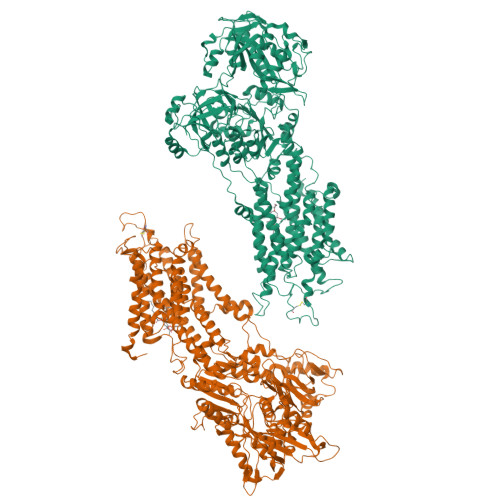
Click to view 3D structureSarcoplasmic/endoplasmic reticulum calcium ATPase 2P11507Rattus norvegicusPredicted (SEA)
Prediction Confidence Score
0.435
Applicability Domain
0.435
Statistical Significance
4.00e-05
Supporting Reference Compounds
1
E-value
0.311397
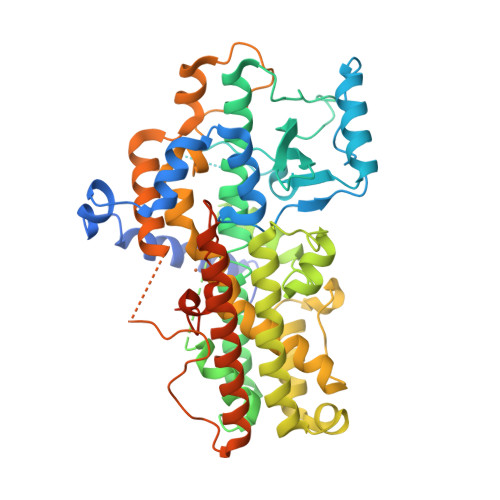
Sarcoplasmic/endoplasmic reticulum calcium ATPase 1 structureClick to view 3D structureSarcoplasmic/endoplasmic reticulum calcium ATPase 1P04191Oryctolagus cuniculusPredicted (SEA)
Prediction Confidence Score
0.325
Applicability Domain
0.565
Statistical Significance
9.00e-05
Supporting Reference Compounds
15
E-value
0.700643
Estrogen receptor beta structureClick to view 3D structureEstrogen receptor betaQ92731HumansPredicted (SEA)
Prediction Confidence Score
0.261
Applicability Domain
0.435
Statistical Significance
0.0384
Supporting Reference Compounds
174
E-value
298.941
Androgen receptor structureClick to view 3D structureAndrogen receptorP10275HumansPredicted (SEA)
Prediction Confidence Score
0.254
Applicability Domain
0.435
Statistical Significance
0.03
Supporting Reference Compounds
146
E-value
233.314
Polyunsaturated fatty acid lipoxygenase ALOX12 structureClick to view 3D structurePolyunsaturated fatty acid lipoxygenase ALOX12P18054HumansPredicted (SEA)
Prediction Confidence Score
0.252
Applicability Domain
0.565
Statistical Significance
0.0044
Supporting Reference Compounds
31
E-value
34.3315
Click to view 3D structurePolyunsaturated fatty acid lipoxygenase ALOX15P16050HumansPredicted (SEA)
Prediction Confidence Score
0.251
Applicability Domain
0.565
Statistical Significance
0.0076
Supporting Reference Compounds
46
E-value
59.2433
Polyunsaturated fatty acid lipoxygenase ALOX15 structureClick to view 3D structurePolyunsaturated fatty acid lipoxygenase ALOX15P12530Oryctolagus cuniculusPredicted (SEA)
Prediction Confidence Score
0.25
Applicability Domain
0.435
Statistical Significance
0.0069
Supporting Reference Compounds
47
E-value
53.4046
Carbonic anhydrase 2 structureClick to view 3D structureCarbonic anhydrase 2P00918HumansPredicted (SEA)
Prediction Confidence Score
0.25
Applicability Domain
0.4
Statistical Significance
0.1676
Supporting Reference Compounds
472
E-value
1304.52
Estrogen receptor structureClick to view 3D structureEstrogen receptorP03372HumansPredicted (SEA)
Prediction Confidence Score
0.25
Applicability Domain
0.435
Statistical Significance
0.0466
Supporting Reference Compounds
201
E-value
362.622
Prostaglandin G/H synthase 1 structureClick to view 3D structureProstaglandin G/H synthase 1P23219HumansPredicted (SEA)
Prediction Confidence Score
0.244
Applicability Domain
0.267 Low confidence
Statistical Significance
0.0688
Supporting Reference Compounds
136
E-value
535.992
Click to view 3D structurePolyunsaturated fatty acid 5-lipoxygenaseP12527Rattus norvegicusPredicted (SEA)
Prediction Confidence Score
0.244
Applicability Domain
0.257 Low confidence
Statistical Significance
0.0346
Supporting Reference Compounds
78
E-value
269.125
5-hydroxytryptamine receptor 6 structureClick to view 3D structure5-hydroxytryptamine receptor 6P50406HumansPredicted (SEA)
Prediction Confidence Score
0.243
Applicability Domain
0.435
Statistical Significance
0.2111
Supporting Reference Compounds
536
E-value
1643.32
Nuclear receptor ROR-gamma structureClick to view 3D structureNuclear receptor ROR-gammaP51449HumansPredicted (SEA)
Prediction Confidence Score
0.237
Applicability Domain
0.435
Statistical Significance
0.0469
Supporting Reference Compounds
102
E-value
365.191
Prostaglandin G/H synthase 2 structureClick to view 3D structureProstaglandin G/H synthase 2Q05769Mus musculusPredicted (SEA)
Prediction Confidence Score
0.236
Applicability Domain
0.257 Low confidence
Statistical Significance
0.0226
Supporting Reference Compounds
43
E-value
175.939
5-hydroxytryptamine receptor 2B structureClick to view 3D structure5-hydroxytryptamine receptor 2BP41595HumansPredicted (SEA)
Prediction Confidence Score
0.234
Applicability Domain
0.32
Statistical Significance
0.3875
Supporting Reference Compounds
686
E-value
3016.81
Glutathione reductase structureClick to view 3D structureGlutathione reductaseP41921Saccharomyces cerevisiae S288cPredicted (SEA)
Prediction Confidence Score
0.232
Applicability Domain
0.258 Low confidence
Statistical Significance
2.90e-04
Supporting Reference Compounds
2
E-value
2.25763
Transthyretin structureClick to view 3D structureTransthyretinP02766HumansPredicted (SEA)
Prediction Confidence Score
0.228
Applicability Domain
0.297 Low confidence
Statistical Significance
0.0313
Supporting Reference Compounds
55
E-value
243.512
Short transient receptor potential channel 4 structureClick to view 3D structureShort transient receptor potential channel 4Q9QUQ5Mus musculusPredicted (SEA)
Prediction Confidence Score
0.226
Applicability Domain
0.333
Statistical Significance
0.1826
Supporting Reference Compounds
128
E-value
1421.76
Glycogen synthase kinase-3 beta structureClick to view 3D structureGlycogen synthase kinase-3 betaP49841HumansPredicted (SEA)
Prediction Confidence Score
0.225
Applicability Domain
0.435
Statistical Significance
0.661
Supporting Reference Compounds
1157
E-value
5145.99
Click to view 3D structureBeta-ketoacyl-ACP-synthase IIIO77078Plasmodium falciparumPredicted (SEA)
Prediction Confidence Score
0.225
Applicability Domain
0.225 Low confidence
Statistical Significance
0.0066
Supporting Reference Compounds
1
E-value
51.0691
Dual specificity tyrosine-phosphorylation-regulated kinase 1A structureClick to view 3D structureDual specificity tyrosine-phosphorylation-regulated kinase 1AQ13627HumansPredicted (SEA)
Prediction Confidence Score
0.225
Applicability Domain
0.435
Statistical Significance
0.5993
Supporting Reference Compounds
906
E-value
4665.27
Dual specificity protein kinase CLK4 structureClick to view 3D structureDual specificity protein kinase CLK4Q9HAZ1HumansPredicted (SEA)
Prediction Confidence Score
0.223
Applicability Domain
0.435
Statistical Significance
0.5839
Supporting Reference Compounds
742
E-value
4545.54
Vacuolar aminopeptidase 1 structureClick to view 3D structureVacuolar aminopeptidase 1P14904Saccharomyces cerevisiae S288cPredicted (SEA)
Prediction Confidence Score
0.222
Applicability Domain
0.222 Low confidence
Statistical Significance
0.0014
Supporting Reference Compounds
1
E-value
11.2881
Click to view 3D structureL-lactate dehydrogenase B chainP16125Mus musculusPredicted (SEA)
Prediction Confidence Score
0.22
Applicability Domain
0.22 Low confidence
Statistical Significance
4.20e-04
Supporting Reference Compounds
1
E-value
3.26967
Prostaglandin G/H synthase 2 structureClick to view 3D structureProstaglandin G/H synthase 2P35354HumansPredicted (SEA)
Prediction Confidence Score
0.216
Applicability Domain
0.243 Low confidence
Statistical Significance
0.291
Supporting Reference Compounds
201
E-value
2265.49
Concentrations
Not Available
External Links
DrugBank IDNot Available
HMDB IDNot Available
FooDB IDNot Available
Phenol Explorer IDNot Available
KNApSAcK IDNot Available
BiGG IDNot Available
BioCyc IDNot Available
METLIN IDNot Available
PDB IDNot Available
Wikipedia LinkNot Available
Chemspider IDNot Available
ChEBI IDNot Available
PubChem Compound ID79717
Kegg Compound IDNot Available
YMDB IDNot Available
ECMDB IDNot Available
References
Synthesis ReferenceNot Available
MSDSNot Available
General ReferencesNot Available