| Identification |
|---|
| Common Name | Apafant |
|---|
| Class | Small Molecule |
|---|
| Description | |
|---|
| Contaminant Sources | - ToxCast & Tox21 Chemicals
|
|---|
| Contaminant Type | Not Available |
|---|
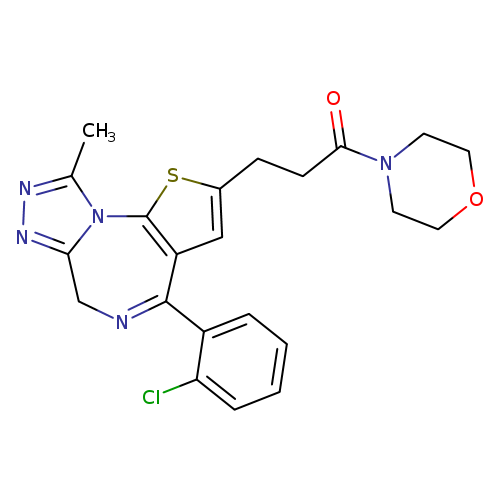
| Chemical Structure | |
|---|
| Synonyms | | Value | Source |
|---|
| WEB 2086 BS | HMDB | | Triazolodiazepine | HMDB | | 3-(4-(2-Chlorophenyl)-9-methyl-6H-thieno(3,2-F)(1,2,4)triazolo(4,3-a)(1,4)diazepine-2-yl)-1-(4-morpholinyl)-1-propanone | HMDB |
|
|---|
| Chemical Formula | C22H22ClN5O2S |
|---|
| Average Molecular Mass | 455.960 g/mol |
|---|
| Monoisotopic Mass | 455.118 g/mol |
|---|
| CAS Registry Number | 105219-56-5 |
|---|
| IUPAC Name | 3-[7-(2-chlorophenyl)-13-methyl-3-thia-1,8,11,12-tetraazatricyclo[8.3.0.0²,⁶]trideca-2(6),4,7,10,12-pentaen-4-yl]-1-(morpholin-4-yl)propan-1-one |
|---|
| Traditional Name | 3-[7-(2-chlorophenyl)-13-methyl-3-thia-1,8,11,12-tetraazatricyclo[8.3.0.0²,⁶]trideca-2(6),4,7,10,12-pentaen-4-yl]-1-(morpholin-4-yl)propan-1-one |
|---|
| SMILES | CC1=NN=C2CN=C(C3=C(SC(CCC(=O)N4CCOCC4)=C3)N12)C1=CC=CC=C1Cl |
|---|
| InChI Identifier | InChI=1S/C22H22ClN5O2S/c1-14-25-26-19-13-24-21(16-4-2-3-5-18(16)23)17-12-15(31-22(17)28(14)19)6-7-20(29)27-8-10-30-11-9-27/h2-5,12H,6-11,13H2,1H3 |
|---|
| InChI Key | JGPJQFOROWSRRS-UHFFFAOYSA-N |
|---|
| Chemical Taxonomy |
|---|
| Description | Belongs to the class of organic compounds known as thienodiazepines. These are heteropolycyclic containing a thiophene ring fused to a diazepine ring. Thiophene is 5-membered ring consisting of four carbon and one sulfur atoms. Diazepine is a 7-membered ring consisting of five carbon and two nitrogen atoms. |
|---|
| Kingdom | Organic compounds |
|---|
| Super Class | Organoheterocyclic compounds |
|---|
| Class | Thienodiazepines |
|---|
| Sub Class | Not Available |
|---|
| Direct Parent | Thienodiazepines |
|---|
| Alternative Parents | |
|---|
| Substituents | - Thieno-para-diazepine
- 2,3,5-trisubstituted thiophene
- Para-diazepine
- Halobenzene
- Chlorobenzene
- Morpholine
- Oxazinane
- Aryl chloride
- Aryl halide
- Benzenoid
- Monocyclic benzene moiety
- Tertiary carboxylic acid amide
- Thiophene
- Azole
- 1,2,4-triazole
- Heteroaromatic compound
- Ketimine
- Carboxamide group
- Oxacycle
- Carboxylic acid derivative
- Azacycle
- Dialkyl ether
- Ether
- Organic 1,3-dipolar compound
- Propargyl-type 1,3-dipolar organic compound
- Organic oxide
- Organopnictogen compound
- Organic oxygen compound
- Organic nitrogen compound
- Hydrocarbon derivative
- Imine
- Carbonyl group
- Organooxygen compound
- Organohalogen compound
- Organochloride
- Organonitrogen compound
- Aromatic heteropolycyclic compound
|
|---|
| Molecular Framework | Aromatic heteropolycyclic compounds |
|---|
| External Descriptors | Not Available |
|---|