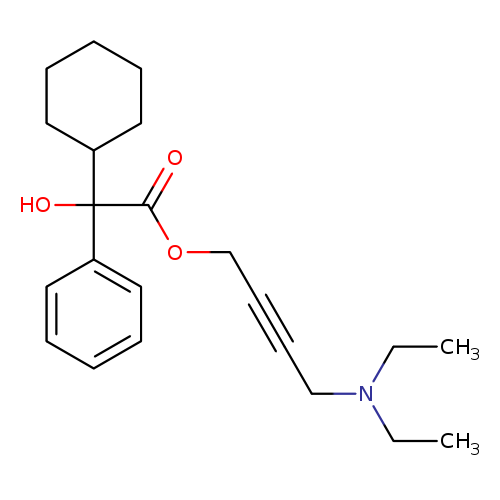
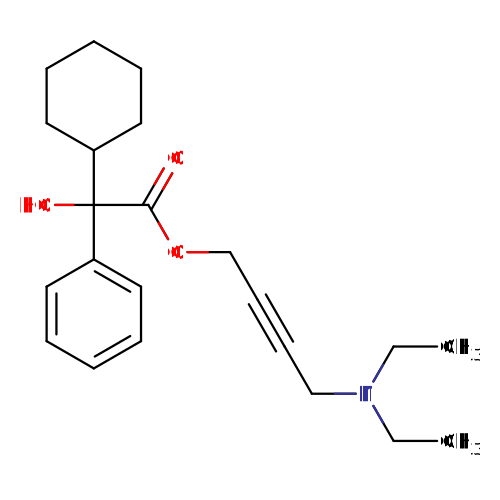
Oxybutynin is an organic compound with the formula C22H31NO3 and an average molecular weight of 357.49 g/mol. Oxybutynin belongs to the benzene and substituted derivatives, a class of benzenoids within the organic compounds.
The compound is recorded as being found in or released from 11 different sources. Within healthcare, pharmaceuticals, and veterinary products, it is used in urologicals. In the category of food, food processing, and cookware, it is used in food preservation. It is also found in household cleaning and consumer products, including perfumes within detergents and soaps, cigar cigarettes, non electric simulated smoking devices, and other smoking requisites. Additionally, it is associated with electrical and electronic equipment, specifically antennas, conductors or conductive bodies characterised by the conductive materials, electrically stimulated smoking devices, hybrid capacitors, and power cables. Recorded routes of exposure for the compound include oral, topical, and transdermal administration.
In terms of biological activity, oxybutynin has three recorded protein targets. It acts as an antagonist of the muscarinic acetylcholine receptor M1 (CHRM1), the muscarinic acetylcholine receptor M2 (CHRM2), and the muscarinic acetylcholine receptor M3 (CHRM3).
Belongs to the class of organic compounds known as benzene and substituted derivatives. These are aromatic compounds containing one monocyclic ring system consisting of benzene.