Maduramicin (CED0012180)

Record Information
Version1.0
Creation Date2016-05-25 20:53:06 UTC
Update Date2026-04-14 18:16:37 UTC
SynCED IDCED0012180
Secondary Accession Numbers
  • CHEM023176
Identification
Common NameMaduramicin
ClassSmall Molecule
Description
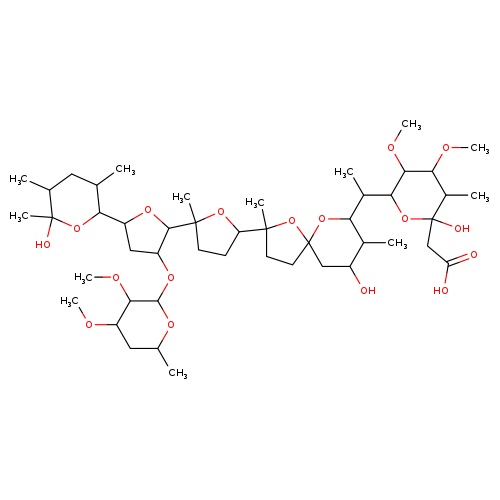
Maduramicin belongs to the carbohydrates and carbohydrate conjugates, a subclass of organooxygen compounds within the organic compounds. It has the chemical formula C47H80O17. With an average molecular weight of 917.13 g/mol, Maduramicin is a heavy molecule.
Contaminant TypeNot Available
Chemical Structure
Synonyms
ValueSource
Antibiotic CL 273703HMDB
Antibiotic LL-C 23024a-aHMDB
CL 273703HMDB
CygroHMDB
LL-C 23024a-aHMDB
Maduramicin aHMDB
Maduramicin, inn, usanHMDB
X 14868aHMDB
2-{6-[1-(2-{3'-[(3,4-dimethoxy-6-methyloxan-2-yl)oxy]-5'-(6-hydroxy-3,5,6-trimethyloxan-2-yl)-2-methyl-[2,2'-bioxolane]-5-yl}-9-hydroxy-2,8-dimethyl-1,6-dioxaspiro[4.5]decan-7-yl)ethyl]-2-hydroxy-4,5-dimethoxy-3-methyloxan-2-yl}acetateHMDB
Chemical FormulaC47H80O17
Average Molecular Mass917.128 g/mol
Monoisotopic Mass916.540 g/mol
CAS Registry Number79356-08-4
IUPAC Name2-(6-{1-[2-(5-{3-[(3,4-dimethoxy-6-methyloxan-2-yl)oxy]-5-(6-hydroxy-3,5,6-trimethyloxan-2-yl)oxolan-2-yl}-5-methyloxolan-2-yl)-9-hydroxy-2,8-dimethyl-1,6-dioxaspiro[4.5]decan-7-yl]ethyl}-2-hydroxy-4,5-dimethoxy-3-methyloxan-2-yl)acetic acid
Traditional Name(6-{1-[2-(5-{3-[(3,4-dimethoxy-6-methyloxan-2-yl)oxy]-5-(6-hydroxy-3,5,6-trimethyloxan-2-yl)oxolan-2-yl}-5-methyloxolan-2-yl)-9-hydroxy-2,8-dimethyl-1,6-dioxaspiro[4.5]decan-7-yl]ethyl}-2-hydroxy-4,5-dimethoxy-3-methyloxan-2-yl)acetic acid
SMILESCOC1CC(C)OC(OC2CC(OC2C2(C)CCC(O2)C2(C)CCC3(CC(O)C(C)C(O3)C(C)C3OC(O)(CC(O)=O)C(C)C(OC)C3OC)O2)C2OC(C)(O)C(C)CC2C)C1OC
InChI IdentifierInChI=1S/C47H80O17/c1-23-18-24(2)45(9,51)61-35(23)31-20-32(59-42-39(55-12)30(53-10)19-25(3)57-42)41(58-31)44(8)15-14-33(60-44)43(7)16-17-46(64-43)21-29(48)26(4)36(62-46)27(5)37-40(56-13)38(54-11)28(6)47(52,63-37)22-34(49)50/h23-33,35-42,48,51-52H,14-22H2,1-13H3,(H,49,50)
InChI KeyVVYPHUVLJAPZHM-UHFFFAOYSA-N
Chemical Taxonomy
Description Belongs to the class of organic compounds known as c-glycosyl compounds. These are glycoside in which a sugar group is bonded through one carbon to another group via a C-glycosidic bond.
KingdomOrganic compounds
Super ClassOrganic oxygen compounds
ClassOrganooxygen compounds
Sub ClassCarbohydrates and carbohydrate conjugates
Direct ParentC-glycosyl compounds
Alternative Parents
Substituents
  • C-glycosyl compound
  • Ketal
  • Monosaccharide
  • Oxane
  • Tetrahydrofuran
  • Hemiacetal
  • Secondary alcohol
  • Acetal
  • Carboxylic acid derivative
  • Carboxylic acid
  • Dialkyl ether
  • Ether
  • Organoheterocyclic compound
  • Oxacycle
  • Monocarboxylic acid or derivatives
  • Carbonyl group
  • Hydrocarbon derivative
  • Alcohol
  • Organic oxide
  • Aliphatic heteropolycyclic compound
Molecular FrameworkAliphatic heteropolycyclic compounds
External DescriptorsNot Available
Biological Properties
StatusDetected and Not Quantified
OriginNot Available
Cellular LocationsNot Available
Biofluid LocationsNot Available
Tissue LocationsNot Available
ApplicationsNot Available
Biological RolesNot Available
Chemical RolesNot Available
Organoleptic EffectsNot Available
Physical Properties
StateNot Available
AppearanceNot Available
Experimental Properties
PropertyValue
Melting PointNot Available
Boiling PointNot Available
SolubilityNot Available
Predicted Properties
PropertyValueSource
Water Solubility0.017 g/LALOGPS
logP2.4ALOGPS
logP4.56ChemAxon
logS-4.7ALOGPS
pKa (Strongest Acidic)4.01ChemAxon
pKa (Strongest Basic)-2.9ChemAxon
Physiological Charge-1ChemAxon
Hydrogen Acceptor Count17ChemAxon
Hydrogen Donor Count4ChemAxon
Polar Surface Area208.75 ŲChemAxon
Rotatable Bond Count13ChemAxon
Refractivity227.7 m³·mol⁻¹ChemAxon
Polarizability99.21 ųChemAxon
Number of Rings7ChemAxon
BioavailabilityNoChemAxon
Rule of FiveNoChemAxon
Ghose FilterNoChemAxon
Veber's RuleNoChemAxon
MDDR-like RuleYesChemAxon
Spectra
Spectra
Spectrum TypeDescriptionSplash KeyDeposition DateView
Predicted LC-MS/MSPredicted LC-MS/MS Spectrumsplash10-006w-1155016892-cafd3ec21622fc38dfd5Not AvailableView Spectrum
Predicted LC-MS/MSPredicted LC-MS/MS Spectrumsplash10-000i-3103095330-336d3bd0b248c68c3133Not AvailableView Spectrum
Predicted LC-MS/MSPredicted LC-MS/MS Spectrumsplash10-001c-7734395110-35a2472153248426dbdeNot AvailableView Spectrum
Predicted LC-MS/MSPredicted LC-MS/MS Spectrumsplash10-0zfr-1698000582-48e0032c63ef8bf4e43eNot AvailableView Spectrum
Predicted LC-MS/MSPredicted LC-MS/MS Spectrumsplash10-066s-2301232960-c32a0ace0bfb850d33dfNot AvailableView Spectrum
Predicted LC-MS/MSPredicted LC-MS/MS Spectrumsplash10-05rr-5752496120-765946df29514b0aa469Not AvailableView Spectrum
Predicted LC-MS/MSPredicted LC-MS/MS Spectrumsplash10-001j-0000000091-89978fd165ea9cb593b2Not AvailableView Spectrum
Predicted LC-MS/MSPredicted LC-MS/MS Spectrumsplash10-00kb-1000010193-0ba0dc1c32c8871a44f7Not AvailableView Spectrum
Predicted LC-MS/MSPredicted LC-MS/MS Spectrumsplash10-0fbc-8904201632-10e2c5a6c4ee0cffd33cNot AvailableView Spectrum
Predicted LC-MS/MSPredicted LC-MS/MS Spectrumsplash10-014i-0000000189-1607c1c1a49f0e59864dNot AvailableView Spectrum
Predicted LC-MS/MSPredicted LC-MS/MS Spectrumsplash10-01bi-2000000093-5ec0e4a3ad07edb24416Not AvailableView Spectrum
Predicted LC-MS/MSPredicted LC-MS/MS Spectrumsplash10-08g0-6521001859-61788eeda8ea782ac344Not AvailableView Spectrum
Toxicity Profile
Toxicity ValuesNot Available
Toxicity / Toxin ClassNot Available
Mechanism of ToxicityNot Available
Carcinogenicity (IARC Classification)Not Available
Minimum Risk LevelNot Available
SymptomsNot Available
TreatmentNot Available
Health Effects
Health EffectRelationshipDirectionDescriptionReference
Exposure Sources
Source IDSourceSectorReference
CEDs000010Insecticides?Insecticides are synthetic chemicals designed to control or eliminate insect pests that threaten crops and other agricultural products.Agriculture & land managementPubChem
CEDs000545Food Preservation?Food preservation often involves the use of synthetic chemicals, such as preservatives, flavor enhancers, and color additives, to extend shelf life and enhance the sensory qualities of food products.Food, food processing & cookwarePubChem
CEDs000569Tobacco Smoke Filters?Tobacco smoke filters are designed to reduce the inhalation of harmful substances in cigarette smoke, including tar and other particulate matter.Household cleaning & consumer productsPubChem
CEDs000596Acaricides?Acaricides are synthetic chemicals specifically designed to target and control mite populations that can damage crops and plants.Agriculture & land managementPubChem
CEDs000602Molluscicides?Molluscicides are synthetic chemicals specifically designed to control and eliminate mollusks, such as snails and slugs, which can be detrimental to crops and agricultural productivity.Agriculture & land managementPubChem
CEDs000603Nematocides?Nematocides are synthetic chemicals specifically designed to control nematodes, which are microscopic roundworms that can cause significant damage to crops and plants.Agriculture & land managementPubChem
CEDs000605Pest Repellants?Pest repellents, often formulated from synthetic chemicals, are widely used to protect crops from insect infestations and other pests.Agriculture & land managementPubChem
CEDs000696Nanotechnology?Nanotechnology involves the manipulation of materials at the molecular or atomic level, typically within the range of 1 to 100 nanometers.Industrial manufacturing & chemical processingPubChem
CEDs000743Sludge Treatment?Sludge treatment involves the processing of waste materials generated from wastewater treatment plants, which often contain a variety of organic and inorganic substances.Wastewater, sanitation & biosolidsPubChem
CEDs000744Water, Wastewater, & Sewage Treatment?Water, wastewater, and sewage treatment processes are critical for managing and mitigating pollutants in water systems.Wastewater, sanitation & biosolidsPubChem
Pathways
0 pathwaysPathway Source: PathBank

No pathways found

No metabolic pathways have been associated with this synthetic chemical

Targets
StructureProteinUniProt IDOrganismRelationshipDetails
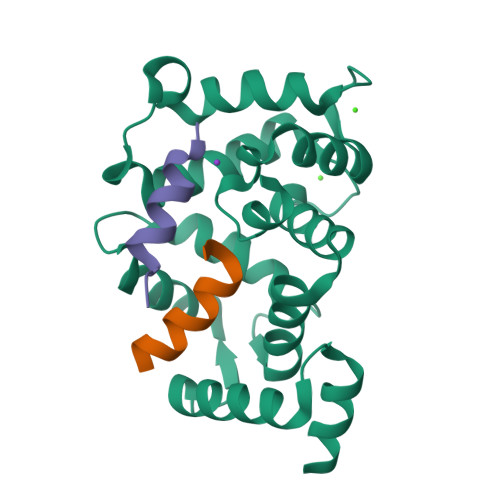
D(1A) dopamine receptor structureClick to view 3D structureD(1A) dopamine receptorP21728HumansPredicted (SEA)
Prediction Confidence Score
0.273
Applicability Domain
0.847
Statistical Significance
0.0712
Supporting Reference Compounds
425
E-value
554.209
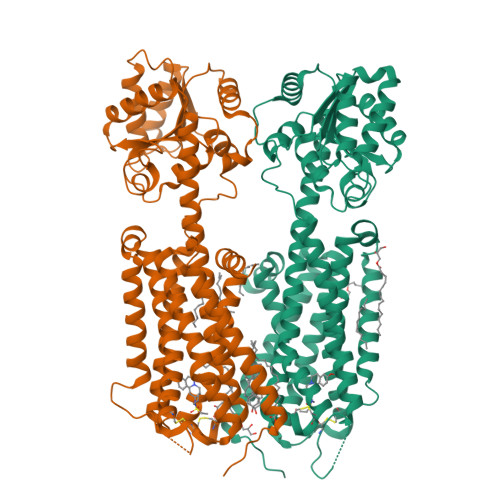
D(2) dopamine receptor structureClick to view 3D structureD(2) dopamine receptorP14416HumansPredicted (SEA)
Prediction Confidence Score
0.273
Applicability Domain
0.847
Statistical Significance
0.1683
Supporting Reference Compounds
1103
E-value
1310.51
Click to view 3D structureAlpha-1B adrenergic receptorP15823Rattus norvegicusPredicted (SEA)
Prediction Confidence Score
0.271
Applicability Domain
0.847
Statistical Significance
0.0276
Supporting Reference Compounds
130
E-value
215.175
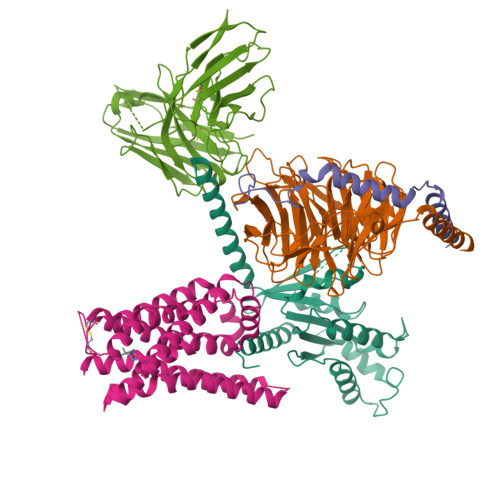
5-hydroxytryptamine receptor 2B structureClick to view 3D structure5-hydroxytryptamine receptor 2BP41595HumansPredicted (SEA)
Prediction Confidence Score
0.271
Applicability Domain
0.847
Statistical Significance
0.1197
Supporting Reference Compounds
686
E-value
931.933
Cytochrome P450 2D6 structureClick to view 3D structureCytochrome P450 2D6P10635HumansPredicted (SEA)
Prediction Confidence Score
0.269
Applicability Domain
0.847
Statistical Significance
0.2661
Supporting Reference Compounds
1130
E-value
2071.65
Alpha-2C adrenergic receptor structureClick to view 3D structureAlpha-2C adrenergic receptorP18825HumansPredicted (SEA)
Prediction Confidence Score
0.268
Applicability Domain
0.847
Statistical Significance
0.0718
Supporting Reference Compounds
386
E-value
558.724
Click to view 3D structure5-hydroxytryptamine receptor 1AP19327Rattus norvegicusPredicted (SEA)
Prediction Confidence Score
0.268
Applicability Domain
0.847
Statistical Significance
0.1153
Supporting Reference Compounds
541
E-value
897.368
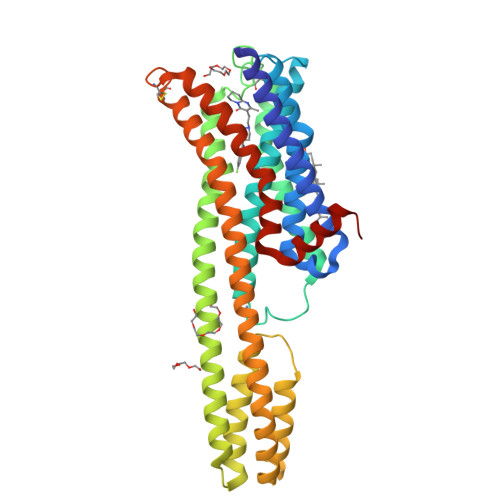
5-hydroxytryptamine receptor 2C structureClick to view 3D structure5-hydroxytryptamine receptor 2CP28335HumansPredicted (SEA)
Prediction Confidence Score
0.267
Applicability Domain
0.847
Statistical Significance
0.164
Supporting Reference Compounds
823
E-value
1276.96
D(3) dopamine receptor structureClick to view 3D structureD(3) dopamine receptorP35462HumansPredicted (SEA)
Prediction Confidence Score
0.266
Applicability Domain
0.847
Statistical Significance
0.1635
Supporting Reference Compounds
861
E-value
1273.22
Alpha-2A adrenergic receptor structureClick to view 3D structureAlpha-2A adrenergic receptorP08913HumansPredicted (SEA)
Prediction Confidence Score
0.266
Applicability Domain
0.847
Statistical Significance
0.1013
Supporting Reference Compounds
487
E-value
788.301
Alpha-2B adrenergic receptor structureClick to view 3D structureAlpha-2B adrenergic receptorP18089HumansPredicted (SEA)
Prediction Confidence Score
0.264
Applicability Domain
0.847
Statistical Significance
0.0738
Supporting Reference Compounds
340
E-value
574.839
5-hydroxytryptamine receptor 2A structureClick to view 3D structure5-hydroxytryptamine receptor 2AP28223HumansPredicted (SEA)
Prediction Confidence Score
0.264
Applicability Domain
0.847
Statistical Significance
0.1989
Supporting Reference Compounds
955
E-value
1548.19
Click to view 3D structureAlpha-1D adrenergic receptorP25100HumansPredicted (SEA)
Prediction Confidence Score
0.262
Applicability Domain
0.847
Statistical Significance
0.0645
Supporting Reference Compounds
258
E-value
501.816
Click to view 3D structure5-hydroxytryptamine receptor 1BP28564Rattus norvegicusPredicted (SEA)
Prediction Confidence Score
0.262
Applicability Domain
0.847
Statistical Significance
0.045
Supporting Reference Compounds
154
E-value
350.01
5-hydroxytryptamine receptor 6 structureClick to view 3D structure5-hydroxytryptamine receptor 6P50406HumansPredicted (SEA)
Prediction Confidence Score
0.261
Applicability Domain
0.847
Statistical Significance
0.1203
Supporting Reference Compounds
536
E-value
936.838
Click to view 3D structureAlpha-1A adrenergic receptorP43140Rattus norvegicusPredicted (SEA)
Prediction Confidence Score
0.261
Applicability Domain
0.847
Statistical Significance
0.0589
Supporting Reference Compounds
208
E-value
458.61
ATP synthase subunit beta, mitochondrial structureClick to view 3D structureATP synthase subunit beta, mitochondrialP00830Saccharomyces cerevisiae S288cPredicted (SEA)
Prediction Confidence Score
0.183
Applicability Domain
0.183 Low confidence
Statistical Significance
3.30e-04
Supporting Reference Compounds
1
E-value
2.56902
DIS3-like exonuclease 2 structureClick to view 3D structureDIS3-like exonuclease 2Q8IYB7HumansPredicted (SEA)
Prediction Confidence Score
0.18
Applicability Domain
0.18 Low confidence
Statistical Significance
5.40e-04
Supporting Reference Compounds
1
E-value
4.20386
Click to view 3D structureStreptokinase AP10520Streptococcus pyogenes serotype M1Predicted (SEA)
Prediction Confidence Score
0.177
Applicability Domain
0.188 Low confidence
Statistical Significance
0.8552
Supporting Reference Compounds
425
E-value
6658.05
Cytochrome P450 3A4 structureClick to view 3D structureCytochrome P450 3A4P08684HumansPredicted (SEA)
Prediction Confidence Score
0.175
Applicability Domain
0.188 Low confidence
Statistical Significance
0.9889
Supporting Reference Compounds
1538
E-value
7698.28
Solute carrier organic anion transporter family member 1B1 structureClick to view 3D structureSolute carrier organic anion transporter family member 1B1Q9Y6L6HumansPredicted (SEA)
Prediction Confidence Score
0.175
Applicability Domain
0.188 Low confidence
Statistical Significance
0.4996
Supporting Reference Compounds
82
E-value
3889.11
Neurogenic locus notch homolog protein 1 structureClick to view 3D structureNeurogenic locus notch homolog protein 1Q01705Mus musculusPredicted (SEA)
Prediction Confidence Score
0.169
Applicability Domain
0.169 Low confidence
Statistical Significance
0.0044
Supporting Reference Compounds
1
E-value
34.2537
Voltage-gated inwardly rectifying potassium channel KCNH2 structureClick to view 3D structureVoltage-gated inwardly rectifying potassium channel KCNH2Q12809HumansPredicted (SEA)
Prediction Confidence Score
0.169
Applicability Domain
0.191 Low confidence
Statistical Significance
0.9883
Supporting Reference Compounds
1498
E-value
7694.15
Click to view 3D structureMotilin receptorA5A4K8Oryctolagus cuniculusPredicted (SEA)
Prediction Confidence Score
0.167
Applicability Domain
0.191 Low confidence
Statistical Significance
3.40e-04
Supporting Reference Compounds
5
E-value
2.64687
Ras-related protein Rap-1A structureClick to view 3D structureRas-related protein Rap-1AP62834HumansPredicted (SEA)
Prediction Confidence Score
0.165
Applicability Domain
0.205 Low confidence
Statistical Significance
6.00e-05
Supporting Reference Compounds
3
E-value
0.467095
Concentrations
Not Available
External Links
DrugBank IDNot Available
HMDB IDHMDB0029453
FooDB IDFDB000573
Phenol Explorer IDNot Available
KNApSAcK IDC00018494
BiGG IDNot Available
BioCyc IDNot Available
METLIN IDNot Available
PDB IDNot Available
Wikipedia LinkMaduramicin
Chemspider ID35032873
ChEBI IDNot Available
PubChem Compound ID131750871
Kegg Compound IDNot Available
YMDB IDNot Available
ECMDB IDNot Available
References
Synthesis ReferenceNot Available
MSDSNot Available
General ReferencesNot Available