2-Ethyl-3,(5 or 6)-dimethylpyrazine (CED0132903)

Record Information
Version1.0
Creation Date2016-05-25 23:20:54 UTC
Update Date2026-04-16 22:46:29 UTC
SynCED IDCED0132903
Secondary Accession Numbers
  • CHEM026929
Identification
Common Name2-Ethyl-3,(5 or 6)-dimethylpyrazine
ClassSmall Molecule
Description
2-Ethyl-3,(5 or 6)-dimethylpyrazine belongs to the pyrazines, a subclass of diazines within the organic compounds. This organoheterocyclic compound has the chemical formula C8H12N2 and an average molecular weight of 136.19 g/mol. In industrial applications, the compound is utilized as a fragrance, as well as a flavouring and nutrient. It is identified in twelve recorded sources. Within the category of household cleaning and consumer products, it is found in bleaching agents, cigar cigarettes, non electric simulated smoking devices, other smoking requisites, pipe accessories, and three additional sources. It is also associated with food, food processing and cookware, specifically in food contact materials and the preparation of vinegar, wine, or sparkling wine. Furthermore, it is found in electrical and electronic equipment, specifically electrically stimulated smoking devices. Recorded exposure routes for this substance include inhalation, oral, and touch.
Contaminant TypeNot Available
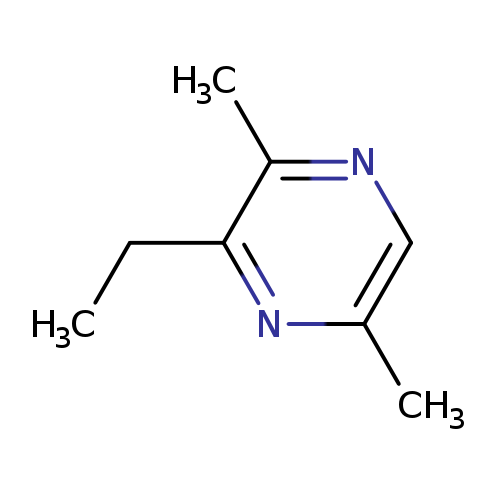
Chemical Structure
Synonyms
ValueSource
2E3,6DMPMeSH
2-Ethyl-3,6-dimethylpyrazineMeSH
2-Ethyl-3,5/6-dimethyl-pyrazineHMDB
Chemical FormulaC8H12N2
Average Molecular Mass136.194 g/mol
Monoisotopic Mass136.100 g/mol
CAS Registry Number27043-05-6
IUPAC Name3-ethyl-2,5-dimethylpyrazine
Traditional Name3-ethyl-2,5-dimethylpyrazine
SMILESCCC1=NC(C)=CN=C1C
InChI IdentifierInChI=1S/C8H12N2/c1-4-8-7(3)9-5-6(2)10-8/h5H,4H2,1-3H3
InChI KeyWHMWOHBXYIZFPF-UHFFFAOYSA-N
Chemical Taxonomy
Description Belongs to the class of organic compounds known as pyrazines. Pyrazines are compounds containing a pyrazine ring, which is a six-member aromatic heterocycle, that consists of two nitrogen atoms (at positions 1 and 4) and four carbon atoms.
KingdomOrganic compounds
Super ClassOrganoheterocyclic compounds
ClassDiazines
Sub ClassPyrazines
Direct ParentPyrazines
Alternative Parents
Substituents
  • Pyrazine
  • Heteroaromatic compound
  • Azacycle
  • Organic nitrogen compound
  • Organopnictogen compound
  • Hydrocarbon derivative
  • Organonitrogen compound
  • Aromatic heteromonocyclic compound
Molecular FrameworkAromatic heteromonocyclic compounds
External DescriptorsNot Available
Biological Properties
StatusDetected and Not Quantified
OriginNot Available
Cellular LocationsNot Available
Biofluid LocationsNot Available
Tissue LocationsNot Available
ApplicationsNot Available
Biological RolesNot Available
Chemical RolesNot Available
Organoleptic EffectsNot Available
Physical Properties
StateNot Available
AppearanceNot Available
Experimental Properties
PropertyValue
Melting PointNot Available
Boiling PointNot Available
SolubilityNot Available
Predicted Properties
PropertyValueSource
Water Solubility21.4 g/LALOGPS
logP1.59ALOGPS
logP0.63ChemAxon
logS-0.8ALOGPS
pKa (Strongest Basic)1.93ChemAxon
Physiological Charge0ChemAxon
Hydrogen Acceptor Count2ChemAxon
Hydrogen Donor Count0ChemAxon
Polar Surface Area25.78 ŲChemAxon
Rotatable Bond Count1ChemAxon
Refractivity40.15 m³·mol⁻¹ChemAxon
Polarizability15.86 ųChemAxon
Number of Rings1ChemAxon
BioavailabilityYesChemAxon
Rule of FiveYesChemAxon
Ghose FilterNoChemAxon
Veber's RuleYesChemAxon
MDDR-like RuleNoChemAxon
Spectra
Spectra
Spectrum TypeDescriptionSplash KeyDeposition DateView
Predicted GC-MSPredicted GC-MS Spectrumsplash10-0079-5900000000-8972bb1f230d4ce37aa0Not AvailableView Spectrum
Predicted GC-MSPredicted GC-MS SpectrumNot AvailableNot AvailableView Spectrum
Predicted LC-MS/MSPredicted LC-MS/MS Spectrumsplash10-000i-0900000000-0314177c3c76c33d3a62Not AvailableView Spectrum
Predicted LC-MS/MSPredicted LC-MS/MS Spectrumsplash10-000i-2900000000-17c28b506f498cff1d9fNot AvailableView Spectrum
Predicted LC-MS/MSPredicted LC-MS/MS Spectrumsplash10-00kf-9100000000-53eee1c2cd50606623a0Not AvailableView Spectrum
Predicted LC-MS/MSPredicted LC-MS/MS Spectrumsplash10-000i-0900000000-ec3a2f6d876ea167479fNot AvailableView Spectrum
Predicted LC-MS/MSPredicted LC-MS/MS Spectrumsplash10-000i-1900000000-eb3d7afc9b1afc13d34cNot AvailableView Spectrum
Predicted LC-MS/MSPredicted LC-MS/MS Spectrumsplash10-0ap0-8900000000-4026d008af47668a5d3dNot AvailableView Spectrum
Predicted LC-MS/MSPredicted LC-MS/MS Spectrumsplash10-000i-0900000000-560d709635c029cd0cbaNot AvailableView Spectrum
Predicted LC-MS/MSPredicted LC-MS/MS Spectrumsplash10-000i-6900000000-a822bb86992113f3c90bNot AvailableView Spectrum
Predicted LC-MS/MSPredicted LC-MS/MS Spectrumsplash10-0f7o-9500000000-43ee0e402d531191a7dbNot AvailableView Spectrum
Predicted LC-MS/MSPredicted LC-MS/MS Spectrumsplash10-000i-0900000000-ac299646e14f1770c4b5Not AvailableView Spectrum
Predicted LC-MS/MSPredicted LC-MS/MS Spectrumsplash10-000i-8900000000-14fd5e997abecd36a2f5Not AvailableView Spectrum
Predicted LC-MS/MSPredicted LC-MS/MS Spectrumsplash10-00l6-9000000000-c858357dc68519b94e38Not AvailableView Spectrum
1D NMR1H NMR Spectrum (1D, D2O, predicted)Not AvailableNot AvailableView Spectrum
1D NMR13C NMR Spectrum (1D, D2O, predicted)Not AvailableNot AvailableView Spectrum
Toxicity Profile
Toxicity Values
Toxicity ValueOrganismDose DescriptorRoute of ExposurePredicted or ExperimentalToxicity RatingReference
675.0 Log mg/kg [380:1200]RatLD50oralpredictedNot AvailableNot Available
Toxicity / Toxin ClassNot Available
Mechanism of ToxicityNot Available
Carcinogenicity (IARC Classification)Not Available
Minimum Risk LevelNot Available
SymptomsNot Available
TreatmentNot Available
Health Effects
Health EffectRelationshipDirectionDescriptionReference
Exposure Sources
Source IDSourceSectorReference
CEDs000010Insecticides?Insecticides are synthetic chemicals designed to control or eliminate insect pests that threaten crops and other agricultural products.Agriculture & land managementPubChem
CEDs000490Personal care & cosmeticsNot Available
CEDs000494Food contact materials?Food contact materials refer to substances and products that are intended to come into contact with food during processing, packaging, or preparation.Food, food processing & cookwareNot Available
CEDs000511Conductors Or Conductive Bodies Characterised By The Conductive Materials?Conductors, or conductive bodies, are materials that allow the flow of electrical current, typically made from metals such as copper, aluminum, or silver.Electrical & Electronic EquipmentPubChem
CEDs000518Electrically Stimulated Smoking Devices?Electrically stimulated smoking devices, commonly known as e-cigarettes or vape pens, utilize electrical components to heat a liquid solution, often containing nicotine, flavorings, and other additives, to produce an aerosol for inhalation.Electrical & Electronic EquipmentPubChem
CEDs000545Food Preservation?Food preservation often involves the use of synthetic chemicals, such as preservatives, flavor enhancers, and color additives, to extend shelf life and enhance the sensory qualities of food products.Food, food processing & cookwarePubChem
CEDs000548Preparation Of Vinegar?Vinegar is produced through the fermentation of ethanol by acetic acid bacteria, resulting in a solution that typically contains 4-8% acetic acid.Food, food processing & cookwarePubChem
CEDs000549Preparation Of Wine Or Sparkling Wine?The preparation of wine or sparkling wine involves various stages, including fermentation, aging, and bottling, which can introduce potential sources of synthetic chemical contamination.Food, food processing & cookwarePubChem
CEDs000555Bleaching Agents?Bleaching agents are chemical substances used to whiten or lighten materials, often employed in various cleaning products for their stain removal and disinfecting properties.Household cleaning & consumer productsPubChem
CEDs000556Cigar Cigarettes?Cigar cigarettes are a source of synthetic chemical contamination due to the combustion of various tobacco blends and additives.Household cleaning & consumer productsPubChem
CEDs000559Non Electric Simulated Smoking Devices?Non-electric simulated smoking devices, often designed to mimic the experience of smoking without combustion, can be sources of synthetic chemical contamination due to the materials and chemicals used in their construction and operation.Household cleaning & consumer productsPubChem
CEDs000560Other Smoking Requisites?Other smoking requisites, including items such as lighters, matches, and rolling papers, can introduce synthetic chemical contamination through various components and additives.Household cleaning & consumer productsPubChem
CEDs000561Perfumes Within Detergents And Soaps?Perfumes within detergents and soaps are synthetic fragrance compounds added to enhance the sensory experience of cleaning products.Household cleaning & consumer productsPubChem
CEDs000562Pipe Accessories?Pipe accessories, such as fittings, connectors, and seals, are components used in plumbing systems to facilitate the flow of liquids and gases.Household cleaning & consumer productsPubChem
CEDs000563Soap Detergents?Soap detergents are synthetic surfactants designed to enhance the cleaning efficacy of water by reducing surface tension, allowing for better interaction with dirt and grease.Household cleaning & consumer productsPubChem
CEDs000567Tobacco Product Cases?Tobacco product cases can serve as a source of synthetic chemical contamination due to the presence of various additives and chemicals used in tobacco processing and product manufacturing.Household cleaning & consumer productsPubChem
CEDs000568Tobacco Product Moisture Control?Tobacco product moisture control involves the use of synthetic chemicals to manage the humidity levels in tobacco products, aiming to preserve flavor and extend shelf life.Household cleaning & consumer productsPubChem
CEDs000569Tobacco Smoke Filters?Tobacco smoke filters are designed to reduce the inhalation of harmful substances in cigarette smoke, including tar and other particulate matter.Household cleaning & consumer productsPubChem
CEDs000578Making Cigars?The process of making cigars involves several steps, including the cultivation of tobacco, fermentation, and the application of various additives to enhance flavor and preservation.Industrial manufacturing & chemical processingPubChem
CEDs000580Manufacture Preparation Of Tobacco Products?The manufacture and preparation of tobacco products involve various processes that can result in the introduction of synthetic chemicals into the environment.Industrial manufacturing & chemical processingPubChem
CEDs000604Pest Attractants?Pest attractants are synthetic chemicals designed to lure specific pests for monitoring or control purposes.Agriculture & land managementPubChem
CEDs000605Pest Repellants?Pest repellents, often formulated from synthetic chemicals, are widely used to protect crops from insect infestations and other pests.Agriculture & land managementPubChem
CEDs000607Rodenticides(1)?Rodenticides are synthetic chemicals specifically formulated to control rodent populations, serving as a crucial tool in managing pests that can damage crops and spread diseases.Agriculture & land managementPubChem
CEDs000608Rodenticides?Rodenticides are chemical substances specifically designed to control rodent populations by causing death through various mechanisms, including anticoagulation or neurotoxicity.Agriculture & land managementPubChem
CEDs000609Aftershave?Aftershave is a grooming product typically used to soothe and protect the skin following shaving.Personal care & cosmeticsPubChem
CEDs000610Aftersun Products?Aftersun products are designed to soothe and hydrate the skin after sun exposure, often containing various synthetic chemicals such as emollients, preservatives, and fragrances.Personal care & cosmeticsPubChem
CEDs000611Anti Perspirants Or Body Deoderants?Antiperspirants and body deodorants commonly contain synthetic chemicals such as aluminum compounds, parabens, and synthetic fragrances.Personal care & cosmeticsPubChem
CEDs000613Depilatories?Depilatories are products designed to remove unwanted hair through the application of synthetic chemicals that break down the protein structure of hair, facilitating its removal.Personal care & cosmeticsPubChem
CEDs000614Essential Oils Or Perfumes?Essential oils and perfumes are complex mixtures of volatile compounds derived from natural or synthetic sources, commonly used for their aromatic properties.Personal care & cosmeticsPubChem
CEDs000617Lip Care Products?Lip care products, including lipsticks, balms, and glosses, often contain a variety of synthetic chemicals such as parabens, phthalates, and synthetic fragrances.Personal care & cosmeticsPubChem
CEDs000618Lip Makeup Products?Lip makeup products, such as lipsticks, lip glosses, and lip liners, often contain a variety of synthetic chemicals, including pigments, preservatives, and emollients.Personal care & cosmeticsPubChem
CEDs000632Apparel?Apparel production often involves the use of various synthetic chemicals, including dyes, finishing agents, and preservatives.Textiles, leather & furnishingsPubChem
CEDs000696Nanotechnology?Nanotechnology involves the manipulation of materials at the molecular or atomic level, typically within the range of 1 to 100 nanometers.Industrial manufacturing & chemical processingPubChem
CEDs000738Cooling Circuit Water?Cooling circuit water is utilized in various industrial processes to absorb and dissipate heat generated during operations.Industrial manufacturing & chemical processingPubChem
CEDs000740Paper?Paper production involves the processing of wood fibers and the use of various chemicals, which can lead to synthetic chemical contamination.Paper, pulp & fiber productsPubChem
CEDs000744Water, Wastewater, & Sewage Treatment?Water, wastewater, and sewage treatment processes are critical for managing and mitigating pollutants in water systems.Wastewater, sanitation & biosolidsPubChem
Pathways
0 pathwaysPathway Source: PathBank

No pathways found

No metabolic pathways have been associated with this synthetic chemical

Targets
StructureProteinUniProt IDOrganismRelationshipDetails
Click to view 3D structureMultidrug and toxin extrusion protein 1Q8K0H1Mus musculusPredicted (SEA)
Prediction Confidence Score
0.244
Applicability Domain
0.244 Low confidence
Statistical Significance
0.0018
Supporting Reference Compounds
1
E-value
14.0129
Click to view 3D structureCytosolic carboxypeptidase 2Q5U5Z8HumansPredicted (SEA)
Prediction Confidence Score
0.225
Applicability Domain
0.225 Low confidence
Statistical Significance
0.0039
Supporting Reference Compounds
1
E-value
30.5169
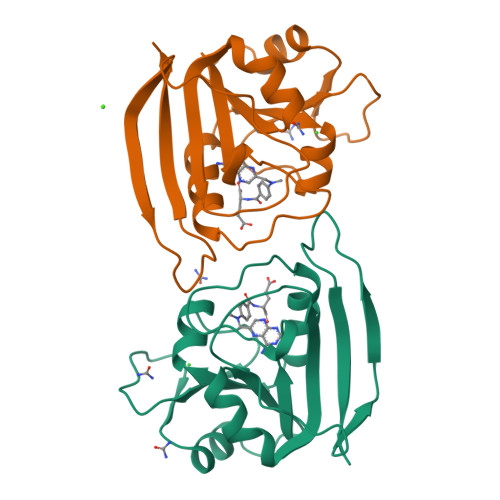
Dihydrofolate reductase structureClick to view 3D structureDihydrofolate reductaseP0ABQ4Escherichia coli (strain K12)Predicted (SEA)
Prediction Confidence Score
0.222
Applicability Domain
0.244 Low confidence
Statistical Significance
0.0366
Supporting Reference Compounds
92
E-value
284.928
Dihydrofolate reductase structureClick to view 3D structureDihydrofolate reductaseP00374HumansPredicted (SEA)
Prediction Confidence Score
0.214
Applicability Domain
0.244 Low confidence
Statistical Significance
0.1186
Supporting Reference Compounds
156
E-value
923.681
Pyridoxine-5'-phosphate oxidase structureClick to view 3D structurePyridoxine-5'-phosphate oxidaseQ9NVS9HumansPredicted (SEA)
Prediction Confidence Score
0.213
Applicability Domain
0.213 Low confidence
Statistical Significance
2.80e-04
Supporting Reference Compounds
1
E-value
2.17978
Click to view 3D structureBifunctional dihydrofolate reductase-thymidylate synthaseQ27713Plasmodium berghei str. ANKAPredicted (SEA)
Prediction Confidence Score
0.209
Applicability Domain
0.233 Low confidence
Statistical Significance
0.0077
Supporting Reference Compounds
14
E-value
60.3331
G-prodeshotein coupled receptor 4 structureClick to view 3D structureG-prodeshotein coupled receptor 4P46093HumansPredicted (SEA)
Prediction Confidence Score
0.207
Applicability Domain
0.22 Low confidence
Statistical Significance
0.0019
Supporting Reference Compounds
9
E-value
14.9471
Cytochrome P450 1A2 structureClick to view 3D structureCytochrome P450 1A2P05177HumansPredicted (SEA)
Prediction Confidence Score
0.205
Applicability Domain
0.231 Low confidence
Statistical Significance
0.8523
Supporting Reference Compounds
793
E-value
6635.32
Voltage-gated inwardly rectifying potassium channel KCNH2 structureClick to view 3D structureVoltage-gated inwardly rectifying potassium channel KCNH2Q12809HumansPredicted (SEA)
Prediction Confidence Score
0.204
Applicability Domain
0.21 Low confidence
Statistical Significance
0.9317
Supporting Reference Compounds
1498
E-value
7253.13
Protein deacetylase HDAC6 structureClick to view 3D structureProtein deacetylase HDAC6Q9UBN7HumansPredicted (SEA)
Prediction Confidence Score
0.204
Applicability Domain
0.233 Low confidence
Statistical Significance
0.7239
Supporting Reference Compounds
553
E-value
5635.5
Click to view 3D structureStreptokinase AP10520Streptococcus pyogenes serotype M1Predicted (SEA)
Prediction Confidence Score
0.203
Applicability Domain
0.244 Low confidence
Statistical Significance
0.5664
Supporting Reference Compounds
425
E-value
4409.3
Click to view 3D structureDihydrofolate reductaseP04174Neisseria gonorrhoeaePredicted (SEA)
Prediction Confidence Score
0.203
Applicability Domain
0.217 Low confidence
Statistical Significance
0.0085
Supporting Reference Compounds
12
E-value
65.9383
C-C chemokine receptor type 1 structureClick to view 3D structureC-C chemokine receptor type 1P32246HumansPredicted (SEA)
Prediction Confidence Score
0.202
Applicability Domain
0.286 Low confidence
Statistical Significance
0.1975
Supporting Reference Compounds
54
E-value
1537.76
Metabotropic glutamate receptor 5 structureClick to view 3D structureMetabotropic glutamate receptor 5P31424Rattus norvegicusPredicted (SEA)
Prediction Confidence Score
0.201
Applicability Domain
0.211 Low confidence
Statistical Significance
0.2146
Supporting Reference Compounds
68
E-value
1670.41
Click to view 3D structureATP-dependent molecular chaperone HSP82C4YTQ8Candida albicans (strain WO-1) (Yeast)Predicted (SEA)
Prediction Confidence Score
0.2
Applicability Domain
0.286 Low confidence
Statistical Significance
0.416
Supporting Reference Compounds
205
E-value
3238.84
Vacuolar aminopeptidase 1 structureClick to view 3D structureVacuolar aminopeptidase 1P14904Saccharomyces cerevisiae S288cPredicted (SEA)
Prediction Confidence Score
0.2
Applicability Domain
0.2 Low confidence
Statistical Significance
0.0045
Supporting Reference Compounds
1
E-value
34.9543
Click to view 3D structureAcetyl-CoA carboxylaseQ3V4E6Zea maysPredicted (SEA)
Prediction Confidence Score
0.2
Applicability Domain
0.2 Low confidence
Statistical Significance
0.0072
Supporting Reference Compounds
1
E-value
56.1293
Metabotropic glutamate receptor 5 structureClick to view 3D structureMetabotropic glutamate receptor 5P41594HumansPredicted (SEA)
Prediction Confidence Score
0.199
Applicability Domain
0.211 Low confidence
Statistical Significance
0.2862
Supporting Reference Compounds
89
E-value
2228.36
Click to view 3D structureDihydrofolate reductaseQ920D2Rattus norvegicusPredicted (SEA)
Prediction Confidence Score
0.199
Applicability Domain
0.244 Low confidence
Statistical Significance
0.1099
Supporting Reference Compounds
82
E-value
855.252
Vascular endothelial growth factor receptor 2 structureClick to view 3D structureVascular endothelial growth factor receptor 2P35968HumansPredicted (SEA)
Prediction Confidence Score
0.197
Applicability Domain
0.217 Low confidence
Statistical Significance
0.9053
Supporting Reference Compounds
1660
E-value
7047.61
Cyclin-dependent kinase 2 structureClick to view 3D structureCyclin-dependent kinase 2P24941HumansPredicted (SEA)
Prediction Confidence Score
0.197
Applicability Domain
0.217 Low confidence
Statistical Significance
0.8723
Supporting Reference Compounds
1029
E-value
6791.02
Macrophage colony-stimulating factor 1 receptor structureClick to view 3D structureMacrophage colony-stimulating factor 1 receptorP07333HumansPredicted (SEA)
Prediction Confidence Score
0.196
Applicability Domain
0.22 Low confidence
Statistical Significance
0.8548
Supporting Reference Compounds
833
E-value
6654.32
Adenosine receptor A2a structureClick to view 3D structureAdenosine receptor A2aP29274HumansPredicted (SEA)
Prediction Confidence Score
0.196
Applicability Domain
0.212 Low confidence
Statistical Significance
0.6267
Supporting Reference Compounds
303
E-value
4879.04
Dihydrofolate reductase structureClick to view 3D structureDihydrofolate reductaseP16184Pneumocystis cariniiPredicted (SEA)
Prediction Confidence Score
0.193
Applicability Domain
0.244 Low confidence
Statistical Significance
0.1247
Supporting Reference Compounds
62
E-value
970.624
Bifunctional dihydrofolate reductase-thymidylate synthase structureClick to view 3D structureBifunctional dihydrofolate reductase-thymidylate synthaseQ07422Toxoplasma gondiiPredicted (SEA)
Prediction Confidence Score
0.193
Applicability Domain
0.244 Low confidence
Statistical Significance
0.1645
Supporting Reference Compounds
89
E-value
1280.62
Concentrations
Not Available
External Links
DrugBank IDNot Available
HMDB IDHMDB0032276
FooDB IDFDB020022
Phenol Explorer IDNot Available
KNApSAcK IDC00052678
BiGG IDNot Available
BioCyc IDNot Available
METLIN IDNot Available
PDB IDNot Available
Wikipedia LinkNot Available
Chemspider ID24145
ChEBI IDNot Available
PubChem Compound ID25916
Kegg Compound IDNot Available
YMDB IDNot Available
ECMDB IDNot Available
References
Synthesis ReferenceNot Available
MSDSNot Available
General ReferencesNot Available