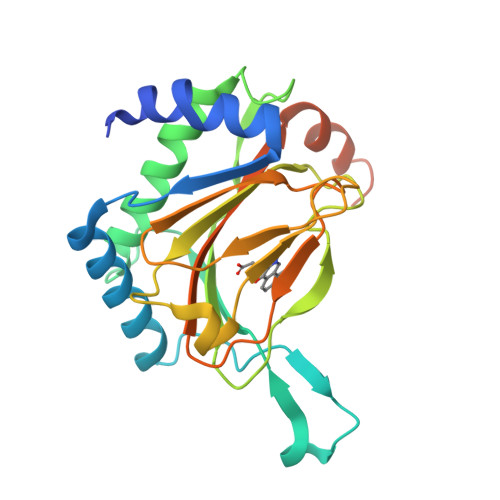
Iron citrate (CED0001001)

Record Information
Version1.0
Creation Date2016-05-25 23:21:30 UTC
Update Date2026-04-05 19:33:50 UTC
SynCED IDCED0001001
Secondary Accession Numbers
  • CHEM026933
Identification
Common NameIron citrate
ClassSmall Molecule
Description
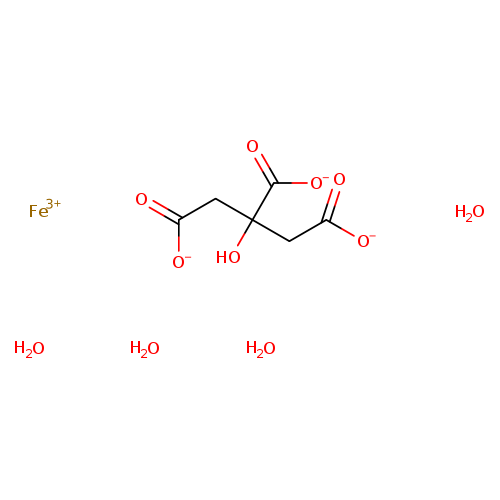
Iron citrate is an organic compound with the formula C6H13FeO11 and an average molecular weight of 317.01 g/mol. Iron citrate belongs to the tricarboxylic acids and derivatives, a subclass of carboxylic acids and derivatives within the organic compounds. Industrially, the compound is utilized as a nutrient and a flavouring agent.
Contaminant TypeNot Available
Chemical Structure
Synonyms
ValueSource
Iron(3+) ion 2-hydroxypropane-1,2,3-tricarboxylic acid tetrahydric acidGenerator
Iron citric acidGenerator
Chemical FormulaC6H13FeO11
Average Molecular Mass317.006 g/mol
Monoisotopic Mass316.981 g/mol
CAS Registry Number2338-05-8
IUPAC Nameiron(3+) ion 2-hydroxypropane-1,2,3-tricarboxylate tetrahydrate
Traditional Nameiron(3+) ion citrate tetrahydrate
SMILESO.O.O.O.[Fe+3].OC(CC([O-])=O)(CC([O-])=O)C([O-])=O
InChI IdentifierInChI=1S/C6H8O7.Fe.4H2O/c7-3(8)1-6(13,5(11)12)2-4(9)10;;;;;/h13H,1-2H2,(H,7,8)(H,9,10)(H,11,12);;4*1H2/q;+3;;;;/p-3
InChI KeyVTIIZUHZMUVVCB-UHFFFAOYSA-K
Chemical Taxonomy
Description Belongs to the class of organic compounds known as tricarboxylic acids and derivatives. These are carboxylic acids containing exactly three carboxyl groups.
KingdomOrganic compounds
Super ClassOrganic acids and derivatives
ClassCarboxylic acids and derivatives
Sub ClassTricarboxylic acids and derivatives
Direct ParentTricarboxylic acids and derivatives
Alternative Parents
Substituents
  • Tricarboxylic acid or derivatives
  • Tertiary alcohol
  • Carboxylic acid salt
  • Organic transition metal salt
  • Carboxylic acid
  • Organic oxygen compound
  • Organic oxide
  • Hydrocarbon derivative
  • Organic salt
  • Organooxygen compound
  • Carbonyl group
  • Alcohol
  • Aliphatic acyclic compound
Molecular FrameworkAliphatic acyclic compounds
External DescriptorsNot Available
Biological Properties
StatusDetected and Not Quantified
OriginNot Available
Cellular LocationsNot Available
Biofluid LocationsNot Available
Tissue LocationsNot Available
ApplicationsNot Available
Biological RolesNot Available
Chemical RolesNot Available
Organoleptic EffectsNot Available
Physical Properties
StateNot Available
AppearanceNot Available
Experimental Properties
PropertyValue
Melting PointNot Available
Boiling PointNot Available
SolubilityNot Available
Predicted Properties
PropertyValueSource
logP-1.3ChemAxon
pKa (Strongest Acidic)3.05ChemAxon
pKa (Strongest Basic)-4.2ChemAxon
Physiological Charge-3ChemAxon
Hydrogen Acceptor Count7ChemAxon
Hydrogen Donor Count1ChemAxon
Polar Surface Area140.62 ŲChemAxon
Rotatable Bond Count5ChemAxon
Refractivity68.14 m³·mol⁻¹ChemAxon
Polarizability14.23 ųChemAxon
Number of Rings0ChemAxon
BioavailabilityYesChemAxon
Rule of FiveYesChemAxon
Ghose FilterNoChemAxon
Veber's RuleNoChemAxon
MDDR-like RuleNoChemAxon
Spectra
SpectraNot Available
Toxicity Profile
Toxicity ValuesNot Available
Toxicity / Toxin ClassNot Available
Mechanism of ToxicityNot Available
Carcinogenicity (IARC Classification)Not Available
Minimum Risk LevelNot Available
SymptomsNot Available
TreatmentNot Available
Health Effects
Health EffectRelationshipDirectionDescriptionReference
Exposure Sources
Source IDSourceSectorReference
CEDs000010Insecticides?Insecticides are synthetic chemicals designed to control or eliminate insect pests that threaten crops and other agricultural products.Agriculture & land managementPubChem
CEDs000070Stormwater runoff?Stormwater runoff refers to the flow of rainwater or melted snow that does not soak into the ground and instead collects pollutants as it travels over impervious surfaces such as roads and parking lots.Automotive & urban infrastructurePubChem
CEDs000511Conductors Or Conductive Bodies Characterised By The Conductive Materials?Conductors, or conductive bodies, are materials that allow the flow of electrical current, typically made from metals such as copper, aluminum, or silver.Electrical & Electronic EquipmentPubChem
CEDs000514Discharge Lamps?Discharge lamps, including fluorescent and high-intensity discharge (HID) lamps, are commonly used for lighting applications due to their energy efficiency and brightness.Electrical & Electronic EquipmentPubChem
CEDs000518Electrically Stimulated Smoking Devices?Electrically stimulated smoking devices, commonly known as e-cigarettes or vape pens, utilize electrical components to heat a liquid solution, often containing nicotine, flavorings, and other additives, to produce an aerosol for inhalation.Electrical & Electronic EquipmentPubChem
CEDs000519Electrodes?Electrodes, used in various electrical and electronic applications, can be a source of synthetic chemical contamination due to the materials from which they are constructed and the processes involved in their manufacturing.Electrical & Electronic EquipmentPubChem
CEDs000524Hybrid Capacitors?Hybrid capacitors are energy storage devices that combine the properties of electrolytic and supercapacitors, utilizing a combination of electrochemical principles to achieve higher energy density and power density.Electrical & Electronic EquipmentPubChem
CEDs000545Food Preservation?Food preservation often involves the use of synthetic chemicals, such as preservatives, flavor enhancers, and color additives, to extend shelf life and enhance the sensory qualities of food products.Food, food processing & cookwarePubChem
CEDs000556Cigar Cigarettes?Cigar cigarettes are a source of synthetic chemical contamination due to the combustion of various tobacco blends and additives.Household cleaning & consumer productsPubChem
CEDs000559Non Electric Simulated Smoking Devices?Non-electric simulated smoking devices, often designed to mimic the experience of smoking without combustion, can be sources of synthetic chemical contamination due to the materials and chemicals used in their construction and operation.Household cleaning & consumer productsPubChem
CEDs000563Soap Detergents?Soap detergents are synthetic surfactants designed to enhance the cleaning efficacy of water by reducing surface tension, allowing for better interaction with dirt and grease.Household cleaning & consumer productsPubChem
CEDs000580Manufacture Preparation Of Tobacco Products?The manufacture and preparation of tobacco products involve various processes that can result in the introduction of synthetic chemicals into the environment.Industrial manufacturing & chemical processingPubChem
CEDs000596Acaricides?Acaricides are synthetic chemicals specifically designed to target and control mite populations that can damage crops and plants.Agriculture & land managementPubChem
CEDs000600Herbicides And Algicides?Herbicides and algicides are synthetic chemicals primarily used to control unwanted plants and algae in various environments.Agriculture & land managementPubChem
CEDs000602Molluscicides?Molluscicides are synthetic chemicals specifically designed to control and eliminate mollusks, such as snails and slugs, which can be detrimental to crops and agricultural productivity.Agriculture & land managementPubChem
CEDs000603Nematocides?Nematocides are synthetic chemicals specifically designed to control nematodes, which are microscopic roundworms that can cause significant damage to crops and plants.Agriculture & land managementPubChem
CEDs000604Pest Attractants?Pest attractants are synthetic chemicals designed to lure specific pests for monitoring or control purposes.Agriculture & land managementPubChem
CEDs000605Pest Repellants?Pest repellents, often formulated from synthetic chemicals, are widely used to protect crops from insect infestations and other pests.Agriculture & land managementPubChem
CEDs000606Plant Growth Regulators?Plant Growth Regulators (PGRs) are synthetic chemicals designed to influence the growth and development of plants.Agriculture & land managementPubChem
CEDs000610Aftersun Products?Aftersun products are designed to soothe and hydrate the skin after sun exposure, often containing various synthetic chemicals such as emollients, preservatives, and fragrances.Personal care & cosmeticsPubChem
CEDs000614Essential Oils Or Perfumes?Essential oils and perfumes are complex mixtures of volatile compounds derived from natural or synthetic sources, commonly used for their aromatic properties.Personal care & cosmeticsPubChem
CEDs000615Eye Makeup Products?Eye makeup products, including mascaras, eyeliners, and eyeshadows, often contain a variety of synthetic chemicals such as pigments, preservatives, and film-forming agents.Personal care & cosmeticsPubChem
CEDs000617Lip Care Products?Lip care products, including lipsticks, balms, and glosses, often contain a variety of synthetic chemicals such as parabens, phthalates, and synthetic fragrances.Personal care & cosmeticsPubChem
CEDs000618Lip Makeup Products?Lip makeup products, such as lipsticks, lip glosses, and lip liners, often contain a variety of synthetic chemicals, including pigments, preservatives, and emollients.Personal care & cosmeticsPubChem
CEDs000632Apparel?Apparel production often involves the use of various synthetic chemicals, including dyes, finishing agents, and preservatives.Textiles, leather & furnishingsPubChem
CEDs000642Footwear?Footwear production often involves the use of various synthetic chemicals, such as adhesives, dyes, and treatments, which can contribute to environmental contamination.Textiles, leather & furnishingsPubChem
CEDs000678Nitrogenous Fertilisers?Nitrogenous fertilizers are synthetic chemical compounds primarily used to enhance plant growth by supplying essential nitrogen, a crucial nutrient for photosynthesis and protein synthesis.Agriculture & land managementPubChem
CEDs000679Phosphatic Fertilisers?Phosphatic fertilizers are synthetic chemical products primarily composed of phosphorus, which is essential for plant growth.Agriculture & land managementPubChem
CEDs000684Cements?Cements are a composite material primarily used as a binding agent in construction applications, formed by the calcination of limestone and clay minerals at high temperatures.Building & ConstructionPubChem
CEDs000685Ceramics?Ceramics can be a source of synthetic chemical contamination through various additives and processing agents used in their production.Building & ConstructionPubChem
CEDs000686Clay Wares?Clay wares are ceramic products made from natural clay, often utilized in various construction applications such as tiles, bricks, and sanitary ware.Building & ConstructionPubChem
CEDs000696Nanotechnology?Nanotechnology involves the manipulation of materials at the molecular or atomic level, typically within the range of 1 to 100 nanometers.Industrial manufacturing & chemical processingPubChem
CEDs000726Pens?Pens, commonly utilized for writing and marking, can be a source of synthetic chemical contamination primarily due to the materials used in their manufacturing.Paper, pulp & fiber productsPubChem
CEDs000734Coating Compositions?Coating compositions, which include paints, sealants, and varnishes, are formulated with a variety of synthetic chemicals such as solvents, resins, pigments, and additives.Building & ConstructionPubChem
CEDs000735Explosives?Explosives are chemical compounds or mixtures designed to undergo rapid decomposition, releasing energy in the form of gas and heat.Defense & military infrastructurePubChem
CEDs000738Cooling Circuit Water?Cooling circuit water is utilized in various industrial processes to absorb and dissipate heat generated during operations.Industrial manufacturing & chemical processingPubChem
CEDs000739Inks?Inks are complex mixtures composed of pigments or dyes, solvents, resins, and additives used primarily for printing and writing applications.Paper, pulp & fiber productsPubChem
CEDs000740Paper?Paper production involves the processing of wood fibers and the use of various chemicals, which can lead to synthetic chemical contamination.Paper, pulp & fiber productsPubChem
CEDs000741Pigment Pastes?Pigment pastes are concentrated dispersions of pigments used to impart color and properties to materials.Paper, pulp & fiber productsPubChem
CEDs000743Sludge Treatment?Sludge treatment involves the processing of waste materials generated from wastewater treatment plants, which often contain a variety of organic and inorganic substances.Wastewater, sanitation & biosolidsPubChem
CEDs000744Water, Wastewater, & Sewage Treatment?Water, wastewater, and sewage treatment processes are critical for managing and mitigating pollutants in water systems.Wastewater, sanitation & biosolidsPubChem
CEDs01078OintmentsHealthcare, pharmaceuticals & veterinary productsPMC3769771
CEDs01081TabletsHealthcare, pharmaceuticals & veterinary productsPMC3769771
Pathways
0 pathwaysPathway Source: PathBank

No pathways found

No metabolic pathways have been associated with this synthetic chemical

Targets
StructureProteinUniProt IDOrganismRelationshipDetails
Click to view 3D structureFree fatty acid receptor 3B2GV46Rattus norvegicusPredicted (SEA)
Prediction Confidence Score
0.18
Applicability Domain
0.318
Statistical Significance
3.30e-04
Supporting Reference Compounds
2
E-value
2.56902
Click to view 3D structureCarnitine O-palmitoyltransferase 2, mitochondrialP23786HumansPredicted (SEA)
Prediction Confidence Score
0.18
Applicability Domain
0.226 Low confidence
Statistical Significance
0.1902
Supporting Reference Compounds
14
E-value
1480.77
Liver carboxylesterase 1 structureClick to view 3D structureLiver carboxylesterase 1P23141HumansPredicted (SEA)
Prediction Confidence Score
0.179
Applicability Domain
0.188 Low confidence
Statistical Significance
0.219
Supporting Reference Compounds
55
E-value
1705.13
Click to view 3D structureCocaine esteraseO00748HumansPredicted (SEA)
Prediction Confidence Score
0.178
Applicability Domain
0.188 Low confidence
Statistical Significance
0.1775
Supporting Reference Compounds
40
E-value
1381.75
Click to view 3D structureFatty-acid amide hydrolase 1O00519HumansPredicted (SEA)
Prediction Confidence Score
0.177
Applicability Domain
0.188 Low confidence
Statistical Significance
0.7037
Supporting Reference Compounds
106
E-value
5478.25
Click to view 3D structureExcitatory amino acid transporter 3P51907Rattus norvegicusPredicted (SEA)
Prediction Confidence Score
0.175
Applicability Domain
0.175 Low confidence
Statistical Significance
0.0048
Supporting Reference Compounds
1
E-value
37.2119
Juvenile hormone esterase structureClick to view 3D structureJuvenile hormone esteraseQ9GPG0Manduca sextaPredicted (SEA)
Prediction Confidence Score
0.175
Applicability Domain
0.188 Low confidence
Statistical Significance
0.0072
Supporting Reference Compounds
2
E-value
55.8957
Liver carboxylesterase structureClick to view 3D structureLiver carboxylesteraseQ29550Sus scrofaPredicted (SEA)
Prediction Confidence Score
0.174
Applicability Domain
0.188 Low confidence
Statistical Significance
0.0811
Supporting Reference Compounds
20
E-value
631.746
Click to view 3D structureCG8425-PA [Drosophila melanogaster]A1ZA98Drosophila melanogasterPredicted (SEA)
Prediction Confidence Score
0.17
Applicability Domain
0.188 Low confidence
Statistical Significance
0.0082
Supporting Reference Compounds
4
E-value
64.0699
Click to view 3D structureIsopentenyl-diphosphate Delta-isomerase 1O35760Rattus norvegicusPredicted (SEA)
Prediction Confidence Score
0.167
Applicability Domain
0.167 Low confidence
Statistical Significance
5.40e-04
Supporting Reference Compounds
1
E-value
4.20386
Click to view 3D structureFarnesyl pyrophosphate synthaseP05369Rattus norvegicusPredicted (SEA)
Prediction Confidence Score
0.167
Applicability Domain
0.167 Low confidence
Statistical Significance
5.40e-04
Supporting Reference Compounds
1
E-value
4.20386
Click to view 3D structurePerilipin-1O60240HumansPredicted (SEA)
Prediction Confidence Score
0.166
Applicability Domain
0.333
Statistical Significance
0.4873
Supporting Reference Compounds
47
E-value
3793.83
Acylcarnitine hydrolase structureClick to view 3D structureAcylcarnitine hydrolaseQ91WG0Mus musculusPredicted (SEA)
Prediction Confidence Score
0.164
Applicability Domain
0.167 Low confidence
Statistical Significance
0.0095
Supporting Reference Compounds
2
E-value
74.1125
3-dehydroquinate dehydratase structureClick to view 3D structure3-dehydroquinate dehydrataseP15474Streptomyces coelicolor (strain ATCC BAA-471 / A3(2) / M145)Predicted (SEA)
Prediction Confidence Score
0.164
Applicability Domain
0.333
Statistical Significance
0.0011
Supporting Reference Compounds
3
E-value
8.71911
Solute carrier family 13 member 2 structureClick to view 3D structureSolute carrier family 13 member 2Q13183HumansPredicted (SEA)
Prediction Confidence Score
0.163
Applicability Domain
0.163 Low confidence
Statistical Significance
0.0634
Supporting Reference Compounds
1
E-value
493.486
Click to view 3D structureNa(+)/citrate cotransporterQ8CJ44Rattus norvegicusPredicted (SEA)
Prediction Confidence Score
0.163
Applicability Domain
0.163 Low confidence
Statistical Significance
0.0634
Supporting Reference Compounds
1
E-value
493.486
Click to view 3D structureNa(+)/citrate cotransporterQ67BT3Mus musculusPredicted (SEA)
Prediction Confidence Score
0.163
Applicability Domain
0.163 Low confidence
Statistical Significance
0.0634
Supporting Reference Compounds
1
E-value
493.486
3-dehydroquinate dehydratase structureClick to view 3D structure3-dehydroquinate dehydrataseQ48255Helicobacter pylori (strain ATCC 700392 / 26695)Predicted (SEA)
Prediction Confidence Score
0.16
Applicability Domain
0.333
Statistical Significance
5.50e-04
Supporting Reference Compounds
3
E-value
4.28171
Click to view 3D structureMitochondrial carnitine/acylcarnitine carrier proteinO43772HumansPredicted (SEA)
Prediction Confidence Score
0.159
Applicability Domain
0.159 Low confidence
Statistical Significance
0.0089
Supporting Reference Compounds
1
E-value
69.5194
Click to view 3D structureEsteraseA3QR02Chilo suppressalisPredicted (SEA)
Prediction Confidence Score
0.158
Applicability Domain
0.158 Low confidence
Statistical Significance
0.0047
Supporting Reference Compounds
1
E-value
36.8227
Olfactory receptor 51E2 structureClick to view 3D structureOlfactory receptor 51E2Q9H255HumansPredicted (SEA)
Prediction Confidence Score
0.157
Applicability Domain
0.192 Low confidence
Statistical Significance
0.0139
Supporting Reference Compounds
9
E-value
108.6
3-isopropylmalate dehydrogenase structureClick to view 3D structure3-isopropylmalate dehydrogenaseQ5SIY4Thermus thermophilusPredicted (SEA)
Prediction Confidence Score
0.156
Applicability Domain
0.156 Low confidence
Statistical Significance
6.40e-04
Supporting Reference Compounds
1
E-value
4.98235
Click to view 3D structureATP-citrate synthaseP16638Rattus norvegicusPredicted (SEA)
Prediction Confidence Score
0.156
Applicability Domain
0.226 Low confidence
Statistical Significance
0.0022
Supporting Reference Compounds
5
E-value
16.8933
Acetylpolyamine amidohydrolase structureClick to view 3D structureAcetylpolyamine amidohydrolaseQ48935Mycoplana ramosaPredicted (SEA)
Prediction Confidence Score
0.154
Applicability Domain
0.154 Low confidence
Statistical Significance
0.0071
Supporting Reference Compounds
1
E-value
55.6622
Egl nine homolog 1 structureClick to view 3D structureEgl nine homolog 1Q9GZT9HumansPredicted (SEA)
Prediction Confidence Score
0.153
Applicability Domain
0.192 Low confidence
Statistical Significance
0.7106
Supporting Reference Compounds
41
E-value
5531.97
Concentrations
Not Available
External Links
DrugBank IDNot Available
HMDB IDHMDB0303240
FooDB IDFDB009627
Phenol Explorer IDNot Available
KNApSAcK IDNot Available
BiGG IDNot Available
BioCyc IDNot Available
METLIN IDNot Available
PDB IDNot Available
Wikipedia LinkNot Available
Chemspider ID4447470
ChEBI IDNot Available
PubChem Compound IDNot Available
Kegg Compound IDNot Available
YMDB IDNot Available
ECMDB IDNot Available
References
Synthesis ReferenceNot Available
MSDSNot Available
General ReferencesNot Available