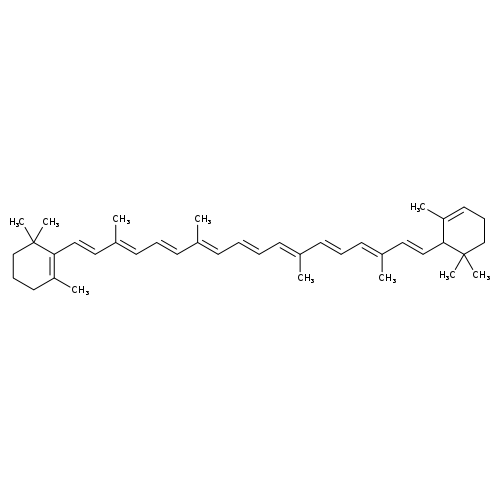
alpha-Carotene (CED0004078)

Record Information
Version1.0
Creation Date2016-05-26 00:52:35 UTC
Update Date2026-05-14 19:53:32 UTC
SynCED IDCED0004078
Secondary Accession Numbers
  • CHEM029033
Identification
Common Namealpha-Carotene
ClassSmall Molecule
Description
alpha-Carotene belongs to the tetraterpenoids, a subclass of prenol lipids within the organic compounds. It has the chemical formula C40H56. With an average molecular weight of 536.87 g/mol, alpha-Carotene is a heavy molecule. It is further classified under the superclass of lipids and lipid-like molecules.
Contaminant TypeNot Available
Chemical Structure
Synonyms
ValueSource
all-trans-alpha-CaroteneChEBI
all-trans-a-CaroteneGenerator
all-trans-Α-caroteneGenerator
a-CaroteneGenerator
Α-caroteneGenerator
(+)-alpha-CaroteneHMDB
(6'r)-beta,epsilon-CaroteneHMDB
BCRHMDB
beta,epsilon-CaroteneHMDB
Hi-alphaHMDB
alpha-Carotene, (6'r)-isomerHMDB
Chemical FormulaC40H56
Average Molecular Mass536.873 g/mol
Monoisotopic Mass536.438 g/mol
CAS Registry Number7488-99-5
IUPAC Name1,5,5-trimethyl-6-[(1E,3E,5E,7E,9E,11E,13E,15E,17E)-3,7,12,16-tetramethyl-18-(2,6,6-trimethylcyclohex-1-en-1-yl)octadeca-1,3,5,7,9,11,13,15,17-nonaen-1-yl]cyclohex-1-ene
Traditional Nameα-carotene
SMILESC/C(=C\C=C\C=C(/C)\C=C\C=C(/C)\C=C\C1=C(C)CCCC1(C)C)/C=C/C=C(\C)/C=C/[C@H]1C(C)=CCCC1(C)C
InChI IdentifierInChI=1S/C40H56/c1-31(19-13-21-33(3)25-27-37-35(5)23-15-29-39(37,7)8)17-11-12-18-32(2)20-14-22-34(4)26-28-38-36(6)24-16-30-40(38,9)10/h11-14,17-23,25-28,37H,15-16,24,29-30H2,1-10H3/b12-11+,19-13+,20-14+,27-25+,28-26+,31-17+,32-18+,33-21+,34-22+/t37-/m0/s1
InChI KeyANVAOWXLWRTKGA-NTXLUARGSA-N
Chemical Taxonomy
Description Belongs to the class of organic compounds known as carotenes. These are a type of unsaturated hydrocarbons containing eight consecutive isoprene units. They are characterized by the presence of two end-groups (mostly cyclohexene rings, but also cyclopentene rings or acyclic groups) linked by a long branched alkyl chain. Carotenes belonging form a subgroup of the carotenoids family.
KingdomOrganic compounds
Super ClassLipids and lipid-like molecules
ClassPrenol lipids
Sub ClassTetraterpenoids
Direct ParentCarotenes
Alternative Parents
Substituents
  • Carotene
  • Branched unsaturated hydrocarbon
  • Cycloalkene
  • Cyclic olefin
  • Unsaturated aliphatic hydrocarbon
  • Unsaturated hydrocarbon
  • Olefin
  • Hydrocarbon
  • Aliphatic homomonocyclic compound
Molecular FrameworkAliphatic homomonocyclic compounds
External Descriptors
Biological Properties
StatusDetected and Not Quantified
OriginNot Available
Cellular LocationsNot Available
Biofluid LocationsNot Available
Tissue LocationsNot Available
ApplicationsNot Available
Biological Roles
Chemical RolesNot Available
Organoleptic Effects
  • red colour ?
  • orange-yellow colour ?
  • dark yellow colour ?
Physical Properties
StateNot Available
AppearanceNot Available
Experimental Properties
PropertyValue
Melting PointNot Available
Boiling PointNot Available
SolubilityNot Available
Predicted Properties
PropertyValueSource
Water Solubility0.00031 g/LALOGPS
logP9.79ALOGPS
logP11.17ChemAxon
logS-6.2ALOGPS
Physiological Charge0ChemAxon
Hydrogen Acceptor Count0ChemAxon
Hydrogen Donor Count0ChemAxon
Polar Surface Area0 ŲChemAxon
Rotatable Bond Count10ChemAxon
Refractivity191.88 m³·mol⁻¹ChemAxon
Polarizability71.27 ųChemAxon
Number of Rings2ChemAxon
BioavailabilityNoChemAxon
Rule of FiveNoChemAxon
Ghose FilterNoChemAxon
Veber's RuleYesChemAxon
MDDR-like RuleNoChemAxon
Spectra
Spectra
Spectrum TypeDescriptionSplash KeyDeposition DateView
Predicted LC-MS/MSPredicted LC-MS/MS Spectrumsplash10-000i-0334190000-e05f79db2e425bfe8186Not AvailableView Spectrum
Predicted LC-MS/MSPredicted LC-MS/MS Spectrumsplash10-000b-0769200000-81f1f88961c73bc3943aNot AvailableView Spectrum
Predicted LC-MS/MSPredicted LC-MS/MS Spectrumsplash10-004j-2689700000-a8528456aa6fa28bfb10Not AvailableView Spectrum
Predicted LC-MS/MSPredicted LC-MS/MS Spectrumsplash10-000i-0000090000-df0db1851156c1e36da6Not AvailableView Spectrum
Predicted LC-MS/MSPredicted LC-MS/MS Spectrumsplash10-000i-0000090000-ac5ac3829642d0394d24Not AvailableView Spectrum
Predicted LC-MS/MSPredicted LC-MS/MS Spectrumsplash10-014i-0947360000-b2ba5d2cce5367c8424bNot AvailableView Spectrum
Predicted LC-MS/MSPredicted LC-MS/MS Spectrumsplash10-000i-0101090000-e6a413ebb46fe9a97e60Not AvailableView Spectrum
Predicted LC-MS/MSPredicted LC-MS/MS Spectrumsplash10-000j-0336290000-c736f8dfebfeee67f7c1Not AvailableView Spectrum
Predicted LC-MS/MSPredicted LC-MS/MS Spectrumsplash10-0a4i-0319000000-1e7037ebf4dd84aadb00Not AvailableView Spectrum
Predicted LC-MS/MSPredicted LC-MS/MS Spectrumsplash10-01pa-0269820000-f183b75adeec60119332Not AvailableView Spectrum
Predicted LC-MS/MSPredicted LC-MS/MS Spectrumsplash10-007t-0429400000-232c7e964986bedd5ad6Not AvailableView Spectrum
Predicted LC-MS/MSPredicted LC-MS/MS Spectrumsplash10-01q0-0229100000-971b11f97635708e0130Not AvailableView Spectrum
Toxicity Profile
Toxicity Values
Toxicity ValueOrganismDose DescriptorRoute of ExposurePredicted or ExperimentalToxicity RatingReference
3597.0 Log mg/kg [2000:6400]RatLD50oralpredictedNot AvailableNot Available
Toxicity / Toxin ClassNot Available
Mechanism of ToxicityNot Available
Carcinogenicity (IARC Classification)Not Available
Minimum Risk LevelNot Available
SymptomsNot Available
TreatmentNot Available
Health Effects
Health EffectRelationshipDirectionDescriptionReference
inflammationHas Therapeutic Effect OnNot AvailableNot AvailablePMC8392048
cancerHas Therapeutic Effect OnNot AvailableCancer is a group of diseases involving abnormal cell growth with the potential to invade or spread to other parts of the body. Possible signs and symptoms include a lump, abnormal bleeding, prolonged cough, unexplained weight loss, and a change in bowel movements. There are over 100 types of cancers affect humans. The risk of developing certain cancers can be reduced by not smoking, maintaining a healthy weight, not drinking too much alcohol, eating plenty of vegetables, fruits and whole grains, vaccination against certain infectious diseases, not eating too much processed and red meat and avoiding too much sunlight exposure. Cancer is often treated with some combination of radiation therapy, surgery, chemotherapy and targeted therapy. The majority of cancers, some 90–95% of cases, are due to genetic mutations from environmental and lifestyle factors. The remaining 5–10% are due to inherited genetics.PMC7520503
breast cancerAssociated With?inverseA breast cancer that has material basis in abnormally proliferating cells derives from epithelial cells. (DO)PMC3224257
anemiaAssociated With?Not AvailableA disorder characterized by a reduction in the amount of hemoglobin in 100 ml of blood. Signs and symptoms of anemia may include pallor of the skin and mucous membranes, shortness of breath, palpitations of the heart, soft systolic murmurs, lethargy, and fatigability. (NCI CTCAE)PMC11694997 , PMC11694997
anemiaHas Therapeutic Effect OnNot AvailableA disorder characterized by a reduction in the amount of hemoglobin in 100 ml of blood. Signs and symptoms of anemia may include pallor of the skin and mucous membranes, shortness of breath, palpitations of the heart, soft systolic murmurs, lethargy, and fatigability. (NCI CTCAE)PMC11694997
Prostate cancerAssociated With?decreaseA male reproductive organ cancer that is located in the prostate. (DO)PMC3823537
Prostate cancerHas Therapeutic Effect OnNot AvailableA male reproductive organ cancer that is located in the prostate. (DO)PMC10089266
obesityDecreased in Blood InNot AvailableA disorder characterized by having a high amount of body fat. (NCI CTCAE)PMC7402162
skin cancerAssociated With?decreaseNot AvailablePMC11799957
cardiovascular disorderHas Therapeutic Effect OnNot AvailableNot AvailablePMC10220679
Chronic DiseaseAssociated With?Not AvailableNot AvailablePMC12878118
SarcopeniaHas Therapeutic Effect OnNot AvailableNot AvailablePMC6878783
polypAssociated With?Not AvailableNot AvailablePMC12582728
nasal cavity polypAssociated With?decreaseNot AvailablePMC12582728
Exposure Sources
Source IDSourceSectorReference
CEDs000545Food Preservation?Food preservation often involves the use of synthetic chemicals, such as preservatives, flavor enhancers, and color additives, to extend shelf life and enhance the sensory qualities of food products.Food, food processing & cookwarePubChem
CEDs000609Aftershave?Aftershave is a grooming product typically used to soothe and protect the skin following shaving.Personal care & cosmeticsPubChem
CEDs000610Aftersun Products?Aftersun products are designed to soothe and hydrate the skin after sun exposure, often containing various synthetic chemicals such as emollients, preservatives, and fragrances.Personal care & cosmeticsPubChem
CEDs000611Anti Perspirants Or Body Deoderants?Antiperspirants and body deodorants commonly contain synthetic chemicals such as aluminum compounds, parabens, and synthetic fragrances.Personal care & cosmeticsPubChem
CEDs000615Eye Makeup Products?Eye makeup products, including mascaras, eyeliners, and eyeshadows, often contain a variety of synthetic chemicals such as pigments, preservatives, and film-forming agents.Personal care & cosmeticsPubChem
CEDs000617Lip Care Products?Lip care products, including lipsticks, balms, and glosses, often contain a variety of synthetic chemicals such as parabens, phthalates, and synthetic fragrances.Personal care & cosmeticsPubChem
CEDs000618Lip Makeup Products?Lip makeup products, such as lipsticks, lip glosses, and lip liners, often contain a variety of synthetic chemicals, including pigments, preservatives, and emollients.Personal care & cosmeticsPubChem
CEDs000696Nanotechnology?Nanotechnology involves the manipulation of materials at the molecular or atomic level, typically within the range of 1 to 100 nanometers.Industrial manufacturing & chemical processingPubChem
CEDs000739Inks?Inks are complex mixtures composed of pigments or dyes, solvents, resins, and additives used primarily for printing and writing applications.Paper, pulp & fiber productsPubChem
CEDs000740Paper?Paper production involves the processing of wood fibers and the use of various chemicals, which can lead to synthetic chemical contamination.Paper, pulp & fiber productsPubChem
CEDs01143DietFood, food processing & cookwarePMC7402162
CEDs01144FoodFood, food processing & cookwarePMC10089266
CEDs01145BeveragesFood, food processing & cookwarePMC11274592
CEDs01148MilkFood, food processing & cookwarePMC12641879 , PMC11364480
CEDs01151FruitsFood, food processing & cookwarePMC12582728
CEDs01157FoodsFood, food processing & cookwarePMC6971896
CEDs01200VegetablesFood, food processing & cookwarePMC12582728
CEDs01208FruitFood, food processing & cookwarePMC9854589
CEDs01245Fruit JuiceFood, food processing & cookwarePMC9364028
CEDs01325Shea butterFood, food processing & cookwarePMC4631807
CEDs01378Pasteurized MilkFood, food processing & cookwarePMC11354856
CEDs02845CosmeticsPersonal care & cosmeticsPMC10089266
CEDs02977BiodieselEnergy, oil & gasPMC10534917
Pathways
0 pathwaysPathway Source: PathBank

No pathways found

No metabolic pathways have been associated with this synthetic chemical

Targets
StructureProteinUniProt IDOrganismRelationshipDetails
Click to view 3D structureAldehyde dehydrogenase 1A1P27463Gallus gallusPredicted (SEA)
Prediction Confidence Score
0.559
Applicability Domain
0.559
Statistical Significance
2.00e-05
Supporting Reference Compounds
1
E-value
0.155698
Click to view 3D structureRetinoic acid receptor alphaP11416Mus musculusPredicted (SEA)
Prediction Confidence Score
0.521
Applicability Domain
0.582
Statistical Significance
4.00e-05
Supporting Reference Compounds
16
E-value
0.311397
Click to view 3D structureRetinoic acid receptor gammaP18911Mus musculusPredicted (SEA)
Prediction Confidence Score
0.513
Applicability Domain
0.582
Statistical Significance
4.00e-05
Supporting Reference Compounds
14
E-value
0.311397
Retinoic acid receptor beta structureClick to view 3D structureRetinoic acid receptor betaP22605Mus musculusPredicted (SEA)
Prediction Confidence Score
0.513
Applicability Domain
0.582
Statistical Significance
4.00e-05
Supporting Reference Compounds
14
E-value
0.311397
Retinoic acid receptor RXR-alpha structureClick to view 3D structureRetinoic acid receptor RXR-alphaP19793HumansPredicted (SEA)
Prediction Confidence Score
0.505
Applicability Domain
0.582
Statistical Significance
5.40e-04
Supporting Reference Compounds
82
E-value
4.20386
Retinoic acid receptor gamma structureClick to view 3D structureRetinoic acid receptor gammaP13631HumansPredicted (SEA)
Prediction Confidence Score
0.501
Applicability Domain
0.582
Statistical Significance
3.00e-04
Supporting Reference Compounds
52
E-value
2.33548
Prosaposin structureClick to view 3D structureProsaposinP07602HumansPredicted (SEA)
Prediction Confidence Score
0.5
Applicability Domain
0.5
Statistical Significance
3.00e-05
Supporting Reference Compounds
1
E-value
0.233548
Beta-lactoglobulin structureClick to view 3D structureBeta-lactoglobulinP02754Bos taurusPredicted (SEA)
Prediction Confidence Score
0.479
Applicability Domain
0.582
Statistical Significance
2.00e-05
Supporting Reference Compounds
2
E-value
0.155698
Retinoic acid receptor RXR-alpha structureClick to view 3D structureRetinoic acid receptor RXR-alphaP28700Mus musculusPredicted (SEA)
Prediction Confidence Score
0.459
Applicability Domain
0.582
Statistical Significance
1.50e-04
Supporting Reference Compounds
17
E-value
1.16774
Cellular retinoic acid-binding protein 1 structureClick to view 3D structureCellular retinoic acid-binding protein 1P62965Mus musculusPredicted (SEA)
Prediction Confidence Score
0.459
Applicability Domain
0.582
Statistical Significance
3.00e-05
Supporting Reference Compounds
7
E-value
0.233548
Click to view 3D structureCellular retinoic acid-binding protein 2P22935Mus musculusPredicted (SEA)
Prediction Confidence Score
0.459
Applicability Domain
0.582
Statistical Significance
3.00e-05
Supporting Reference Compounds
7
E-value
0.233548
Retinoic acid receptor beta structureClick to view 3D structureRetinoic acid receptor betaP10826HumansPredicted (SEA)
Prediction Confidence Score
0.447
Applicability Domain
0.582
Statistical Significance
3.20e-04
Supporting Reference Compounds
47
E-value
2.49118
Retinoic acid receptor alpha structureClick to view 3D structureRetinoic acid receptor alphaP10276HumansPredicted (SEA)
Prediction Confidence Score
0.447
Applicability Domain
0.582
Statistical Significance
5.20e-04
Supporting Reference Compounds
53
E-value
4.04816
Click to view 3D structureCellular retinoic acid-binding protein 1P40220Gallus gallusPredicted (SEA)
Prediction Confidence Score
0.44
Applicability Domain
0.582
Statistical Significance
3.00e-05
Supporting Reference Compounds
5
E-value
0.233548
Retinoic acid receptor RXR-gamma structureClick to view 3D structureRetinoic acid receptor RXR-gammaP48443HumansPredicted (SEA)
Prediction Confidence Score
0.43
Applicability Domain
0.582
Statistical Significance
2.70e-04
Supporting Reference Compounds
31
E-value
2.10193
Retinoic acid receptor RXR-beta structureClick to view 3D structureRetinoic acid receptor RXR-betaP28702HumansPredicted (SEA)
Prediction Confidence Score
0.417
Applicability Domain
0.582
Statistical Significance
3.20e-04
Supporting Reference Compounds
31
E-value
2.49118
Amyloid-beta precursor protein structureClick to view 3D structureAmyloid-beta precursor proteinP05067HumansPredicted (SEA)
Prediction Confidence Score
0.401
Applicability Domain
0.604
Statistical Significance
0.0029
Supporting Reference Compounds
109
E-value
22.9655
Alpha-synuclein structureClick to view 3D structureAlpha-synucleinP37840HumansPredicted (SEA)
Prediction Confidence Score
0.393
Applicability Domain
0.604
Statistical Significance
2.70e-04
Supporting Reference Compounds
38
E-value
2.10193
Click to view 3D structureRetinoic acid receptor RXR-gammaP28705Mus musculusPredicted (SEA)
Prediction Confidence Score
0.355
Applicability Domain
0.582
Statistical Significance
3.20e-04
Supporting Reference Compounds
20
E-value
2.49118
Click to view 3D structureRetinoic acid receptor RXR-betaP28704Mus musculusPredicted (SEA)
Prediction Confidence Score
0.341
Applicability Domain
0.582
Statistical Significance
3.90e-04
Supporting Reference Compounds
19
E-value
3.03612
Bile salt export pump structureClick to view 3D structureBile salt export pumpO95342HumansPredicted (SEA)
Prediction Confidence Score
0.336
Applicability Domain
0.688
Statistical Significance
0.0016
Supporting Reference Compounds
104
E-value
12.2223
5-hydroxytryptamine receptor 2B structureClick to view 3D structure5-hydroxytryptamine receptor 2BP41595HumansPredicted (SEA)
Prediction Confidence Score
0.316
Applicability Domain
0.582
Statistical Significance
0.0368
Supporting Reference Compounds
686
E-value
286.641
Adenosine receptor A3 structureClick to view 3D structureAdenosine receptor A3P0DMS8HumansPredicted (SEA)
Prediction Confidence Score
0.316
Applicability Domain
0.582
Statistical Significance
0.0195
Supporting Reference Compounds
391
E-value
151.728
Mitogen-activated protein kinase 1 structureClick to view 3D structureMitogen-activated protein kinase 1P28482HumansPredicted (SEA)
Prediction Confidence Score
0.302
Applicability Domain
0.582
Statistical Significance
0.084
Supporting Reference Compounds
763
E-value
653.622
Click to view 3D structureSphingolipid delta(4)-desaturase DES1Q5XIF5Rattus norvegicusPredicted (SEA)
Prediction Confidence Score
0.3
Applicability Domain
0.5
Statistical Significance
3.00e-05
Supporting Reference Compounds
3
E-value
0.233548
Concentrations
Not Available
External Links
DrugBank IDNot Available
HMDB IDHMDB0003993
FooDB IDFDB013716
Phenol Explorer IDNot Available
KNApSAcK IDC00003765
BiGG IDNot Available
BioCyc IDNot Available
METLIN ID6998
PDB IDNot Available
Wikipedia LinkAlpha-Carotene
Chemspider ID3571861
ChEBI ID28425
PubChem Compound ID4369188
Kegg Compound IDC05433
YMDB IDNot Available
ECMDB IDM2MDB005179
References
Synthesis ReferenceNot Available
MSDSNot Available
General ReferencesNot Available