Costunolide (CED0007092)

Record Information
Version1.0
Creation Date2016-05-26 01:50:11 UTC
Update Date2026-04-17 17:43:31 UTC
SynCED IDCED0007092
Secondary Accession Numbers
  • CHEM030347
Identification
Common NameCostunolide
ClassSmall Molecule
Description
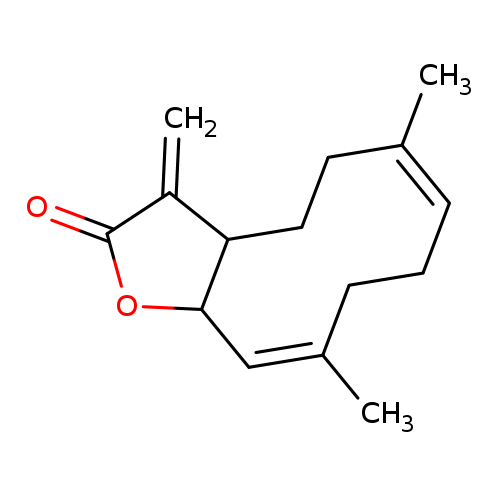
Costunolide is an organic compound with the chemical formula C15H20O2 and an average molecular weight of 232.32 g/mol. Costunolide belongs to the terpene lactones, a subclass of prenol lipids within the organic compounds. This compound is present in polyethylene terephthalate plastics and has been found in or released from 15 recorded sources across several sectors. These sources include electrical and electronic equipment, specifically batteries, capacitors, printed circuit boards, wires and cables, and cell phones, as well as one additional item. Within the food, food processing and cookware sector, it is associated with food contact materials and food packaging. It is also found in synthetic textiles, carpets, and rugs within the textiles, leather and furnishings sector. Other recorded sources include medical devices from the healthcare, pharmaceuticals and veterinary products sector, lubricants from the energy, oil and gas sector, and drinking water from the drinking water and water supply sector, among two other sectors. Recorded exposure routes for costunolide include oral, inhalation, and touch.
Contaminant Type
  • PFAS
  • Phytotoxin
Chemical Structure
Synonyms
ValueSource
CostunlideHMDB
CostunolidHMDB
Costus lactoneHMDB
IsocostunolideMeSH
CostunolideMeSH
Chemical FormulaC15H20O2
Average Molecular Mass232.318 g/mol
Monoisotopic Mass232.146 g/mol
CAS Registry Number553-21-9
IUPAC Name6,10-dimethyl-3-methylidene-2H,3H,3aH,4H,5H,8H,9H,11aH-cyclodeca[b]furan-2-one
Traditional Name6,10-dimethyl-3-methylidene-3aH,4H,5H,8H,9H,11aH-cyclodeca[b]furan-2-one
SMILESC\C1=C\CC\C(C)=C/C2OC(=O)C(=C)C2CC1
InChI IdentifierInChI=1S/C15H20O2/c1-10-5-4-6-11(2)9-14-13(8-7-10)12(3)15(16)17-14/h5,9,13-14H,3-4,6-8H2,1-2H3/b10-5-,11-9-
InChI KeyHRYLQFBHBWLLLL-GYIATTAWSA-N
Chemical Taxonomy
Description Belongs to the class of organic compounds known as germacranolides and derivatives. These are sesquiterpene lactones with a structure based on the germacranolide skeleton, characterized by a gamma lactone fused to a 1,7-dimethylcyclodec-1-ene moiety.
KingdomOrganic compounds
Super ClassLipids and lipid-like molecules
ClassPrenol lipids
Sub ClassTerpene lactones
Direct ParentGermacranolides and derivatives
Alternative Parents
Substituents
  • Germacranolide
  • Germacrane sesquiterpenoid
  • Sesquiterpenoid
  • Gamma butyrolactone
  • Tetrahydrofuran
  • Enoate ester
  • Alpha,beta-unsaturated carboxylic ester
  • Lactone
  • Carboxylic acid ester
  • Oxacycle
  • Monocarboxylic acid or derivatives
  • Carboxylic acid derivative
  • Organoheterocyclic compound
  • Organooxygen compound
  • Hydrocarbon derivative
  • Organic oxide
  • Organic oxygen compound
  • Carbonyl group
  • Aliphatic heteropolycyclic compound
Molecular FrameworkAliphatic heteropolycyclic compounds
External DescriptorsNot Available
Biological Properties
StatusDetected and Not Quantified
OriginNot Available
Cellular LocationsNot Available
Biofluid LocationsNot Available
Tissue LocationsNot Available
ApplicationsNot Available
Biological RolesNot Available
Chemical RolesNot Available
Organoleptic EffectsNot Available
Physical Properties
StateNot Available
AppearanceNot Available
Experimental Properties
PropertyValue
Melting PointNot Available
Boiling PointNot Available
SolubilityNot Available
Predicted Properties
PropertyValueSource
Water Solubility0.097 g/LALOGPS
logP4.22ALOGPS
logP3.82ChemAxon
logS-3.4ALOGPS
pKa (Strongest Basic)-6.9ChemAxon
Physiological Charge0ChemAxon
Hydrogen Acceptor Count1ChemAxon
Hydrogen Donor Count0ChemAxon
Polar Surface Area26.3 ŲChemAxon
Rotatable Bond Count0ChemAxon
Refractivity69.95 m³·mol⁻¹ChemAxon
Polarizability26.38 ųChemAxon
Number of Rings2ChemAxon
BioavailabilityYesChemAxon
Rule of FiveYesChemAxon
Ghose FilterYesChemAxon
Veber's RuleYesChemAxon
MDDR-like RuleNoChemAxon
Spectra
Spectra
Spectrum TypeDescriptionSplash KeyDeposition DateView
Predicted GC-MSPredicted GC-MS Spectrumsplash10-004i-4920000000-4e64fd5fdc43499db09cNot AvailableView Spectrum
Predicted GC-MSPredicted GC-MS SpectrumNot AvailableNot AvailableView Spectrum
Predicted LC-MS/MSPredicted LC-MS/MS Spectrumsplash10-001i-0390000000-90b5c48b328b46f82204Not AvailableView Spectrum
Predicted LC-MS/MSPredicted LC-MS/MS Spectrumsplash10-01qi-1930000000-6cfdc6b5c84eab2f9f7dNot AvailableView Spectrum
Predicted LC-MS/MSPredicted LC-MS/MS Spectrumsplash10-0mi6-9710000000-ddda69ef8cc562458ad9Not AvailableView Spectrum
Predicted LC-MS/MSPredicted LC-MS/MS Spectrumsplash10-001i-0290000000-07ab038b28845f8d64a1Not AvailableView Spectrum
Predicted LC-MS/MSPredicted LC-MS/MS Spectrumsplash10-001r-0790000000-f2b3e216b0db2d7a4dcaNot AvailableView Spectrum
Predicted LC-MS/MSPredicted LC-MS/MS Spectrumsplash10-000i-5900000000-157775eb321e2f75fa2dNot AvailableView Spectrum
Predicted LC-MS/MSPredicted LC-MS/MS Spectrumsplash10-001i-0090000000-403b175a8d75af9b9dc4Not AvailableView Spectrum
Predicted LC-MS/MSPredicted LC-MS/MS Spectrumsplash10-001i-0390000000-16fbf014b5978f284c85Not AvailableView Spectrum
Predicted LC-MS/MSPredicted LC-MS/MS Spectrumsplash10-01b9-9500000000-2ce7ff1d0912ac2d90eeNot AvailableView Spectrum
Predicted LC-MS/MSPredicted LC-MS/MS Spectrumsplash10-001i-0190000000-c5e9a61d3011edbf30f3Not AvailableView Spectrum
Predicted LC-MS/MSPredicted LC-MS/MS Spectrumsplash10-001r-0980000000-0a8be66862e84091d6a4Not AvailableView Spectrum
Predicted LC-MS/MSPredicted LC-MS/MS Spectrumsplash10-0a4i-0900000000-9eaa625d0c4efee67791Not AvailableView Spectrum
Toxicity Profile
Toxicity Values
Toxicity ValueOrganismDose DescriptorRoute of ExposurePredicted or ExperimentalToxicity RatingReference
6273.0 Log mg/kg [3500:11000]RatLD50oralpredictedNot AvailableNot Available
Toxicity / Toxin ClassNot Available
Mechanism of ToxicityNot Available
Carcinogenicity (IARC Classification)Not Available
Minimum Risk LevelNot Available
SymptomsNot Available
TreatmentNot Available
Health Effects
Health EffectRelationshipDirectionDescriptionReference
inflammationHas Therapeutic Effect OnNot AvailableNot AvailablePMC9369284
cancerHas Therapeutic Effect OnNot AvailableCancer is a group of diseases involving abnormal cell growth with the potential to invade or spread to other parts of the body. Possible signs and symptoms include a lump, abnormal bleeding, prolonged cough, unexplained weight loss, and a change in bowel movements. There are over 100 types of cancers affect humans. The risk of developing certain cancers can be reduced by not smoking, maintaining a healthy weight, not drinking too much alcohol, eating plenty of vegetables, fruits and whole grains, vaccination against certain infectious diseases, not eating too much processed and red meat and avoiding too much sunlight exposure. Cancer is often treated with some combination of radiation therapy, surgery, chemotherapy and targeted therapy. The majority of cancers, some 90–95% of cases, are due to genetic mutations from environmental and lifestyle factors. The remaining 5–10% are due to inherited genetics.PMC11357401
gastric ulcerNot AvailableNot AvailableA disorder characterized by a circumscribed, inflammatory and necrotic erosive lesion on the mucosal surface of the stomach lining.PMC9369284
Exposure Sources
Source IDSourceSectorReference
CEDs000007Pesticides?Pesticides are synthetic chemicals designed to prevent, destroy, or control pests that threaten crops and agricultural productivity.Agriculture & land managementNot Available
CEDs000010Insecticides?Insecticides are synthetic chemicals designed to control or eliminate insect pests that threaten crops and other agricultural products.Agriculture & land managementPubChem
CEDs000115Drinking water?Drinking water can be a medium for synthetic chemical contamination, often originating from various industrial processes and agricultural practices.Drinking water & water supplyNot Available
CEDs000120Wires and cables?Wires and cables are integral components in the transmission of electrical power and signals.Electrical & Electronic EquipmentNot Available
CEDs000121Printed circuit boards?Printed circuit boards (PCBs) are essential components in the manufacturing of electronic devices, serving as the backbone for electrical connections and circuit pathways.Electrical & Electronic EquipmentNot Available
CEDs000125Batteries?Batteries are devices that store and release electrical energy through electrochemical reactions.Electrical & Electronic EquipmentNot Available
CEDs000130Semiconductors?Semiconductors are materials that possess electrical conductivity between that of conductors and insulators, making them essential for various electronic applications, including transistors, diodes, and integrated circuits.Electrical & Electronic EquipmentNot Available
CEDs000138Lubricants?Lubricants are synthetic or petroleum-derived substances used to reduce friction between surfaces in machinery and equipment, enhancing operational efficiency and longevity.Energy, oil & gasNot Available
CEDs000147Food packaging?Food packaging often utilizes synthetic chemicals, such as plastics and coatings, to enhance durability, moisture resistance, and shelf life.Food, food processing & cookwareNot Available
CEDs000174Lubricants?Lubricants are synthetic or petroleum-based substances used to reduce friction and wear between moving parts in machinery and equipment.Industrial manufacturing & chemical processingNot Available
CEDs000234Medical devices?Medical devices often incorporate synthetic chemicals in their manufacturing processes, which can contribute to contamination in healthcare settings.Healthcare, pharmaceuticals & veterinary productsNot Available
CEDs000451Carpets and Rugs?Carpets and rugs are commonly manufactured using synthetic fibers such as nylon, polyester, and polypropylene, which can be derived from petrochemical sources.Textiles, leather & furnishingsNot Available
CEDs000454Synthetic textiles?Synthetic textiles are materials derived from man-made fibers, such as polyester, nylon, and acrylic, which are produced through chemical processes involving petrochemicals.Textiles, leather & furnishingsNot Available
CEDs000490Personal care & cosmeticsNot Available
CEDs000492Cell phones?Cell phones contain a variety of synthetic chemicals and materials, including plastics, metals, and glass, which can contribute to environmental contamination.Electrical & Electronic EquipmentNot Available
CEDs000493Capacitors?Capacitors are electronic components that store and release electrical energy, often using dielectric materials that can include synthetic chemicals.Electrical & Electronic EquipmentNot Available
CEDs000494Food contact materials?Food contact materials refer to substances and products that are intended to come into contact with food during processing, packaging, or preparation.Food, food processing & cookwareNot Available
CEDs000545Food Preservation?Food preservation often involves the use of synthetic chemicals, such as preservatives, flavor enhancers, and color additives, to extend shelf life and enhance the sensory qualities of food products.Food, food processing & cookwarePubChem
CEDs000556Cigar Cigarettes?Cigar cigarettes are a source of synthetic chemical contamination due to the combustion of various tobacco blends and additives.Household cleaning & consumer productsPubChem
CEDs000561Perfumes Within Detergents And Soaps?Perfumes within detergents and soaps are synthetic fragrance compounds added to enhance the sensory experience of cleaning products.Household cleaning & consumer productsPubChem
CEDs000580Manufacture Preparation Of Tobacco Products?The manufacture and preparation of tobacco products involve various processes that can result in the introduction of synthetic chemicals into the environment.Industrial manufacturing & chemical processingPubChem
CEDs000600Herbicides And Algicides?Herbicides and algicides are synthetic chemicals primarily used to control unwanted plants and algae in various environments.Agriculture & land managementPubChem
CEDs000605Pest Repellants?Pest repellents, often formulated from synthetic chemicals, are widely used to protect crops from insect infestations and other pests.Agriculture & land managementPubChem
CEDs000606Plant Growth Regulators?Plant Growth Regulators (PGRs) are synthetic chemicals designed to influence the growth and development of plants.Agriculture & land managementPubChem
CEDs000611Anti Perspirants Or Body Deoderants?Antiperspirants and body deodorants commonly contain synthetic chemicals such as aluminum compounds, parabens, and synthetic fragrances.Personal care & cosmeticsPubChem
CEDs000614Essential Oils Or Perfumes?Essential oils and perfumes are complex mixtures of volatile compounds derived from natural or synthetic sources, commonly used for their aromatic properties.Personal care & cosmeticsPubChem
CEDs000632Apparel?Apparel production often involves the use of various synthetic chemicals, including dyes, finishing agents, and preservatives.Textiles, leather & furnishingsPubChem
CEDs000679Phosphatic Fertilisers?Phosphatic fertilizers are synthetic chemical products primarily composed of phosphorus, which is essential for plant growth.Agriculture & land managementPubChem
CEDs000696Nanotechnology?Nanotechnology involves the manipulation of materials at the molecular or atomic level, typically within the range of 1 to 100 nanometers.Industrial manufacturing & chemical processingPubChem
Pathways
0 pathwaysPathway Source: PathBank

No pathways found

No metabolic pathways have been associated with this synthetic chemical

Targets
StructureProteinUniProt IDOrganismRelationshipDetails
Cannabinoid receptor 1 structureClick to view 3D structureCannabinoid receptor 1P21554HumansPredicted (SEA)
Prediction Confidence Score
0.213
Applicability Domain
0.22 Low confidence
Statistical Significance
0.3841
Supporting Reference Compounds
200
E-value
2990.5
NACHT, LRR and PYD domains-containing protein 3 structureClick to view 3D structureNACHT, LRR and PYD domains-containing protein 3Q8R4B8Mus musculusPredicted (SEA)
Prediction Confidence Score
0.212
Applicability Domain
0.345
Statistical Significance
0.0581
Supporting Reference Compounds
29
E-value
452.148
Click to view 3D structureDNA damage-inducible transcript 3 proteinP35639Mus musculusPredicted (SEA)
Prediction Confidence Score
0.21
Applicability Domain
0.254 Low confidence
Statistical Significance
0.3631
Supporting Reference Compounds
226
E-value
2826.47
X-box-binding protein 1 structureClick to view 3D structureX-box-binding protein 1P17861HumansPredicted (SEA)
Prediction Confidence Score
0.21
Applicability Domain
0.254 Low confidence
Statistical Significance
0.3637
Supporting Reference Compounds
227
E-value
2831.45
Transient receptor potential cation channel subfamily M member 8 structureClick to view 3D structureTransient receptor potential cation channel subfamily M member 8Q7Z2W7HumansPredicted (SEA)
Prediction Confidence Score
0.21
Applicability Domain
0.217 Low confidence
Statistical Significance
0.0946
Supporting Reference Compounds
43
E-value
736.22
Transient receptor potential cation channel subfamily V member 1 structureClick to view 3D structureTransient receptor potential cation channel subfamily V member 1Q8NER1HumansPredicted (SEA)
Prediction Confidence Score
0.207
Applicability Domain
0.217 Low confidence
Statistical Significance
0.3058
Supporting Reference Compounds
104
E-value
2380.63
Gamma-aminobutyric acid receptor subunit beta-2 structureClick to view 3D structureGamma-aminobutyric acid receptor subunit beta-2P47870HumansPredicted (SEA)
Prediction Confidence Score
0.206
Applicability Domain
0.206 Low confidence
Statistical Significance
0.002
Supporting Reference Compounds
1
E-value
15.8034
Ubiquitin carboxyl-terminal hydrolase 7 structureClick to view 3D structureUbiquitin carboxyl-terminal hydrolase 7Q93009HumansPredicted (SEA)
Prediction Confidence Score
0.2
Applicability Domain
0.52
Statistical Significance
0.0113
Supporting Reference Compounds
17
E-value
88.2032
Protein deacetylase HDAC6 structureClick to view 3D structureProtein deacetylase HDAC6Q9UBN7HumansPredicted (SEA)
Prediction Confidence Score
0.199
Applicability Domain
0.286 Low confidence
Statistical Significance
0.7697
Supporting Reference Compounds
553
E-value
5991.74
Nitric oxide synthase, inducible structureClick to view 3D structureNitric oxide synthase, inducibleP29477Mus musculusPredicted (SEA)
Prediction Confidence Score
0.199
Applicability Domain
0.52
Statistical Significance
0.0634
Supporting Reference Compounds
47
E-value
493.486
Toll-like receptor 4 structureClick to view 3D structureToll-like receptor 4O00206HumansPredicted (SEA)
Prediction Confidence Score
0.194
Applicability Domain
0.52
Statistical Significance
0.0105
Supporting Reference Compounds
16
E-value
82.1309
Histone deacetylase 1 structureClick to view 3D structureHistone deacetylase 1Q13547HumansPredicted (SEA)
Prediction Confidence Score
0.194
Applicability Domain
0.286 Low confidence
Statistical Significance
0.789
Supporting Reference Compounds
497
E-value
6142.46
Histone deacetylase 2 structureClick to view 3D structureHistone deacetylase 2Q92769HumansPredicted (SEA)
Prediction Confidence Score
0.194
Applicability Domain
0.286 Low confidence
Statistical Significance
0.6932
Supporting Reference Compounds
307
E-value
5396.27
Click to view 3D structurePyruvate kinase PKMP52480Mus musculusPredicted (SEA)
Prediction Confidence Score
0.194
Applicability Domain
0.194 Low confidence
Statistical Significance
4.30e-04
Supporting Reference Compounds
1
E-value
3.34752
Histone deacetylase 3 structureClick to view 3D structureHistone deacetylase 3O15379HumansPredicted (SEA)
Prediction Confidence Score
0.192
Applicability Domain
0.286 Low confidence
Statistical Significance
0.668
Supporting Reference Compounds
257
E-value
5200.56
Taste receptor type 2 member 46 structureClick to view 3D structureTaste receptor type 2 member 46P59540HumansPredicted (SEA)
Prediction Confidence Score
0.426
Applicability Domain
1.0
Statistical Significance
1.00e-05
Supporting Reference Compounds
5
E-value
0.0778492
Pyruvate kinase PKM structureClick to view 3D structurePyruvate kinase PKMP14618HumansPredicted (SEA)
Prediction Confidence Score
0.34
Applicability Domain
1.0
Statistical Significance
8.10e-04
Supporting Reference Compounds
29
E-value
6.30579
Cannabinoid receptor 2 structureClick to view 3D structureCannabinoid receptor 2P34972HumansPredicted (SEA)
Prediction Confidence Score
0.252
Applicability Domain
0.383
Statistical Significance
0.0758
Supporting Reference Compounds
175
E-value
590.175
NACHT, LRR and PYD domains-containing protein 3 structureClick to view 3D structureNACHT, LRR and PYD domains-containing protein 3Q96P20HumansPredicted (SEA)
Prediction Confidence Score
0.247
Applicability Domain
0.345
Statistical Significance
0.0186
Supporting Reference Compounds
51
E-value
144.955
Ubiquitin-conjugating enzyme E2 D3 structureClick to view 3D structureUbiquitin-conjugating enzyme E2 D3P61077HumansPredicted (SEA)
Prediction Confidence Score
0.243
Applicability Domain
0.243 Low confidence
Statistical Significance
3.20e-04
Supporting Reference Compounds
1
E-value
2.49118
Prostaglandin G/H synthase 2 structureClick to view 3D structureProstaglandin G/H synthase 2P35354HumansPredicted (SEA)
Prediction Confidence Score
0.239
Applicability Domain
0.52
Statistical Significance
0.1294
Supporting Reference Compounds
201
E-value
1007.06
Click to view 3D structureHeat sensitive channel TRPV3Q4QYD9Rattus norvegicusPredicted (SEA)
Prediction Confidence Score
0.232
Applicability Domain
0.302
Statistical Significance
2.60e-04
Supporting Reference Compounds
3
E-value
2.02408
G-protein coupled receptor 55 structureClick to view 3D structureG-protein coupled receptor 55Q9Y2T6HumansPredicted (SEA)
Prediction Confidence Score
0.229
Applicability Domain
0.254 Low confidence
Statistical Significance
0.1111
Supporting Reference Compounds
125
E-value
865.294
Transcriptional activator Myb structureClick to view 3D structureTranscriptional activator MybP01103Gallus gallusPredicted (SEA)
Prediction Confidence Score
0.226
Applicability Domain
0.254 Low confidence
Statistical Significance
1.40e-04
Supporting Reference Compounds
4
E-value
1.08989
Mu-type opioid receptor structureClick to view 3D structureMu-type opioid receptorP35372HumansPredicted (SEA)
Prediction Confidence Score
0.215
Applicability Domain
0.224 Low confidence
Statistical Significance
0.5264
Supporting Reference Compounds
527
E-value
4097.67
Concentrations
Not Available
External Links
DrugBank IDNot Available
HMDB IDHMDB0036688
FooDB IDFDB015618
Phenol Explorer IDNot Available
KNApSAcK IDC00003240
BiGG IDNot Available
BioCyc IDNot Available
METLIN IDNot Available
PDB IDNot Available
Wikipedia LinkCostunolide
Chemspider ID4519051
ChEBI IDNot Available
PubChem Compound ID5367559
Kegg Compound IDC09382
YMDB IDNot Available
ECMDB IDNot Available
References
Synthesis ReferenceNot Available
MSDSNot Available
General ReferencesNot Available