Bradykinin (CED0001490)

Record Information
Version1.0
Creation Date2016-05-26 05:58:11 UTC
Update Date2026-08-22 19:28:02 UTC
SynCED IDCED0001490
Secondary Accession Numbers
  • CHEM035663
Identification
Common NameBradykinin
ClassSmall Molecule
Description
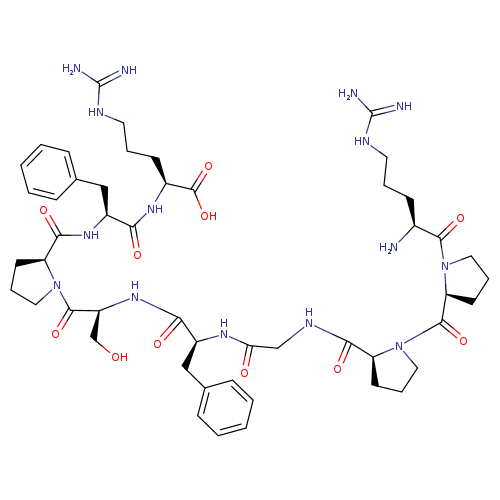
Bradykinin (C50H73N15O11) is a chemical compound with an average molecular weight of 1,060 g/mol. With an average molecular weight of 1,060 g/mol, Bradykinin is a heavy molecule. Bradykinin belongs to the amino acids, peptides, and analogues, a subclass of carboxylic acids and derivatives within the organic compounds. This compound is found in or released from four recorded sources, including food, food processing and cookware, specifically the preparation of wort, as well as electrical and electronic equipment such as antennas, gas filled discharge tubes with gaseous cathodes, and discharge tubes with liquid pool cathodes. Regarding its biological activity, Bradykinin acts as an inhibitor of the B2 bradykinin receptor (BDKRB2). In terms of health effects, the compound is associated with inflammation (PMC9784116 ) and cancer (PMC9784116 ).
Contaminant TypeNot Available
Chemical Structure
Synonyms
ValueSource
Arg-pro-pro-gly-phe-ser-pro-phe-argChEBI
BKChEBI
L-Arg-L-pro-L-pro-gly-L-phe-L-ser-L-pro-L-phe-L-argChEBI
L-BradykininChEBI
RPPGFSPFRChEBI
Callidin IHMDB
Kallidin 9HMDB
Kallidin IHMDB
L-Arginyl-L-prolyl-L-prolylglycyl-L-phenylalanyl-L-seryl-L-prolyl-L-phenylalanyl-L-arginineHMDB
Bradykinin acetate, (9-D-arg)-isomerHMDB
Bradykinin hydrochlorideHMDB
Bradykinin triacetateHMDB
Bradykinin, (2-D-pro-7-D-pro)-isomerHMDB
Bradykinin, (8-D-phe)-isomerHMDB
Arg pro pro gly phe ser pro phe argHMDB
Bradykinin, (1-D-arg)-isomerHMDB
Bradykinin, (2-D-pro-3-D-pro-7-D-pro)-isomerHMDB
Bradykinin, (3-D-pro-7-D-pro)-isomerHMDB
Bradykinin, (5-D-phe)-isomerHMDB
Bradykinin, (5-D-phe-8-D-phe)-isomerHMDB
Bradykinin, (6-D-ser)-isomerHMDB
Bradykinin, (7-D-pro)-isomerHMDB
Bradykinin, (9-D-arg)-isomerHMDB
Bradykinin diacetateHMDB
Bradykinin, (2-D-pro)-isomerHMDB
Bradykinin, (3-D-pro)-isomerHMDB
Chemical FormulaC50H73N15O11
Average Molecular Mass1060.209 g/mol
Monoisotopic Mass1059.561 g/mol
CAS Registry Number58-82-2
IUPAC Name(2S)-2-[(2S)-2-{[(2S)-1-[(2S)-2-[(2S)-2-(2-{[(2S)-1-[(2S)-1-[(2S)-2-amino-5-carbamimidamidopentanoyl]pyrrolidine-2-carbonyl]pyrrolidin-2-yl]formamido}acetamido)-3-phenylpropanamido]-3-hydroxypropanoyl]pyrrolidin-2-yl]formamido}-3-phenylpropanamido]-5-carbamimidamidopentanoic acid
Traditional NameL-bradykinin
SMILESN[C@@H](CCCNC(N)=N)C(=O)N1CCC[C@H]1C(=O)N1CCC[C@H]1C(=O)NCC(=O)N[C@@H](CC1=CC=CC=C1)C(=O)N[C@@H](CO)C(=O)N1CCC[C@H]1C(=O)N[C@@H](CC1=CC=CC=C1)C(=O)N[C@@H](CCCNC(N)=N)C(O)=O
InChI IdentifierInChI=1S/C50H73N15O11/c51-32(16-7-21-56-49(52)53)45(72)65-25-11-20-39(65)47(74)64-24-9-18-37(64)43(70)58-28-40(67)59-34(26-30-12-3-1-4-13-30)41(68)62-36(29-66)46(73)63-23-10-19-38(63)44(71)61-35(27-31-14-5-2-6-15-31)42(69)60-33(48(75)76)17-8-22-57-50(54)55/h1-6,12-15,32-39,66H,7-11,16-29,51H2,(H,58,70)(H,59,67)(H,60,69)(H,61,71)(H,62,68)(H,75,76)(H4,52,53,56)(H4,54,55,57)/t32-,33-,34-,35-,36-,37-,38-,39-/m0/s1
InChI KeyQXZGBUJJYSLZLT-FDISYFBBSA-N
Chemical Taxonomy
Description Belongs to the class of organic compounds known as oligopeptides. These are organic compounds containing a sequence of between three and ten alpha-amino acids joined by peptide bonds.
KingdomOrganic compounds
Super ClassOrganic acids and derivatives
ClassCarboxylic acids and derivatives
Sub ClassAmino acids, peptides, and analogues
Direct ParentOligopeptides
Alternative Parents
Substituents
  • Alpha-oligopeptide
  • Phenylalanine or derivatives
  • Proline or derivatives
  • N-acyl-alpha amino acid or derivatives
  • N-acyl-l-alpha-amino acid
  • N-acyl-alpha-amino acid
  • Alpha-amino acid amide
  • N-substituted-alpha-amino acid
  • Alpha-amino acid or derivatives
  • Amphetamine or derivatives
  • N-acylpyrrolidine
  • Pyrrolidine carboxylic acid or derivatives
  • Pyrrolidine-2-carboxamide
  • Monocyclic benzene moiety
  • Fatty acyl
  • Benzenoid
  • Fatty amide
  • Tertiary carboxylic acid amide
  • Pyrrolidine
  • Secondary carboxylic acid amide
  • Carboxamide group
  • Amino acid or derivatives
  • Guanidine
  • Amino acid
  • Azacycle
  • Organoheterocyclic compound
  • Carboxylic acid
  • Organic 1,3-dipolar compound
  • Propargyl-type 1,3-dipolar organic compound
  • Monocarboxylic acid or derivatives
  • Carboximidamide
  • Amine
  • Organopnictogen compound
  • Organic oxygen compound
  • Organic nitrogen compound
  • Carbonyl group
  • Alcohol
  • Primary aliphatic amine
  • Organic oxide
  • Hydrocarbon derivative
  • Primary amine
  • Primary alcohol
  • Organonitrogen compound
  • Organooxygen compound
  • Aromatic heteromonocyclic compound
Molecular FrameworkAromatic heteromonocyclic compounds
External Descriptors
Biological Properties
StatusDetected and Not Quantified
OriginNot Available
Cellular LocationsNot Available
Biofluid LocationsNot Available
Tissue LocationsNot Available
ApplicationsNot Available
Biological Roles
Chemical RolesNot Available
Organoleptic EffectsNot Available
Physical Properties
StateNot Available
AppearanceNot Available
Experimental Properties
PropertyValue
Melting PointNot Available
Boiling PointNot Available
SolubilityNot Available
Predicted Properties
PropertyValueSource
Water Solubility0.057 g/LALOGPS
logP-2.1ALOGPS
logP-6.4ChemAxon
logS-4.3ALOGPS
pKa (Strongest Acidic)3.39ChemAxon
pKa (Strongest Basic)12.44ChemAxon
Physiological Charge2ChemAxon
Hydrogen Acceptor Count18ChemAxon
Hydrogen Donor Count14ChemAxon
Polar Surface Area413.78 ŲChemAxon
Rotatable Bond Count27ChemAxon
Refractivity295.08 m³·mol⁻¹ChemAxon
Polarizability109.98 ųChemAxon
Number of Rings5ChemAxon
BioavailabilityNoChemAxon
Rule of FiveNoChemAxon
Ghose FilterNoChemAxon
Veber's RuleNoChemAxon
MDDR-like RuleYesChemAxon
Spectra
Spectra
Spectrum TypeDescriptionSplash KeyDeposition DateView
Predicted LC-MS/MSPredicted LC-MS/MS Spectrumsplash10-00di-9605021310-963d37a5c0a6a8c3b581Not AvailableView Spectrum
Predicted LC-MS/MSPredicted LC-MS/MS Spectrumsplash10-00fr-4914021100-da28e55acbc5e55e7615Not AvailableView Spectrum
Predicted LC-MS/MSPredicted LC-MS/MS Spectrumsplash10-00di-9824010200-b5b2c55602c29375ed1aNot AvailableView Spectrum
Predicted LC-MS/MSPredicted LC-MS/MS Spectrumsplash10-0ard-9000000008-70e85b5126294f4866f8Not AvailableView Spectrum
Predicted LC-MS/MSPredicted LC-MS/MS Spectrumsplash10-0a4m-8001001009-d8431ee82b28629bac33Not AvailableView Spectrum
Predicted LC-MS/MSPredicted LC-MS/MS Spectrumsplash10-0a4i-9001111000-9de36ae5c0196bc1ca98Not AvailableView Spectrum
Predicted LC-MS/MSPredicted LC-MS/MS Spectrumsplash10-03di-9000000000-eb21ccd98d434e431a1eNot AvailableView Spectrum
Predicted LC-MS/MSPredicted LC-MS/MS Spectrumsplash10-03dl-9000210241-b63ee10d53ba3efc65cbNot AvailableView Spectrum
Predicted LC-MS/MSPredicted LC-MS/MS Spectrumsplash10-022l-9780340000-45c697c4a631655e2811Not AvailableView Spectrum
Predicted LC-MS/MSPredicted LC-MS/MS Spectrumsplash10-0a4i-9000000000-6f7d24ea48539f7cd9fbNot AvailableView Spectrum
Predicted LC-MS/MSPredicted LC-MS/MS Spectrumsplash10-052f-9000100016-0338af4c69622fd514d8Not AvailableView Spectrum
Predicted LC-MS/MSPredicted LC-MS/MS Spectrumsplash10-052g-9003871073-646bd5ef5605a552ce67Not AvailableView Spectrum
1D NMR13C NMR Spectrum (1D, D2O, predicted)Not AvailableNot AvailableView Spectrum
1D NMR1H NMR Spectrum (1D, D2O, predicted)Not AvailableNot AvailableView Spectrum
Toxicity Profile
Toxicity ValuesNot Available
Toxicity / Toxin ClassNot Available
Mechanism of ToxicityNot Available
Carcinogenicity (IARC Classification)Not Available
Minimum Risk LevelNot Available
SymptomsNot Available
TreatmentNot Available
Health Effects
Health EffectRelationshipDirectionDescriptionReference
hypertensionAssociated With?Not AvailableA disorder characterized by a pathological increase in blood pressure; a repeatedly elevation in the blood pressure exceeding 140 over 90 mm Hg. (NCI CTCAE)PMC12584831
inflammationAssociated With?Not AvailableNot AvailablePMC9784116 , PMC7400062
inflammationAssociated With?increaseNot AvailablePMC13347398
cancerAssociated With?Not AvailableCancer is a group of diseases involving abnormal cell growth with the potential to invade or spread to other parts of the body. Possible signs and symptoms include a lump, abnormal bleeding, prolonged cough, unexplained weight loss, and a change in bowel movements. There are over 100 types of cancers affect humans. The risk of developing certain cancers can be reduced by not smoking, maintaining a healthy weight, not drinking too much alcohol, eating plenty of vegetables, fruits and whole grains, vaccination against certain infectious diseases, not eating too much processed and red meat and avoiding too much sunlight exposure. Cancer is often treated with some combination of radiation therapy, surgery, chemotherapy and targeted therapy. The majority of cancers, some 90–95% of cases, are due to genetic mutations from environmental and lifestyle factors. The remaining 5–10% are due to inherited genetics.PMC9784116
type 2 diabetes mellitusAssociated With?decreaseNot AvailablePMC5552834
strokeAssociated With?Not AvailableNot AvailablePMC12584831
rheumatoid arthritisElevated in Blood InincreaseAn arthritis that is an autoimmune disease which attacks healthy cells and tissue located in joint. (DO)PMC12584831
painAssociated With?Not AvailableA disorder characterized by the sensation of marked discomfort, distress or agony. (NCI CTCAE)PMC12584831 , PMC12584831
coughAssociated With?increaseA sudden, often repetitive, spasmodic contraction of the thoracic cavity, resulting in violent release of air from the lungs and usually accompanied by a distinctive sound. (NCI CTCAE)PMC3537328
coughAssociated With?Not AvailableA sudden, often repetitive, spasmodic contraction of the thoracic cavity, resulting in violent release of air from the lungs and usually accompanied by a distinctive sound. (NCI CTCAE)PMC6405328
osteoarthritisElevated in Blood InincreaseAn arthritis that has material basis in worn out cartilage located in joint. (DO)PMC12584831
interstitial cystitisAssociated With?increaseNot AvailablePMC13103315
angioedemaAssociated With?Not AvailableNot AvailablePMC6405328
migraine with auraAssociated With?Not AvailableNot AvailablePMC6220531
bacterial infectious diseaseAssociated With?Not AvailableNot AvailablePMC9784116
Lung InjuryAssociated With?Not AvailableNot AvailablePMC10069302
DeathAssociated With?Not AvailableNot AvailablePMC5832253
septic shockAssociated With?Not AvailableNot AvailablePMC12584831
ArthralgiaAssociated With?increaseNot AvailablePMC12584831
adult respiratory distress syndromeAssociated With?Not AvailableNot AvailablePMC10069302
Cancer PainAssociated With?Not AvailableNot AvailablePMC6302803
Pelvic painAssociated With?Not AvailableNot AvailablePMC7076794
Exposure Sources
Source IDSourceSectorReference
CEDs000010Insecticides?Insecticides are synthetic chemicals designed to control or eliminate insect pests that threaten crops and other agricultural products.Agriculture & land managementPubChem
CEDs000506Antennas?Antennas, commonly used in communication technologies, can be a source of synthetic chemical contamination through the materials and coatings used in their construction.Electrical & Electronic EquipmentPubChem
CEDs000511Conductors Or Conductive Bodies Characterised By The Conductive Materials?Conductors, or conductive bodies, are materials that allow the flow of electrical current, typically made from metals such as copper, aluminum, or silver.Electrical & Electronic EquipmentPubChem
CEDs000515Discharge Tubes With Liquid Pool Cathodes?Discharge tubes with liquid pool cathodes are devices that utilize a liquid metal as the cathode in gas discharge applications.Electrical & Electronic EquipmentPubChem
CEDs000522Gas Filled Discharge Tubes With Gaseous Cathodes?Gas Filled Discharge Tubes with Gaseous Cathodes are electrical devices that facilitate the conduction of electricity through a gas medium.Electrical & Electronic EquipmentPubChem
CEDs000545Food Preservation?Food preservation often involves the use of synthetic chemicals, such as preservatives, flavor enhancers, and color additives, to extend shelf life and enhance the sensory qualities of food products.Food, food processing & cookwarePubChem
CEDs000550Preparation Of Wort?The preparation of wort involves the extraction of sugars from malted grains, a crucial step in the brewing process.Food, food processing & cookwarePubChem
CEDs000561Perfumes Within Detergents And Soaps?Perfumes within detergents and soaps are synthetic fragrance compounds added to enhance the sensory experience of cleaning products.Household cleaning & consumer productsPubChem
CEDs000580Manufacture Preparation Of Tobacco Products?The manufacture and preparation of tobacco products involve various processes that can result in the introduction of synthetic chemicals into the environment.Industrial manufacturing & chemical processingPubChem
CEDs000596Acaricides?Acaricides are synthetic chemicals specifically designed to target and control mite populations that can damage crops and plants.Agriculture & land managementPubChem
CEDs000603Nematocides?Nematocides are synthetic chemicals specifically designed to control nematodes, which are microscopic roundworms that can cause significant damage to crops and plants.Agriculture & land managementPubChem
CEDs000606Plant Growth Regulators?Plant Growth Regulators (PGRs) are synthetic chemicals designed to influence the growth and development of plants.Agriculture & land managementPubChem
CEDs000609Aftershave?Aftershave is a grooming product typically used to soothe and protect the skin following shaving.Personal care & cosmeticsPubChem
CEDs000610Aftersun Products?Aftersun products are designed to soothe and hydrate the skin after sun exposure, often containing various synthetic chemicals such as emollients, preservatives, and fragrances.Personal care & cosmeticsPubChem
CEDs000611Anti Perspirants Or Body Deoderants?Antiperspirants and body deodorants commonly contain synthetic chemicals such as aluminum compounds, parabens, and synthetic fragrances.Personal care & cosmeticsPubChem
CEDs000612Body Washing Or Cleaning Implements?Body washing or cleaning implements, such as synthetic sponges, loofahs, and washcloths, can be sources of synthetic chemical contamination due to the materials used in their production.Personal care & cosmeticsPubChem
CEDs000614Essential Oils Or Perfumes?Essential oils and perfumes are complex mixtures of volatile compounds derived from natural or synthetic sources, commonly used for their aromatic properties.Personal care & cosmeticsPubChem
CEDs000615Eye Makeup Products?Eye makeup products, including mascaras, eyeliners, and eyeshadows, often contain a variety of synthetic chemicals such as pigments, preservatives, and film-forming agents.Personal care & cosmeticsPubChem
CEDs000617Lip Care Products?Lip care products, including lipsticks, balms, and glosses, often contain a variety of synthetic chemicals such as parabens, phthalates, and synthetic fragrances.Personal care & cosmeticsPubChem
CEDs000618Lip Makeup Products?Lip makeup products, such as lipsticks, lip glosses, and lip liners, often contain a variety of synthetic chemicals, including pigments, preservatives, and emollients.Personal care & cosmeticsPubChem
CEDs000620Card Games?Card games often utilize synthetic materials for playing cards and associated gaming equipment, which may contain various chemicals such as polyvinyl chloride (PVC), plastics, and dyes.Recreation & sports surfacesPubChem
CEDs000632Apparel?Apparel production often involves the use of various synthetic chemicals, including dyes, finishing agents, and preservatives.Textiles, leather & furnishingsPubChem
CEDs000642Footwear?Footwear production often involves the use of various synthetic chemicals, such as adhesives, dyes, and treatments, which can contribute to environmental contamination.Textiles, leather & furnishingsPubChem
CEDs000643Headwear?Headwear made from synthetic materials often incorporates chemicals used in the manufacturing and finishing processes, such as dyes, flame retardants, and water repellents.Textiles, leather & furnishingsPubChem
CEDs000650Purses Luggage Hand Bags?Purses, luggage, and handbags are often manufactured using synthetic materials such as polyvinyl chloride (PVC), polyurethane, and various types of nylon.Textiles, leather & furnishingsPubChem
CEDs000678Nitrogenous Fertilisers?Nitrogenous fertilizers are synthetic chemical compounds primarily used to enhance plant growth by supplying essential nitrogen, a crucial nutrient for photosynthesis and protein synthesis.Agriculture & land managementPubChem
CEDs000679Phosphatic Fertilisers?Phosphatic fertilizers are synthetic chemical products primarily composed of phosphorus, which is essential for plant growth.Agriculture & land managementPubChem
CEDs000685Ceramics?Ceramics can be a source of synthetic chemical contamination through various additives and processing agents used in their production.Building & ConstructionPubChem
CEDs000696Nanotechnology?Nanotechnology involves the manipulation of materials at the molecular or atomic level, typically within the range of 1 to 100 nanometers.Industrial manufacturing & chemical processingPubChem
CEDs000698Jewellery?Jewellery production often involves the use of various synthetic chemicals during the extraction and processing of metals.Mining & metal processingPubChem
CEDs000732Spectacle Cases?Spectacle cases can serve as a source of synthetic chemical contamination due to the materials used in their production, such as polycarbonate, PVC, and various plastics, which may leach harmful substances over time.Healthcare, pharmaceuticals & veterinary productsPubChem
CEDs000739Inks?Inks are complex mixtures composed of pigments or dyes, solvents, resins, and additives used primarily for printing and writing applications.Paper, pulp & fiber productsPubChem
CEDs000740Paper?Paper production involves the processing of wood fibers and the use of various chemicals, which can lead to synthetic chemical contamination.Paper, pulp & fiber productsPubChem
CEDs000744Water, Wastewater, & Sewage Treatment?Water, wastewater, and sewage treatment processes are critical for managing and mitigating pollutants in water systems.Wastewater, sanitation & biosolidsPubChem
Pathways
1 pathwayPathway Source: PathBank
Targets
StructureProteinUniProt IDOrganismRelationshipDetails
Click to view 3D structureKappa-type opioid receptorP34975Rattus norvegicusPredicted (SEA)
Prediction Confidence Score
0.509
Applicability Domain
0.58
Statistical Significance
0.003
Supporting Reference Compounds
66
E-value
23.0434
Click to view 3D structureSubstance-P receptorP14600Rattus norvegicusPredicted (SEA)
Prediction Confidence Score
0.505
Applicability Domain
0.541
Statistical Significance
0.002
Supporting Reference Compounds
34
E-value
15.6477
Click to view 3D structureNeurotensin receptor type 2O95665HumansPredicted (SEA)
Prediction Confidence Score
0.502
Applicability Domain
0.559
Statistical Significance
9.60e-04
Supporting Reference Compounds
9
E-value
7.47353
Apical membrane antigen 1 structureClick to view 3D structureApical membrane antigen 1Q7KQK5Plasmodium falciparum (isolate 3D7)Predicted (SEA)
Prediction Confidence Score
0.5
Applicability Domain
0.5
Statistical Significance
0.0034
Supporting Reference Compounds
1
E-value
26.7023
Plasminogen structureClick to view 3D structurePlasminogenP00747HumansPredicted (SEA)
Prediction Confidence Score
0.497
Applicability Domain
0.69
Statistical Significance
0.0018
Supporting Reference Compounds
195
E-value
13.7793
Click to view 3D structureNeuromedin-U receptor 1O55040Mus musculusPredicted (SEA)
Prediction Confidence Score
0.497
Applicability Domain
0.52
Statistical Significance
0.0011
Supporting Reference Compounds
3
E-value
8.25202
Mu-type opioid receptor structureClick to view 3D structureMu-type opioid receptorP42866Mus musculusPredicted (SEA)
Prediction Confidence Score
0.49
Applicability Domain
0.541
Statistical Significance
0.003
Supporting Reference Compounds
107
E-value
23.0434
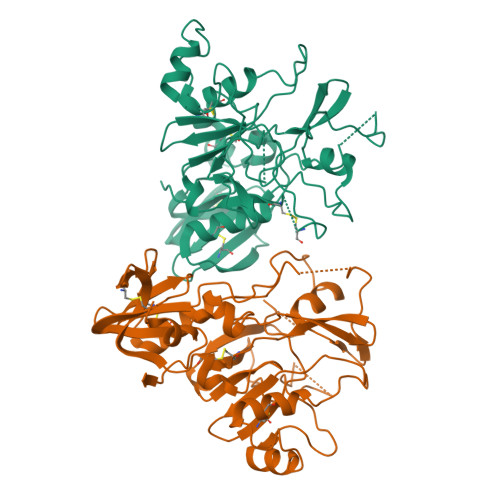
Plasma kallikrein structureClick to view 3D structurePlasma kallikreinP03952HumansKnownNot Available
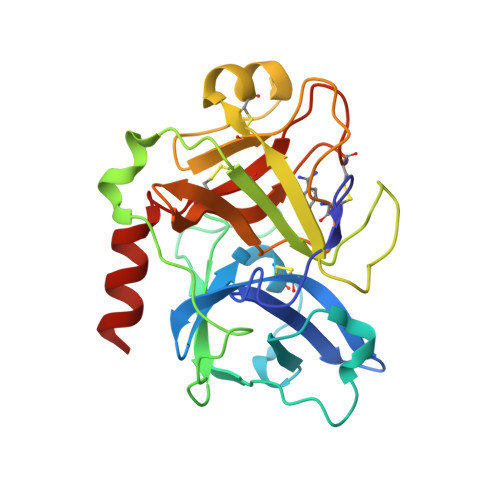
Click to view 3D structurePiezo-type mechanosensitive ion channel component 2Q9H5I5HumansKnownNot Available
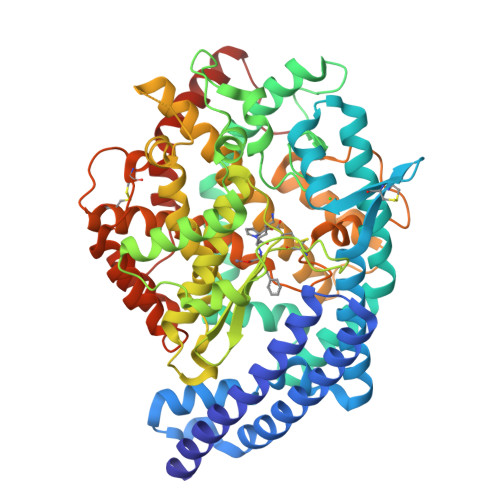
Angiotensin-converting enzyme structureClick to view 3D structureAngiotensin-converting enzymeP12821HumansKnownNot Available
Click to view 3D structureB2 bradykinin receptorP25023Rattus norvegicusPredicted (SEA)
Prediction Confidence Score
0.68
Applicability Domain
1.0
Statistical Significance
4.00e-05
Supporting Reference Compounds
10
E-value
0.311397
B2 bradykinin receptor structureClick to view 3D structureB2 bradykinin receptorP30411HumansPredicted (SEA)
Prediction Confidence Score
0.634
Applicability Domain
1.0
Statistical Significance
1.00e-05
Supporting Reference Compounds
18
E-value
0.0778492
Adapter molecule crk structureClick to view 3D structureAdapter molecule crkP46108HumansPredicted (SEA)
Prediction Confidence Score
0.602
Applicability Domain
0.602
Statistical Significance
2.30e-04
Supporting Reference Compounds
1
E-value
1.79053
Kappa-type opioid receptor structureClick to view 3D structureKappa-type opioid receptorP41145HumansPredicted (SEA)
Prediction Confidence Score
0.582
Applicability Domain
0.611
Statistical Significance
0.0034
Supporting Reference Compounds
532
E-value
26.1573
Delta-type opioid receptor structureClick to view 3D structureDelta-type opioid receptorP41143HumansPredicted (SEA)
Prediction Confidence Score
0.581
Applicability Domain
0.602
Statistical Significance
0.0036
Supporting Reference Compounds
427
E-value
27.9479
Mu-type opioid receptor structureClick to view 3D structureMu-type opioid receptorP35372HumansPredicted (SEA)
Prediction Confidence Score
0.576
Applicability Domain
0.602
Statistical Significance
0.0035
Supporting Reference Compounds
527
E-value
27.4029
Click to view 3D structureNeuropeptide FF receptor 2Q9Y5X5HumansPredicted (SEA)
Prediction Confidence Score
0.572
Applicability Domain
0.611
Statistical Significance
5.10e-04
Supporting Reference Compounds
25
E-value
3.97031
Neuropilin-1 structureClick to view 3D structureNeuropilin-1Q9QWJ9Rattus norvegicusPredicted (SEA)
Prediction Confidence Score
0.566
Applicability Domain
0.582
Statistical Significance
6.00e-05
Supporting Reference Compounds
2
E-value
0.467095
C5a anaphylatoxin chemotactic receptor 1 structureClick to view 3D structureC5a anaphylatoxin chemotactic receptor 1P30993Mus musculusPredicted (SEA)
Prediction Confidence Score
0.563
Applicability Domain
0.563
Statistical Significance
5.70e-04
Supporting Reference Compounds
1
E-value
4.43741
Click to view 3D structureMu-type opioid receptorP33535Rattus norvegicusPredicted (SEA)
Prediction Confidence Score
0.562
Applicability Domain
0.595
Statistical Significance
0.0043
Supporting Reference Compounds
229
E-value
33.6309
Click to view 3D structureMu-type opioid receptorP97266Cavia porcellusPredicted (SEA)
Prediction Confidence Score
0.558
Applicability Domain
0.641
Statistical Significance
0.0045
Supporting Reference Compounds
186
E-value
34.8764
Click to view 3D structureKappa-type opioid receptorP41144Cavia porcellusPredicted (SEA)
Prediction Confidence Score
0.538
Applicability Domain
0.58
Statistical Significance
0.0051
Supporting Reference Compounds
199
E-value
39.4696
Delta-type opioid receptor structureClick to view 3D structureDelta-type opioid receptorP32300Mus musculusPredicted (SEA)
Prediction Confidence Score
0.533
Applicability Domain
0.58
Statistical Significance
0.0051
Supporting Reference Compounds
166
E-value
39.3917
Click to view 3D structureNeuropeptide FF receptor 1Q9GZQ6HumansPredicted (SEA)
Prediction Confidence Score
0.531
Applicability Domain
0.611
Statistical Significance
8.40e-04
Supporting Reference Compounds
21
E-value
6.53933
Click to view 3D structureDelta-type opioid receptorP33533Rattus norvegicusPredicted (SEA)
Prediction Confidence Score
0.524
Applicability Domain
0.543
Statistical Significance
0.0049
Supporting Reference Compounds
164
E-value
38.5354
Neurotensin receptor type 1 structureClick to view 3D structureNeurotensin receptor type 1P30989HumansPredicted (SEA)
Prediction Confidence Score
0.515
Applicability Domain
0.559
Statistical Significance
9.60e-04
Supporting Reference Compounds
44
E-value
7.47353
Click to view 3D structureNeuromedin-U receptor 2Q8BZ39Mus musculusPredicted (SEA)
Prediction Confidence Score
0.514
Applicability Domain
0.514
Statistical Significance
0.0011
Supporting Reference Compounds
1
E-value
8.25202
Click to view 3D structureUncharacterized proteinF1N083Bos taurusPredicted (SEA)
Prediction Confidence Score
0.511
Applicability Domain
0.511
Statistical Significance
7.60e-04
Supporting Reference Compounds
1
E-value
5.91654
Concentrations
Not Available
External Links
DrugBank IDDB12126
HMDB IDHMDB0004246
FooDB IDFDB023350
Phenol Explorer IDNot Available
KNApSAcK IDNot Available
BiGG IDNot Available
BioCyc IDNot Available
METLIN IDNot Available
PDB IDNot Available
Wikipedia LinkBradykinin
Chemspider ID388341
ChEBI ID3165
PubChem Compound ID439201
Kegg Compound IDC00306
YMDB IDNot Available
ECMDB IDM2MDB005413
References
Synthesis ReferenceNot Available
MSDSNot Available
General ReferencesNot Available