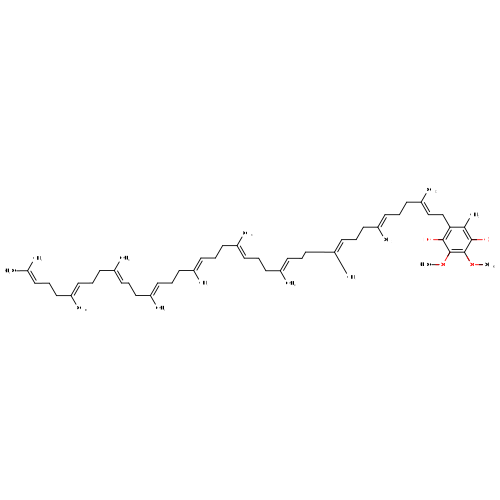
Ubiquinol-10 (CED0009064)

Record Information
Version1.0
Creation Date2016-05-27 01:13:23 UTC
Update Date2026-05-14 19:08:52 UTC
Accession NumberCHEM041100
Identification
Common NameUbiquinol-10
ClassSmall Molecule
Description
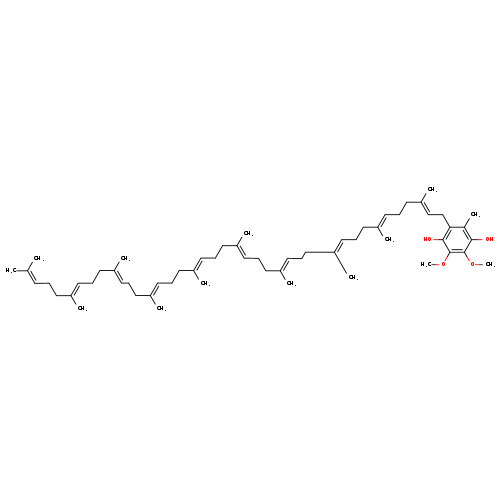
Ubiquinol-10 (C59H92O4) is a chemical compound. Ubiquinol-10 belongs to the quinone and hydroquinone lipids, a subclass of prenol lipids within the organic compounds. With an average molecular weight of 865.36 g/mol, Ubiquinol-10 is a heavy molecule. Biologically, Ubiquinol-10 functions as an antioxidant (PMC12466395, PMC2933331, PMC4665427, PMC7452004, PMC7765667, PMC9657286). Additionally, it has therapeutic effects on inflammation and obesity (PMC11852089).
Contaminant TypeNot Available
Chemical Structure
Synonyms
ValueSource
Coenzyme Q10-H2ChEBI
CoQ10h2ChEBI
Reduced coenzyme Q10ChEBI
Ubiquinol(10)ChEBI
Ubiquinol 0MeSH
Ubiquinol 7MeSH
Ubiquinol 9MeSH
Ubiquinol 6 (ubiquinol 30)MeSH
UbiquinolsMeSH
UbiquinolMeSH
Ubiquinol 1MeSH
Ubiquinol 50MeSH
Ubiquinone hydroquinoneMeSH
CoQ(,10)H(,2)HMDB
CoQH(,2)HMDB
Coenzyme Q10, reducedMeSH, HMDB
Chemical FormulaC59H92O4
Average Molecular Mass865.359 g/mol
Monoisotopic Mass864.700 g/mol
CAS Registry Number5677-55-4
IUPAC Name2-[(2E,6E,10E,14E,18E,22E,26E,30E,34E)-3,7,11,15,19,23,27,31,35,39-decamethyltetraconta-2,6,10,14,18,22,26,30,34,38-decaen-1-yl]-5,6-dimethoxy-3-methylbenzene-1,4-diol
Traditional Nameubiquinol(10)
SMILESCOC1=C(OC)C(O)=C(C\C=C(/C)CC\C=C(/C)CC\C=C(/C)CC\C=C(/C)CC\C=C(/C)CC\C=C(/C)CC\C=C(/C)CC\C=C(/C)CC\C=C(/C)CCC=C(C)C)C(C)=C1O
InChI IdentifierInChI=1S/C59H92O4/c1-44(2)24-15-25-45(3)26-16-27-46(4)28-17-29-47(5)30-18-31-48(6)32-19-33-49(7)34-20-35-50(8)36-21-37-51(9)38-22-39-52(10)40-23-41-53(11)42-43-55-54(12)56(60)58(62-13)59(63-14)57(55)61/h24,26,28,30,32,34,36,38,40,42,60-61H,15-23,25,27,29,31,33,35,37,39,41,43H2,1-14H3/b45-26+,46-28+,47-30+,48-32+,49-34+,50-36+,51-38+,52-40+,53-42+
InChI KeyQNTNKSLOFHEFPK-UPTCCGCDSA-N
Chemical Taxonomy
Description Belongs to the class of organic compounds known as polyprenyl quinols. Polyprenyl quinols are compounds containing a polyisoprene chain attached to a quinol(hydroquinone) at the second ring position.
KingdomOrganic compounds
Super ClassLipids and lipid-like molecules
ClassPrenol lipids
Sub ClassQuinone and hydroquinone lipids
Direct ParentPolyprenyl quinols
Alternative Parents
Substituents
  • Polyterpenoid
  • 2-polyprenyl-6-methoxyphenol
  • Polyprenylbenzoquinol
  • Polyprenylphenol
  • Ubiquinol skeleton
  • Methoxyphenol
  • O-dimethoxybenzene
  • Dimethoxybenzene
  • Anisole
  • Hydroquinone
  • M-cresol
  • Phenoxy compound
  • O-cresol
  • Phenol ether
  • Methoxybenzene
  • Alkyl aryl ether
  • Phenol
  • Toluene
  • Monocyclic benzene moiety
  • Benzenoid
  • Ether
  • Organooxygen compound
  • Organic oxygen compound
  • Hydrocarbon derivative
  • Aromatic homomonocyclic compound
Molecular FrameworkAromatic homomonocyclic compounds
External Descriptors
Biological Properties
StatusDetected and Not Quantified
OriginNot Available
Cellular LocationsNot Available
Biofluid LocationsNot Available
Tissue LocationsNot Available
ApplicationsNot Available
Biological Roles
Chemical RolesNot Available
Organoleptic EffectsNot Available
Physical Properties
StateNot Available
AppearanceNot Available
Experimental Properties
PropertyValue
Melting PointNot Available
Boiling PointNot Available
SolubilityNot Available
Predicted Properties
PropertyValueSource
Water Solubility0.00023 g/LALOGPS
logP9.68ALOGPS
logP18.23ChemAxon
logS-6.6ALOGPS
pKa (Strongest Acidic)10.27ChemAxon
pKa (Strongest Basic)-4.7ChemAxon
Physiological Charge0ChemAxon
Hydrogen Acceptor Count4ChemAxon
Hydrogen Donor Count2ChemAxon
Polar Surface Area58.92 ŲChemAxon
Rotatable Bond Count31ChemAxon
Refractivity286.45 m³·mol⁻¹ChemAxon
Polarizability112.46 ųChemAxon
Number of Rings1ChemAxon
BioavailabilityNoChemAxon
Rule of FiveNoChemAxon
Ghose FilterNoChemAxon
Veber's RuleNoChemAxon
MDDR-like RuleNoChemAxon
Spectra
Spectra
Spectrum TypeDescriptionSplash KeyDeposition DateView
Predicted LC-MS/MSPredicted LC-MS/MS Spectrumsplash10-014i-0212122090-5e306e2cf0f1f2a759a7Not AvailableView Spectrum
Predicted LC-MS/MSPredicted LC-MS/MS Spectrumsplash10-016s-0958587200-fef2b628971a8a4a77b8Not AvailableView Spectrum
Predicted LC-MS/MSPredicted LC-MS/MS Spectrumsplash10-014j-1555659310-8eeeca49aeaf08faf8feNot AvailableView Spectrum
Predicted LC-MS/MSPredicted LC-MS/MS Spectrumsplash10-03di-0000000090-f5379c25b8f0dc4902cfNot AvailableView Spectrum
Predicted LC-MS/MSPredicted LC-MS/MS Spectrumsplash10-03ds-1000000690-b45be3825182ab04e016Not AvailableView Spectrum
Predicted LC-MS/MSPredicted LC-MS/MS Spectrumsplash10-006t-9100000770-b1fa0941ae35b7012e61Not AvailableView Spectrum
Predicted LC-MS/MSPredicted LC-MS/MS Spectrumsplash10-03di-0000000090-a8d6a4ccca778cf72be3Not AvailableView Spectrum
Predicted LC-MS/MSPredicted LC-MS/MS Spectrumsplash10-02u1-0500000090-ff2eeb32c7e6ef8fb97eNot AvailableView Spectrum
Predicted LC-MS/MSPredicted LC-MS/MS Spectrumsplash10-015a-0690022730-f3ab2e42a34357cb53c2Not AvailableView Spectrum
Predicted LC-MS/MSPredicted LC-MS/MS Spectrumsplash10-066s-5413056790-24f2348633f2f7030eb1Not AvailableView Spectrum
Predicted LC-MS/MSPredicted LC-MS/MS Spectrumsplash10-0002-4915635410-53f2c6d0cb82e1fb7e3aNot AvailableView Spectrum
Predicted LC-MS/MSPredicted LC-MS/MS Spectrumsplash10-0036-8514922000-b386bae8b68d37f324acNot AvailableView Spectrum
MSMS SpectrumNot AvailableNot AvailableView Spectrum
1D NMR13C NMR Spectrum (1D, H2O, predicted)Not AvailableNot AvailableView Spectrum
1D NMR1H NMR Spectrum (1D, H2O, predicted)Not AvailableNot AvailableView Spectrum
Toxicity Profile
Mechanism of ToxicityNot Available
Carcinogenicity (IARC Classification)Not Available
Minimum Risk LevelNot Available
SymptomsNot Available
TreatmentNot Available
Toxicity ValuesNot Available
Health Effects
Health EffectRelationshipDirectionReference
inflammationhas_therapeutic_effect_onNot AvailablePMC11852089
obesityhas_therapeutic_effect_onNot AvailablePMC11852089
Exposure Sources
Source IDSourceSectorReference
612Body Washing Or Cleaning ImplementsPersonal care & cosmeticsNot Available
616Face Mask CosmeticsPersonal care & cosmeticsNot Available
Pathways
0 pathways

No pathways found

No metabolic pathways have been associated with this synthetic chemical

Targets
StructureProteinUniProt IDOrganismRelationshipDetails
Click to view 3D structureInhibin alpha chainP05111HumansPredicted (SEA)0.233548
Tyrosine-protein phosphatase non-receptor type 1 structureClick to view 3D structureTyrosine-protein phosphatase non-receptor type 1P18031HumansPredicted (SEA)22.187
Click to view 3D structureTransient receptor potential cation channel subfamily A member 1Q6RI86Rattus norvegicusPredicted (SEA)4.5931
Click to view 3D structureTransient receptor potential cation channel subfamily M member 8Q8R455Rattus norvegicusPredicted (SEA)2.17978
Click to view 3D structureSqualene epoxidaseA7L861Sus scrofaPredicted (SEA)0.700643
Click to view 3D structureProtein-S-isoprenylcysteine O-methyltransferaseP32584Saccharomyces cerevisiae S288cPredicted (SEA)0.622794
Click to view 3D structureProtein-S-isoprenylcysteine O-methyltransferaseQ9WVM4Rattus norvegicusPredicted (SEA)0.622794
Polyunsaturated fatty acid 5-lipoxygenase structureClick to view 3D structurePolyunsaturated fatty acid 5-lipoxygenaseP09917HumansPredicted (SEA)57.9977
Click to view 3D structureSqualene synthase ERG9P29704Saccharomyces cerevisiae (strain ATCC 204508 / S288c) (Baker's yeast)Predicted (SEA)0.544945
Prostaglandin G/H synthase 2 structureClick to view 3D structureProstaglandin G/H synthase 2P35354HumansPredicted (SEA)98.4014
Beta-secretase 1 structureClick to view 3D structureBeta-secretase 1P56817HumansPredicted (SEA)131.02
Transient receptor potential cation channel subfamily V member 1 structureClick to view 3D structureTransient receptor potential cation channel subfamily V member 1Q8NER1HumansPredicted (SEA)79.4062
Click to view 3D structureCytochrome P450 2B4P00178Oryctolagus cuniculusPredicted (SEA)1.47914
Fatty acid synthase structureClick to view 3D structureFatty acid synthaseP49327HumansPredicted (SEA)105.564
Click to view 3D structureSialidaseP10481Clostridium perfringensPredicted (SEA)15.3363
Cannabinoid receptor 1 structureClick to view 3D structureCannabinoid receptor 1P21554HumansPredicted (SEA)328.057
Cannabinoid receptor 2 structureClick to view 3D structureCannabinoid receptor 2P34972HumansPredicted (SEA)260.483
Aromatase structureClick to view 3D structureAromataseP11511HumansPredicted (SEA)144.255
Click to view 3D structureProstaglandin G/H synthase 1P05979Ovis ariesPredicted (SEA)160.681
Click to view 3D structureLanosterol synthaseQ04782YeastPredicted (SEA)0.700643
Prostaglandin G/H synthase 1 structureClick to view 3D structureProstaglandin G/H synthase 1P23219HumansPredicted (SEA)228.565
Sodium-dependent dopamine transporter structureClick to view 3D structureSodium-dependent dopamine transporterQ01959HumansPredicted (SEA)872.612
Click to view 3D structureTransient receptor potential cation channel subfamily V member 2Q9WUD2Rattus norvegicusPredicted (SEA)31.1397
Click to view 3D structurePancreatic triacylglycerol lipaseP00591Sus scrofaPredicted (SEA)2.41333
Click to view 3D structureProtein farnesyltransferase/geranylgeranyltransferase type-1 subunit alphaP29703Saccharomyces cerevisiae S288cPredicted (SEA)3.26967
Concentrations
Not Available
External Links
DrugBank IDDB11340
HMDB IDHMDB0013111
FooDB IDFDB029288
Phenol Explorer IDNot Available
KNApSAcK IDNot Available
BiGG IDNot Available
BioCyc IDCPD-9958
METLIN IDNot Available
PDB IDNot Available
Wikipedia LinkNot Available
Chemspider ID8138335
ChEBI ID64183
PubChem Compound ID9962735
Kegg Compound IDNot Available
YMDB IDNot Available
ECMDB IDNot Available
References
Synthesis ReferenceNot Available
MSDSNot Available
General References
1. https://www.ncbi.nlm.nih.gov/pubmed/?term=10416034
2. https://www.ncbi.nlm.nih.gov/pubmed/?term=10993485
3. https://www.ncbi.nlm.nih.gov/pubmed/?term=11319712
4. https://www.ncbi.nlm.nih.gov/pubmed/?term=15942122
5. https://www.ncbi.nlm.nih.gov/pubmed/?term=17228924
6. https://www.ncbi.nlm.nih.gov/pubmed/?term=17955966
7. https://www.ncbi.nlm.nih.gov/pubmed/?term=17996879
8. https://www.ncbi.nlm.nih.gov/pubmed/?term=18021919
9. https://www.ncbi.nlm.nih.gov/pubmed/?term=18173722
10. https://www.ncbi.nlm.nih.gov/pubmed/?term=19390647
11. https://www.ncbi.nlm.nih.gov/pubmed/?term=20667755
12. https://www.ncbi.nlm.nih.gov/pubmed/?term=20815779
13. https://www.ncbi.nlm.nih.gov/pubmed/?term=22316107
14. Liu Y, Zhao H, Li H, Kalyanaraman B, Nicolosi AC, Gutterman DD: Mitochondrial sources of H2O2 generation play a key role in flow-mediated dilation in human coronary resistance arteries. Circ Res. 2003 Sep 19;93(6):573-80. Epub 2003 Aug 14.
15. Frei B, Kim MC, Ames BN: Ubiquinol-10 is an effective lipid-soluble antioxidant at physiological concentrations. Proc Natl Acad Sci U S A. 1990 Jun;87(12):4879-83.
16. Simons K, Toomre D: Lipid rafts and signal transduction. Nat Rev Mol Cell Biol. 2000 Oct;1(1):31-9.
17. Watson AD: Thematic review series: systems biology approaches to metabolic and cardiovascular disorders. Lipidomics: a global approach to lipid analysis in biological systems. J Lipid Res. 2006 Oct;47(10):2101-11. Epub 2006 Aug 10.
18. Sethi JK, Vidal-Puig AJ: Thematic review series: adipocyte biology. Adipose tissue function and plasticity orchestrate nutritional adaptation. J Lipid Res. 2007 Jun;48(6):1253-62. Epub 2007 Mar 20.
19. Lingwood D, Simons K: Lipid rafts as a membrane-organizing principle. Science. 2010 Jan 1;327(5961):46-50. doi: 10.1126/science.1174621.
20. The lipid handbook with CD-ROM