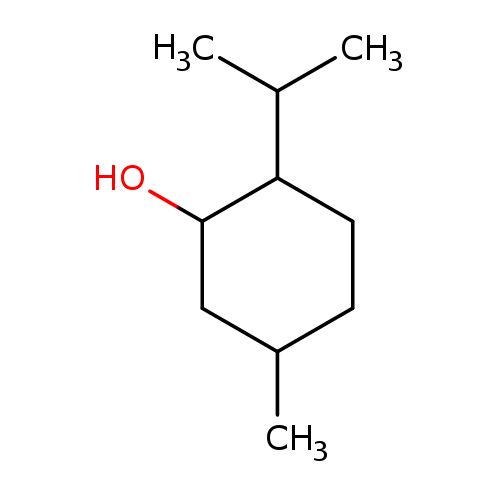
DL-menthol (CED0012891)

Record Information
Version1.0
Creation Date2016-06-03 09:43:01 UTC
Update Date2026-05-14 19:41:03 UTC
SynCED IDCED0012891
Secondary Accession Numbers
  • CHEM042514
Identification
Common NameDL-menthol
ClassSmall Molecule
Description
DL-menthol (C10H20O) is a compound with an average molecular weight of 156.27 g/mol. DL-menthol belongs to the monoterpenoids, a subclass of prenol lipids within the organic compounds. Industrially, it is utilized as a fragrance, an additive (PMC9357114 ), and as a flavouring and nutrient (PMC12159706 , PMC8776015 ). Biologically, it acts as an antioxidant (PMC12159706 , PMC8776015 ) and an analgesic (PMC7609673 ). Due to its analgesic properties, it is used as a treatment for arthritis (PMC7609673 ). The compound is found in or released from 37 recorded sources. These include drinking water and water supply (Drinking water), building and construction (Fencing, Stairs And Ramps), and household items such as medals, badges, and watch chains. It is also associated with food, food processing, and cookware, specifically including food contact materials, food preservation, the preparation of vinegar, molasses and treatment of molasses, and fermentation processes for beer. Additionally, it is found in electrical and electronic equipment, including electrodes, fixed capacitors and their manufacture, electric switches, electrically stimulated smoking devices, and conductors or conductive bodies characterised by the conductive materials. Household cleaning and consumer products such as bleaching agents, ash trays, cigar cigarettes, non electric simulated smoking devices, other smoking requisites, and 8 more are also recorded sources. Recorded exposure routes include touch, oral, and inhalation, with literature support provided for inhalation (PMC9498982 ).
Contaminant Type
  • Human Neurotoxin
Chemical Structure
Synonyms
ValueSource
Fisherman's friend lozengesKegg
1-Methyl-4-isopropyl-3-hydroxycyclohexaneHMDB
2-Isopropyl-5-methylcyclohexanolHMDB
3-Hydroxy-P-menthaneHMDB
3-P-MenthanolHMDB
3-P-MentholHMDB
4-Isopropyl-1-methylcyclohexan-3-olHMDB
5-Methyl-2-(1-methylethyl)-cyclohexanolHMDB
5-Methyl-2-(1-methylethyl)cyclohexanolHMDB
MentholHMDB
Menthol, (1alpha,2beta,5alpha)-isomerMeSH, HMDB
Chemical FormulaC10H20O
Average Molecular Mass156.265 g/mol
Monoisotopic Mass156.151 g/mol
CAS Registry Number89-78-1
IUPAC Name5-methyl-2-(propan-2-yl)cyclohexan-1-ol
Traditional Namementhol natural
SMILESCC(C)C1CCC(C)CC1O
InChI IdentifierInChI=1S/C10H20O/c1-7(2)9-5-4-8(3)6-10(9)11/h7-11H,4-6H2,1-3H3
InChI KeyNOOLISFMXDJSKH-UHFFFAOYSA-N
Chemical Taxonomy
Description Belongs to the class of organic compounds known as menthane monoterpenoids. These are monoterpenoids with a structure based on the o-, m-, or p-menthane backbone. P-menthane consists of the cyclohexane ring with a methyl group and a (2-methyl)-propyl group at the 1 and 4 ring position, respectively. The o- and m- menthanes are much rarer, and presumably arise by alkyl migration of p-menthanes.
KingdomOrganic compounds
Super ClassLipids and lipid-like molecules
ClassPrenol lipids
Sub ClassMonoterpenoids
Direct ParentMenthane monoterpenoids
Alternative Parents
Substituents
  • P-menthane monoterpenoid
  • Monocyclic monoterpenoid
  • Cyclohexanol
  • Cyclic alcohol
  • Secondary alcohol
  • Organic oxygen compound
  • Hydrocarbon derivative
  • Organooxygen compound
  • Alcohol
  • Aliphatic homomonocyclic compound
Molecular FrameworkAliphatic homomonocyclic compounds
External Descriptors
Biological Properties
StatusDetected and Not Quantified
OriginNot Available
Cellular LocationsNot Available
Biofluid LocationsNot Available
Tissue LocationsNot Available
ApplicationsNot Available
Biological Roles
Chemical RolesNot Available
Organoleptic Effects
  • white colour ?
  • colorless colour ?
  • bitter taste ?
  • sweet taste ?
  • cooling sensation touch ?
  • mint odour ?
  • fresh taste ?
  • refreshing taste ?
  • cooling effect touch ?
  • minty taste ?
Physical Properties
StateNot Available
AppearanceNot Available
Experimental Properties
PropertyValue
Melting PointNot Available
Boiling PointNot Available
SolubilityNot Available
Predicted Properties
PropertyValueSource
Water Solubility0.56 g/LALOGPS
logP2.68ALOGPS
logP2.66ChemAxon
logS-2.4ALOGPS
pKa (Strongest Acidic)19.55ChemAxon
pKa (Strongest Basic)-0.81ChemAxon
Physiological Charge0ChemAxon
Hydrogen Acceptor Count1ChemAxon
Hydrogen Donor Count1ChemAxon
Polar Surface Area20.23 ŲChemAxon
Rotatable Bond Count1ChemAxon
Refractivity47.45 m³·mol⁻¹ChemAxon
Polarizability19.69 ųChemAxon
Number of Rings1ChemAxon
BioavailabilityYesChemAxon
Rule of FiveYesChemAxon
Ghose FilterNoChemAxon
Veber's RuleYesChemAxon
MDDR-like RuleNoChemAxon
Spectra
Spectra
Spectrum TypeDescriptionSplash KeyDeposition DateView
GC-MSGC-MS Spectrumsplash10-00ry-9000000000-1a50289cf86435b01727Not AvailableView Spectrum
GC-MSGC-MS Spectrumsplash10-000i-3900000000-081c83125641df212ef8Not AvailableView Spectrum
GC-MSGC-MS Spectrumsplash10-05gm-9100000000-8a126fba3de41f12e6beNot AvailableView Spectrum
GC-MSGC-MS Spectrumsplash10-00ry-9000000000-1a50289cf86435b01727Not AvailableView Spectrum
GC-MSGC-MS Spectrumsplash10-000i-3900000000-081c83125641df212ef8Not AvailableView Spectrum
GC-MSGC-MS Spectrumsplash10-05gm-9100000000-8a126fba3de41f12e6beNot AvailableView Spectrum
Predicted GC-MSPredicted GC-MS Spectrumsplash10-0a4l-9600000000-fcf4b2a96455b111f889Not AvailableView Spectrum
Predicted GC-MSPredicted GC-MS Spectrumsplash10-06y9-9520000000-14606b3a7ce33696837bNot AvailableView Spectrum
Predicted GC-MSPredicted GC-MS SpectrumNot AvailableNot AvailableView Spectrum
Predicted LC-MS/MSPredicted LC-MS/MS Spectrumsplash10-052r-0900000000-fc39fb91c62eb627e3afNot AvailableView Spectrum
Predicted LC-MS/MSPredicted LC-MS/MS Spectrumsplash10-052r-5900000000-839aa9da0c06f6d09968Not AvailableView Spectrum
Predicted LC-MS/MSPredicted LC-MS/MS Spectrumsplash10-0avi-9200000000-e9b33e704445c7e908ecNot AvailableView Spectrum
Predicted LC-MS/MSPredicted LC-MS/MS Spectrumsplash10-0a4i-0900000000-3a700dc611fb070e6b45Not AvailableView Spectrum
Predicted LC-MS/MSPredicted LC-MS/MS Spectrumsplash10-0a4i-0900000000-5a80eb79e919e06fa63aNot AvailableView Spectrum
Predicted LC-MS/MSPredicted LC-MS/MS Spectrumsplash10-0bti-7900000000-67a39bf95581e52cb931Not AvailableView Spectrum
Predicted LC-MS/MSPredicted LC-MS/MS Spectrumsplash10-052r-0900000000-fc39fb91c62eb627e3afNot AvailableView Spectrum
Predicted LC-MS/MSPredicted LC-MS/MS Spectrumsplash10-052r-5900000000-839aa9da0c06f6d09968Not AvailableView Spectrum
Predicted LC-MS/MSPredicted LC-MS/MS Spectrumsplash10-0avi-9200000000-e9b33e704445c7e908ecNot AvailableView Spectrum
Predicted LC-MS/MSPredicted LC-MS/MS Spectrumsplash10-0a4i-0900000000-3a700dc611fb070e6b45Not AvailableView Spectrum
Predicted LC-MS/MSPredicted LC-MS/MS Spectrumsplash10-0a4i-0900000000-5a80eb79e919e06fa63aNot AvailableView Spectrum
Predicted LC-MS/MSPredicted LC-MS/MS Spectrumsplash10-0bti-7900000000-67a39bf95581e52cb931Not AvailableView Spectrum
Predicted LC-MS/MSPredicted LC-MS/MS Spectrumsplash10-0a4i-0900000000-f6034c6a8245c68a37acNot AvailableView Spectrum
Predicted LC-MS/MSPredicted LC-MS/MS Spectrumsplash10-0a4i-0900000000-7efa42d43b7858e2c2ceNot AvailableView Spectrum
Predicted LC-MS/MSPredicted LC-MS/MS Spectrumsplash10-0zfr-0900000000-b6eef0a7f66ac7e97e78Not AvailableView Spectrum
Predicted LC-MS/MSPredicted LC-MS/MS Spectrumsplash10-05mk-9800000000-bb8a9e58bdc61e2654e6Not AvailableView Spectrum
Predicted LC-MS/MSPredicted LC-MS/MS Spectrumsplash10-053e-9100000000-6405f7fe35f6f6bdc8c5Not AvailableView Spectrum
Predicted LC-MS/MSPredicted LC-MS/MS Spectrumsplash10-0006-9000000000-fee5c7d55bf523973cbfNot AvailableView Spectrum
1D NMR13C NMR Spectrum (1D, H2O, predicted)Not AvailableNot AvailableView Spectrum
1D NMR1H NMR Spectrum (1D, H2O, predicted)Not AvailableNot AvailableView Spectrum
Toxicity Profile
Toxicity Values
Toxicity ValueOrganismDose DescriptorRoute of ExposurePredicted or ExperimentalToxicity RatingReference
2300.0 Log mg/kg [1300:4100]RatLD50oralpredictedNot AvailableNot Available
0.7 % RatNOELoralexperimentalNot AvailableECOTOX - EPA ORD
0.36 % MouseNOELoralexperimentalNot AvailableECOTOX - EPA ORD
0.19 % MouseNOELoralexperimentalNot AvailableECOTOX - EPA ORD
0.36 % MouseLOELoralexperimentalNot AvailableECOTOX - EPA ORD
1450.0 mg/kg-day RatNOELoralexperimentalNot AvailableECOTOX - EPA ORD
0.7 % RatNOELoralexperimentalNot AvailableECOTOX - EPA ORD
0.36 % MouseNOELoralexperimentalNot AvailableECOTOX - EPA ORD
1450.0 mg/kg-day RatNOELoralexperimentalNot AvailableECOTOX - EPA ORD
Toxicity / Toxin ClassNot Available
Mechanism of ToxicityNot Available
Carcinogenicity (IARC Classification)Not Available
Minimum Risk LevelNot Available
SymptomsNot Available
TreatmentNot Available
Health Effects
Health EffectRelationshipDirectionDescriptionReference
arthritisNot AvailableNot AvailableA disorder characterized by inflammation involving a joint. (NCI CTCAE)PMC7609673
type 2 diabetes mellitusHas Therapeutic Effect OnNot AvailableNot AvailablePMC10888697
diabetes mellitusHas Therapeutic Effect OnNot AvailableA glucose metabolism disease characterized by chronic hyperglycaemia with disturbances of carbohydrate, fat and protein metabolism resulting from defects in insulin secretion, insulin action, or both. (DO)PMC11497135
feverNot AvailableNot AvailableA disorder characterized by an abnormally high body temperature.PMC13467945
headacheNot AvailableNot AvailableA disorder characterized by a sensation of marked discomfort in various parts of the head, not confined to the area of distribution of any nerve. (NCI CTCAE)PMC13467945
coughHas Therapeutic Effect OnNot AvailableA sudden, often repetitive, spasmodic contraction of the thoracic cavity, resulting in violent release of air from the lungs and usually accompanied by a distinctive sound. (NCI CTCAE)PMC3922013
inflammatory bowel diseaseHas Therapeutic Effect OnNot AvailableAn intestinal disease characterized by inflammation located in all parts of digestive tract. (DO)PMC13467945
urticariaAssociated With?decreaseNot AvailablePMC7152208
substance dependenceAssociated With?increaseNot AvailablePMC9357114
gastrointestinal system diseaseHas Therapeutic Effect OnNot AvailableNot AvailablePMC12159706
Mortality, PrematureAssociated With?Not AvailableNot AvailablePMC9357114
respiratory system disorderAssociated With?Not AvailableNot AvailablePMC9144092
pharyngitisNot AvailableNot AvailableNot AvailablePMC13467945
nicotine dependenceAssociated With?increaseNot AvailablePMC10935798
abdominal discomfortNot AvailableNot AvailableNot AvailablePMC13156410
Athletic InjuriesNot AvailableNot AvailableNot AvailablePMC7609673
PharyngalgiaHas Therapeutic Effect OnNot AvailableNot AvailablePMC3922013
Red eyeNot AvailableNot AvailableNot AvailablePMC13467945
Exposure Sources
Source IDSourceSectorReference
CEDs000010Insecticides?Insecticides are synthetic chemicals designed to control or eliminate insect pests that threaten crops and other agricultural products.Agriculture & land managementPubChem
CEDs000115Drinking water?Drinking water can be a medium for synthetic chemical contamination, often originating from various industrial processes and agricultural practices.Drinking water & water supplyNot Available
CEDs000214Toothpaste?Toothpaste often contains a variety of synthetic chemicals that serve specific functions, such as abrasives, foaming agents, and flavoring agents.Personal care & cosmeticsPMC10531698
CEDs000226Fragrances?Fragrances are complex mixtures of aromatic compounds used to impart pleasant scents to various products.Personal care & cosmeticsPMC9401909 , PMC7435942
CEDs000233Brushes?Brushes used in personal care and cosmetics can be a source of synthetic chemical contamination due to the materials and coatings used in their manufacturing.Personal care & cosmeticsPubChem
CEDs000494Food contact materials?Food contact materials refer to substances and products that are intended to come into contact with food during processing, packaging, or preparation.Food, food processing & cookwareNot Available
CEDs000496Fencing?Fencing materials, particularly those used in construction and landscaping, can be a source of synthetic chemical contamination due to the treatments and coatings applied for durability and weather resistance.Building & ConstructionPubChem
CEDs000500Stairs And Ramps?Stairs and ramps in construction are often treated with various synthetic chemicals to enhance durability, slip resistance, and weather resistance.Building & ConstructionPubChem
CEDs000511Conductors Or Conductive Bodies Characterised By The Conductive Materials?Conductors, or conductive bodies, are materials that allow the flow of electrical current, typically made from metals such as copper, aluminum, or silver.Electrical & Electronic EquipmentPubChem
CEDs000517Electric Switches?Electric switches, integral components in numerous devices, can be a source of synthetic chemical contamination due to the materials and manufacturing processes involved in their production.Electrical & Electronic EquipmentPubChem
CEDs000518Electrically Stimulated Smoking Devices?Electrically stimulated smoking devices, commonly known as e-cigarettes or vape pens, utilize electrical components to heat a liquid solution, often containing nicotine, flavorings, and other additives, to produce an aerosol for inhalation.Electrical & Electronic EquipmentPubChem
CEDs000519Electrodes?Electrodes, used in various electrical and electronic applications, can be a source of synthetic chemical contamination due to the materials from which they are constructed and the processes involved in their manufacturing.Electrical & Electronic EquipmentPubChem
CEDs000521Fixed Capacitors And Their Manufacture?Fixed capacitors are passive electronic components used to store and release electrical energy, playing a critical role in various circuits.Electrical & Electronic EquipmentPubChem
CEDs000524Hybrid Capacitors?Hybrid capacitors are energy storage devices that combine the properties of electrolytic and supercapacitors, utilizing a combination of electrochemical principles to achieve higher energy density and power density.Electrical & Electronic EquipmentPubChem
CEDs000529Power Cables?Power cables are used to transmit electrical energy and are typically composed of conductive materials, insulation, and protective coatings.Electrical & Electronic EquipmentPubChem
CEDs000530Radio Transmission Systems?Radio transmission systems utilize a variety of synthetic chemicals in their manufacturing and maintenance processes.Electrical & Electronic EquipmentPubChem
CEDs000537Television Systems?Television systems can be a source of synthetic chemical contamination due to the various materials and components used in their manufacture and operation.Electrical & Electronic EquipmentPubChem
CEDs000538Thin Magnetic Films?Thin magnetic films are layers of magnetic material ranging from a few nanometers to several micrometers in thickness, commonly used in applications such as magnetic sensors, data storage devices, and electronic components.Electrical & Electronic EquipmentPubChem
CEDs000544Fermentation Processes For Beer?Fermentation processes for beer involve the conversion of sugars into alcohol and carbon dioxide by yeast.Food, food processing & cookwarePubChem
CEDs000545Food Preservation?Food preservation often involves the use of synthetic chemicals, such as preservatives, flavor enhancers, and color additives, to extend shelf life and enhance the sensory qualities of food products.Food, food processing & cookwarePubChem
CEDs000546Molasses And Treatment Of Molasses?Molasses is a thick, viscous byproduct of sugar production, derived from the extraction of sugar cane or sugar beet juice.Food, food processing & cookwarePubChem
CEDs000548Preparation Of Vinegar?Vinegar is produced through the fermentation of ethanol by acetic acid bacteria, resulting in a solution that typically contains 4-8% acetic acid.Food, food processing & cookwarePubChem
CEDs000549Preparation Of Wine Or Sparkling Wine?The preparation of wine or sparkling wine involves various stages, including fermentation, aging, and bottling, which can introduce potential sources of synthetic chemical contamination.Food, food processing & cookwarePubChem
CEDs000552Processing Meats?Processing meats can lead to synthetic chemical contamination primarily through the use of additives and preservatives.Food, food processing & cookwarePubChem
CEDs000553Treatment Of Hops?Hops, a key ingredient in brewing and food flavoring, can be a source of synthetic chemical contamination due to various agricultural practices.Food, food processing & cookwarePubChem
CEDs000554Ash Trays?Ash trays, commonly used for the disposal of cigarette butts and ash, can be a source of synthetic chemical contamination due to the presence of various toxic compounds in tobacco smoke.Household cleaning & consumer productsPubChem
CEDs000555Bleaching Agents?Bleaching agents are chemical substances used to whiten or lighten materials, often employed in various cleaning products for their stain removal and disinfecting properties.Household cleaning & consumer productsPubChem
CEDs000556Cigar Cigarettes?Cigar cigarettes are a source of synthetic chemical contamination due to the combustion of various tobacco blends and additives.Household cleaning & consumer productsPubChem
CEDs000559Non Electric Simulated Smoking Devices?Non-electric simulated smoking devices, often designed to mimic the experience of smoking without combustion, can be sources of synthetic chemical contamination due to the materials and chemicals used in their construction and operation.Household cleaning & consumer productsPubChem
CEDs000560Other Smoking Requisites?Other smoking requisites, including items such as lighters, matches, and rolling papers, can introduce synthetic chemical contamination through various components and additives.Household cleaning & consumer productsPubChem
CEDs000561Perfumes Within Detergents And Soaps?Perfumes within detergents and soaps are synthetic fragrance compounds added to enhance the sensory experience of cleaning products.Household cleaning & consumer productsPubChem
CEDs000562Pipe Accessories?Pipe accessories, such as fittings, connectors, and seals, are components used in plumbing systems to facilitate the flow of liquids and gases.Household cleaning & consumer productsPubChem
CEDs000563Soap Detergents?Soap detergents are synthetic surfactants designed to enhance the cleaning efficacy of water by reducing surface tension, allowing for better interaction with dirt and grease.Household cleaning & consumer productsPubChem
CEDs000564Soap Dispensers?Soap dispensers, commonly used for dispensing liquid soaps and sanitizers, can become a source of synthetic chemical contamination due to the materials used in their construction and the products they dispense.Household cleaning & consumer productsPubChem
CEDs000566Tobacco Pipes?Tobacco pipes, often made from materials such as plastic, wood, or metal, can serve as sources of synthetic chemical contamination due to the residues left by tobacco products.Household cleaning & consumer productsPubChem
CEDs000567Tobacco Product Cases?Tobacco product cases can serve as a source of synthetic chemical contamination due to the presence of various additives and chemicals used in tobacco processing and product manufacturing.Household cleaning & consumer productsPubChem
CEDs000568Tobacco Product Moisture Control?Tobacco product moisture control involves the use of synthetic chemicals to manage the humidity levels in tobacco products, aiming to preserve flavor and extend shelf life.Household cleaning & consumer productsPubChem
CEDs000569Tobacco Smoke Filters?Tobacco smoke filters are designed to reduce the inhalation of harmful substances in cigarette smoke, including tar and other particulate matter.Household cleaning & consumer productsPubChem
CEDs000570Badges?Badges, often used for identification or decorative purposes, can be made from various synthetic materials including plastics, metals, and coatings.Household itemsPubChem
CEDs000574Medals?Medals, often made from various metals and alloys, can be a source of synthetic chemical contamination due to the coatings and finishes applied to enhance their appearance and durability.Household itemsPubChem
CEDs000577Watch Chains?Watch chains, often made from various metals and synthetic materials, can be a source of chemical contamination due to the presence of coatings, adhesives, and plasticizers used in their manufacturing.Household itemsPubChem
CEDs000578Making Cigars?The process of making cigars involves several steps, including the cultivation of tobacco, fermentation, and the application of various additives to enhance flavor and preservation.Industrial manufacturing & chemical processingPubChem
CEDs000579Manufacture Of Iron Or Steel?The manufacture of iron or steel involves various processes, including smelting, refining, and alloying, which can result in the release of synthetic chemicals and contaminants.Industrial manufacturing & chemical processingPubChem
CEDs000580Manufacture Preparation Of Tobacco Products?The manufacture and preparation of tobacco products involve various processes that can result in the introduction of synthetic chemicals into the environment.Industrial manufacturing & chemical processingPubChem
CEDs000581Paper Making Machines?Paper making machines utilize various synthetic chemicals throughout the production process, including additives, coatings, and bleaching agents.Industrial manufacturing & chemical processingPubChem
CEDs000584Buoys?Buoys, often used for navigation and marine monitoring, can be sources of synthetic chemical contamination due to the materials and coatings employed in their construction.Marine, shipping & aquaculturePubChem
CEDs000596Acaricides?Acaricides are synthetic chemicals specifically designed to target and control mite populations that can damage crops and plants.Agriculture & land managementPubChem
CEDs000600Herbicides And Algicides?Herbicides and algicides are synthetic chemicals primarily used to control unwanted plants and algae in various environments.Agriculture & land managementPubChem
CEDs000602Molluscicides?Molluscicides are synthetic chemicals specifically designed to control and eliminate mollusks, such as snails and slugs, which can be detrimental to crops and agricultural productivity.Agriculture & land managementPubChem
CEDs000603Nematocides?Nematocides are synthetic chemicals specifically designed to control nematodes, which are microscopic roundworms that can cause significant damage to crops and plants.Agriculture & land managementPubChem
CEDs000604Pest Attractants?Pest attractants are synthetic chemicals designed to lure specific pests for monitoring or control purposes.Agriculture & land managementPubChem
CEDs000605Pest Repellants?Pest repellents, often formulated from synthetic chemicals, are widely used to protect crops from insect infestations and other pests.Agriculture & land managementPubChem
CEDs000606Plant Growth Regulators?Plant Growth Regulators (PGRs) are synthetic chemicals designed to influence the growth and development of plants.Agriculture & land managementPubChem
CEDs000607Rodenticides(1)?Rodenticides are synthetic chemicals specifically formulated to control rodent populations, serving as a crucial tool in managing pests that can damage crops and spread diseases.Agriculture & land managementPubChem
CEDs000608Rodenticides?Rodenticides are chemical substances specifically designed to control rodent populations by causing death through various mechanisms, including anticoagulation or neurotoxicity.Agriculture & land managementPubChem
CEDs000609Aftershave?Aftershave is a grooming product typically used to soothe and protect the skin following shaving.Personal care & cosmeticsPubChem
CEDs000610Aftersun Products?Aftersun products are designed to soothe and hydrate the skin after sun exposure, often containing various synthetic chemicals such as emollients, preservatives, and fragrances.Personal care & cosmeticsPubChem
CEDs000611Anti Perspirants Or Body Deoderants?Antiperspirants and body deodorants commonly contain synthetic chemicals such as aluminum compounds, parabens, and synthetic fragrances.Personal care & cosmeticsPubChem
CEDs000612Body Washing Or Cleaning Implements?Body washing or cleaning implements, such as synthetic sponges, loofahs, and washcloths, can be sources of synthetic chemical contamination due to the materials used in their production.Personal care & cosmeticsPubChem
CEDs000613Depilatories?Depilatories are products designed to remove unwanted hair through the application of synthetic chemicals that break down the protein structure of hair, facilitating its removal.Personal care & cosmeticsPubChem
CEDs000614Essential Oils Or Perfumes?Essential oils and perfumes are complex mixtures of volatile compounds derived from natural or synthetic sources, commonly used for their aromatic properties.Personal care & cosmeticsPubChem
CEDs000615Eye Makeup Products?Eye makeup products, including mascaras, eyeliners, and eyeshadows, often contain a variety of synthetic chemicals such as pigments, preservatives, and film-forming agents.Personal care & cosmeticsPubChem
CEDs000616Face Mask Cosmetics?Face mask cosmetics often contain a variety of synthetic chemicals, including preservatives, emulsifiers, and fragrances, which can contribute to chemical contamination.Personal care & cosmeticsPubChem
CEDs000617Lip Care Products?Lip care products, including lipsticks, balms, and glosses, often contain a variety of synthetic chemicals such as parabens, phthalates, and synthetic fragrances.Personal care & cosmeticsPubChem
CEDs000618Lip Makeup Products?Lip makeup products, such as lipsticks, lip glosses, and lip liners, often contain a variety of synthetic chemicals, including pigments, preservatives, and emollients.Personal care & cosmeticsPubChem
CEDs000619Manicure Pedicure?Manicure and pedicure procedures often involve the use of various synthetic chemicals, including solvents, nail polishes, and nail adhesives.Personal care & cosmeticsPubChem
CEDs000630Toys?Toys, particularly those made from synthetic materials such as plastics, can be a source of chemical contamination due to the presence of various additives and compounds used in their production.Recreation & sports surfacesPubChem
CEDs000632Apparel?Apparel production often involves the use of various synthetic chemicals, including dyes, finishing agents, and preservatives.Textiles, leather & furnishingsPubChem
CEDs000642Footwear?Footwear production often involves the use of various synthetic chemicals, such as adhesives, dyes, and treatments, which can contribute to environmental contamination.Textiles, leather & furnishingsPubChem
CEDs000643Headwear?Headwear made from synthetic materials often incorporates chemicals used in the manufacturing and finishing processes, such as dyes, flame retardants, and water repellents.Textiles, leather & furnishingsPubChem
CEDs000650Purses Luggage Hand Bags?Purses, luggage, and handbags are often manufactured using synthetic materials such as polyvinyl chloride (PVC), polyurethane, and various types of nylon.Textiles, leather & furnishingsPubChem
CEDs000651Purses Money Bags Wallets?Purses, money bags, and wallets are often manufactured using synthetic materials, including plastics, polyurethanes, and various treated fabrics.Textiles, leather & furnishingsPubChem
CEDs000653Sewing?Sewing processes often involve the use of various synthetic chemicals, which can become sources of contamination in the environment.Textiles, leather & furnishingsPubChem
CEDs000655Slide Fasteners?Slide fasteners, commonly known as zippers, are mechanical devices used to join two edges of fabric or other materials.Textiles, leather & furnishingsPubChem
CEDs000657Surface Finishing Of Leather?Surface finishing of leather often involves the use of various synthetic chemicals, including dyes, resins, and finishing agents.Textiles, leather & furnishingsPubChem
CEDs000661Umbrellas?Umbrellas are commonly manufactured using synthetic materials such as polyester, nylon, and polyvinyl chloride (PVC), which can contribute to synthetic chemical contamination.Textiles, leather & furnishingsPubChem
CEDs000662Yarns Or Threads?Yarns or threads used in textiles can be a source of synthetic chemical contamination due to the production processes and treatments they undergo.Textiles, leather & furnishingsPubChem
CEDs000678Nitrogenous Fertilisers?Nitrogenous fertilizers are synthetic chemical compounds primarily used to enhance plant growth by supplying essential nitrogen, a crucial nutrient for photosynthesis and protein synthesis.Agriculture & land managementPubChem
CEDs000679Phosphatic Fertilisers?Phosphatic fertilizers are synthetic chemical products primarily composed of phosphorus, which is essential for plant growth.Agriculture & land managementPubChem
CEDs000684Cements?Cements are a composite material primarily used as a binding agent in construction applications, formed by the calcination of limestone and clay minerals at high temperatures.Building & ConstructionPubChem
CEDs000685Ceramics?Ceramics can be a source of synthetic chemical contamination through various additives and processing agents used in their production.Building & ConstructionPubChem
CEDs000686Clay Wares?Clay wares are ceramic products made from natural clay, often utilized in various construction applications such as tiles, bricks, and sanitary ware.Building & ConstructionPubChem
CEDs000688Glass Coatings?Glass coatings are synthetic chemical formulations applied to glass surfaces to enhance properties such as durability, UV resistance, and aesthetic appeal.Building & ConstructionPubChem
CEDs000690Lime?Lime, primarily comprised of calcium oxide (CaO) or calcium hydroxide (Ca(OH)₂), is widely used in various applications, including as a key ingredient in mortars, plasters, and cement.Building & ConstructionPubChem
CEDs000693Silica Glass?Silica glass, primarily composed of silicon dioxide (SiO2), is widely used in various applications, including windows, glass facades, and insulation materials.Building & ConstructionPubChem
CEDs000696Nanotechnology?Nanotechnology involves the manipulation of materials at the molecular or atomic level, typically within the range of 1 to 100 nanometers.Industrial manufacturing & chemical processingPubChem
CEDs000698Jewellery?Jewellery production often involves the use of various synthetic chemicals during the extraction and processing of metals.Mining & metal processingPubChem
CEDs000707Books?Books can be a source of synthetic chemical contamination due to the use of various chemicals in their production and preservation processes.Paper, pulp & fiber productsPubChem
CEDs000714Embossing Machines?Embossing machines are industrial devices used to create raised patterns or designs on materials, including paper and fiber products.Paper, pulp & fiber productsPubChem
CEDs000717Fountain Pens?Fountain pens utilize a liquid ink that often contains synthetic chemicals, including dyes, pigments, and solvents, which can contribute to environmental contamination.Paper, pulp & fiber productsPubChem
CEDs000720Ink Reservoir Pens2?Ink reservoir pens are writing instruments that utilize a reservoir to store ink, which is often composed of synthetic dyes, solvents, and additives.Paper, pulp & fiber productsPubChem
CEDs000727Printing Machines Or Presses?Printing machines or presses commonly utilize synthetic chemicals such as inks, solvents, and cleaning agents.Paper, pulp & fiber productsPubChem
CEDs000730Contact Lens Cases?Contact lens cases are small containers designed to store contact lenses in a sterile environment, typically made from various synthetic materials including plastics such as polypropylene or polycarbonate.Healthcare, pharmaceuticals & veterinary productsPubChem
CEDs000733Walking Sticks?Walking sticks, while primarily designed for mobility assistance, can be sources of synthetic chemical contamination if not properly manufactured or maintained.Healthcare, pharmaceuticals & veterinary productsPubChem
CEDs000734Coating Compositions?Coating compositions, which include paints, sealants, and varnishes, are formulated with a variety of synthetic chemicals such as solvents, resins, pigments, and additives.Building & ConstructionPubChem
CEDs000738Cooling Circuit Water?Cooling circuit water is utilized in various industrial processes to absorb and dissipate heat generated during operations.Industrial manufacturing & chemical processingPubChem
CEDs000739Inks?Inks are complex mixtures composed of pigments or dyes, solvents, resins, and additives used primarily for printing and writing applications.Paper, pulp & fiber productsPubChem
CEDs000740Paper?Paper production involves the processing of wood fibers and the use of various chemicals, which can lead to synthetic chemical contamination.Paper, pulp & fiber productsPubChem
CEDs000741Pigment Pastes?Pigment pastes are concentrated dispersions of pigments used to impart color and properties to materials.Paper, pulp & fiber productsPubChem
CEDs000743Sludge Treatment?Sludge treatment involves the processing of waste materials generated from wastewater treatment plants, which often contain a variety of organic and inorganic substances.Wastewater, sanitation & biosolidsPubChem
CEDs000744Water, Wastewater, & Sewage Treatment?Water, wastewater, and sewage treatment processes are critical for managing and mitigating pollutants in water systems.Wastewater, sanitation & biosolidsPubChem
CEDs00751FeedAgriculture & land managementPMC7254159
CEDs01080CapsuleHealthcare, pharmaceuticals & veterinary productsPMC8051088
CEDs01082PharmaceuticalsHealthcare, pharmaceuticals & veterinary productsPMC9401909
CEDs01084Pharmaceutical IndustriesHealthcare, pharmaceuticals & veterinary productsPMC9959473
CEDs01144FoodFood, food processing & cookwarePMC6115949 , PMC13093976
CEDs01145BeveragesFood, food processing & cookwarePMC13093976
CEDs01157FoodsFood, food processing & cookwarePMC9412368
CEDs01198HoneyFood, food processing & cookwarePMC6466162
CEDs02182Recycled PlasticWaste management, landfill & incinerationPMC10041343
CEDs02255WaterAquatic systems & sedimentsPMC13491502
CEDs02845CosmeticsPersonal care & cosmeticsPMC9401909 , PMC9412368
CEDs02851CosmeticPersonal care & cosmeticsPMC9959473
Pathways
0 pathwaysPathway Source: PathBank

No pathways found

No metabolic pathways have been associated with this synthetic chemical

Targets
StructureProteinUniProt IDOrganismRelationshipDetails
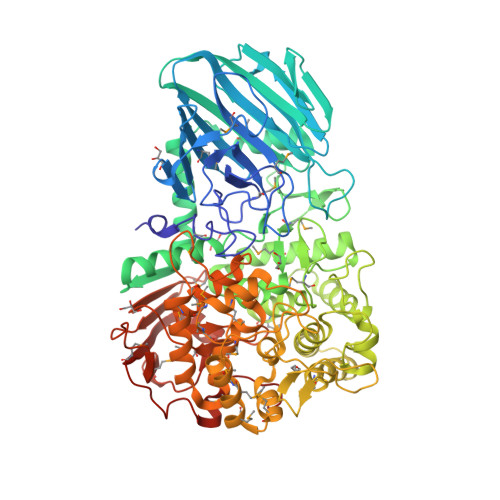
Click to view 3D structureAlpha-galactosidaseQ5DUH8Coffea arabicaPredicted (SEA)
Prediction Confidence Score
0.179
Applicability Domain
0.179 Low confidence
Statistical Significance
7.10e-04
Supporting Reference Compounds
1
E-value
5.52729
Click to view 3D structurePlasma alpha-L-fucosidaseQ9BTY2HumansPredicted (SEA)
Prediction Confidence Score
0.179
Applicability Domain
0.219 Low confidence
Statistical Significance
5.50e-04
Supporting Reference Compounds
2
E-value
4.28171
Sigma non-opioid intracellular receptor 1 structureClick to view 3D structureSigma non-opioid intracellular receptor 1Q99720HumansPredicted (SEA)
Prediction Confidence Score
0.172
Applicability Domain
0.208 Low confidence
Statistical Significance
0.948
Supporting Reference Compounds
562
E-value
7380.18
Click to view 3D structureCholinesteraseP81908Equus caballusPredicted (SEA)
Prediction Confidence Score
0.167
Applicability Domain
0.319
Statistical Significance
0.8308
Supporting Reference Compounds
201
E-value
6467.64
Click to view 3D structureGamma-aminobutyric acid receptor subunit alpha-4P28471Rattus norvegicusPredicted (SEA)
Prediction Confidence Score
0.167
Applicability Domain
0.167 Low confidence
Statistical Significance
0.0033
Supporting Reference Compounds
1
E-value
25.7681
Click to view 3D structureDNA damage-inducible transcript 3 proteinP35639Mus musculusPredicted (SEA)
Prediction Confidence Score
0.166
Applicability Domain
0.239 Low confidence
Statistical Significance
0.8616
Supporting Reference Compounds
226
E-value
6707.64
X-box-binding protein 1 structureClick to view 3D structureX-box-binding protein 1P17861HumansPredicted (SEA)
Prediction Confidence Score
0.166
Applicability Domain
0.239 Low confidence
Statistical Significance
0.8622
Supporting Reference Compounds
227
E-value
6712.55
Alpha-1,2-mannosidase (BT_3990) structureClick to view 3D structureAlpha-1,2-mannosidase (BT_3990)Q8A0N1Bacteroides thetaiotaomicronPredicted (SEA)
Prediction Confidence Score
0.162
Applicability Domain
0.162 Low confidence
Statistical Significance
0.0022
Supporting Reference Compounds
1
E-value
17.3604
Muscarinic acetylcholine receptor M2 structureClick to view 3D structureMuscarinic acetylcholine receptor M2P08172HumansPredicted (SEA)
Prediction Confidence Score
0.161
Applicability Domain
0.222 Low confidence
Statistical Significance
0.9716
Supporting Reference Compounds
373
E-value
7563.52
Muscarinic acetylcholine receptor M4 structureClick to view 3D structureMuscarinic acetylcholine receptor M4P08173HumansPredicted (SEA)
Prediction Confidence Score
0.161
Applicability Domain
0.222 Low confidence
Statistical Significance
0.9524
Supporting Reference Compounds
297
E-value
7414.13
Click to view 3D structureMuscarinic acetylcholine receptor M1P08482Rattus norvegicusPredicted (SEA)
Prediction Confidence Score
0.161
Applicability Domain
0.222 Low confidence
Statistical Significance
0.7827
Supporting Reference Compounds
109
E-value
6093.57
Click to view 3D structureMuscarinic acetylcholine receptor M2P10980Rattus norvegicusPredicted (SEA)
Prediction Confidence Score
0.161
Applicability Domain
0.222 Low confidence
Statistical Significance
0.6819
Supporting Reference Compounds
98
E-value
5308.23
Click to view 3D structureAcetylcholinesteraseO42275Electrophorus electricusPredicted (SEA)
Prediction Confidence Score
0.161
Applicability Domain
0.319
Statistical Significance
0.8869
Supporting Reference Compounds
206
E-value
6904.21
Muscarinic acetylcholine receptor M1 structureClick to view 3D structureMuscarinic acetylcholine receptor M1P11229HumansPredicted (SEA)
Prediction Confidence Score
0.16
Applicability Domain
0.222 Low confidence
Statistical Significance
0.9716
Supporting Reference Compounds
385
E-value
7564.14
Click to view 3D structureMuscarinic acetylcholine receptor M4P08485Rattus norvegicusPredicted (SEA)
Prediction Confidence Score
0.16
Applicability Domain
0.222 Low confidence
Statistical Significance
0.6551
Supporting Reference Compounds
38
E-value
5099.67
G-protein coupled bile acid receptor 1 structureClick to view 3D structureG-protein coupled bile acid receptor 1Q8TDU6HumansPredicted (SEA)
Prediction Confidence Score
0.159
Applicability Domain
0.175 Low confidence
Statistical Significance
0.6557
Supporting Reference Compounds
54
E-value
5104.57
Click to view 3D structureTransient receptor potential cation channel subfamily A member 1Q6RI86Rattus norvegicusPredicted (SEA)
Prediction Confidence Score
0.332
Applicability Domain
1.0
Statistical Significance
0.0011
Supporting Reference Compounds
56
E-value
8.79696
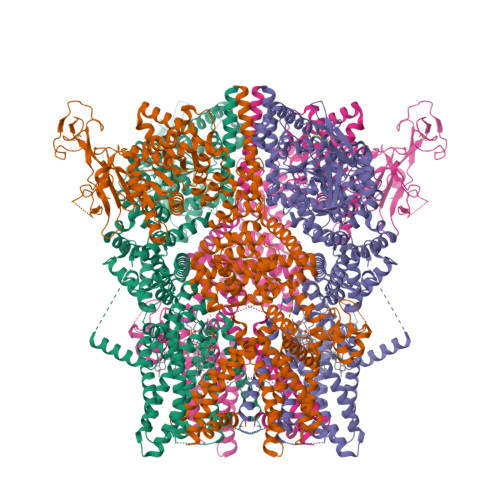
Transient receptor potential cation channel subfamily M member 8 structureClick to view 3D structureTransient receptor potential cation channel subfamily M member 8Q7Z2W7HumansPredicted (SEA)
Prediction Confidence Score
0.328
Applicability Domain
1.0
Statistical Significance
0.0011
Supporting Reference Compounds
43
E-value
8.25202
Click to view 3D structureTransient receptor potential cation channel subfamily A member 1Q8BLA8Mus musculusPredicted (SEA)
Prediction Confidence Score
0.268
Applicability Domain
1.0
Statistical Significance
8.50e-04
Supporting Reference Compounds
18
E-value
6.61718
Click to view 3D structureSpermidine synthaseQ6QA75Sus scrofaPredicted (SEA)
Prediction Confidence Score
0.259
Applicability Domain
0.259 Low confidence
Statistical Significance
3.00e-05
Supporting Reference Compounds
1
E-value
0.233548
Click to view 3D structureSpermidine synthaseQ4CXJ6Trypanosoma cruzi (strain CL Brener)Predicted (SEA)
Prediction Confidence Score
0.259
Applicability Domain
0.259 Low confidence
Statistical Significance
3.00e-05
Supporting Reference Compounds
1
E-value
0.233548
Click to view 3D structureSpermidine synthaseQ9NFS5Plasmodium falciparumPredicted (SEA)
Prediction Confidence Score
0.259
Applicability Domain
0.259 Low confidence
Statistical Significance
3.00e-05
Supporting Reference Compounds
1
E-value
0.233548
Click to view 3D structureAlpha-mannosidase 2C1P21139Rattus norvegicusPredicted (SEA)
Prediction Confidence Score
0.199
Applicability Domain
0.235 Low confidence
Statistical Significance
1.80e-04
Supporting Reference Compounds
2
E-value
1.40129
Carbonic anhydrase 2 structureClick to view 3D structureCarbonic anhydrase 2P00918HumansPredicted (SEA)
Prediction Confidence Score
0.183
Applicability Domain
0.319
Statistical Significance
0.7621
Supporting Reference Compounds
472
E-value
5932.73
Carbonic anhydrase 1 structureClick to view 3D structureCarbonic anhydrase 1P00915HumansPredicted (SEA)
Prediction Confidence Score
0.183
Applicability Domain
0.319
Statistical Significance
0.7135
Supporting Reference Compounds
407
E-value
5554.46
Concentrations
Not Available
External Links
DrugBank IDNot Available
HMDB IDHMDB0035765
FooDB IDFDB014502
Phenol Explorer IDNot Available
KNApSAcK IDNot Available
BiGG IDNot Available
BioCyc IDNot Available
METLIN IDNot Available
PDB IDNot Available
Wikipedia LinkNot Available
Chemspider ID1216
ChEBI ID25187
PubChem Compound ID1254
Kegg Compound IDNot Available
YMDB IDYMDB01740
ECMDB IDNot Available
References
Synthesis ReferenceNot Available
MSDSNot Available
General ReferencesNot Available