2-Propenoic acid, 2-cyano-, 1-methylheptyl ester (CED0133959)

Record Information
Version1.0
Creation Date2016-06-03 10:48:52 UTC
Update Date2026-08-18 19:57:22 UTC
SynCED IDCED0133959
Secondary Accession Numbers
  • CHEM043315
Identification
Common Name2-Propenoic acid, 2-cyano-, 1-methylheptyl ester
ClassSmall Molecule
Description
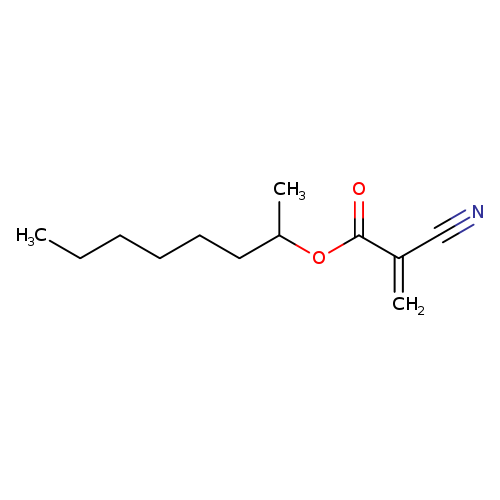
2-Propenoic acid, 2-cyano-, 1-methylheptyl ester is an organic compound with the formula C12H19NO2 and an average molecular weight of 209.29 g/mol. 2-Propenoic acid, 2-cyano-, 1-methylheptyl ester belongs to the carboxylic acid derivatives, a subclass of carboxylic acids and derivatives within the organic compounds. The compound has been identified in or released from five recorded sources. These include electrical and electronic equipment, specifically antennas, loudspeakers, and electric hearing aids, as well as drinking water and water supply. Additionally, it is associated with building and construction materials, specifically tents or canopies. The recorded route of exposure for this substance is oral.
Contaminant TypeNot Available
Chemical Structure
Synonyms
ValueSource
2-Octyl cyanoacrylic acidGenerator
N-Octyl-cyanoacrylateMeSH
2-OctylcyanoacrylateMeSH
DermabondMeSH
Octyl 2-cyanoacrylateMeSH
Octan-2-yl 2-cyanoprop-2-enoic acidGenerator
2-Propenoic acid, 2-cyano-, octyl esterMeSH
Octyl cyanoacrylateMeSH
OcrylateMeSH
OcrilateMeSH
Chemical FormulaC12H19NO2
Average Molecular Mass209.289 g/mol
Monoisotopic Mass209.142 g/mol
CAS Registry Number133978-15-1
IUPAC Nameoctan-2-yl 2-cyanoprop-2-enoate
Traditional Name2-octyl cyanoacrylate
SMILESCCCCCCC(C)OC(=O)C(=C)C#N
InChI IdentifierInChI=1S/C12H19NO2/c1-4-5-6-7-8-11(3)15-12(14)10(2)9-13/h11H,2,4-8H2,1,3H3
InChI KeyCQVWXNBVRLKXPE-UHFFFAOYSA-N
Chemical Taxonomy
Description Belongs to the class of organic compounds known as cyanoacrylates. These are organonitrogen compounds containing an acrylic acid ester, which carries a nitrile group. They have the general structure ROC(=O)C(=C)C#N, where R is an organic group.
KingdomOrganic compounds
Super ClassOrganic acids and derivatives
ClassCarboxylic acids and derivatives
Sub ClassCarboxylic acid derivatives
Direct ParentCyanoacrylates
Alternative Parents
Substituents
  • Cyanoacrylic acid ester
  • Nitrile
  • Carbonitrile
  • Monocarboxylic acid or derivatives
  • Organic nitrogen compound
  • Organic oxygen compound
  • Organopnictogen compound
  • Organic oxide
  • Hydrocarbon derivative
  • Organooxygen compound
  • Organonitrogen compound
  • Carbonyl group
  • Aliphatic acyclic compound
Molecular FrameworkAliphatic acyclic compounds
External DescriptorsNot Available
Biological Properties
StatusDetected and Not Quantified
OriginNot Available
Cellular LocationsNot Available
Biofluid LocationsNot Available
Tissue LocationsNot Available
ApplicationsNot Available
Biological RolesNot Available
Chemical RolesNot Available
Organoleptic EffectsNot Available
Physical Properties
StateNot Available
AppearanceNot Available
Experimental Properties
PropertyValue
Melting PointNot Available
Boiling PointNot Available
SolubilityNot Available
Predicted Properties
PropertyValueSource
Water Solubility0.024 g/LALOGPS
logP4.1ALOGPS
logP3.8ChemAxon
logS-3.9ALOGPS
pKa (Strongest Basic)-7.2ChemAxon
Physiological Charge0ChemAxon
Hydrogen Acceptor Count2ChemAxon
Hydrogen Donor Count0ChemAxon
Polar Surface Area50.09 ŲChemAxon
Rotatable Bond Count8ChemAxon
Refractivity59.21 m³·mol⁻¹ChemAxon
Polarizability24.3 ųChemAxon
Number of Rings0ChemAxon
BioavailabilityYesChemAxon
Rule of FiveYesChemAxon
Ghose FilterYesChemAxon
Veber's RuleNoChemAxon
MDDR-like RuleNoChemAxon
Spectra
Spectra
Spectrum TypeDescriptionSplash KeyDeposition DateView
Predicted GC-MSPredicted GC-MS Spectrumsplash10-0f89-9100000000-f63857b3e7528e61d27fNot AvailableView Spectrum
Predicted LC-MS/MSPredicted LC-MS/MS Spectrumsplash10-03di-5790000000-379e8abce8c60ee9070aNot AvailableView Spectrum
Predicted LC-MS/MSPredicted LC-MS/MS Spectrumsplash10-0ik9-9600000000-da91adc127f142980d8bNot AvailableView Spectrum
Predicted LC-MS/MSPredicted LC-MS/MS Spectrumsplash10-0udi-9000000000-92a834fc3ded95c84e7fNot AvailableView Spectrum
Predicted LC-MS/MSPredicted LC-MS/MS Spectrumsplash10-0a4i-2390000000-009ee8854ddcc6433ccdNot AvailableView Spectrum
Predicted LC-MS/MSPredicted LC-MS/MS Spectrumsplash10-0k92-9330000000-c5d5d4e548a4de5c02bdNot AvailableView Spectrum
Predicted LC-MS/MSPredicted LC-MS/MS Spectrumsplash10-0udi-9100000000-d96cb67450d73e69134cNot AvailableView Spectrum
Toxicity Profile
Toxicity Values
Toxicity ValueOrganismDose DescriptorRoute of ExposurePredicted or ExperimentalToxicity RatingReference
2178.0 Log mg/kg [1200:3900]RatLD50oralpredictedNot AvailableNot Available
Toxicity / Toxin ClassNot Available
Mechanism of ToxicityNot Available
Carcinogenicity (IARC Classification)Not Available
Minimum Risk LevelNot Available
SymptomsNot Available
TreatmentNot Available
Health Effects
Health EffectRelationshipDirectionDescriptionReference
Surgical WoundNot AvailableNot AvailableNot AvailablePMC7997729
LacerationsNot AvailableNot AvailableNot AvailablePMC7997729
Exposure Sources
Source IDSourceSectorReference
CEDs000010Insecticides?Insecticides are synthetic chemicals designed to control or eliminate insect pests that threaten crops and other agricultural products.Agriculture & land managementPubChem
CEDs000115Drinking water?Drinking water can be a medium for synthetic chemical contamination, often originating from various industrial processes and agricultural practices.Drinking water & water supplyNot Available
CEDs000233Brushes?Brushes used in personal care and cosmetics can be a source of synthetic chemical contamination due to the materials and coatings used in their manufacturing.Personal care & cosmeticsPubChem
CEDs000503Tents Or Canopies?Tents and canopies used in various applications can be a source of synthetic chemical contamination primarily due to the materials from which they are made.Building & ConstructionPubChem
CEDs000506Antennas?Antennas, commonly used in communication technologies, can be a source of synthetic chemical contamination through the materials and coatings used in their construction.Electrical & Electronic EquipmentPubChem
CEDs000511Conductors Or Conductive Bodies Characterised By The Conductive Materials?Conductors, or conductive bodies, are materials that allow the flow of electrical current, typically made from metals such as copper, aluminum, or silver.Electrical & Electronic EquipmentPubChem
CEDs000516Electric Hearing Aids?Electric hearing aids are small electronic devices designed to amplify sound for individuals with hearing loss.Electrical & Electronic EquipmentPubChem
CEDs000519Electrodes?Electrodes, used in various electrical and electronic applications, can be a source of synthetic chemical contamination due to the materials from which they are constructed and the processes involved in their manufacturing.Electrical & Electronic EquipmentPubChem
CEDs000526Loudspeakers?Loudspeakers, as components in audio systems, can be sources of synthetic chemical contamination primarily due to the materials used in their construction.Electrical & Electronic EquipmentPubChem
CEDs000537Television Systems?Television systems can be a source of synthetic chemical contamination due to the various materials and components used in their manufacture and operation.Electrical & Electronic EquipmentPubChem
CEDs000600Herbicides And Algicides?Herbicides and algicides are synthetic chemicals primarily used to control unwanted plants and algae in various environments.Agriculture & land managementPubChem
CEDs000611Anti Perspirants Or Body Deoderants?Antiperspirants and body deodorants commonly contain synthetic chemicals such as aluminum compounds, parabens, and synthetic fragrances.Personal care & cosmeticsPubChem
CEDs000615Eye Makeup Products?Eye makeup products, including mascaras, eyeliners, and eyeshadows, often contain a variety of synthetic chemicals such as pigments, preservatives, and film-forming agents.Personal care & cosmeticsPubChem
CEDs000618Lip Makeup Products?Lip makeup products, such as lipsticks, lip glosses, and lip liners, often contain a variety of synthetic chemicals, including pigments, preservatives, and emollients.Personal care & cosmeticsPubChem
CEDs000619Manicure Pedicure?Manicure and pedicure procedures often involve the use of various synthetic chemicals, including solvents, nail polishes, and nail adhesives.Personal care & cosmeticsPubChem
CEDs000632Apparel?Apparel production often involves the use of various synthetic chemicals, including dyes, finishing agents, and preservatives.Textiles, leather & furnishingsPubChem
CEDs000643Headwear?Headwear made from synthetic materials often incorporates chemicals used in the manufacturing and finishing processes, such as dyes, flame retardants, and water repellents.Textiles, leather & furnishingsPubChem
CEDs000662Yarns Or Threads?Yarns or threads used in textiles can be a source of synthetic chemical contamination due to the production processes and treatments they undergo.Textiles, leather & furnishingsPubChem
CEDs000670Solid Fire Fighting Substances?Solid fire fighting substances, such as certain types of dry chemical powders, are used in fire suppression applications to extinguish flames and prevent fire spread.Fire suppression systems & agentsPubChem
CEDs000671Airplanes And Helicopters?Airplanes and helicopters are significant sources of synthetic chemical contamination primarily through the use of aviation fuels, lubricants, and de-icing agents.Aviation & AerospacePubChem
CEDs000684Cements?Cements are a composite material primarily used as a binding agent in construction applications, formed by the calcination of limestone and clay minerals at high temperatures.Building & ConstructionPubChem
CEDs000685Ceramics?Ceramics can be a source of synthetic chemical contamination through various additives and processing agents used in their production.Building & ConstructionPubChem
CEDs000686Clay Wares?Clay wares are ceramic products made from natural clay, often utilized in various construction applications such as tiles, bricks, and sanitary ware.Building & ConstructionPubChem
CEDs000688Glass Coatings?Glass coatings are synthetic chemical formulations applied to glass surfaces to enhance properties such as durability, UV resistance, and aesthetic appeal.Building & ConstructionPubChem
CEDs000696Nanotechnology?Nanotechnology involves the manipulation of materials at the molecular or atomic level, typically within the range of 1 to 100 nanometers.Industrial manufacturing & chemical processingPubChem
CEDs000698Jewellery?Jewellery production often involves the use of various synthetic chemicals during the extraction and processing of metals.Mining & metal processingPubChem
CEDs000739Inks?Inks are complex mixtures composed of pigments or dyes, solvents, resins, and additives used primarily for printing and writing applications.Paper, pulp & fiber productsPubChem
CEDs000744Water, Wastewater, & Sewage Treatment?Water, wastewater, and sewage treatment processes are critical for managing and mitigating pollutants in water systems.Wastewater, sanitation & biosolidsPubChem
Pathways
0 pathwaysPathway Source: PathBank

No pathways found

No metabolic pathways have been associated with this synthetic chemical

Targets
StructureProteinUniProt IDOrganismRelationshipDetails
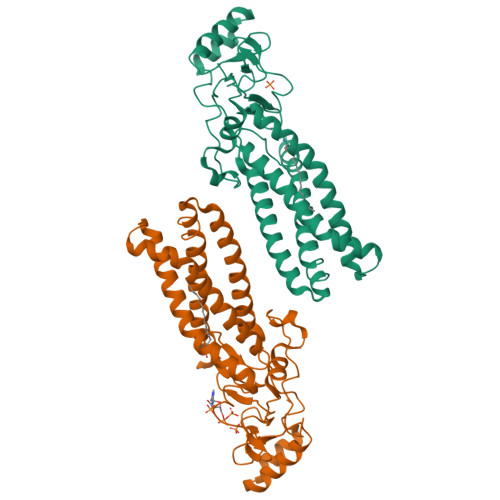
Peroxisome proliferator-activated receptor alpha structureClick to view 3D structurePeroxisome proliferator-activated receptor alphaQ07869HumansPredicted (SEA)
Prediction Confidence Score
0.274
Applicability Domain
0.289 Low confidence
Statistical Significance
0.0324
Supporting Reference Compounds
127
E-value
251.998
Click to view 3D structureMitochondrial carnitine/acylcarnitine carrier proteinO43772HumansPredicted (SEA)
Prediction Confidence Score
0.269
Applicability Domain
0.269 Low confidence
Statistical Significance
5.50e-04
Supporting Reference Compounds
1
E-value
4.28171
Click to view 3D structurePalmitoyltransferase ZDHHC7Q9NXF8HumansPredicted (SEA)
Prediction Confidence Score
0.269
Applicability Domain
0.269 Low confidence
Statistical Significance
3.10e-04
Supporting Reference Compounds
1
E-value
2.41333
Transient receptor potential cation channel subfamily V member 2 structureClick to view 3D structureTransient receptor potential cation channel subfamily V member 2Q9WUD2Rattus norvegicusPredicted (SEA)
Prediction Confidence Score
0.265
Applicability Domain
0.289 Low confidence
Statistical Significance
0.0039
Supporting Reference Compounds
21
E-value
30.1276
Click to view 3D structurePutative inactive group IIC secretory phospholipase A2Q5R387HumansPredicted (SEA)
Prediction Confidence Score
0.264
Applicability Domain
0.264 Low confidence
Statistical Significance
0.0011
Supporting Reference Compounds
1
E-value
8.95266
Click to view 3D structureAlkaline ceramidase 2Q5QJU3HumansPredicted (SEA)
Prediction Confidence Score
0.264
Applicability Domain
0.264 Low confidence
Statistical Significance
0.0065
Supporting Reference Compounds
1
E-value
50.602
Peroxisome proliferator-activated receptor gamma structureClick to view 3D structurePeroxisome proliferator-activated receptor gammaP37231HumansPredicted (SEA)
Prediction Confidence Score
0.259
Applicability Domain
0.289 Low confidence
Statistical Significance
0.071
Supporting Reference Compounds
192
E-value
552.652
Click to view 3D structureCG8425-PA [Drosophila melanogaster]A1ZA98Drosophila melanogasterPredicted (SEA)
Prediction Confidence Score
0.256
Applicability Domain
0.267 Low confidence
Statistical Significance
6.60e-04
Supporting Reference Compounds
4
E-value
5.13805
Click to view 3D structureCocaine esteraseO00748HumansPredicted (SEA)
Prediction Confidence Score
0.255
Applicability Domain
0.267 Low confidence
Statistical Significance
0.0039
Supporting Reference Compounds
40
E-value
30.0498
Geranylgeranyl pyrophosphate synthase structureClick to view 3D structureGeranylgeranyl pyrophosphate synthaseO95749HumansPredicted (SEA)
Prediction Confidence Score
0.255
Applicability Domain
0.256 Low confidence
Statistical Significance
0.0012
Supporting Reference Compounds
15
E-value
9.03051
Click to view 3D structureFarnesyl pyrophosphate synthaseQ0GKD7Leishmania donovaniPredicted (SEA)
Prediction Confidence Score
0.255
Applicability Domain
0.256 Low confidence
Statistical Significance
0.0011
Supporting Reference Compounds
14
E-value
8.79696
G-protein coupled receptor 84 structureClick to view 3D structureG-protein coupled receptor 84Q9NQS5HumansPredicted (SEA)
Prediction Confidence Score
0.252
Applicability Domain
0.289 Low confidence
Statistical Significance
0.0027
Supporting Reference Compounds
15
E-value
20.8636
Fatty-acid amide hydrolase 1 structureClick to view 3D structureFatty-acid amide hydrolase 1P97612Rattus norvegicusPredicted (SEA)
Prediction Confidence Score
0.252
Applicability Domain
0.262 Low confidence
Statistical Significance
0.0465
Supporting Reference Compounds
102
E-value
362.155
Click to view 3D structureFatty-acid amide hydrolase 1O00519HumansPredicted (SEA)
Prediction Confidence Score
0.252
Applicability Domain
0.262 Low confidence
Statistical Significance
0.0687
Supporting Reference Compounds
106
E-value
534.98
Cannabinoid receptor 1 structureClick to view 3D structureCannabinoid receptor 1P21554HumansPredicted (SEA)
Prediction Confidence Score
0.251
Applicability Domain
0.254 Low confidence
Statistical Significance
0.0896
Supporting Reference Compounds
200
E-value
697.373
Cannabinoid receptor 2 structureClick to view 3D structureCannabinoid receptor 2P34972HumansPredicted (SEA)
Prediction Confidence Score
0.251
Applicability Domain
0.254 Low confidence
Statistical Significance
0.0796
Supporting Reference Compounds
175
E-value
619.991
Click to view 3D structureDiacylglycerol lipase-alphaQ9Y4D2HumansPredicted (SEA)
Prediction Confidence Score
0.251
Applicability Domain
0.254 Low confidence
Statistical Significance
0.0127
Supporting Reference Compounds
35
E-value
98.8685
Acylcarnitine hydrolase structureClick to view 3D structureAcylcarnitine hydrolaseQ91WG0Mus musculusPredicted (SEA)
Prediction Confidence Score
0.25
Applicability Domain
0.267 Low confidence
Statistical Significance
7.10e-04
Supporting Reference Compounds
2
E-value
5.52729
Palmitoyltransferase ZDHHC20 structureClick to view 3D structurePalmitoyltransferase ZDHHC20Q5W0Z9HumansPredicted (SEA)
Prediction Confidence Score
0.312
Applicability Domain
0.35
Statistical Significance
8.00e-05
Supporting Reference Compounds
3
E-value
0.622794
Click to view 3D structureUDP-N-acetylmuramoyl-tripeptide--D-alanyl-D-alanine ligaseQ5HMD9Staphylococcus epidermidis (strain ATCC 35984 / RP62A)Predicted (SEA)
Prediction Confidence Score
0.306
Applicability Domain
0.306
Statistical Significance
3.40e-04
Supporting Reference Compounds
1
E-value
2.64687
Click to view 3D structurePalmitoyltransferase ZDHHC2Q9UIJ5HumansPredicted (SEA)
Prediction Confidence Score
0.292
Applicability Domain
0.35
Statistical Significance
1.50e-04
Supporting Reference Compounds
3
E-value
1.16774
Peroxisome proliferator-activated receptor delta structureClick to view 3D structurePeroxisome proliferator-activated receptor deltaQ03181HumansPredicted (SEA)
Prediction Confidence Score
0.286
Applicability Domain
0.35
Statistical Significance
0.0138
Supporting Reference Compounds
89
E-value
107.354
Click to view 3D structureCAI-1 autoinducer sensor kinase/phosphatase CqsSQ9KM66Vibrio cholerae serotype O1 (strain ATCC 39315 / El Tor Inaba N16961)Predicted (SEA)
Prediction Confidence Score
0.286
Applicability Domain
0.286 Low confidence
Statistical Significance
6.40e-04
Supporting Reference Compounds
1
E-value
4.98235
Click to view 3D structureSphingosine-1-phosphate lyase 1Q8CHN6Rattus norvegicusPredicted (SEA)
Prediction Confidence Score
0.278
Applicability Domain
0.278 Low confidence
Statistical Significance
2.40e-04
Supporting Reference Compounds
1
E-value
1.86838
Tyrosine-protein phosphatase non-receptor type 1 structureClick to view 3D structureTyrosine-protein phosphatase non-receptor type 1P18031HumansPredicted (SEA)
Prediction Confidence Score
0.274
Applicability Domain
0.289 Low confidence
Statistical Significance
0.0241
Supporting Reference Compounds
197
E-value
187.383
Concentrations
Not Available
External Links
DrugBank IDDB12040
HMDB IDNot Available
FooDB IDNot Available
Phenol Explorer IDNot Available
KNApSAcK IDNot Available
BiGG IDNot Available
BioCyc IDNot Available
METLIN IDNot Available
PDB IDNot Available
Wikipedia Link2-Octyl cyanoacrylate
Chemspider IDNot Available
ChEBI IDNot Available
PubChem Compound ID9815689
Kegg Compound IDNot Available
YMDB IDNot Available
ECMDB IDNot Available
References
Synthesis ReferenceNot Available
MSDSNot Available
General ReferencesNot Available