Some data may have been extracted from scientific literature using a pipeline that uses large language models (LLMs). Source articles are cited where applicable to help verify the extracted relationships.
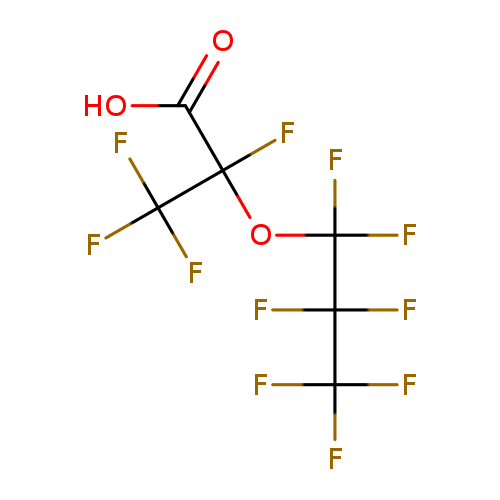
2,3,3,3-Tetrafluoro-2-(heptafluoropropoxy)propanoic acid (C6HF11O3) is an organic compound with an average molecular weight of 330.05 g/mol. 2,3,3,3-Tetrafluoro-2-(heptafluoropropoxy)propanoic acid belongs to the alpha-halocarboxylic acids and derivatives, a subclass of carboxylic acids and derivatives within the organic compounds.
This compound is found in or released from 14 recorded sources. These include electrical and electronic equipment such as capacitors, cell phones, batteries, wires and cables, and printed circuit boards. It is also associated with food, food processing and cookware, specifically food contact materials and food packaging. Other sources include lubricants used in energy, oil and gas or industrial manufacturing and chemical processing, as well as medical devices from the healthcare, pharmaceuticals and veterinary products sector, and synthetic textiles, carpets and rugs from the textiles, leather and furnishings sector.
Recorded exposure routes for the compound include oral, touch, and inhalation. Literature support specifically identifies inhalation as an exposure route (PMC13110237 ). Regarding health effects, the compound is associated with an increase in inflammation (PMC12512164 , PMC13110237 ).
Belongs to the class of organic compounds known as alpha-halocarboxylic acids. These are carboxylic acids containing a halogen atom bonded to the alpha carbon atom.
A pervasive developmental disorder that is a spectrum of psychological conditions. The disease has_symptom widespread abnormalities of social interactions and communication, has_symptom severely restricted interests and has symptom highly repetitive behavior.
Irrigation water?Irrigation water can serve as a vector for synthetic chemical contamination due to its potential exposure to agricultural inputs such as fertilizers, pesticides, and herbicides.
Soil?Soil serves as a critical medium for plant growth and sustains various ecological functions; however, it can become a reservoir for synthetic chemical contamination.
Indoor dust?Indoor dust is a complex mixture of particles that accumulates in indoor environments, consisting of materials such as skin flakes, hair, textile fibers, and particles from outdoor sources.
Groundwater?Groundwater serves as a vital resource for drinking water and agricultural irrigation but is increasingly susceptible to contamination from synthetic chemicals.
Drinking water?Drinking water can be a medium for synthetic chemical contamination, often originating from various industrial processes and agricultural practices.
Printed circuit boards?Printed circuit boards (PCBs) are essential components in the manufacturing of electronic devices, serving as the backbone for electrical connections and circuit pathways.
Semiconductors?Semiconductors are materials that possess electrical conductivity between that of conductors and insulators, making them essential for various electronic applications, including transistors, diodes, and integrated circuits.
Lubricants?Lubricants are synthetic or petroleum-derived substances used to reduce friction between surfaces in machinery and equipment, enhancing operational efficiency and longevity.
Food packaging?Food packaging often utilizes synthetic chemicals, such as plastics and coatings, to enhance durability, moisture resistance, and shelf life.
Medical devices?Medical devices often incorporate synthetic chemicals in their manufacturing processes, which can contribute to contamination in healthcare settings.
Carpets and Rugs?Carpets and rugs are commonly manufactured using synthetic fibers such as nylon, polyester, and polypropylene, which can be derived from petrochemical sources.
Synthetic textiles?Synthetic textiles are materials derived from man-made fibers, such as polyester, nylon, and acrylic, which are produced through chemical processes involving petrochemicals.
Landfill leachate?Landfill leachate is a liquid that forms when rainwater or moisture percolates through waste materials in a landfill, dissolving various soluble substances and contaminants.
Effluent?Effluent refers to liquid waste or sewage that is discharged into the environment, typically resulting from industrial processes, municipal wastewater treatment, or agricultural runoff.
Cell phones?Cell phones contain a variety of synthetic chemicals and materials, including plastics, metals, and glass, which can contribute to environmental contamination.
Capacitors?Capacitors are electronic components that store and release electrical energy, often using dielectric materials that can include synthetic chemicals.
Food contact materials?Food contact materials refer to substances and products that are intended to come into contact with food during processing, packaging, or preparation.
Conductors Or Conductive Bodies Characterised By The Conductive Materials?Conductors, or conductive bodies, are materials that allow the flow of electrical current, typically made from metals such as copper, aluminum, or silver.
Electrodes?Electrodes, used in various electrical and electronic applications, can be a source of synthetic chemical contamination due to the materials from which they are constructed and the processes involved in their manufacturing.
Hybrid Capacitors?Hybrid capacitors are energy storage devices that combine the properties of electrolytic and supercapacitors, utilizing a combination of electrochemical principles to achieve higher energy density and power density.
Nanotechnology?Nanotechnology involves the manipulation of materials at the molecular or atomic level, typically within the range of 1 to 100 nanometers.
Sludge Treatment?Sludge treatment involves the processing of waste materials generated from wastewater treatment plants, which often contain a variety of organic and inorganic substances.
Water, Wastewater, & Sewage Treatment?Water, wastewater, and sewage treatment processes are critical for managing and mitigating pollutants in water systems.