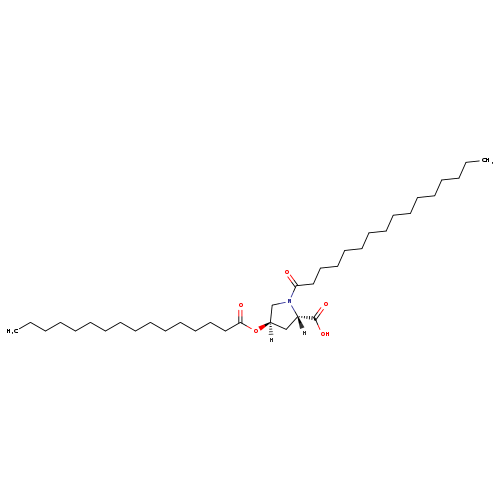
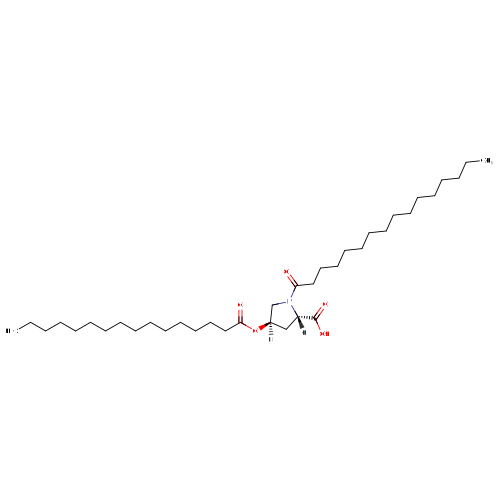
trans-1-(1-oxohexadecyl)-4-[(1-oxohexadecyl)oxy]-L-proline (CED0174734)

Record Information
Version1.0
Creation Date2016-06-03 12:13:42 UTC
Update Date2026-04-15 18:25:19 UTC
SynCED IDCED0174734
Secondary Accession Numbers
  • CHEM044425
Identification
Common Nametrans-1-(1-oxohexadecyl)-4-[(1-oxohexadecyl)oxy]-L-proline
ClassSmall Molecule
Description
trans-1-(1-oxohexadecyl)-4-[(1-oxohexadecyl)oxy]-L-proline belongs to the amino acids, peptides, and analogues, a subclass of carboxylic acids and derivatives within the organic compounds. With an average molecular weight of 607.96 g/mol, trans-1-(1-oxohexadecyl)-4-[(1-oxohexadecyl)oxy]-L-proline is a heavy molecule. This compound has the chemical formula C37H69NO5. In industrial applications, it is utilized as an anti-static agent as well as a softener and conditioner. The substance has been recorded in one source, specifically drinking water and water supply. The recorded route of exposure for this compound is oral.
Contaminant TypeNot Available
Chemical Structure
SynonymsNot Available
Chemical FormulaC37H69NO5
Average Molecular Mass607.961 g/mol
Monoisotopic Mass607.518 g/mol
CAS Registry Number41672-81-5
IUPAC Name(2S,4R)-1-hexadecanoyl-4-(hexadecanoyloxy)pyrrolidine-2-carboxylic acid
Traditional Name(2S,4R)-1-hexadecanoyl-4-(hexadecanoyloxy)pyrrolidine-2-carboxylic acid
SMILES[H][C@@]1(CN(C(=O)CCCCCCCCCCCCCCC)[C@@]([H])(C1)C(O)=O)OC(=O)CCCCCCCCCCCCCCC
InChI IdentifierInChI=1S/C37H69NO5/c1-3-5-7-9-11-13-15-17-19-21-23-25-27-29-35(39)38-32-33(31-34(38)37(41)42)43-36(40)30-28-26-24-22-20-18-16-14-12-10-8-6-4-2/h33-34H,3-32H2,1-2H3,(H,41,42)/t33-,34+/m1/s1
InChI KeyQZLXCFQVOCEKSX-NOCHOARKSA-N
Chemical Taxonomy
Description Belongs to the class of organic compounds known as proline and derivatives. Proline and derivatives are compounds containing proline or a derivative thereof resulting from reaction of proline at the amino group or the carboxy group, or from the replacement of any hydrogen of glycine by a heteroatom.
KingdomOrganic compounds
Super ClassOrganic acids and derivatives
ClassCarboxylic acids and derivatives
Sub ClassAmino acids, peptides, and analogues
Direct ParentProline and derivatives
Alternative Parents
Substituents
  • Proline or derivatives
  • N-acyl-l-alpha-amino acid
  • N-acyl-alpha amino acid or derivatives
  • N-acyl-alpha-amino acid
  • Pyrrolidine carboxylic acid or derivatives
  • Pyrrolidine carboxylic acid
  • N-acylpyrrolidine
  • Fatty acid ester
  • Fatty acyl
  • Dicarboxylic acid or derivatives
  • Tertiary carboxylic acid amide
  • Pyrrolidine
  • Carboxylic acid ester
  • Carboxamide group
  • Azacycle
  • Organoheterocyclic compound
  • Carboxylic acid
  • Organic nitrogen compound
  • Organic oxygen compound
  • Organopnictogen compound
  • Organic oxide
  • Hydrocarbon derivative
  • Organooxygen compound
  • Organonitrogen compound
  • Carbonyl group
  • Aliphatic heteromonocyclic compound
Molecular FrameworkAliphatic heteromonocyclic compounds
External DescriptorsNot Available
Biological Properties
StatusDetected and Not Quantified
OriginNot Available
Cellular LocationsNot Available
Biofluid LocationsNot Available
Tissue LocationsNot Available
ApplicationsNot Available
Biological RolesNot Available
Chemical RolesNot Available
Organoleptic EffectsNot Available
Physical Properties
StateNot Available
AppearanceNot Available
Experimental Properties
PropertyValue
Melting PointNot Available
Boiling PointNot Available
SolubilityNot Available
Predicted Properties
PropertyValueSource
Water Solubility2.2e-05 g/LALOGPS
logP9.34ALOGPS
logP11.77ChemAxon
logS-7.4ALOGPS
pKa (Strongest Acidic)3.82ChemAxon
pKa (Strongest Basic)-1.1ChemAxon
Physiological Charge-1ChemAxon
Hydrogen Acceptor Count4ChemAxon
Hydrogen Donor Count1ChemAxon
Polar Surface Area83.91 ŲChemAxon
Rotatable Bond Count31ChemAxon
Refractivity176.98 m³·mol⁻¹ChemAxon
Polarizability79.53 ųChemAxon
Number of Rings1ChemAxon
BioavailabilityNoChemAxon
Rule of FiveNoChemAxon
Ghose FilterNoChemAxon
Veber's RuleNoChemAxon
MDDR-like RuleNoChemAxon
Spectra
Spectra
Spectrum TypeDescriptionSplash KeyDeposition DateView
Predicted LC-MS/MSPredicted LC-MS/MS Spectrumsplash10-0pi3-0119054000-3f53d81d6123dff6e4feNot AvailableView Spectrum
Predicted LC-MS/MSPredicted LC-MS/MS Spectrumsplash10-0ik9-1729020000-99193fdbe18d3dda02e2Not AvailableView Spectrum
Predicted LC-MS/MSPredicted LC-MS/MS Spectrumsplash10-03di-1932130000-9699637a3785ab88cb07Not AvailableView Spectrum
Predicted LC-MS/MSPredicted LC-MS/MS Spectrumsplash10-0a4i-0049088000-9dca5bc883125555aea2Not AvailableView Spectrum
Predicted LC-MS/MSPredicted LC-MS/MS Spectrumsplash10-0cei-1079031000-989b469e608992a93045Not AvailableView Spectrum
Predicted LC-MS/MSPredicted LC-MS/MS Spectrumsplash10-0udr-2977000000-04d2740de1bb25e97a4bNot AvailableView Spectrum
Toxicity Profile
Toxicity Values
Toxicity ValueOrganismDose DescriptorRoute of ExposurePredicted or ExperimentalToxicity RatingReference
5136.0 Log mg/kg [2900:9100]RatLD50oralpredictedNot AvailableNot Available
Toxicity / Toxin ClassNot Available
Mechanism of ToxicityNot Available
Carcinogenicity (IARC Classification)Not Available
Minimum Risk LevelNot Available
SymptomsNot Available
TreatmentNot Available
Health Effects
Health EffectRelationshipDirectionReference
Exposure Sources
Source IDSourceSectorReference
CEDs000115Drinking water?Drinking water can be a medium for synthetic chemical contamination, often originating from various industrial processes and agricultural practices.Drinking water & water supplyNot Available
CEDs000490Personal care & cosmeticsNot Available
CEDs000561Perfumes Within Detergents And Soaps?Perfumes within detergents and soaps are synthetic fragrance compounds added to enhance the sensory experience of cleaning products.Household cleaning & consumer productsNot Available
CEDs000563Soap Detergents?Soap detergents are synthetic surfactants designed to enhance the cleaning efficacy of water by reducing surface tension, allowing for better interaction with dirt and grease.Household cleaning & consumer productsNot Available
CEDs000609Aftershave?Aftershave is a grooming product typically used to soothe and protect the skin following shaving.Personal care & cosmeticsNot Available
CEDs000610Aftersun Products?Aftersun products are designed to soothe and hydrate the skin after sun exposure, often containing various synthetic chemicals such as emollients, preservatives, and fragrances.Personal care & cosmeticsNot Available
CEDs000611Anti Perspirants Or Body Deoderants?Antiperspirants and body deodorants commonly contain synthetic chemicals such as aluminum compounds, parabens, and synthetic fragrances.Personal care & cosmeticsNot Available
CEDs000613Depilatories?Depilatories are products designed to remove unwanted hair through the application of synthetic chemicals that break down the protein structure of hair, facilitating its removal.Personal care & cosmeticsNot Available
CEDs000614Essential Oils Or Perfumes?Essential oils and perfumes are complex mixtures of volatile compounds derived from natural or synthetic sources, commonly used for their aromatic properties.Personal care & cosmeticsNot Available
CEDs000615Eye Makeup Products?Eye makeup products, including mascaras, eyeliners, and eyeshadows, often contain a variety of synthetic chemicals such as pigments, preservatives, and film-forming agents.Personal care & cosmeticsNot Available
CEDs000616Face Mask Cosmetics?Face mask cosmetics often contain a variety of synthetic chemicals, including preservatives, emulsifiers, and fragrances, which can contribute to chemical contamination.Personal care & cosmeticsNot Available
CEDs000617Lip Care Products?Lip care products, including lipsticks, balms, and glosses, often contain a variety of synthetic chemicals such as parabens, phthalates, and synthetic fragrances.Personal care & cosmeticsNot Available
CEDs000618Lip Makeup Products?Lip makeup products, such as lipsticks, lip glosses, and lip liners, often contain a variety of synthetic chemicals, including pigments, preservatives, and emollients.Personal care & cosmeticsNot Available
CEDs000632Apparel?Apparel production often involves the use of various synthetic chemicals, including dyes, finishing agents, and preservatives.Textiles, leather & furnishingsNot Available
CEDs000696Nanotechnology?Nanotechnology involves the manipulation of materials at the molecular or atomic level, typically within the range of 1 to 100 nanometers.Industrial manufacturing & chemical processingNot Available
CEDs000740Paper?Paper production involves the processing of wood fibers and the use of various chemicals, which can lead to synthetic chemical contamination.Paper, pulp & fiber productsNot Available
Pathways
0 pathwaysPathway Source: PathBank

No pathways found

No metabolic pathways have been associated with this synthetic chemical

Targets
StructureProteinUniProt IDOrganismRelationshipDetails
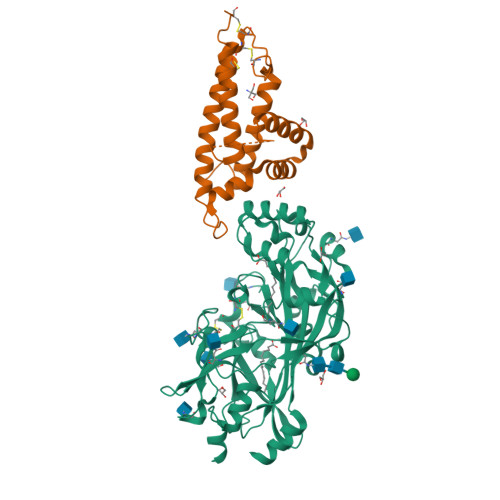
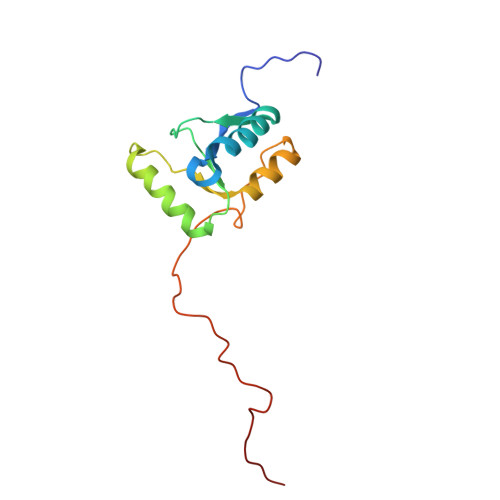
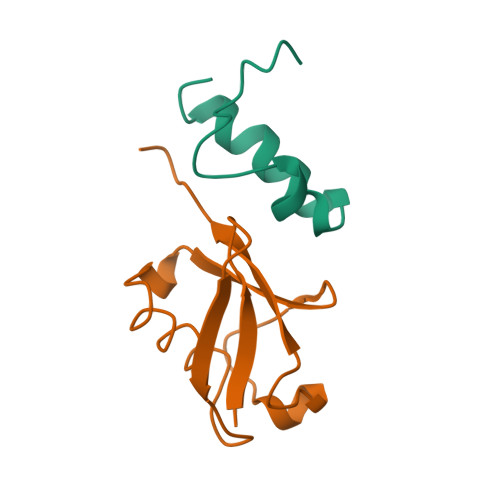
Guanine nucleotide-binding protein G(i) subunit alpha-1 structureClick to view 3D structureGuanine nucleotide-binding protein G(i) subunit alpha-1P63096HumansPredicted (SEA)
Prediction Confidence Score
0.34
Applicability Domain
0.346
Statistical Significance
4.00e-05
Supporting Reference Compounds
2
E-value
0.311397
Tyrosine-protein phosphatase non-receptor type 1 structureClick to view 3D structureTyrosine-protein phosphatase non-receptor type 1P18031HumansPredicted (SEA)
Prediction Confidence Score
0.324
Applicability Domain
0.341
Statistical Significance
0.0055
Supporting Reference Compounds
197
E-value
43.1285
Peroxisome proliferator-activated receptor alpha structureClick to view 3D structurePeroxisome proliferator-activated receptor alphaQ07869HumansPredicted (SEA)
Prediction Confidence Score
0.324
Applicability Domain
0.341
Statistical Significance
0.0078
Supporting Reference Compounds
127
E-value
60.9559
Platelet glycoprotein 4 structureClick to view 3D structurePlatelet glycoprotein 4P16671HumansPredicted (SEA)
Prediction Confidence Score
0.317
Applicability Domain
0.317
Statistical Significance
2.60e-04
Supporting Reference Compounds
1
E-value
2.02408
Peroxisome proliferator-activated receptor delta structureClick to view 3D structurePeroxisome proliferator-activated receptor deltaQ03181HumansPredicted (SEA)
Prediction Confidence Score
0.312
Applicability Domain
0.341
Statistical Significance
0.0072
Supporting Reference Compounds
89
E-value
56.2071
Transient receptor potential cation channel subfamily V member 2 structureClick to view 3D structureTransient receptor potential cation channel subfamily V member 2Q9WUD2Rattus norvegicusPredicted (SEA)
Prediction Confidence Score
0.303
Applicability Domain
0.341
Statistical Significance
0.0022
Supporting Reference Compounds
21
E-value
17.049
Peroxisome proliferator-activated receptor gamma structureClick to view 3D structurePeroxisome proliferator-activated receptor gammaP37231HumansPredicted (SEA)
Prediction Confidence Score
0.299
Applicability Domain
0.341
Statistical Significance
0.0185
Supporting Reference Compounds
192
E-value
144.41
Click to view 3D structureAcidic phospholipase A2 CM-IP00602Naja mossambicaPredicted (SEA)
Prediction Confidence Score
0.288
Applicability Domain
0.288 Low confidence
Statistical Significance
0.0024
Supporting Reference Compounds
1
E-value
18.606
DNA-directed DNA/RNA polymerase mu structureClick to view 3D structureDNA-directed DNA/RNA polymerase muQ9NP87HumansPredicted (SEA)
Prediction Confidence Score
0.288
Applicability Domain
0.288 Low confidence
Statistical Significance
6.70e-04
Supporting Reference Compounds
1
E-value
5.2159
Click to view 3D structureDNA nucleotidylexotransferaseP06526Bos taurusPredicted (SEA)
Prediction Confidence Score
0.288
Applicability Domain
0.288 Low confidence
Statistical Significance
6.70e-04
Supporting Reference Compounds
1
E-value
5.2159
Click to view 3D structureMitochondrial carnitine/acylcarnitine carrier proteinO43772HumansPredicted (SEA)
Prediction Confidence Score
0.286
Applicability Domain
0.286 Low confidence
Statistical Significance
4.30e-04
Supporting Reference Compounds
1
E-value
3.34752
Click to view 3D structureHistone deacetylase 11Q96DB2HumansPredicted (SEA)
Prediction Confidence Score
0.285
Applicability Domain
0.341
Statistical Significance
0.0274
Supporting Reference Compounds
149
E-value
213.385
Protein kinase C alpha type structureClick to view 3D structureProtein kinase C alpha typeP17252HumansPredicted (SEA)
Prediction Confidence Score
0.278
Applicability Domain
0.357
Statistical Significance
0.0384
Supporting Reference Compounds
258
E-value
298.863
Click to view 3D structureCarnitine palmitoyltransferase 1AQ9MYX2Sus scrofaPredicted (SEA)
Prediction Confidence Score
0.277
Applicability Domain
0.286 Low confidence
Statistical Significance
3.50e-04
Supporting Reference Compounds
2
E-value
2.72472
Click to view 3D structureCAI-1 autoinducer sensor kinase/phosphatase CqsSQ9KM66Vibrio cholerae serotype O1 (strain ATCC 39315 / El Tor Inaba N16961)Predicted (SEA)
Prediction Confidence Score
0.277
Applicability Domain
0.277 Low confidence
Statistical Significance
8.40e-04
Supporting Reference Compounds
1
E-value
6.53933
G-protein coupled receptor 84 structureClick to view 3D structureG-protein coupled receptor 84Q9NQS5HumansPredicted (SEA)
Prediction Confidence Score
0.275
Applicability Domain
0.341
Statistical Significance
0.0016
Supporting Reference Compounds
15
E-value
12.3002
DNA polymerase iota structureClick to view 3D structureDNA polymerase iotaQ6R3M4Mus musculusPredicted (SEA)
Prediction Confidence Score
0.275
Applicability Domain
0.288 Low confidence
Statistical Significance
0.0012
Supporting Reference Compounds
2
E-value
9.26406
Autotaxin structureClick to view 3D structureAutotaxinQ13822HumansPredicted (SEA)
Prediction Confidence Score
0.274
Applicability Domain
0.281 Low confidence
Statistical Significance
0.003
Supporting Reference Compounds
40
E-value
23.6662
Click to view 3D structureLysophosphatidic acid receptor 3Q9UBY5HumansPredicted (SEA)
Prediction Confidence Score
0.274
Applicability Domain
0.281 Low confidence
Statistical Significance
0.0024
Supporting Reference Compounds
21
E-value
18.3724
Lysophosphatidic acid receptor 1 structureClick to view 3D structureLysophosphatidic acid receptor 1Q92633HumansPredicted (SEA)
Prediction Confidence Score
0.271
Applicability Domain
0.281 Low confidence
Statistical Significance
0.0024
Supporting Reference Compounds
31
E-value
18.9952
Lysophosphatidic acid receptor 2 structureClick to view 3D structureLysophosphatidic acid receptor 2Q9HBW0HumansPredicted (SEA)
Prediction Confidence Score
0.27
Applicability Domain
0.276 Low confidence
Statistical Significance
0.0019
Supporting Reference Compounds
30
E-value
14.9471
Click to view 3D structureFatty-acid amide hydrolase 1O00519HumansPredicted (SEA)
Prediction Confidence Score
0.267
Applicability Domain
0.298 Low confidence
Statistical Significance
0.0412
Supporting Reference Compounds
106
E-value
321.05
Guanine nucleotide-binding protein G(o) subunit alpha structureClick to view 3D structureGuanine nucleotide-binding protein G(o) subunit alphaP09471HumansPredicted (SEA)
Prediction Confidence Score
0.265
Applicability Domain
0.333
Statistical Significance
2.30e-04
Supporting Reference Compounds
2
E-value
1.79053
Click to view 3D structureLysophosphatidic acid receptor 4Q8BLG2Mus musculusPredicted (SEA)
Prediction Confidence Score
0.262
Applicability Domain
0.262 Low confidence
Statistical Significance
0.0014
Supporting Reference Compounds
1
E-value
10.5875
Click to view 3D structureNon-lysosomal glucosylceramidaseQ9HCG7HumansPredicted (SEA)
Prediction Confidence Score
0.259
Applicability Domain
0.259 Low confidence
Statistical Significance
7.40e-04
Supporting Reference Compounds
21
E-value
5.76084
Concentrations
Not Available
External Links
DrugBank IDNot Available
HMDB IDNot Available
FooDB IDNot Available
Phenol Explorer IDNot Available
KNApSAcK IDNot Available
BiGG IDNot Available
BioCyc IDNot Available
METLIN IDNot Available
PDB IDNot Available
Wikipedia LinkNot Available
Chemspider IDNot Available
ChEBI IDNot Available
PubChem Compound ID170556
Kegg Compound IDNot Available
YMDB IDNot Available
ECMDB IDNot Available
References
Synthesis ReferenceNot Available
MSDSNot Available
General ReferencesNot Available