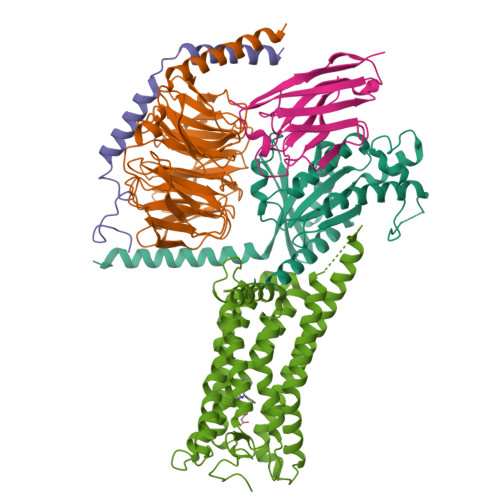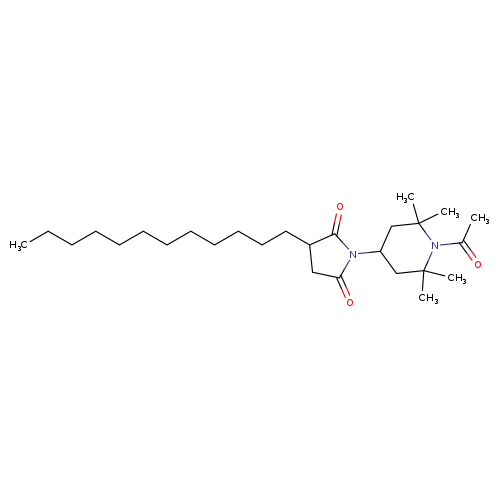
1-acetyl-4-(3-dodecyl-2,5-dioxo-1-pyrrolidinyl)-2,2,6,6-tetramethylpiperidine (CED0141159)

Record Information
Version1.0
Creation Date2016-06-03 12:38:26 UTC
Update Date2026-08-22 07:54:31 UTC
SynCED IDCED0141159
Secondary Accession Numbers
  • CHEM044866
Identification
Common Name1-acetyl-4-(3-dodecyl-2,5-dioxo-1-pyrrolidinyl)-2,2,6,6-tetramethylpiperidine
ClassSmall Molecule
Description
1-acetyl-4-(3-dodecyl-2,5-dioxo-1-pyrrolidinyl)-2,2,6,6-tetramethylpiperidine belongs to the n-acylpiperidines, a subclass of piperidines within the organic compounds. This organoheterocyclic compound has the chemical formula C27H48N2O3 and an average molecular weight of 448.69 g/mol. In industrial applications, it is utilized as a UV stabilizer. It has been recorded as being released from electrical and electronic equipment, specifically antennas.
Contaminant TypeNot Available
Chemical Structure
SynonymsNot Available
Chemical FormulaC27H48N2O3
Average Molecular Mass448.692 g/mol
Monoisotopic Mass448.366 g/mol
CAS Registry Number106917-31-1
IUPAC Name1-(1-acetyl-2,2,6,6-tetramethylpiperidin-4-yl)-3-dodecylpyrrolidine-2,5-dione
Traditional Name1-(1-acetyl-2,2,6,6-tetramethylpiperidin-4-yl)-3-dodecylpyrrolidine-2,5-dione
SMILESCCCCCCCCCCCCC1CC(=O)N(C2CC(C)(C)N(C(C)=O)C(C)(C)C2)C1=O
InChI IdentifierInChI=1S/C27H48N2O3/c1-7-8-9-10-11-12-13-14-15-16-17-22-18-24(31)28(25(22)32)23-19-26(3,4)29(21(2)30)27(5,6)20-23/h22-23H,7-20H2,1-6H3
InChI KeyVXTRPEFUPWORNH-UHFFFAOYSA-N
Chemical Taxonomy
Description Belongs to the class of organic compounds known as n-acylpiperidines. N-acylpiperidines are compounds containing an N-acyethanolamine moiety, which is characterized by an acyl group is linked to the nitrogen atom of a piperidine.
KingdomOrganic compounds
Super ClassOrganoheterocyclic compounds
ClassPiperidines
Sub ClassN-acylpiperidines
Direct ParentN-acylpiperidines
Alternative Parents
Substituents
  • N-acyl-piperidine
  • Carboxylic acid imide, n-substituted
  • Pyrrolidone
  • 2-pyrrolidone
  • N-alkylpyrrolidine
  • Carboxylic acid imide
  • Dicarboximide
  • Pyrrolidine
  • Tertiary carboxylic acid amide
  • Acetamide
  • Carboxamide group
  • Lactam
  • Carboxylic acid derivative
  • Azacycle
  • Organopnictogen compound
  • Organooxygen compound
  • Organonitrogen compound
  • Organic oxygen compound
  • Organic nitrogen compound
  • Carbonyl group
  • Organic oxide
  • Hydrocarbon derivative
  • Aliphatic heteromonocyclic compound
Molecular FrameworkAliphatic heteromonocyclic compounds
External DescriptorsNot Available
Biological Properties
StatusDetected and Not Quantified
OriginNot Available
Cellular LocationsNot Available
Biofluid LocationsNot Available
Tissue LocationsNot Available
ApplicationsNot Available
Biological RolesNot Available
Chemical RolesNot Available
Organoleptic EffectsNot Available
Physical Properties
StateNot Available
AppearanceNot Available
Experimental Properties
PropertyValue
Melting PointNot Available
Boiling PointNot Available
SolubilityNot Available
Predicted Properties
PropertyValueSource
Water Solubility0.00097 g/LALOGPS
logP6.66ALOGPS
logP5.31ChemAxon
logS-5.7ALOGPS
pKa (Strongest Basic)-0.71ChemAxon
Physiological Charge0ChemAxon
Hydrogen Acceptor Count3ChemAxon
Hydrogen Donor Count0ChemAxon
Polar Surface Area57.69 ŲChemAxon
Rotatable Bond Count12ChemAxon
Refractivity130.2 m³·mol⁻¹ChemAxon
Polarizability56.26 ųChemAxon
Number of Rings2ChemAxon
BioavailabilityNoChemAxon
Rule of FiveNoChemAxon
Ghose FilterNoChemAxon
Veber's RuleNoChemAxon
MDDR-like RuleNoChemAxon
Spectra
Spectra
Spectrum TypeDescriptionSplash KeyDeposition DateView
Predicted LC-MS/MSPredicted LC-MS/MS Spectrumsplash10-0002-0100900000-10c0c1b42a93ccb9e7feNot AvailableView Spectrum
Predicted LC-MS/MSPredicted LC-MS/MS Spectrumsplash10-0a4j-4920800000-0888c0e96a2201c7d1bbNot AvailableView Spectrum
Predicted LC-MS/MSPredicted LC-MS/MS Spectrumsplash10-0007-4912000000-8a86ae07fe2efc8cec72Not AvailableView Spectrum
Predicted LC-MS/MSPredicted LC-MS/MS Spectrumsplash10-0002-0010900000-dc9a2fe1656a6467c048Not AvailableView Spectrum
Predicted LC-MS/MSPredicted LC-MS/MS Spectrumsplash10-05mk-0140900000-9531591b8ecdaa813854Not AvailableView Spectrum
Predicted LC-MS/MSPredicted LC-MS/MS Spectrumsplash10-0059-1910000000-a8b3b0537bf2720ad0edNot AvailableView Spectrum
Toxicity Profile
Toxicity Values
Toxicity ValueOrganismDose DescriptorRoute of ExposurePredicted or ExperimentalToxicity RatingReference
2498.0 Log mg/kg [1400:4400]RatLD50oralpredictedNot AvailableNot Available
Toxicity / Toxin ClassNot Available
Mechanism of ToxicityNot Available
Carcinogenicity (IARC Classification)Not Available
Minimum Risk LevelNot Available
SymptomsNot Available
TreatmentNot Available
Health Effects
Health EffectRelationshipDirectionDescriptionReference
Exposure Sources
Source IDSourceSectorReference
CEDs000226Fragrances?Fragrances are complex mixtures of aromatic compounds used to impart pleasant scents to various products.Personal care & cosmeticsPMC8114949
CEDs000506Antennas?Antennas, commonly used in communication technologies, can be a source of synthetic chemical contamination through the materials and coatings used in their construction.Electrical & Electronic EquipmentPubChem
CEDs000511Conductors Or Conductive Bodies Characterised By The Conductive Materials?Conductors, or conductive bodies, are materials that allow the flow of electrical current, typically made from metals such as copper, aluminum, or silver.Electrical & Electronic EquipmentPubChem
CEDs000519Electrodes?Electrodes, used in various electrical and electronic applications, can be a source of synthetic chemical contamination due to the materials from which they are constructed and the processes involved in their manufacturing.Electrical & Electronic EquipmentPubChem
CEDs000545Food Preservation?Food preservation often involves the use of synthetic chemicals, such as preservatives, flavor enhancers, and color additives, to extend shelf life and enhance the sensory qualities of food products.Food, food processing & cookwarePubChem
CEDs000632Apparel?Apparel production often involves the use of various synthetic chemicals, including dyes, finishing agents, and preservatives.Textiles, leather & furnishingsPubChem
CEDs000662Yarns Or Threads?Yarns or threads used in textiles can be a source of synthetic chemical contamination due to the production processes and treatments they undergo.Textiles, leather & furnishingsPubChem
CEDs000685Ceramics?Ceramics can be a source of synthetic chemical contamination through various additives and processing agents used in their production.Building & ConstructionPubChem
CEDs000688Glass Coatings?Glass coatings are synthetic chemical formulations applied to glass surfaces to enhance properties such as durability, UV resistance, and aesthetic appeal.Building & ConstructionPubChem
CEDs000696Nanotechnology?Nanotechnology involves the manipulation of materials at the molecular or atomic level, typically within the range of 1 to 100 nanometers.Industrial manufacturing & chemical processingPubChem
CEDs000734Coating Compositions?Coating compositions, which include paints, sealants, and varnishes, are formulated with a variety of synthetic chemicals such as solvents, resins, pigments, and additives.Building & ConstructionPubChem
CEDs000739Inks?Inks are complex mixtures composed of pigments or dyes, solvents, resins, and additives used primarily for printing and writing applications.Paper, pulp & fiber productsPubChem
CEDs000740Paper?Paper production involves the processing of wood fibers and the use of various chemicals, which can lead to synthetic chemical contamination.Paper, pulp & fiber productsPubChem
CEDs000744Water, Wastewater, & Sewage Treatment?Water, wastewater, and sewage treatment processes are critical for managing and mitigating pollutants in water systems.Wastewater, sanitation & biosolidsPubChem
CEDs03169Consumer ProductsHousehold cleaning & consumer productsPMC8114949
Pathways
0 pathwaysPathway Source: PathBank

No pathways found

No metabolic pathways have been associated with this synthetic chemical

Targets
StructureProteinUniProt IDOrganismRelationshipDetails
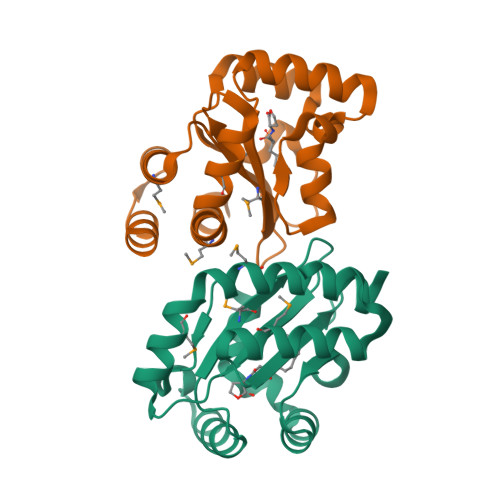
Platelet glycoprotein 4 structureClick to view 3D structurePlatelet glycoprotein 4P16671HumansPredicted (SEA)
Prediction Confidence Score
0.279
Applicability Domain
0.279 Low confidence
Statistical Significance
7.30e-04
Supporting Reference Compounds
1
E-value
5.68299
Click to view 3D structureCarnitine palmitoyltransferase 1AQ9MYX2Sus scrofaPredicted (SEA)
Prediction Confidence Score
0.269
Applicability Domain
0.288 Low confidence
Statistical Significance
4.50e-04
Supporting Reference Compounds
2
E-value
3.50322
Click to view 3D structureNuclear receptor subfamily 4 group A member 2Q07917Rattus norvegicusPredicted (SEA)
Prediction Confidence Score
0.242
Applicability Domain
0.257 Low confidence
Statistical Significance
0.0013
Supporting Reference Compounds
3
E-value
9.9647
Click to view 3D structureDiacylglycerol lipase-alphaQ9Y4D2HumansPredicted (SEA)
Prediction Confidence Score
0.238
Applicability Domain
0.25 Low confidence
Statistical Significance
0.0233
Supporting Reference Compounds
35
E-value
181.311
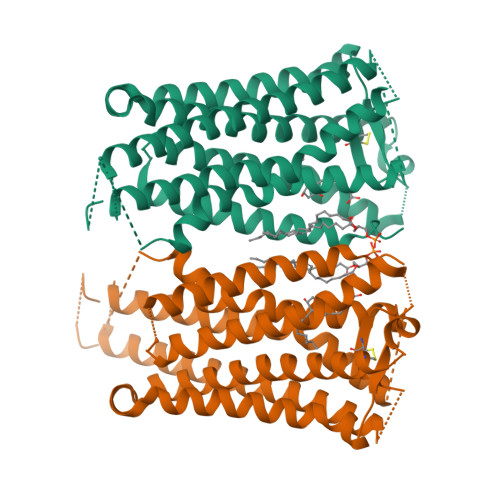
Click to view 3D structureSynaptic vesicle glycoprotein 2AQ02563Rattus norvegicusPredicted (SEA)
Prediction Confidence Score
0.237
Applicability Domain
0.237 Low confidence
Statistical Significance
2.10e-04
Supporting Reference Compounds
1
E-value
1.63483
Transcriptional activator protein LasR structureClick to view 3D structureTranscriptional activator protein LasRP25084Pseudomonas aeruginosa (strain ATCC 15692 / PAO1 / 1C / PRS 101 / LMG 12228)Predicted (SEA)
Prediction Confidence Score
0.237
Applicability Domain
0.246 Low confidence
Statistical Significance
0.0023
Supporting Reference Compounds
12
E-value
18.1389
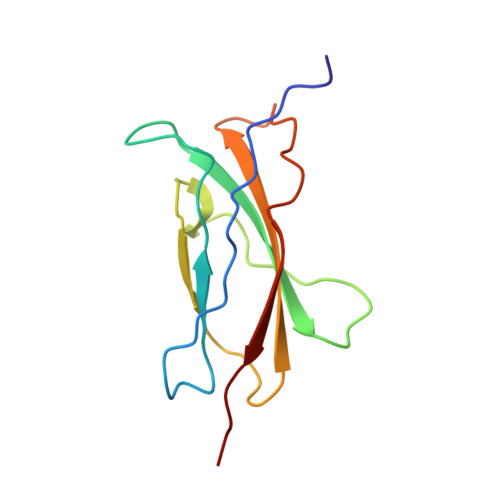
Interleukin-6 receptor subunit beta structureClick to view 3D structureInterleukin-6 receptor subunit betaP40189HumansPredicted (SEA)
Prediction Confidence Score
0.236
Applicability Domain
0.243 Low confidence
Statistical Significance
8.00e-04
Supporting Reference Compounds
2
E-value
6.22794
Prostaglandin E2 receptor EP2 subtype structureClick to view 3D structureProstaglandin E2 receptor EP2 subtypeP43116HumansPredicted (SEA)
Prediction Confidence Score
0.235
Applicability Domain
0.253 Low confidence
Statistical Significance
0.0602
Supporting Reference Compounds
95
E-value
468.497
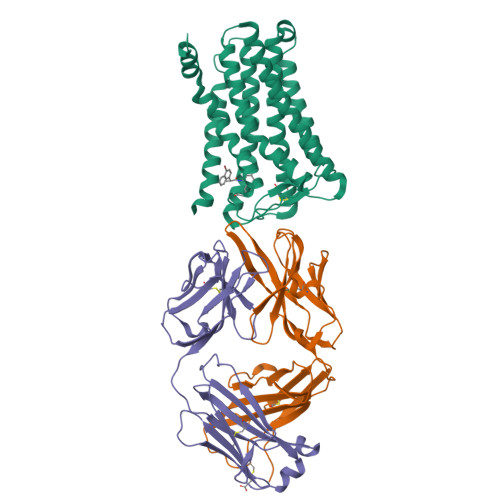
Cannabinoid receptor 1 structureClick to view 3D structureCannabinoid receptor 1P21554HumansPredicted (SEA)
Prediction Confidence Score
0.235
Applicability Domain
0.25 Low confidence
Statistical Significance
0.1713
Supporting Reference Compounds
200
E-value
1333.56
Fatty-acid amide hydrolase 1 structureClick to view 3D structureFatty-acid amide hydrolase 1P97612Rattus norvegicusPredicted (SEA)
Prediction Confidence Score
0.234
Applicability Domain
0.25 Low confidence
Statistical Significance
0.0961
Supporting Reference Compounds
102
E-value
748.442
Tyrosine-protein phosphatase non-receptor type 1 structureClick to view 3D structureTyrosine-protein phosphatase non-receptor type 1P18031HumansPredicted (SEA)
Prediction Confidence Score
0.233
Applicability Domain
0.25 Low confidence
Statistical Significance
0.1033
Supporting Reference Compounds
197
E-value
804.416
Prostaglandin E2 receptor EP3 subtype structureClick to view 3D structureProstaglandin E2 receptor EP3 subtypeP43115HumansPredicted (SEA)
Prediction Confidence Score
0.232
Applicability Domain
0.253 Low confidence
Statistical Significance
0.0847
Supporting Reference Compounds
102
E-value
659.305
Prostaglandin E2 receptor EP4 subtype structureClick to view 3D structureProstaglandin E2 receptor EP4 subtypeP35408HumansPredicted (SEA)
Prediction Confidence Score
0.232
Applicability Domain
0.253 Low confidence
Statistical Significance
0.0811
Supporting Reference Compounds
92
E-value
631.046
Cannabinoid receptor 2 structureClick to view 3D structureCannabinoid receptor 2P34972HumansPredicted (SEA)
Prediction Confidence Score
0.23
Applicability Domain
0.25 Low confidence
Statistical Significance
0.1946
Supporting Reference Compounds
175
E-value
1514.95
Click to view 3D structure3-keto-steroid reductase/17-beta-hydroxysteroid dehydrogenase 7P56937HumansPredicted (SEA)
Prediction Confidence Score
0.23
Applicability Domain
0.23 Low confidence
Statistical Significance
9.50e-04
Supporting Reference Compounds
1
E-value
7.39568
Guanine nucleotide-binding protein G(i) subunit alpha-1 structureClick to view 3D structureGuanine nucleotide-binding protein G(i) subunit alpha-1P63096HumansPredicted (SEA)
Prediction Confidence Score
0.23
Applicability Domain
0.233 Low confidence
Statistical Significance
0.0023
Supporting Reference Compounds
2
E-value
17.8275
G-protein coupled receptor 84 structureClick to view 3D structureG-protein coupled receptor 84Q9NQS5HumansPredicted (SEA)
Prediction Confidence Score
0.227
Applicability Domain
0.229 Low confidence
Statistical Significance
0.0055
Supporting Reference Compounds
15
E-value
42.6614
Prostacyclin receptor structureClick to view 3D structureProstacyclin receptorP43119HumansPredicted (SEA)
Prediction Confidence Score
0.226
Applicability Domain
0.257 Low confidence
Statistical Significance
0.0621
Supporting Reference Compounds
63
E-value
483.132
Click to view 3D structureExtended-spectrum beta-lactamase PER-6D5HSX5Aeromonas allosaccharophilaPredicted (SEA)
Prediction Confidence Score
0.224
Applicability Domain
0.224 Low confidence
Statistical Significance
1.30e-04
Supporting Reference Compounds
1
E-value
1.01204
Click to view 3D structureADC-14 proteinQ0VTR6Acinetobacter genomosp. 3Predicted (SEA)
Prediction Confidence Score
0.224
Applicability Domain
0.224 Low confidence
Statistical Significance
1.30e-04
Supporting Reference Compounds
1
E-value
1.01204
Click to view 3D structureBeta-lactamase SHV-11Q7X575Escherichia coliPredicted (SEA)
Prediction Confidence Score
0.224
Applicability Domain
0.224 Low confidence
Statistical Significance
1.30e-04
Supporting Reference Compounds
1
E-value
1.01204
Click to view 3D structureADC-16 proteinQ0VTR8Acinetobacter genomosp. 3Predicted (SEA)
Prediction Confidence Score
0.224
Applicability Domain
0.224 Low confidence
Statistical Significance
1.30e-04
Supporting Reference Compounds
1
E-value
1.01204
Protein kinase C alpha type structureClick to view 3D structureProtein kinase C alpha typeP17252HumansPredicted (SEA)
Prediction Confidence Score
0.223
Applicability Domain
0.29 Low confidence
Statistical Significance
0.2534
Supporting Reference Compounds
258
E-value
1972.47
Click to view 3D structureProstaglandin E2 receptor EP1 subtypeP34995HumansPredicted (SEA)
Prediction Confidence Score
0.221
Applicability Domain
0.253 Low confidence
Statistical Significance
0.1208
Supporting Reference Compounds
78
E-value
940.808
Click to view 3D structureNon-lysosomal glucosylceramidaseQ9HCG7HumansPredicted (SEA)
Prediction Confidence Score
0.22
Applicability Domain
0.22 Low confidence
Statistical Significance
0.0021
Supporting Reference Compounds
21
E-value
16.0369
Concentrations
Not Available
External Links
DrugBank IDNot Available
HMDB IDNot Available
FooDB IDNot Available
Phenol Explorer IDNot Available
KNApSAcK IDNot Available
BiGG IDNot Available
BioCyc IDNot Available
METLIN IDNot Available
PDB IDNot Available
Wikipedia LinkNot Available
Chemspider IDNot Available
ChEBI IDNot Available
PubChem Compound ID3034263
Kegg Compound IDNot Available
YMDB IDNot Available
ECMDB IDNot Available
References
Synthesis ReferenceNot Available
MSDSNot Available
General ReferencesNot Available