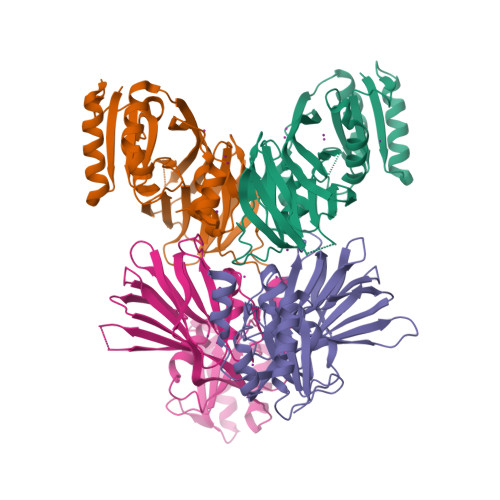
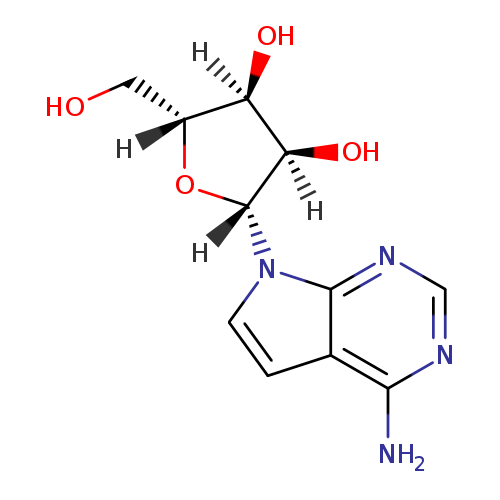
Tubercidin (CED0009729)

Record Information
Version1.0
Creation Date2026-03-31 20:49:13 UTC
Update Date2026-05-14 17:48:25 UTC
SynCED IDCED0009729
Secondary Accession Numbers
  • CHEM057872
Identification
Common NameTubercidin
ClassSmall Molecule
Description
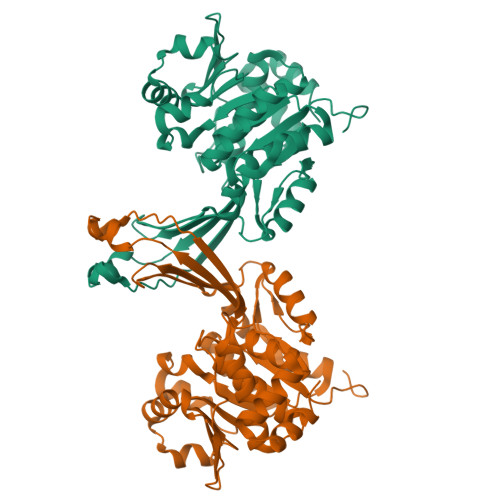
Tubercidin is an organic compound with the chemical formula C11H14N4O4 and an average molecular weight of 266.26 g/mol. Tubercidin belongs to the pyrrolopyrimidine nucleosides and nucleotides, a class of nucleosides, nucleotides, and analogues within the organic compounds. This compound is found in or released from five recorded sources, including antibiotics within healthcare, pharmaceuticals, and veterinary products. It is also associated with household cleaning and consumer products, specifically soap detergents and perfumes within detergents and soaps, as well as electrical and electronic equipment, specifically thin magnetic films and conductors or conductive bodies characterised by the conductive materials. Recorded routes of exposure for this substance include oral and inhalation pathways. Regarding its biological activity, there is one recorded protein target: the DeoD-type purine nucleoside phosphorylase (deoD).
Contaminant TypeNot Available
Chemical Structure
Synonyms
ValueSource
7-DeazaadenosineChEBI
Sparsomycin aChEBI
7 DeazaadenosineMeSH
4-Amino-7 beta-D-ribofuranosyl-7H-pyrrolo(2,3-D)pyrimidineMeSH
DeazaadenosineMeSH
Chemical FormulaC11H14N4O4
Average Molecular Mass266.257 g/mol
Monoisotopic Mass266.102 g/mol
CAS Registry Number69-33-0
IUPAC Name(2R,3R,4S,5R)-2-{4-amino-7H-pyrrolo[2,3-d]pyrimidin-7-yl}-5-(hydroxymethyl)oxolane-3,4-diol
Traditional Nametubercidin
SMILESNC1=C2C=CN([C@@H]3O[C@H](CO)[C@@H](O)[C@H]3O)C2=NC=N1
InChI IdentifierInChI=1S/C11H14N4O4/c12-9-5-1-2-15(10(5)14-4-13-9)11-8(18)7(17)6(3-16)19-11/h1-2,4,6-8,11,16-18H,3H2,(H2,12,13,14)/t6-,7-,8-,11-/m1/s1
InChI KeyHDZZVAMISRMYHH-KCGFPETGSA-N
Chemical Taxonomy
Description Belongs to the class of organic compounds known as pyrrolopyrimidine nucleosides and nucleotides. These are nucleoside derivatives containing a ribose derivative which is n-glycosylated to a pyrrolopyrimidine. Also called deazapurine nucleosides, they are analogs of purine nucleosides with the N atom of the purine being replaced by a C atom at position 7.
KingdomOrganic compounds
Super ClassNucleosides, nucleotides, and analogues
ClassPyrrolopyrimidine nucleosides and nucleotides
Sub ClassNot Available
Direct ParentPyrrolopyrimidine nucleosides and nucleotides
Alternative Parents
Substituents
  • Pyrrolopyrimidine ribonucleoside
  • Glycosyl compound
  • N-glycosyl compound
  • Pentose monosaccharide
  • Pyrrolo[2,3-d]pyrimidine
  • Pyrrolopyrimidine
  • Aminopyrimidine
  • Monosaccharide
  • Pyrimidine
  • Imidolactam
  • Substituted pyrrole
  • Heteroaromatic compound
  • Pyrrole
  • Tetrahydrofuran
  • Secondary alcohol
  • Oxacycle
  • Azacycle
  • Organoheterocyclic compound
  • Primary alcohol
  • Alcohol
  • Organooxygen compound
  • Organonitrogen compound
  • Hydrocarbon derivative
  • Organopnictogen compound
  • Organic oxygen compound
  • Primary amine
  • Amine
  • Organic nitrogen compound
  • Aromatic heteropolycyclic compound
Molecular FrameworkAromatic heteropolycyclic compounds
External Descriptors
Biological Properties
StatusDetected and Not Quantified
OriginNot Available
Cellular LocationsNot Available
Biofluid LocationsNot Available
Tissue LocationsNot Available
ApplicationsNot Available
Biological Roles
Chemical RolesNot Available
Organoleptic EffectsNot Available
Physical Properties
StateNot Available
AppearanceNot Available
Experimental Properties
PropertyValue
Melting PointNot Available
Boiling PointNot Available
SolubilityNot Available
Predicted Properties
PropertyValueSource
Water Solubility16.6 g/LALOGPS
logP-0.83ALOGPS
logP-1.3ChemAxon
logS-1.2ALOGPS
pKa (Strongest Acidic)12.46ChemAxon
pKa (Strongest Basic)7.2ChemAxon
Physiological Charge1ChemAxon
Hydrogen Acceptor Count7ChemAxon
Hydrogen Donor Count4ChemAxon
Polar Surface Area126.65 ŲChemAxon
Rotatable Bond Count2ChemAxon
Refractivity65.37 m³·mol⁻¹ChemAxon
Polarizability25.62 ųChemAxon
Number of Rings3ChemAxon
BioavailabilityYesChemAxon
Rule of FiveYesChemAxon
Ghose FilterNoChemAxon
Veber's RuleNoChemAxon
MDDR-like RuleNoChemAxon
Spectra
Spectra
Spectrum TypeDescriptionSplash KeyDeposition DateView
Predicted GC-MSPredicted GC-MS Spectrumsplash10-00bm-9550000000-16876c0a7138908cbddaNot AvailableView Spectrum
LC-MS/MSLC-MS/MS Spectrumsplash10-000i-0900000000-36d410d303827e6de6d9Not AvailableView Spectrum
Predicted LC-MS/MSPredicted LC-MS/MS Spectrumsplash10-00kr-0960000000-1a5e02593ed83cb531cdNot AvailableView Spectrum
Predicted LC-MS/MSPredicted LC-MS/MS Spectrumsplash10-000i-1910000000-7cc0105828de928ddcf6Not AvailableView Spectrum
Predicted LC-MS/MSPredicted LC-MS/MS Spectrumsplash10-000i-2900000000-369f974973fc879a7824Not AvailableView Spectrum
Predicted LC-MS/MSPredicted LC-MS/MS Spectrumsplash10-0159-0690000000-1ae582cae83a006db24dNot AvailableView Spectrum
Predicted LC-MS/MSPredicted LC-MS/MS Spectrumsplash10-001i-0910000000-96ad7decf39fc934a27cNot AvailableView Spectrum
Predicted LC-MS/MSPredicted LC-MS/MS Spectrumsplash10-0kai-2900000000-fcb5b39379ac9b95b344Not AvailableView Spectrum
Toxicity Profile
Toxicity Values
Toxicity ValueOrganismDose DescriptorRoute of ExposurePredicted or ExperimentalToxicity RatingReference
272.0 Log mg/kg [150:480]RatLD50oralpredictedNot AvailableNot Available
Toxicity / Toxin ClassNot Available
Mechanism of ToxicityNot Available
Carcinogenicity (IARC Classification)Not Available
Minimum Risk LevelNot Available
SymptomsNot Available
TreatmentNot Available
Health Effects
Health EffectRelationshipDirectionDescriptionReference
Exposure Sources
Source IDSourceSectorReference
CEDs000306Antibiotics?Antibiotics are synthetic or semi-synthetic compounds used to treat bacterial infections in humans and animals.Healthcare, pharmaceuticals & veterinary productsNot Available
CEDs000511Conductors Or Conductive Bodies Characterised By The Conductive Materials?Conductors, or conductive bodies, are materials that allow the flow of electrical current, typically made from metals such as copper, aluminum, or silver.Electrical & Electronic EquipmentPubChem
CEDs000538Thin Magnetic Films?Thin magnetic films are layers of magnetic material ranging from a few nanometers to several micrometers in thickness, commonly used in applications such as magnetic sensors, data storage devices, and electronic components.Electrical & Electronic EquipmentPubChem
CEDs000561Perfumes Within Detergents And Soaps?Perfumes within detergents and soaps are synthetic fragrance compounds added to enhance the sensory experience of cleaning products.Household cleaning & consumer productsPubChem
CEDs000563Soap Detergents?Soap detergents are synthetic surfactants designed to enhance the cleaning efficacy of water by reducing surface tension, allowing for better interaction with dirt and grease.Household cleaning & consumer productsPubChem
CEDs000600Herbicides And Algicides?Herbicides and algicides are synthetic chemicals primarily used to control unwanted plants and algae in various environments.Agriculture & land managementPubChem
CEDs000610Aftersun Products?Aftersun products are designed to soothe and hydrate the skin after sun exposure, often containing various synthetic chemicals such as emollients, preservatives, and fragrances.Personal care & cosmeticsPubChem
CEDs000611Anti Perspirants Or Body Deoderants?Antiperspirants and body deodorants commonly contain synthetic chemicals such as aluminum compounds, parabens, and synthetic fragrances.Personal care & cosmeticsPubChem
CEDs000615Eye Makeup Products?Eye makeup products, including mascaras, eyeliners, and eyeshadows, often contain a variety of synthetic chemicals such as pigments, preservatives, and film-forming agents.Personal care & cosmeticsPubChem
CEDs000642Footwear?Footwear production often involves the use of various synthetic chemicals, such as adhesives, dyes, and treatments, which can contribute to environmental contamination.Textiles, leather & furnishingsPubChem
CEDs000685Ceramics?Ceramics can be a source of synthetic chemical contamination through various additives and processing agents used in their production.Building & ConstructionPubChem
CEDs000696Nanotechnology?Nanotechnology involves the manipulation of materials at the molecular or atomic level, typically within the range of 1 to 100 nanometers.Industrial manufacturing & chemical processingPubChem
CEDs000698Jewellery?Jewellery production often involves the use of various synthetic chemicals during the extraction and processing of metals.Mining & metal processingPubChem
CEDs000739Inks?Inks are complex mixtures composed of pigments or dyes, solvents, resins, and additives used primarily for printing and writing applications.Paper, pulp & fiber productsPubChem
Pathways
0 pathwaysPathway Source: PathBank

No pathways found

No metabolic pathways have been associated with this synthetic chemical

Targets
StructureProteinUniProt IDOrganismRelationshipDetails
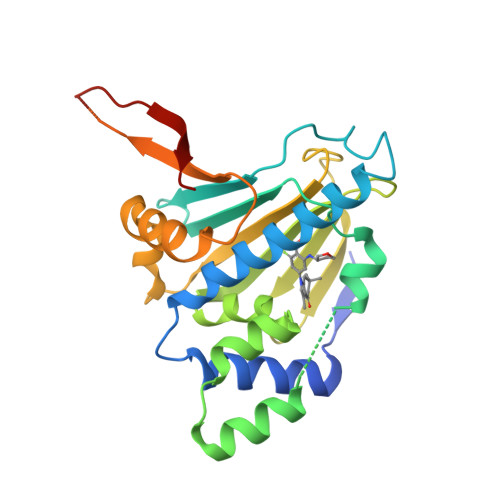
Adenosine kinase structureClick to view 3D structureAdenosine kinaseP55263HumansPredicted (SEA)
Prediction Confidence Score
0.693
Applicability Domain
1.0
Statistical Significance
1.00e-05
Supporting Reference Compounds
22
E-value
0.0778492
Click to view 3D structureAdenosine kinaseP9WID4Mycobacterium tuberculosis (strain CDC 1551 / Oshkosh)Predicted (SEA)
Prediction Confidence Score
0.655
Applicability Domain
0.68
Statistical Significance
2.00e-05
Supporting Reference Compounds
2
E-value
0.155698
Click to view 3D structureAdenosine kinaseA5U4N0Mycobacterium tuberculosis (strain ATCC 25177 / H37Ra)Predicted (SEA)
Prediction Confidence Score
0.608
Applicability Domain
0.608
Statistical Significance
8.00e-05
Supporting Reference Compounds
1
E-value
0.622794
Click to view 3D structureNS5A0A143MHK7Zika virusPredicted (SEA)
Prediction Confidence Score
0.548
Applicability Domain
1.0
Statistical Significance
1.00e-05
Supporting Reference Compounds
10
E-value
0.0778492
Click to view 3D structureAdenosine receptor A1P25099Rattus norvegicusPredicted (SEA)
Prediction Confidence Score
0.544
Applicability Domain
0.646
Statistical Significance
0.0019
Supporting Reference Compounds
221
E-value
15.0249
Click to view 3D structureAdenosine receptor A2aP30543Rattus norvegicusPredicted (SEA)
Prediction Confidence Score
0.541
Applicability Domain
0.646
Statistical Significance
0.0018
Supporting Reference Compounds
174
E-value
13.8572
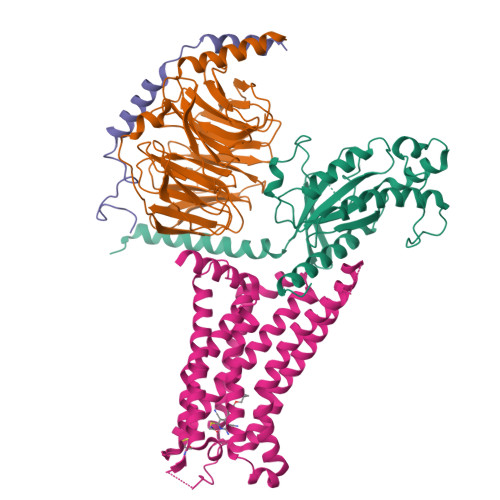
Adenosine receptor A3 structureClick to view 3D structureAdenosine receptor A3P0DMS8HumansPredicted (SEA)
Prediction Confidence Score
0.535
Applicability Domain
0.646
Statistical Significance
0.0027
Supporting Reference Compounds
391
E-value
21.0193
Click to view 3D structureAdenosine receptor A3P28647Rattus norvegicusPredicted (SEA)
Prediction Confidence Score
0.535
Applicability Domain
0.646
Statistical Significance
0.0013
Supporting Reference Compounds
71
E-value
10.1982
Heat shock protein HSP 90-alpha structureClick to view 3D structureHeat shock protein HSP 90-alphaP07900HumansPredicted (SEA)
Prediction Confidence Score
0.533
Applicability Domain
0.646
Statistical Significance
5.90e-04
Supporting Reference Compounds
109
E-value
4.5931
Endoplasmin structureClick to view 3D structureEndoplasminP14625HumansPredicted (SEA)
Prediction Confidence Score
0.533
Applicability Domain
0.646
Statistical Significance
4.20e-04
Supporting Reference Compounds
31
E-value
3.26967
Adenosine receptor A2a structureClick to view 3D structureAdenosine receptor A2aP29274HumansPredicted (SEA)
Prediction Confidence Score
0.512
Applicability Domain
0.646
Statistical Significance
0.0031
Supporting Reference Compounds
303
E-value
24.289
Adenosine receptor A1 structureClick to view 3D structureAdenosine receptor A1P30542HumansPredicted (SEA)
Prediction Confidence Score
0.506
Applicability Domain
0.646
Statistical Significance
0.0031
Supporting Reference Compounds
302
E-value
23.8219
Adenosine kinase structureClick to view 3D structureAdenosine kinaseP9WID5Mycobacterium tuberculosis (strain ATCC 25618 / H37Rv)Predicted (SEA)
Prediction Confidence Score
0.504
Applicability Domain
0.608
Statistical Significance
5.00e-05
Supporting Reference Compounds
4
E-value
0.389246
Click to view 3D structureAdenosine receptor A1P47745Cavia porcellusPredicted (SEA)
Prediction Confidence Score
0.484
Applicability Domain
0.646
Statistical Significance
8.40e-04
Supporting Reference Compounds
38
E-value
6.53933
Histone-lysine N-methyltransferase, H3 lysine-79 specific structureClick to view 3D structureHistone-lysine N-methyltransferase, H3 lysine-79 specificQ8TEK3HumansPredicted (SEA)
Prediction Confidence Score
0.476
Applicability Domain
0.608
Statistical Significance
5.00e-04
Supporting Reference Compounds
18
E-value
3.89246
Adenosine receptor A2b structureClick to view 3D structureAdenosine receptor A2bP29275HumansPredicted (SEA)
Prediction Confidence Score
0.47
Applicability Domain
0.646
Statistical Significance
0.0033
Supporting Reference Compounds
187
E-value
25.7681
High affinity choline transporter 1 structureClick to view 3D structureHigh affinity choline transporter 1Q9GZV3HumansPredicted (SEA)
Prediction Confidence Score
0.459
Applicability Domain
0.646
Statistical Significance
3.90e-04
Supporting Reference Compounds
75
E-value
3.03612
Solute carrier family 28 member 3 structureClick to view 3D structureSolute carrier family 28 member 3Q9HAS3HumansPredicted (SEA)
Prediction Confidence Score
0.453
Applicability Domain
0.646
Statistical Significance
2.00e-05
Supporting Reference Compounds
3
E-value
0.155698
Adenosine deaminase structureClick to view 3D structureAdenosine deaminaseP56658Bos taurusPredicted (SEA)
Prediction Confidence Score
0.451
Applicability Domain
0.509
Statistical Significance
3.70e-04
Supporting Reference Compounds
17
E-value
2.88042
Click to view 3D structureS-methyl-5'-thioadenosine phosphorylaseQ9CQ65Mus musculusPredicted (SEA)
Prediction Confidence Score
0.45
Applicability Domain
0.45
Statistical Significance
5.70e-04
Supporting Reference Compounds
1
E-value
4.43741
Click to view 3D structureAdenosine receptor A1P49892Gallus gallusPredicted (SEA)
Prediction Confidence Score
0.449
Applicability Domain
0.475
Statistical Significance
7.60e-04
Supporting Reference Compounds
6
E-value
5.91654
Click to view 3D structureAdenosine receptor A1P28190Bos taurusPredicted (SEA)
Prediction Confidence Score
0.446
Applicability Domain
0.491
Statistical Significance
0.002
Supporting Reference Compounds
72
E-value
15.6477
Click to view 3D structureNAD kinaseQ5HH78Staphylococcus aureus (strain COL)Predicted (SEA)
Prediction Confidence Score
0.443
Applicability Domain
0.443
Statistical Significance
3.80e-04
Supporting Reference Compounds
1
E-value
2.95827
NAD kinase 1 structureClick to view 3D structureNAD kinase 1Q8Y8D7Listeria monocytogenes serovar 1/2a (strain ATCC BAA-679 / EGD-e)Predicted (SEA)
Prediction Confidence Score
0.443
Applicability Domain
0.443
Statistical Significance
3.80e-04
Supporting Reference Compounds
1
E-value
2.95827
Adenosine kinase structureClick to view 3D structureAdenosine kinaseQ9TVW2Toxoplasma gondiiPredicted (SEA)
Prediction Confidence Score
0.442
Applicability Domain
0.646
Statistical Significance
3.60e-04
Supporting Reference Compounds
5
E-value
2.80257
Concentrations
Not Available
External Links
DrugBank IDDB03172
HMDB IDNot Available
FooDB IDNot Available
Phenol Explorer IDNot Available
KNApSAcK IDNot Available
BiGG IDNot Available
BioCyc IDCPD-13054
METLIN IDNot Available
PDB IDNot Available
Wikipedia LinkNot Available
Chemspider IDNot Available
ChEBI ID48267
PubChem Compound ID6245
Kegg Compound IDNot Available
YMDB IDNot Available
ECMDB IDNot Available
References
Synthesis ReferenceNot Available
MSDSNot Available
General ReferencesNot Available