Beta-Asarone (CED0006684)

Record Information
Version1.0
Creation Date2026-04-03 04:48:50 UTC
Update Date2026-05-20 21:28:59 UTC
SynCED IDCED0006684
Secondary Accession Numbers
  • CHEM061408
Identification
Common NameBeta-Asarone
ClassSmall Molecule
Description
Beta-Asarone is an organic compound with the formula C12H16O3 and an average molecular weight of 208.26 g/mol. Beta-Asarone belongs to the anisoles, a subclass of phenol ethers within the organic compounds. This compound is found in or released from 14 recorded sources across multiple sectors. Within electrical and electronic equipment, it is associated with batteries, capacitors, cell phones, printed circuit boards, wires and cables, and one additional source. In the food, food processing and cookware sector, it is found in food packaging and the preparation of vinegar. Its presence is also recorded in textiles, leather and furnishings, specifically in carpets, rugs, and synthetic textiles. Additionally, it is found in medical devices within the healthcare, pharmaceuticals and veterinary products sector. In the energy, oil and gas sector as well as industrial manufacturing and chemical processing, it is associated with lubricants. One other sector is also recorded as a source. Recorded exposure routes for Beta-Asarone include oral, inhalation, and touch.
Contaminant Type
  • PFAS
  • Phytotoxin
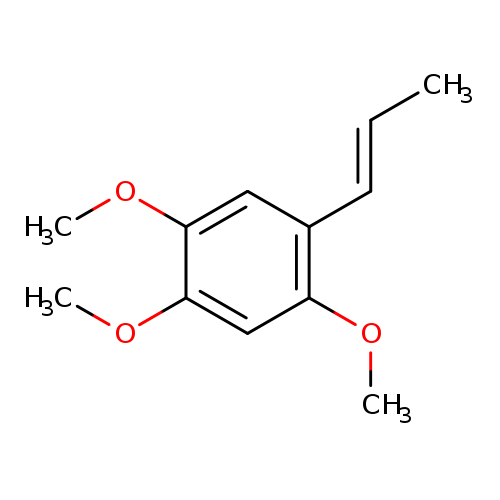
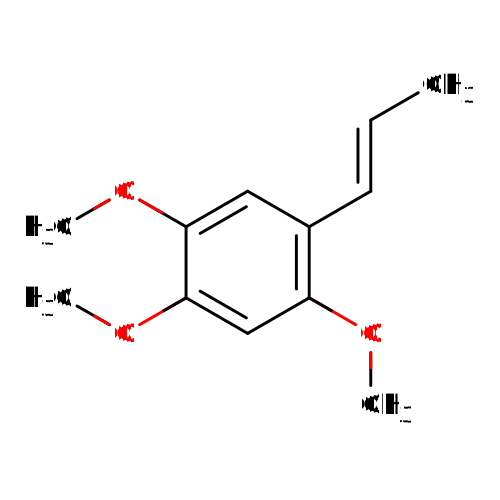
Chemical Structure
Synonyms
ValueSource
AsaroneChEBI
trans-1,2,4-Trimethoxy-5-(1-propenyl)benzeneChEBI
trans-IsoasaronChEBI
Asarone, (e)-isomerMeSH
Asarone, (Z)-isomerMeSH
cis-IsoelemicinMeSH
gamma-AsaroneMeSH
(e)-AsaroneMeSH
(Z)-AsaroneMeSH
IsoasaroneMeSH
2,4,5-Trimethoxypropen-1-ylbenzeneMeSH
beta-AsaroneMeSH
cis-beta-AsaroneMeSH
cis-IsoasaroneMeSH
trans-AsaroneMeSH
trans-IsoasaroneChEBI
a-AsaronGenerator, HMDB
α-asaronGenerator, HMDB
(e)-2,4,5-TrimethoxypropenylbenzeneHMDB
1,2,4-Trimethoxy-5-(1-propenyl)-(e)-benzeneHMDB
1,2,4-Trimethoxy-5-propenyl-(e)-benzeneHMDB
1,2,4-Trimethoxy-5-propenyl-trans-benzeneHMDB
1,2,4-Trimethoxy-5-[(1E)-1-propenyl]benzeneHMDB
alpha-AsaroneHMDB
Isoasaron (6ci)HMDB
trans-(alpha )-AsaroneHMDB
trans-2,4,5-TrimethoxypropenylbenzeneHMDB
a-AsaroneGenerator
Α-asaroneGenerator
Chemical FormulaC12H16O3
Average Molecular Mass208.257 g/mol
Monoisotopic Mass208.110 g/mol
CAS Registry Number5273-86-9
IUPAC Name1,2,4-trimethoxy-5-[(1E)-prop-1-en-1-yl]benzene
Traditional Nameasarone
SMILESCOC1=CC(OC)=C(OC)C=C1\C=C/C
InChI IdentifierInChI=1S/C12H16O3/c1-5-6-9-7-11(14-3)12(15-4)8-10(9)13-2/h5-8H,1-4H3/b6-5-
InChI KeyRKFAZBXYICVSKP-WAYWQWQTSA-N
Chemical Taxonomy
Description Belongs to the class of organic compounds known as anisoles. These are organic compounds containing a methoxybenzene or a derivative thereof.
KingdomOrganic compounds
Super ClassBenzenoids
ClassPhenol ethers
Sub ClassAnisoles
Direct ParentAnisoles
Alternative Parents
Substituents
  • Phenoxy compound
  • Methoxybenzene
  • Styrene
  • Anisole
  • Alkyl aryl ether
  • Monocyclic benzene moiety
  • Ether
  • Organic oxygen compound
  • Hydrocarbon derivative
  • Organooxygen compound
  • Aromatic homomonocyclic compound
Molecular FrameworkAromatic homomonocyclic compounds
External Descriptors
Biological Properties
StatusDetected and Not Quantified
OriginNot Available
Cellular LocationsNot Available
Biofluid LocationsNot Available
Tissue LocationsNot Available
ApplicationsNot Available
Biological RolesNot Available
Chemical RolesNot Available
Organoleptic EffectsNot Available
Physical Properties
StateNot Available
AppearanceNot Available
Experimental Properties
PropertyValue
Melting PointNot Available
Boiling PointNot Available
SolubilityNot Available
Predicted Properties
PropertyValueSource
Water Solubility0.35 g/LALOGPS
logP3.35ALOGPS
logP2.62ChemAxon
logS-2.8ALOGPS
pKa (Strongest Basic)-4.4ChemAxon
Physiological Charge0ChemAxon
Hydrogen Acceptor Count3ChemAxon
Hydrogen Donor Count0ChemAxon
Polar Surface Area27.69 ŲChemAxon
Rotatable Bond Count4ChemAxon
Refractivity60.81 m³·mol⁻¹ChemAxon
Polarizability23.24 ųChemAxon
Number of Rings1ChemAxon
BioavailabilityYesChemAxon
Rule of FiveYesChemAxon
Ghose FilterYesChemAxon
Veber's RuleYesChemAxon
MDDR-like RuleNoChemAxon
Spectra
SpectraNot Available
Toxicity Profile
Toxicity Values
Toxicity ValueOrganismDose DescriptorRoute of ExposurePredicted or ExperimentalToxicity RatingReference
1328.0 Log mg/kg [750:2400]RatLD50oralpredictedNot AvailableNot Available
Toxicity / Toxin ClassNot Available
Mechanism of ToxicityNot Available
Carcinogenicity (IARC Classification)Not Available
Minimum Risk LevelNot Available
SymptomsNot Available
TreatmentNot Available
Health Effects
Health EffectRelationshipDirectionReference
Exposure Sources
Source IDSourceSectorReference
CEDs000007Pesticides?Pesticides are synthetic chemicals designed to prevent, destroy, or control pests that threaten crops and agricultural productivity.Agriculture & land managementNot Available
CEDs000010Insecticides?Insecticides are synthetic chemicals designed to control or eliminate insect pests that threaten crops and other agricultural products.Agriculture & land managementNot Available
CEDs000120Wires and cables?Wires and cables are integral components in the transmission of electrical power and signals.Electrical & Electronic EquipmentNot Available
CEDs000121Printed circuit boards?Printed circuit boards (PCBs) are essential components in the manufacturing of electronic devices, serving as the backbone for electrical connections and circuit pathways.Electrical & Electronic EquipmentNot Available
CEDs000125Batteries?Batteries are devices that store and release electrical energy through electrochemical reactions.Electrical & Electronic EquipmentNot Available
CEDs000130Semiconductors?Semiconductors are materials that possess electrical conductivity between that of conductors and insulators, making them essential for various electronic applications, including transistors, diodes, and integrated circuits.Electrical & Electronic EquipmentNot Available
CEDs000138Lubricants?Lubricants are synthetic or petroleum-derived substances used to reduce friction between surfaces in machinery and equipment, enhancing operational efficiency and longevity.Energy, oil & gasNot Available
CEDs000147Food packaging?Food packaging often utilizes synthetic chemicals, such as plastics and coatings, to enhance durability, moisture resistance, and shelf life.Food, food processing & cookwareNot Available
CEDs000174Lubricants?Lubricants are synthetic or petroleum-based substances used to reduce friction and wear between moving parts in machinery and equipment.Industrial manufacturing & chemical processingNot Available
CEDs000234Medical devices?Medical devices often incorporate synthetic chemicals in their manufacturing processes, which can contribute to contamination in healthcare settings.Healthcare, pharmaceuticals & veterinary productsNot Available
CEDs000451Carpets and Rugs?Carpets and rugs are commonly manufactured using synthetic fibers such as nylon, polyester, and polypropylene, which can be derived from petrochemical sources.Textiles, leather & furnishingsNot Available
CEDs000454Synthetic textiles?Synthetic textiles are materials derived from man-made fibers, such as polyester, nylon, and acrylic, which are produced through chemical processes involving petrochemicals.Textiles, leather & furnishingsNot Available
CEDs000490Personal care & cosmeticsNot Available
CEDs000492Cell phones?Cell phones contain a variety of synthetic chemicals and materials, including plastics, metals, and glass, which can contribute to environmental contamination.Electrical & Electronic EquipmentNot Available
CEDs000493Capacitors?Capacitors are electronic components that store and release electrical energy, often using dielectric materials that can include synthetic chemicals.Electrical & Electronic EquipmentNot Available
CEDs000519Electrodes?Electrodes, used in various electrical and electronic applications, can be a source of synthetic chemical contamination due to the materials from which they are constructed and the processes involved in their manufacturing.Electrical & Electronic EquipmentNot Available
CEDs000545Food Preservation?Food preservation often involves the use of synthetic chemicals, such as preservatives, flavor enhancers, and color additives, to extend shelf life and enhance the sensory qualities of food products.Food, food processing & cookwareNot Available
CEDs000548Preparation Of Vinegar?Vinegar is produced through the fermentation of ethanol by acetic acid bacteria, resulting in a solution that typically contains 4-8% acetic acid.Food, food processing & cookwareNot Available
CEDs000561Perfumes Within Detergents And Soaps?Perfumes within detergents and soaps are synthetic fragrance compounds added to enhance the sensory experience of cleaning products.Household cleaning & consumer productsNot Available
CEDs000580Manufacture Preparation Of Tobacco Products?The manufacture and preparation of tobacco products involve various processes that can result in the introduction of synthetic chemicals into the environment.Industrial manufacturing & chemical processingNot Available
CEDs000611Anti Perspirants Or Body Deoderants?Antiperspirants and body deodorants commonly contain synthetic chemicals such as aluminum compounds, parabens, and synthetic fragrances.Personal care & cosmeticsNot Available
CEDs000614Essential Oils Or Perfumes?Essential oils and perfumes are complex mixtures of volatile compounds derived from natural or synthetic sources, commonly used for their aromatic properties.Personal care & cosmeticsNot Available
CEDs000618Lip Makeup Products?Lip makeup products, such as lipsticks, lip glosses, and lip liners, often contain a variety of synthetic chemicals, including pigments, preservatives, and emollients.Personal care & cosmeticsNot Available
CEDs000632Apparel?Apparel production often involves the use of various synthetic chemicals, including dyes, finishing agents, and preservatives.Textiles, leather & furnishingsNot Available
CEDs000678Nitrogenous Fertilisers?Nitrogenous fertilizers are synthetic chemical compounds primarily used to enhance plant growth by supplying essential nitrogen, a crucial nutrient for photosynthesis and protein synthesis.Agriculture & land managementNot Available
CEDs000679Phosphatic Fertilisers?Phosphatic fertilizers are synthetic chemical products primarily composed of phosphorus, which is essential for plant growth.Agriculture & land managementNot Available
CEDs000685Ceramics?Ceramics can be a source of synthetic chemical contamination through various additives and processing agents used in their production.Building & ConstructionNot Available
Pathways
0 pathwaysPathway Source: PathBank

No pathways found

No metabolic pathways have been associated with this synthetic chemical

Targets
StructureProteinUniProt IDOrganismRelationshipDetails
Cytochrome P450 1A1 structureClick to view 3D structureCytochrome P450 1A1P04798HumansPredicted (SEA)
Prediction Confidence Score
0.338
Applicability Domain
0.371
Statistical Significance
0.0035
Supporting Reference Compounds
77
E-value
27.1694
Cytochrome P450 1B1 structureClick to view 3D structureCytochrome P450 1B1Q16678HumansPredicted (SEA)
Prediction Confidence Score
0.322
Applicability Domain
0.371
Statistical Significance
0.0054
Supporting Reference Compounds
88
E-value
41.8829
Nuclear factor erythroid 2-related factor 2 structureClick to view 3D structureNuclear factor erythroid 2-related factor 2Q16236HumansPredicted (SEA)
Prediction Confidence Score
0.32
Applicability Domain
0.371
Statistical Significance
0.0017
Supporting Reference Compounds
19
E-value
12.923
Transcription factor EB structureClick to view 3D structureTranscription factor EBP19484HumansPredicted (SEA)
Prediction Confidence Score
0.306
Applicability Domain
0.306
Statistical Significance
0.0011
Supporting Reference Compounds
1
E-value
8.64126
Cytochrome P450 1A2 structureClick to view 3D structureCytochrome P450 1A2P05177HumansPredicted (SEA)
Prediction Confidence Score
0.297
Applicability Domain
0.371
Statistical Significance
0.0783
Supporting Reference Compounds
793
E-value
609.715
Polyunsaturated fatty acid 5-lipoxygenase structureClick to view 3D structurePolyunsaturated fatty acid 5-lipoxygenaseP09917HumansPredicted (SEA)
Prediction Confidence Score
0.291
Applicability Domain
0.37
Statistical Significance
0.0161
Supporting Reference Compounds
182
E-value
125.493
Prostaglandin G/H synthase 1 structureClick to view 3D structureProstaglandin G/H synthase 1P23219HumansPredicted (SEA)
Prediction Confidence Score
0.288
Applicability Domain
0.343
Statistical Significance
0.014
Supporting Reference Compounds
136
E-value
109.3
Broad substrate specificity ATP-binding cassette transporter ABCG2 structureClick to view 3D structureBroad substrate specificity ATP-binding cassette transporter ABCG2Q9UNQ0HumansPredicted (SEA)
Prediction Confidence Score
0.286
Applicability Domain
0.343
Statistical Significance
0.0252
Supporting Reference Compounds
126
E-value
195.946
Carbonic anhydrase 9 structureClick to view 3D structureCarbonic anhydrase 9Q16790HumansPredicted (SEA)
Prediction Confidence Score
0.282
Applicability Domain
0.308
Statistical Significance
0.0551
Supporting Reference Compounds
372
E-value
428.794
Carbonic anhydrase 2 structureClick to view 3D structureCarbonic anhydrase 2P00918HumansPredicted (SEA)
Prediction Confidence Score
0.282
Applicability Domain
0.308
Statistical Significance
0.0715
Supporting Reference Compounds
472
E-value
556.778
Carbonic anhydrase 7 structureClick to view 3D structureCarbonic anhydrase 7P43166HumansPredicted (SEA)
Prediction Confidence Score
0.282
Applicability Domain
0.308
Statistical Significance
0.0319
Supporting Reference Compounds
242
E-value
248.028
Carbonic anhydrase 12 structureClick to view 3D structureCarbonic anhydrase 12O43570HumansPredicted (SEA)
Prediction Confidence Score
0.282
Applicability Domain
0.308
Statistical Significance
0.0492
Supporting Reference Compounds
332
E-value
383.018
Carbonic anhydrase 14 structureClick to view 3D structureCarbonic anhydrase 14Q9ULX7HumansPredicted (SEA)
Prediction Confidence Score
0.278
Applicability Domain
0.308
Statistical Significance
0.0274
Supporting Reference Compounds
172
E-value
213.618
Prostaglandin G/H synthase 1 structureClick to view 3D structureProstaglandin G/H synthase 1P05979Ovis ariesPredicted (SEA)
Prediction Confidence Score
0.276
Applicability Domain
0.37
Statistical Significance
0.0149
Supporting Reference Compounds
106
E-value
115.762
Carbonic anhydrase 1 structureClick to view 3D structureCarbonic anhydrase 1P00915HumansPredicted (SEA)
Prediction Confidence Score
0.27
Applicability Domain
0.294 Low confidence
Statistical Significance
0.0791
Supporting Reference Compounds
407
E-value
615.865
Click to view 3D structureTransient receptor potential cation channel subfamily A member 1Q6RI86Rattus norvegicusPredicted (SEA)
Prediction Confidence Score
0.266
Applicability Domain
0.324
Statistical Significance
0.005
Supporting Reference Compounds
56
E-value
39.0803
Transient receptor potential cation channel subfamily V member 1 structureClick to view 3D structureTransient receptor potential cation channel subfamily V member 1Q8NER1HumansPredicted (SEA)
Prediction Confidence Score
0.266
Applicability Domain
0.324
Statistical Significance
0.0263
Supporting Reference Compounds
104
E-value
204.977
Amine oxidase [flavin-containing] B structureClick to view 3D structureAmine oxidase [flavin-containing] BP27338HumansPredicted (SEA)
Prediction Confidence Score
0.264
Applicability Domain
0.275 Low confidence
Statistical Significance
0.0878
Supporting Reference Compounds
315
E-value
683.828
Prostaglandin G/H synthase 2 structureClick to view 3D structureProstaglandin G/H synthase 2P35354HumansPredicted (SEA)
Prediction Confidence Score
0.264
Applicability Domain
0.3
Statistical Significance
0.0517
Supporting Reference Compounds
201
E-value
402.325
5-hydroxytryptamine receptor 2C structureClick to view 3D structure5-hydroxytryptamine receptor 2CP08909RatPredicted (SEA)
Prediction Confidence Score
0.26
Applicability Domain
0.324
Statistical Significance
0.0656
Supporting Reference Compounds
185
E-value
510.613
Click to view 3D structure5-hydroxytryptamine receptor 2BP30994Rattus norvegicusPredicted (SEA)
Prediction Confidence Score
0.257
Applicability Domain
0.324
Statistical Significance
0.0105
Supporting Reference Compounds
40
E-value
81.8195
5-hydroxytryptamine receptor 2A structureClick to view 3D structure5-hydroxytryptamine receptor 2AP14842Rattus norvegicusPredicted (SEA)
Prediction Confidence Score
0.257
Applicability Domain
0.324
Statistical Significance
0.1128
Supporting Reference Compounds
380
E-value
878.528
Amyloid-beta precursor protein structureClick to view 3D structureAmyloid-beta precursor proteinP05067HumansPredicted (SEA)
Prediction Confidence Score
0.257
Applicability Domain
0.271 Low confidence
Statistical Significance
0.0331
Supporting Reference Compounds
109
E-value
257.759
ATP-dependent translocase ABCB1 structureClick to view 3D structureATP-dependent translocase ABCB1P08183HumansPredicted (SEA)
Prediction Confidence Score
0.257
Applicability Domain
0.282 Low confidence
Statistical Significance
0.0758
Supporting Reference Compounds
139
E-value
590.331
Epidermal growth factor receptor structureClick to view 3D structureEpidermal growth factor receptorP00533HumansPredicted (SEA)
Prediction Confidence Score
0.257
Applicability Domain
0.282 Low confidence
Statistical Significance
0.3553
Supporting Reference Compounds
1301
E-value
2766.29
Concentrations
Not Available
External Links
DrugBank IDNot Available
HMDB IDHMDB0031469
FooDB IDFDB008006
Phenol Explorer IDNot Available
KNApSAcK IDC00042219
BiGG IDNot Available
BioCyc IDNot Available
METLIN IDNot Available
PDB IDNot Available
Wikipedia LinkAsarone
Chemspider ID552532
ChEBI ID78309
PubChem Compound ID636822
Kegg Compound IDC17846
YMDB IDNot Available
ECMDB IDNot Available
References
Synthesis ReferenceNot Available
MSDSNot Available
General ReferencesNot Available