(4E)-4-Octene (CED0133987)

Record Information
Version1.0
Creation Date2026-04-05 21:02:25 UTC
Update Date2026-04-05 21:02:25 UTC
SynCED IDCED0133987
Secondary Accession Numbers
  • CHEM109433
Identification
Common Name(4E)-4-Octene
ClassSmall Molecule
Description
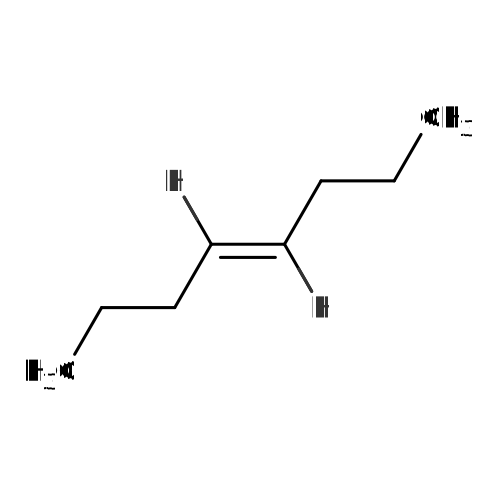
(4E)-4-Octene is an organic compound with the formula C8H16 and an average molecular weight of 112.22 g/mol. (4E)-4-Octene belongs to the unsaturated aliphatic hydrocarbons, a subclass of unsaturated hydrocarbons within the organic compounds. This substance has been found in or released from two recorded sources, specifically antennas and line transmission systems within electrical and electronic equipment.
Contaminant TypeNot Available
Chemical Structure
SynonymsNot Available
Chemical FormulaC8H16
Average Molecular Mass112.216 g/mol
Monoisotopic Mass112.125 g/mol
CAS Registry Number14850-23-8
IUPAC NameNot Available
Traditional NameNot Available
SMILESCCC\C=C\CCC
InChI IdentifierInChI=1S/C8H16/c1-3-5-7-8-6-4-2/h7-8H,3-6H2,1-2H3/b8-7+
InChI KeyIRUCBBFNLDIMIK-BQYQJAHWSA-N
Chemical Taxonomy
ClassificationNot classified
Biological Properties
StatusDetected and Not Quantified
OriginNot Available
Cellular LocationsNot Available
Biofluid LocationsNot Available
Tissue LocationsNot Available
ApplicationsNot Available
Biological RolesNot Available
Chemical RolesNot Available
Organoleptic EffectsNot Available
Physical Properties
StateNot Available
AppearanceNot Available
Experimental Properties
PropertyValue
Melting PointNot Available
Boiling PointNot Available
SolubilityNot Available
Predicted PropertiesNot Available
Spectra
Spectra
Spectrum TypeDescriptionSplash KeyDeposition DateView
Predicted LC-MS/MSPredicted LC-MS/MS Spectrumsplash10-03di-0900000000-d69e8b708171f20e6f86Not AvailableView Spectrum
Predicted LC-MS/MSPredicted LC-MS/MS Spectrumsplash10-03di-3900000000-061264bbe1301e9b89faNot AvailableView Spectrum
Predicted LC-MS/MSPredicted LC-MS/MS Spectrumsplash10-052f-9000000000-6b7583ee1cb76a67bfb0Not AvailableView Spectrum
Predicted LC-MS/MSPredicted LC-MS/MS Spectrumsplash10-03di-0900000000-fd3878c18da96f448911Not AvailableView Spectrum
Predicted LC-MS/MSPredicted LC-MS/MS Spectrumsplash10-03di-0900000000-f3387e61f76e3b79fae8Not AvailableView Spectrum
Predicted LC-MS/MSPredicted LC-MS/MS Spectrumsplash10-03di-9500000000-0136b61492426a122f6eNot AvailableView Spectrum
Toxicity Profile
Toxicity Values
Toxicity ValueOrganismDose DescriptorRoute of ExposurePredicted or ExperimentalToxicity RatingReference
5672.0 Log mg/kg [3200:10000]RatLD50oralpredictedNot AvailableNot Available
Toxicity / Toxin ClassNot Available
Mechanism of ToxicityNot Available
Carcinogenicity (IARC Classification)Not Available
Minimum Risk LevelNot Available
SymptomsNot Available
TreatmentNot Available
Health Effects
Health EffectRelationshipDirectionDescriptionReference
Exposure Sources
Source IDSourceSectorReference
CEDs000010Insecticides?Insecticides are synthetic chemicals designed to control or eliminate insect pests that threaten crops and other agricultural products.Agriculture & land managementPubChem
CEDs000506Antennas?Antennas, commonly used in communication technologies, can be a source of synthetic chemical contamination through the materials and coatings used in their construction.Electrical & Electronic EquipmentPubChem
CEDs000511Conductors Or Conductive Bodies Characterised By The Conductive Materials?Conductors, or conductive bodies, are materials that allow the flow of electrical current, typically made from metals such as copper, aluminum, or silver.Electrical & Electronic EquipmentPubChem
CEDs000519Electrodes?Electrodes, used in various electrical and electronic applications, can be a source of synthetic chemical contamination due to the materials from which they are constructed and the processes involved in their manufacturing.Electrical & Electronic EquipmentPubChem
CEDs000521Fixed Capacitors And Their Manufacture?Fixed capacitors are passive electronic components used to store and release electrical energy, playing a critical role in various circuits.Electrical & Electronic EquipmentPubChem
CEDs000525Line Transmission Systems?Line Transmission Systems, commonly used for the distribution of electrical energy, can be a source of synthetic chemical contamination through the insulation materials and coatings utilized in their construction.Electrical & Electronic EquipmentPubChem
CEDs000530Radio Transmission Systems?Radio transmission systems utilize a variety of synthetic chemicals in their manufacturing and maintenance processes.Electrical & Electronic EquipmentPubChem
CEDs000537Television Systems?Television systems can be a source of synthetic chemical contamination due to the various materials and components used in their manufacture and operation.Electrical & Electronic EquipmentPubChem
CEDs000544Fermentation Processes For Beer?Fermentation processes for beer involve the conversion of sugars into alcohol and carbon dioxide by yeast.Food, food processing & cookwarePubChem
CEDs000545Food Preservation?Food preservation often involves the use of synthetic chemicals, such as preservatives, flavor enhancers, and color additives, to extend shelf life and enhance the sensory qualities of food products.Food, food processing & cookwarePubChem
CEDs000555Bleaching Agents?Bleaching agents are chemical substances used to whiten or lighten materials, often employed in various cleaning products for their stain removal and disinfecting properties.Household cleaning & consumer productsPubChem
CEDs000561Perfumes Within Detergents And Soaps?Perfumes within detergents and soaps are synthetic fragrance compounds added to enhance the sensory experience of cleaning products.Household cleaning & consumer productsPubChem
CEDs000563Soap Detergents?Soap detergents are synthetic surfactants designed to enhance the cleaning efficacy of water by reducing surface tension, allowing for better interaction with dirt and grease.Household cleaning & consumer productsPubChem
CEDs000580Manufacture Preparation Of Tobacco Products?The manufacture and preparation of tobacco products involve various processes that can result in the introduction of synthetic chemicals into the environment.Industrial manufacturing & chemical processingPubChem
CEDs000596Acaricides?Acaricides are synthetic chemicals specifically designed to target and control mite populations that can damage crops and plants.Agriculture & land managementPubChem
CEDs000600Herbicides And Algicides?Herbicides and algicides are synthetic chemicals primarily used to control unwanted plants and algae in various environments.Agriculture & land managementPubChem
CEDs000603Nematocides?Nematocides are synthetic chemicals specifically designed to control nematodes, which are microscopic roundworms that can cause significant damage to crops and plants.Agriculture & land managementPubChem
CEDs000614Essential Oils Or Perfumes?Essential oils and perfumes are complex mixtures of volatile compounds derived from natural or synthetic sources, commonly used for their aromatic properties.Personal care & cosmeticsPubChem
CEDs000630Toys?Toys, particularly those made from synthetic materials such as plastics, can be a source of chemical contamination due to the presence of various additives and compounds used in their production.Recreation & sports surfacesPubChem
CEDs000632Apparel?Apparel production often involves the use of various synthetic chemicals, including dyes, finishing agents, and preservatives.Textiles, leather & furnishingsPubChem
CEDs000640Embroidering And Tufting?Embroidering and tufting processes often involve the use of synthetic chemicals such as dyes, adhesives, and finishing agents.Textiles, leather & furnishingsPubChem
CEDs000647Multicolour Dyeing?Multicolour dyeing involves the application of multiple synthetic dyes to textiles and other materials to achieve vibrant, diverse color patterns.Textiles, leather & furnishingsPubChem
CEDs000685Ceramics?Ceramics can be a source of synthetic chemical contamination through various additives and processing agents used in their production.Building & ConstructionPubChem
CEDs000693Silica Glass?Silica glass, primarily composed of silicon dioxide (SiO2), is widely used in various applications, including windows, glass facades, and insulation materials.Building & ConstructionPubChem
CEDs000696Nanotechnology?Nanotechnology involves the manipulation of materials at the molecular or atomic level, typically within the range of 1 to 100 nanometers.Industrial manufacturing & chemical processingPubChem
CEDs000712Combination Pens?Combination pens, which typically contain both ink and additional functionalities such as highlighters or stylus tips, may contribute to synthetic chemical contamination primarily through their ink formulations and plastic components.Paper, pulp & fiber productsPubChem
CEDs000716Erasers?Erasers, commonly used in writing and drawing applications, are often made from synthetic rubber or thermoplastic materials, which can contain various additives such as plasticizers, fillers, and colorants.Paper, pulp & fiber productsPubChem
CEDs000734Coating Compositions?Coating compositions, which include paints, sealants, and varnishes, are formulated with a variety of synthetic chemicals such as solvents, resins, pigments, and additives.Building & ConstructionPubChem
CEDs000735Explosives?Explosives are chemical compounds or mixtures designed to undergo rapid decomposition, releasing energy in the form of gas and heat.Defense & military infrastructurePubChem
CEDs000739Inks?Inks are complex mixtures composed of pigments or dyes, solvents, resins, and additives used primarily for printing and writing applications.Paper, pulp & fiber productsPubChem
CEDs000740Paper?Paper production involves the processing of wood fibers and the use of various chemicals, which can lead to synthetic chemical contamination.Paper, pulp & fiber productsPubChem
CEDs000741Pigment Pastes?Pigment pastes are concentrated dispersions of pigments used to impart color and properties to materials.Paper, pulp & fiber productsPubChem
CEDs000744Water, Wastewater, & Sewage Treatment?Water, wastewater, and sewage treatment processes are critical for managing and mitigating pollutants in water systems.Wastewater, sanitation & biosolidsPubChem
Pathways
0 pathwaysPathway Source: PathBank

No pathways found

No metabolic pathways have been associated with this synthetic chemical

Targets
StructureProteinUniProt IDOrganismRelationshipDetails
Peroxisome proliferator-activated receptor gamma structureClick to view 3D structurePeroxisome proliferator-activated receptor gammaP37231HumansPredicted (SEA)
Prediction Confidence Score
0.302
Applicability Domain
0.32
Statistical Significance
0.0176
Supporting Reference Compounds
192
E-value
136.859
Peroxisome proliferator-activated receptor alpha structureClick to view 3D structurePeroxisome proliferator-activated receptor alphaQ07869HumansPredicted (SEA)
Prediction Confidence Score
0.302
Applicability Domain
0.32
Statistical Significance
0.0133
Supporting Reference Compounds
127
E-value
103.929
Peroxisome proliferator-activated receptor delta structureClick to view 3D structurePeroxisome proliferator-activated receptor deltaQ03181HumansPredicted (SEA)
Prediction Confidence Score
0.302
Applicability Domain
0.32
Statistical Significance
0.0092
Supporting Reference Compounds
89
E-value
72.0105
Seed linoleate 9S-lipoxygenase structureClick to view 3D structureSeed linoleate 9S-lipoxygenaseP24095Glycine maxPredicted (SEA)
Prediction Confidence Score
0.292
Applicability Domain
0.292 Low confidence
Statistical Significance
1.40e-04
Supporting Reference Compounds
1
E-value
1.08989
Transient receptor potential cation channel subfamily V member 2 structureClick to view 3D structureTransient receptor potential cation channel subfamily V member 2Q9WUD2Rattus norvegicusPredicted (SEA)
Prediction Confidence Score
0.284
Applicability Domain
0.32
Statistical Significance
0.0029
Supporting Reference Compounds
21
E-value
22.3427
Click to view 3D structureFatty-acid amide hydrolase 1O00519HumansPredicted (SEA)
Prediction Confidence Score
0.274
Applicability Domain
0.32
Statistical Significance
0.0321
Supporting Reference Compounds
106
E-value
250.13
Click to view 3D structureCannabinoid receptor 1P20272Rattus norvegicusPredicted (SEA)
Prediction Confidence Score
0.266
Applicability Domain
0.32
Statistical Significance
0.0132
Supporting Reference Compounds
83
E-value
102.761
Fatty-acid amide hydrolase 1 structureClick to view 3D structureFatty-acid amide hydrolase 1P97612Rattus norvegicusPredicted (SEA)
Prediction Confidence Score
0.246
Applicability Domain
0.258 Low confidence
Statistical Significance
0.0599
Supporting Reference Compounds
102
E-value
466.706
Click to view 3D structureCannabinoid receptor 1P47746Mus musculusPredicted (SEA)
Prediction Confidence Score
0.244
Applicability Domain
0.286 Low confidence
Statistical Significance
0.0107
Supporting Reference Compounds
42
E-value
83.6879
Cannabinoid receptor 1 structureClick to view 3D structureCannabinoid receptor 1P21554HumansPredicted (SEA)
Prediction Confidence Score
0.237
Applicability Domain
0.25 Low confidence
Statistical Significance
0.158
Supporting Reference Compounds
200
E-value
1229.86
Cannabinoid receptor 2 structureClick to view 3D structureCannabinoid receptor 2P34972HumansPredicted (SEA)
Prediction Confidence Score
0.237
Applicability Domain
0.25 Low confidence
Statistical Significance
0.1457
Supporting Reference Compounds
175
E-value
1134.57
Click to view 3D structureEsteraseA3QR02Chilo suppressalisPredicted (SEA)
Prediction Confidence Score
0.233
Applicability Domain
0.233 Low confidence
Statistical Significance
0.0011
Supporting Reference Compounds
1
E-value
8.40772
Tyrosine-protein phosphatase non-receptor type 1 structureClick to view 3D structureTyrosine-protein phosphatase non-receptor type 1P18031HumansPredicted (SEA)
Prediction Confidence Score
0.232
Applicability Domain
0.32
Statistical Significance
0.1046
Supporting Reference Compounds
197
E-value
814.381
Transient receptor potential cation channel subfamily V member 1 structureClick to view 3D structureTransient receptor potential cation channel subfamily V member 1Q8NER1HumansPredicted (SEA)
Prediction Confidence Score
0.232
Applicability Domain
0.25 Low confidence
Statistical Significance
0.1106
Supporting Reference Compounds
104
E-value
860.857
Click to view 3D structureCannabinoid receptor 2P47936Mus musculusPredicted (SEA)
Prediction Confidence Score
0.229
Applicability Domain
0.235 Low confidence
Statistical Significance
0.0295
Supporting Reference Compounds
39
E-value
229.422
Fatty acid-binding protein, adipocyte structureClick to view 3D structureFatty acid-binding protein, adipocyteP15090HumansPredicted (SEA)
Prediction Confidence Score
0.227
Applicability Domain
0.32
Statistical Significance
0.0103
Supporting Reference Compounds
19
E-value
80.2626
Click to view 3D structureOxoeicosanoid receptor 1Q8TDS5HumansPredicted (SEA)
Prediction Confidence Score
0.224
Applicability Domain
0.286 Low confidence
Statistical Significance
0.0016
Supporting Reference Compounds
4
E-value
12.4559
Click to view 3D structureCannabinoid receptor 2Q9QZN9Rattus norvegicusPredicted (SEA)
Prediction Confidence Score
0.22
Applicability Domain
0.235 Low confidence
Statistical Significance
0.0057
Supporting Reference Compounds
20
E-value
44.1405
All-trans-retinol dehydrogenase [NAD(+)] ADH7 structureClick to view 3D structureAll-trans-retinol dehydrogenase [NAD(+)] ADH7P40394HumansPredicted (SEA)
Prediction Confidence Score
0.217
Applicability Domain
0.217 Low confidence
Statistical Significance
0.0022
Supporting Reference Compounds
1
E-value
17.4382
1-phosphatidylinositol 4,5-bisphosphate phosphodiesterase gamma-1 structureClick to view 3D structure1-phosphatidylinositol 4,5-bisphosphate phosphodiesterase gamma-1P08487Bos taurusPredicted (SEA)
Prediction Confidence Score
0.215
Applicability Domain
0.235 Low confidence
Statistical Significance
0.0069
Supporting Reference Compounds
3
E-value
53.4046
Monoglyceride lipase structureClick to view 3D structureMonoglyceride lipaseQ99685HumansPredicted (SEA)
Prediction Confidence Score
0.211
Applicability Domain
0.258 Low confidence
Statistical Significance
0.1743
Supporting Reference Compounds
76
E-value
1356.68
Click to view 3D structureLysophosphatidic acid receptor 3Q9UBY5HumansPredicted (SEA)
Prediction Confidence Score
0.209
Applicability Domain
0.276 Low confidence
Statistical Significance
0.0243
Supporting Reference Compounds
21
E-value
189.174
Click to view 3D structureFatty-acid amide hydrolase 1O08914Mus musculusPredicted (SEA)
Prediction Confidence Score
0.208
Applicability Domain
0.286 Low confidence
Statistical Significance
0.1329
Supporting Reference Compounds
46
E-value
1034.38
Lysophosphatidic acid receptor 2 structureClick to view 3D structureLysophosphatidic acid receptor 2Q9HBW0HumansPredicted (SEA)
Prediction Confidence Score
0.203
Applicability Domain
0.276 Low confidence
Statistical Significance
0.0309
Supporting Reference Compounds
30
E-value
240.788
Click to view 3D structurePhospholipase BQ9P8P2Cryptococcus neoformansPredicted (SEA)
Prediction Confidence Score
0.2
Applicability Domain
0.2 Low confidence
Statistical Significance
0.0015
Supporting Reference Compounds
1
E-value
11.9109
Concentrations
Not Available
External Links
IdentifiersNot Available
References
Synthesis ReferenceNot Available
MSDSNot Available
General ReferencesNot Available