 Click to view 3D structure Click to view 3D structure | Cannabinoid receptor 1 | P20272 | Rattus norvegicus | Predicted (SEA) | - Prediction Confidence Score
- 0.375
- Applicability Domain
- 0.441
- Statistical Significance
- 0.0028
- Supporting Reference Compounds
- 83
- E-value
- 21.4864
|
| Click to view 3D structure | Lysophosphatidic acid receptor 3 | Q9UBY5 | Humans | Predicted (SEA) | - Prediction Confidence Score
- 0.368
- Applicability Domain
- 0.472
- Statistical Significance
- 4.70e-04
- Supporting Reference Compounds
- 21
- E-value
- 3.65891
|
| Click to view 3D structure | Esterase | A3QR02 | Chilo suppressalis | Predicted (SEA) | - Prediction Confidence Score
- 0.359
- Applicability Domain
- 0.359
- Statistical Significance
- 1.40e-04
- Supporting Reference Compounds
- 1
- E-value
- 1.08989
|
| Click to view 3D structure | Lysophosphatidic acid receptor 4 | Q8BLG2 | Mus musculus | Predicted (SEA) | - Prediction Confidence Score
- 0.354
- Applicability Domain
- 0.354
- Statistical Significance
- 4.00e-04
- Supporting Reference Compounds
- 1
- E-value
- 3.11397
|
 Click to view 3D structure Click to view 3D structure | Lysophosphatidic acid receptor 2 | Q9HBW0 | Humans | Predicted (SEA) | - Prediction Confidence Score
- 0.354
- Applicability Domain
- 0.472
- Statistical Significance
- 4.60e-04
- Supporting Reference Compounds
- 30
- E-value
- 3.58106
|
| Click to view 3D structure | Fatty-acid amide hydrolase 1 | O00519 | Humans | Predicted (SEA) | - Prediction Confidence Score
- 0.353
- Applicability Domain
- 0.441
- Statistical Significance
- 0.0047
- Supporting Reference Compounds
- 106
- E-value
- 36.3556
|
 Click to view 3D structure Click to view 3D structure | Fatty-acid amide hydrolase 1 | P97612 | Rattus norvegicus | Predicted (SEA) | - Prediction Confidence Score
- 0.347
- Applicability Domain
- 0.378
- Statistical Significance
- 0.0034
- Supporting Reference Compounds
- 102
- E-value
- 26.5466
|
 Click to view 3D structure Click to view 3D structure | Lysophosphatidic acid receptor 1 | Q92633 | Humans | Predicted (SEA) | - Prediction Confidence Score
- 0.346
- Applicability Domain
- 0.472
- Statistical Significance
- 6.90e-04
- Supporting Reference Compounds
- 31
- E-value
- 5.3716
|
 Click to view 3D structure Click to view 3D structure | Transient receptor potential cation channel subfamily V member 1 | Q8NER1 | Humans | Predicted (SEA) | - Prediction Confidence Score
- 0.344
- Applicability Domain
- 0.366
- Statistical Significance
- 0.0037
- Supporting Reference Compounds
- 104
- E-value
- 29.1935
|
 Click to view 3D structure Click to view 3D structure | Cannabinoid receptor 1 | P21554 | Humans | Predicted (SEA) | - Prediction Confidence Score
- 0.343
- Applicability Domain
- 0.366
- Statistical Significance
- 0.0068
- Supporting Reference Compounds
- 200
- E-value
- 52.7039
|
 Click to view 3D structure Click to view 3D structure | Cannabinoid receptor 2 | P34972 | Humans | Predicted (SEA) | - Prediction Confidence Score
- 0.338
- Applicability Domain
- 0.366
- Statistical Significance
- 0.0064
- Supporting Reference Compounds
- 175
- E-value
- 50.2127
|
 Click to view 3D structure Click to view 3D structure | Tyrosine-protein phosphatase non-receptor type 1 | P18031 | Humans | Predicted (SEA) | - Prediction Confidence Score
- 0.335
- Applicability Domain
- 0.441
- Statistical Significance
- 0.0044
- Supporting Reference Compounds
- 197
- E-value
- 34.5651
|
 Click to view 3D structure Click to view 3D structure | Fatty acid-binding protein, adipocyte | P15090 | Humans | Predicted (SEA) | - Prediction Confidence Score
- 0.322
- Applicability Domain
- 0.441
- Statistical Significance
- 8.90e-04
- Supporting Reference Compounds
- 19
- E-value
- 6.92858
|
| Click to view 3D structure | Cannabinoid receptor 2 | P47936 | Mus musculus | Predicted (SEA) | - Prediction Confidence Score
- 0.318
- Applicability Domain
- 0.341
- Statistical Significance
- 0.0026
- Supporting Reference Compounds
- 39
- E-value
- 20.3965
|
| Click to view 3D structure | Cannabinoid receptor 1 | P47746 | Mus musculus | Predicted (SEA) | - Prediction Confidence Score
- 0.311
- Applicability Domain
- 0.318
- Statistical Significance
- 0.0024
- Supporting Reference Compounds
- 42
- E-value
- 18.9952
|
| Click to view 3D structure | Cannabinoid receptor 2 | Q9QZN9 | Rattus norvegicus | Predicted (SEA) | - Prediction Confidence Score
- 0.307
- Applicability Domain
- 0.341
- Statistical Significance
- 8.40e-04
- Supporting Reference Compounds
- 20
- E-value
- 6.53933
|
 Click to view 3D structure Click to view 3D structure | Autotaxin | Q13822 | Humans | Predicted (SEA) | - Prediction Confidence Score
- 0.305
- Applicability Domain
- 0.354
- Statistical Significance
- 0.0015
- Supporting Reference Compounds
- 40
- E-value
- 11.9109
|
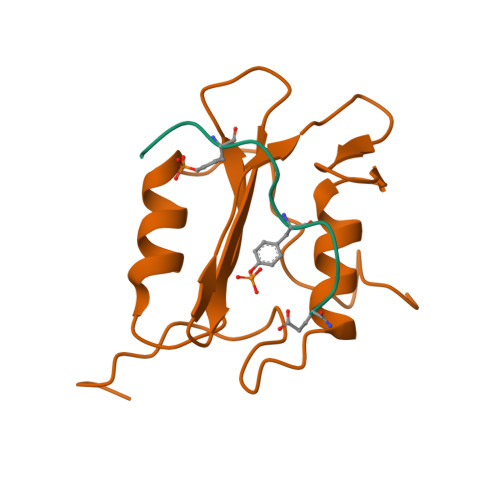 Click to view 3D structure Click to view 3D structure | 1-phosphatidylinositol 4,5-bisphosphate phosphodiesterase gamma-1 | P08487 | Bos taurus | Predicted (SEA) | - Prediction Confidence Score
- 0.305
- Applicability Domain
- 0.313
- Statistical Significance
- 8.00e-04
- Supporting Reference Compounds
- 3
- E-value
- 6.22794
|
 Click to view 3D structure Click to view 3D structure | Free fatty acid receptor 4 | Q5NUL3 | Humans | Predicted (SEA) | - Prediction Confidence Score
- 0.304
- Applicability Domain
- 0.405
- Statistical Significance
- 0.0048
- Supporting Reference Compounds
- 63
- E-value
- 37.679
|
 Click to view 3D structure Click to view 3D structure | Putative P2Y purinoceptor 10 | O00398 | Humans | Predicted (SEA) | - Prediction Confidence Score
- 0.303
- Applicability Domain
- 0.352
- Statistical Significance
- 6.30e-04
- Supporting Reference Compounds
- 10
- E-value
- 4.9045
|
 Click to view 3D structure Click to view 3D structure | Free fatty acid receptor 1 | O14842 | Humans | Predicted (SEA) | - Prediction Confidence Score
- 0.295
- Applicability Domain
- 0.405
- Statistical Significance
- 0.0087
- Supporting Reference Compounds
- 56
- E-value
- 67.4953
|
 Click to view 3D structure Click to view 3D structure | Peroxisome proliferator-activated receptor gamma | P37231 | Humans | Predicted (SEA) | - Prediction Confidence Score
- 0.414
- Applicability Domain
- 0.441
- Statistical Significance
- 0.0027
- Supporting Reference Compounds
- 192
- E-value
- 20.8636
|
 Click to view 3D structure Click to view 3D structure | Peroxisome proliferator-activated receptor alpha | Q07869 | Humans | Predicted (SEA) | - Prediction Confidence Score
- 0.414
- Applicability Domain
- 0.441
- Statistical Significance
- 0.0023
- Supporting Reference Compounds
- 127
- E-value
- 17.9053
|
 Click to view 3D structure Click to view 3D structure | Peroxisome proliferator-activated receptor delta | Q03181 | Humans | Predicted (SEA) | - Prediction Confidence Score
- 0.414
- Applicability Domain
- 0.441
- Statistical Significance
- 0.0016
- Supporting Reference Compounds
- 89
- E-value
- 12.3002
|
 Click to view 3D structure Click to view 3D structure | Transient receptor potential cation channel subfamily V member 2 | Q9WUD2 | Rattus norvegicus | Predicted (SEA) | - Prediction Confidence Score
- 0.393
- Applicability Domain
- 0.441
- Statistical Significance
- 9.50e-04
- Supporting Reference Compounds
- 21
- E-value
- 7.39568
|

