 Click to view 3D structure Click to view 3D structure | Phospholipase B | Q9P8P2 | Cryptococcus neoformans | Predicted (SEA) | - Prediction Confidence Score
- 0.458
- Applicability Domain
- 0.458
- Statistical Significance
- 2.00e-05
- Supporting Reference Compounds
- 1
- E-value
- 0.155698
|
 Click to view 3D structure Click to view 3D structure | Peroxisome proliferator-activated receptor gamma | P37231 | Humans | Predicted (SEA) | - Prediction Confidence Score
- 0.435
- Applicability Domain
- 0.467
- Statistical Significance
- 0.0022
- Supporting Reference Compounds
- 192
- E-value
- 16.8933
|
 Click to view 3D structure Click to view 3D structure | Peroxisome proliferator-activated receptor alpha | Q07869 | Humans | Predicted (SEA) | - Prediction Confidence Score
- 0.435
- Applicability Domain
- 0.467
- Statistical Significance
- 0.0018
- Supporting Reference Compounds
- 127
- E-value
- 14.4021
|
 Click to view 3D structure Click to view 3D structure | Peroxisome proliferator-activated receptor delta | Q03181 | Humans | Predicted (SEA) | - Prediction Confidence Score
- 0.435
- Applicability Domain
- 0.467
- Statistical Significance
- 0.0013
- Supporting Reference Compounds
- 89
- E-value
- 10.1982
|
| Click to view 3D structure | Sodium- and chloride-dependent creatine transporter 1 | P28570 | Rattus norvegicus | Predicted (SEA) | - Prediction Confidence Score
- 0.414
- Applicability Domain
- 0.414
- Statistical Significance
- 2.00e-05
- Supporting Reference Compounds
- 1
- E-value
- 0.155698
|
 Click to view 3D structure Click to view 3D structure | Transient receptor potential cation channel subfamily V member 2 | Q9WUD2 | Rattus norvegicus | Predicted (SEA) | - Prediction Confidence Score
- 0.411
- Applicability Domain
- 0.467
- Statistical Significance
- 8.50e-04
- Supporting Reference Compounds
- 21
- E-value
- 6.61718
|
| Click to view 3D structure | Cannabinoid receptor 1 | P20272 | Rattus norvegicus | Predicted (SEA) | - Prediction Confidence Score
- 0.381
- Applicability Domain
- 0.467
- Statistical Significance
- 0.0026
- Supporting Reference Compounds
- 83
- E-value
- 20.3965
|
| Click to view 3D structure | Fatty-acid amide hydrolase 1 | O00519 | Humans | Predicted (SEA) | - Prediction Confidence Score
- 0.379
- Applicability Domain
- 0.467
- Statistical Significance
- 0.0031
- Supporting Reference Compounds
- 106
- E-value
- 23.9776
|
 Click to view 3D structure Click to view 3D structure | Cannabinoid receptor 1 | P21554 | Humans | Predicted (SEA) | - Prediction Confidence Score
- 0.347
- Applicability Domain
- 0.378
- Statistical Significance
- 0.0062
- Supporting Reference Compounds
- 200
- E-value
- 47.9551
|
 Click to view 3D structure Click to view 3D structure | Tyrosine-protein phosphatase non-receptor type 1 | P18031 | Humans | Predicted (SEA) | - Prediction Confidence Score
- 0.347
- Applicability Domain
- 0.467
- Statistical Significance
- 0.0037
- Supporting Reference Compounds
- 197
- E-value
- 28.5707
|
 Click to view 3D structure Click to view 3D structure | Fatty-acid amide hydrolase 1 | P97612 | Rattus norvegicus | Predicted (SEA) | - Prediction Confidence Score
- 0.344
- Applicability Domain
- 0.351
- Statistical Significance
- 0.0035
- Supporting Reference Compounds
- 102
- E-value
- 27.6365
|
 Click to view 3D structure Click to view 3D structure | Transient receptor potential cation channel subfamily V member 1 | Q8NER1 | Humans | Predicted (SEA) | - Prediction Confidence Score
- 0.342
- Applicability Domain
- 0.378
- Statistical Significance
- 0.0039
- Supporting Reference Compounds
- 104
- E-value
- 30.7504
|
 Click to view 3D structure Click to view 3D structure | Cannabinoid receptor 2 | P34972 | Humans | Predicted (SEA) | - Prediction Confidence Score
- 0.341
- Applicability Domain
- 0.378
- Statistical Significance
- 0.0062
- Supporting Reference Compounds
- 175
- E-value
- 48.3444
|
| Click to view 3D structure | Cannabinoid receptor 1 | P47746 | Mus musculus | Predicted (SEA) | - Prediction Confidence Score
- 0.337
- Applicability Domain
- 0.382
- Statistical Significance
- 0.0018
- Supporting Reference Compounds
- 42
- E-value
- 14.0907
|
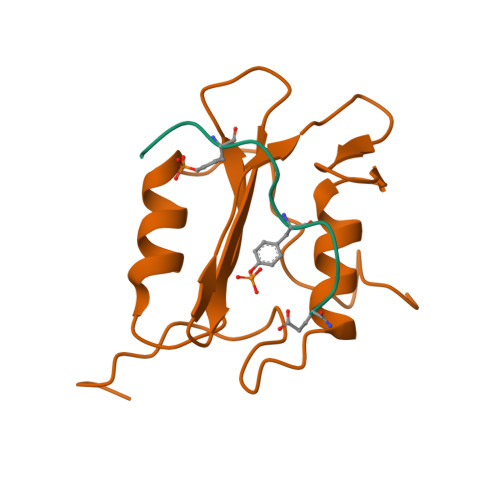 Click to view 3D structure Click to view 3D structure | 1-phosphatidylinositol 4,5-bisphosphate phosphodiesterase gamma-1 | P08487 | Bos taurus | Predicted (SEA) | - Prediction Confidence Score
- 0.332
- Applicability Domain
- 0.359
- Statistical Significance
- 4.10e-04
- Supporting Reference Compounds
- 3
- E-value
- 3.19182
|
| Click to view 3D structure | Streptokinase A | P10520 | Streptococcus pyogenes serotype M1 | Predicted (SEA) | - Prediction Confidence Score
- 0.324
- Applicability Domain
- 0.444
- Statistical Significance
- 0.0101
- Supporting Reference Compounds
- 425
- E-value
- 78.9391
|
 Click to view 3D structure Click to view 3D structure | Fatty acid-binding protein, adipocyte | P15090 | Humans | Predicted (SEA) | - Prediction Confidence Score
- 0.323
- Applicability Domain
- 0.467
- Statistical Significance
- 8.90e-04
- Supporting Reference Compounds
- 19
- E-value
- 6.92858
|
| Click to view 3D structure | Cannabinoid receptor 2 | P47936 | Mus musculus | Predicted (SEA) | - Prediction Confidence Score
- 0.319
- Applicability Domain
- 0.325
- Statistical Significance
- 0.0026
- Supporting Reference Compounds
- 39
- E-value
- 20.3186
|
| Click to view 3D structure | Lysophosphatidic acid receptor 3 | Q9UBY5 | Humans | Predicted (SEA) | - Prediction Confidence Score
- 0.314
- Applicability Domain
- 0.371
- Statistical Significance
- 0.001
- Supporting Reference Compounds
- 21
- E-value
- 7.86277
|
 Click to view 3D structure Click to view 3D structure | Lysophosphatidic acid receptor 2 | Q9HBW0 | Humans | Predicted (SEA) | - Prediction Confidence Score
- 0.311
- Applicability Domain
- 0.371
- Statistical Significance
- 9.30e-04
- Supporting Reference Compounds
- 30
- E-value
- 7.23998
|
| Click to view 3D structure | Cannabinoid receptor 2 | Q9QZN9 | Rattus norvegicus | Predicted (SEA) | - Prediction Confidence Score
- 0.306
- Applicability Domain
- 0.325
- Statistical Significance
- 8.60e-04
- Supporting Reference Compounds
- 20
- E-value
- 6.69503
|
| Click to view 3D structure | Lysophosphatidic acid receptor 4 | Q8BLG2 | Mus musculus | Predicted (SEA) | - Prediction Confidence Score
- 0.304
- Applicability Domain
- 0.304
- Statistical Significance
- 8.20e-04
- Supporting Reference Compounds
- 1
- E-value
- 6.38364
|
 Click to view 3D structure Click to view 3D structure | Monoglyceride lipase | Q99685 | Humans | Predicted (SEA) | - Prediction Confidence Score
- 0.301
- Applicability Domain
- 0.351
- Statistical Significance
- 0.0046
- Supporting Reference Compounds
- 76
- E-value
- 35.8106
|
![All-trans-retinol dehydrogenase [NAD(+)] ADH7 structure](https://cdn.rcsb.org/images/structures/1agn_assembly-1.jpeg) Click to view 3D structure Click to view 3D structure | All-trans-retinol dehydrogenase [NAD(+)] ADH7 | P40394 | Humans | Predicted (SEA) | - Prediction Confidence Score
- 0.3
- Applicability Domain
- 0.3
- Statistical Significance
- 4.30e-04
- Supporting Reference Compounds
- 1
- E-value
- 3.34752
|
| Click to view 3D structure | Esterase | A3QR02 | Chilo suppressalis | Predicted (SEA) | - Prediction Confidence Score
- 0.297
- Applicability Domain
- 0.297 Low confidence
- Statistical Significance
- 4.60e-04
- Supporting Reference Compounds
- 1
- E-value
- 3.58106
|

