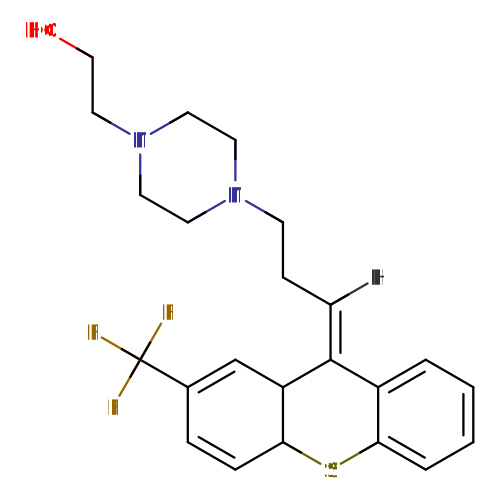
Flupenthixol (CED0006093)

Record Information
Version1.0
Creation Date2009-07-21 20:27:52 UTC
Update Date2026-05-14 16:51:23 UTC
SynCED IDCED0006093
Secondary Accession Numbers
  • CHEM002294
  • T3D2920
Identification
Common NameFlupenthixol
ClassSmall Molecule
Description
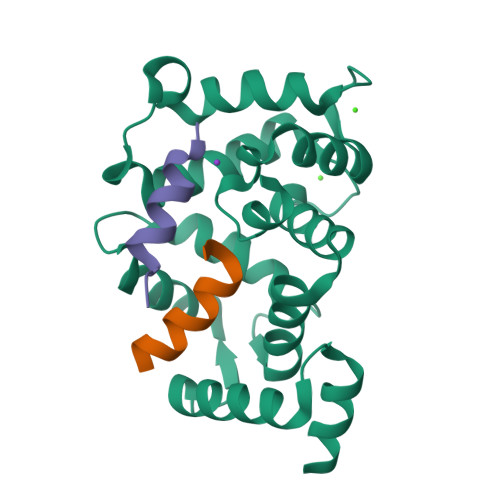
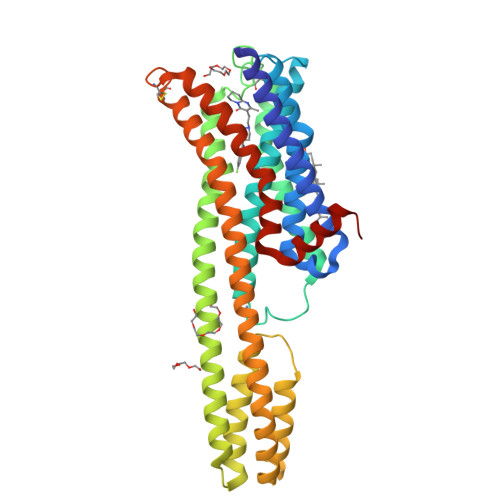
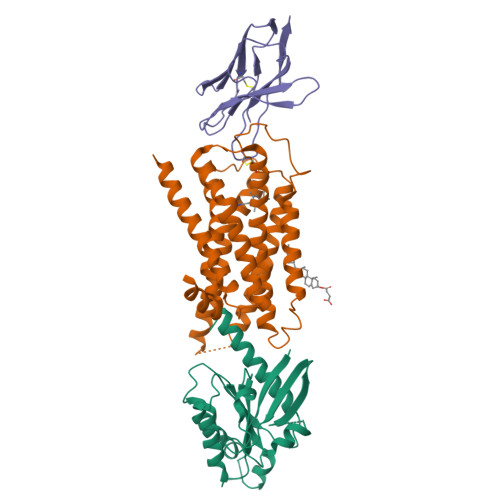
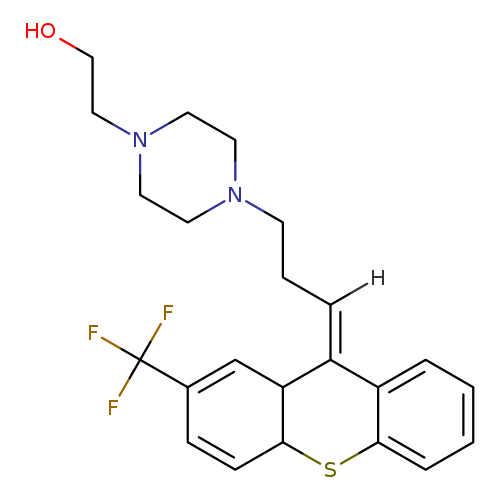
Flupenthixol is an exogenous organic compound with the formula C23H27F3N2OS and an average molecular weight of 436.54 g/mol. It exists as a solid at room temperature. Flupenthixol belongs to the 1-benzothiopyrans, a subclass of benzothiopyrans within the organic compounds. This compound is utilized as a first generation antipsychotic, an antidepressant, and an anxiolytic drug. Biologically, it functions as a dopaminergic antagonist and an alpha-adrenergic antagonist, and it acts as a chemical inhibitor of EC 3.4.21.26 (prolyl oligopeptidase). Its antipsychotic activity is thought to be related to the blocking of postsynaptic dopamine receptors in the central nervous system. Flupenthixol is a powerful antagonist of both D1 and D2 dopamine receptors, as well as an alpha-adrenergic receptor antagonist, although its full mechanism of action is not completely understood. Recorded protein targets include the D(1A) dopamine receptor (DRD1), D(2) dopamine receptor (DRD2), D(3) dopamine receptor (DRD3), Alpha-1A adrenergic receptor (ADRA1A), 5-hydroxytryptamine receptor 2A (HTR2A), Muscarinic acetylcholine receptor M1 (CHRM1), Sigma non-opioid intracellular receptor 1 (SIGMAR1), and ATP-dependent translocase ABCB1, among others. Flupenthixol is found in indoor air (air, dust & atmospheric transport) and in antipsychotics (healthcare, pharmaceuticals & veterinary products). Exposure routes for the compound include oral, intramuscular, and inhalation.
Contaminant Type
  • Amine
  • Antipsychotic Agent
  • Dopamine Antagonist
  • Drug
  • Ether
  • Human Neurotoxin
  • Metabolite
  • Organic Compound
  • Organofluoride
  • Synthetic Compound
  • Thioxanthene
Chemical Structure
SynonymsNot Available
Chemical FormulaC23H27F3N2OS
Average Molecular Mass436.540 g/mol
Monoisotopic Mass436.180 g/mol
CAS Registry Number2709-56-0
IUPAC Name2-(4-{3-[(9E)-2-(trifluoromethyl)-9,9a-dihydro-4aH-thioxanthen-9-ylidene]propyl}piperazin-1-yl)ethan-1-ol
Traditional Name2-(4-{3-[(9E)-2-(trifluoromethyl)-4a,9a-dihydrothioxanthen-9-ylidene]propyl}piperazin-1-yl)ethanol
SMILES[H]\C(CCN1CCN(CCO)CC1)=C1\C2C=C(C=CC2SC2=CC=CC=C12)C(F)(F)F
InChI IdentifierInChI=1S/C23H27F3N2OS/c24-23(25,26)17-7-8-22-20(16-17)18(19-4-1-2-6-21(19)30-22)5-3-9-27-10-12-28(13-11-27)14-15-29/h1-2,4-8,16,20,22,29H,3,9-15H2/b18-5-
InChI KeyDTTVNHWDONBIKE-DVZOWYKESA-N
Chemical Taxonomy
Description Belongs to the class of organic compounds known as thioxanthenes. These are organic polycyclic compounds containing a thioxanthene moiety, which is an aromatic tricycle derived from xanthene by replacing the oxygen atom with a sulfur atom.
KingdomOrganic compounds
Super ClassOrganoheterocyclic compounds
ClassBenzothiopyrans
Sub Class1-benzothiopyrans
Direct ParentThioxanthenes
Alternative Parents
Substituents
  • Thioxanthene
  • Thiochromane
  • Aryl thioether
  • N-alkylpiperazine
  • Alkylarylthioether
  • 1,4-diazinane
  • Piperazine
  • Thiopyran
  • Benzenoid
  • Tertiary aliphatic amine
  • 1,2-aminoalcohol
  • Tertiary amine
  • Azacycle
  • Alkanolamine
  • Thioether
  • Organic oxygen compound
  • Primary alcohol
  • Alcohol
  • Organooxygen compound
  • Organonitrogen compound
  • Organofluoride
  • Organohalogen compound
  • Organic nitrogen compound
  • Amine
  • Alkyl halide
  • Organopnictogen compound
  • Alkyl fluoride
  • Hydrocarbon derivative
  • Aromatic heteropolycyclic compound
Molecular FrameworkAromatic heteropolycyclic compounds
External DescriptorsNot Available
Biological Properties
StatusDetected and Not Quantified
OriginExogenous
Cellular Locations
  • Membrane
Biofluid LocationsNot Available
Tissue LocationsNot Available
Applications
Biological Roles
Chemical Roles
Organoleptic EffectsNot Available
Physical Properties
StateSolid
AppearanceWhite powder.
Experimental Properties
PropertyValue
Melting PointNot Available
Boiling PointNot Available
Solubility0.000346 mg/ml
Predicted Properties
PropertyValueSource
Water Solubility0.003 g/LALOGPS
logP4.12ALOGPS
logP3.54ChemAxon
logS-5.2ALOGPS
pKa (Strongest Acidic)15.59ChemAxon
pKa (Strongest Basic)8.51ChemAxon
Physiological Charge1ChemAxon
Hydrogen Acceptor Count3ChemAxon
Hydrogen Donor Count1ChemAxon
Polar Surface Area26.71 ŲChemAxon
Rotatable Bond Count6ChemAxon
Refractivity120.93 m³·mol⁻¹ChemAxon
Polarizability45.23 ųChemAxon
Number of Rings4ChemAxon
BioavailabilityYesChemAxon
Rule of FiveYesChemAxon
Ghose FilterYesChemAxon
Veber's RuleYesChemAxon
MDDR-like RuleYesChemAxon
Spectra
Spectra
Spectrum TypeDescriptionSplash KeyDeposition DateView
Predicted LC-MS/MSPredicted LC-MS/MS Spectrumsplash10-000i-0201900000-73ec21fa2c7fa423d80cNot AvailableView Spectrum
Predicted LC-MS/MSPredicted LC-MS/MS Spectrumsplash10-0a4i-2937500000-df7eb8e76ec3519db844Not AvailableView Spectrum
Predicted LC-MS/MSPredicted LC-MS/MS Spectrumsplash10-010a-3901000000-9de441d4a43c6d405a24Not AvailableView Spectrum
Predicted LC-MS/MSPredicted LC-MS/MS Spectrumsplash10-000i-0000900000-ac8754cf6336195c2271Not AvailableView Spectrum
Predicted LC-MS/MSPredicted LC-MS/MS Spectrumsplash10-000i-1401900000-bee1aa4336a030e4209aNot AvailableView Spectrum
Predicted LC-MS/MSPredicted LC-MS/MS Spectrumsplash10-0006-9201000000-bbbe4f3d1a218bd24204Not AvailableView Spectrum
Toxicity Profile
Toxicity Values
Toxicity ValueOrganismDose DescriptorRoute of ExposurePredicted or ExperimentalToxicity RatingReference
300.0 mk/kg MouseLD50OralexperimentalNot Available1
791.0 mg/kg RatLD50OralexperimentalNot Available1
87.0 mk/kg MouseLD50IntravenousexperimentalNot Available1
37.0 mg/kg RatLD50IntravenousexperimentalNot Available1
48.0 Log mg/kg [30:85]RatLD50oralpredictedNot AvailableNot Available
Toxicity / Toxin ClassNot Available
Mechanism of ToxicityFlupenthixol is a thioxanthene antipsychotic. The mechanism of action of Flupenthixol is not completely understood. Flupenthixol is a powerful antagonist of both D1 and D2 dopamine receptors, and an alpha-adrenergic receptor antagonist. It's antipsychotic activity is thought to be related to blocks postsynaptic dopamine receptors in the CNS.
Carcinogenicity (IARC Classification)No indication of carcinogenicity to humans (not listed by IARC).
Minimum Risk LevelNot Available
SymptomsNot Available
TreatmentNot Available
Health Effects
Health EffectRelationshipDirectionDescriptionReference
Exposure Sources
Source IDSourceSectorReference
CEDs000019Indoor air?Indoor air can be a significant reservoir for synthetic chemical contaminants, which often originate from various sources within enclosed environments.Air, dust & atmospheric transportNot Available
CEDs000374Antipsychotics?Antipsychotics are a class of synthetic chemicals used primarily for the treatment of psychiatric disorders, including schizophrenia and bipolar disorder.Healthcare, pharmaceuticals & veterinary productsNot Available
CEDs000518Electrically Stimulated Smoking Devices?Electrically stimulated smoking devices, commonly known as e-cigarettes or vape pens, utilize electrical components to heat a liquid solution, often containing nicotine, flavorings, and other additives, to produce an aerosol for inhalation.Electrical & Electronic EquipmentPubChem
CEDs000530Radio Transmission Systems?Radio transmission systems utilize a variety of synthetic chemicals in their manufacturing and maintenance processes.Electrical & Electronic EquipmentPubChem
CEDs000545Food Preservation?Food preservation often involves the use of synthetic chemicals, such as preservatives, flavor enhancers, and color additives, to extend shelf life and enhance the sensory qualities of food products.Food, food processing & cookwarePubChem
CEDs000549Preparation Of Wine Or Sparkling Wine?The preparation of wine or sparkling wine involves various stages, including fermentation, aging, and bottling, which can introduce potential sources of synthetic chemical contamination.Food, food processing & cookwarePubChem
CEDs000559Non Electric Simulated Smoking Devices?Non-electric simulated smoking devices, often designed to mimic the experience of smoking without combustion, can be sources of synthetic chemical contamination due to the materials and chemicals used in their construction and operation.Household cleaning & consumer productsPubChem
CEDs000561Perfumes Within Detergents And Soaps?Perfumes within detergents and soaps are synthetic fragrance compounds added to enhance the sensory experience of cleaning products.Household cleaning & consumer productsPubChem
CEDs000580Manufacture Preparation Of Tobacco Products?The manufacture and preparation of tobacco products involve various processes that can result in the introduction of synthetic chemicals into the environment.Industrial manufacturing & chemical processingPubChem
CEDs000611Anti Perspirants Or Body Deoderants?Antiperspirants and body deodorants commonly contain synthetic chemicals such as aluminum compounds, parabens, and synthetic fragrances.Personal care & cosmeticsPubChem
CEDs000632Apparel?Apparel production often involves the use of various synthetic chemicals, including dyes, finishing agents, and preservatives.Textiles, leather & furnishingsPubChem
CEDs000642Footwear?Footwear production often involves the use of various synthetic chemicals, such as adhesives, dyes, and treatments, which can contribute to environmental contamination.Textiles, leather & furnishingsPubChem
CEDs000671Airplanes And Helicopters?Airplanes and helicopters are significant sources of synthetic chemical contamination primarily through the use of aviation fuels, lubricants, and de-icing agents.Aviation & AerospacePubChem
CEDs000685Ceramics?Ceramics can be a source of synthetic chemical contamination through various additives and processing agents used in their production.Building & ConstructionPubChem
CEDs000696Nanotechnology?Nanotechnology involves the manipulation of materials at the molecular or atomic level, typically within the range of 1 to 100 nanometers.Industrial manufacturing & chemical processingPubChem
CEDs000727Printing Machines Or Presses?Printing machines or presses commonly utilize synthetic chemicals such as inks, solvents, and cleaning agents.Paper, pulp & fiber productsPubChem
CEDs000735Explosives?Explosives are chemical compounds or mixtures designed to undergo rapid decomposition, releasing energy in the form of gas and heat.Defense & military infrastructurePubChem
CEDs000741Pigment Pastes?Pigment pastes are concentrated dispersions of pigments used to impart color and properties to materials.Paper, pulp & fiber productsPubChem
CEDs000744Water, Wastewater, & Sewage Treatment?Water, wastewater, and sewage treatment processes are critical for managing and mitigating pollutants in water systems.Wastewater, sanitation & biosolidsPubChem
Pathways
3 pathwaysPathway Source: PathBank
Targets
StructureProteinUniProt IDOrganismRelationshipDetails
Sigma non-opioid intracellular receptor 1 structureClick to view 3D structureSigma non-opioid intracellular receptor 1Q99720HumansPredicted (SEA)
Prediction Confidence Score
0.368
Applicability Domain
0.478
Statistical Significance
0.0197
Supporting Reference Compounds
562
E-value
153.207
Click to view 3D structureD(1A) dopamine receptorP18901Rattus norvegicusPredicted (SEA)
Prediction Confidence Score
0.332
Applicability Domain
0.478
Statistical Significance
0.0133
Supporting Reference Compounds
206
E-value
103.695
5-hydroxytryptamine receptor 6 structureClick to view 3D structure5-hydroxytryptamine receptor 6P50406HumansPredicted (SEA)
Prediction Confidence Score
0.295
Applicability Domain
0.412
Statistical Significance
0.0508
Supporting Reference Compounds
536
E-value
395.63
Delta-type opioid receptor structureClick to view 3D structureDelta-type opioid receptorP41143HumansPredicted (SEA)
Prediction Confidence Score
0.284
Applicability Domain
0.478
Statistical Significance
0.0757
Supporting Reference Compounds
427
E-value
589.63
Voltage-gated inwardly rectifying potassium channel KCNH2 structureClick to view 3D structureVoltage-gated inwardly rectifying potassium channel KCNH2Q12809HumansPredicted (SEA)
Prediction Confidence Score
0.28
Applicability Domain
0.347
Statistical Significance
0.2692
Supporting Reference Compounds
1498
E-value
2095.78
Click to view 3D structure5-hydroxytryptamine receptor 1AP19327Rattus norvegicusPredicted (SEA)
Prediction Confidence Score
0.274
Applicability Domain
0.347
Statistical Significance
0.0972
Supporting Reference Compounds
541
E-value
756.617
D(2) dopamine receptor structureClick to view 3D structureD(2) dopamine receptorP14416HumansPredicted (SEA)
Prediction Confidence Score
0.273
Applicability Domain
0.347
Statistical Significance
0.1651
Supporting Reference Compounds
1103
E-value
1285.13
5-hydroxytryptamine receptor 7 structureClick to view 3D structure5-hydroxytryptamine receptor 7P34969HumansPredicted (SEA)
Prediction Confidence Score
0.271
Applicability Domain
0.347
Statistical Significance
0.1003
Supporting Reference Compounds
565
E-value
780.516
Alpha-2A adrenergic receptor structureClick to view 3D structureAlpha-2A adrenergic receptorP08913HumansPredicted (SEA)
Prediction Confidence Score
0.268
Applicability Domain
0.347
Statistical Significance
0.0969
Supporting Reference Compounds
487
E-value
754.67
Protein deacetylase HDAC6 structureClick to view 3D structureProtein deacetylase HDAC6Q9UBN7HumansPredicted (SEA)
Prediction Confidence Score
0.264
Applicability Domain
0.412
Statistical Significance
0.1856
Supporting Reference Compounds
553
E-value
1444.57
5-hydroxytryptamine receptor 1A structureClick to view 3D structure5-hydroxytryptamine receptor 1AP08908HumansPredicted (SEA)
Prediction Confidence Score
0.263
Applicability Domain
0.347
Statistical Significance
0.1835
Supporting Reference Compounds
953
E-value
1428.92
5-hydroxytryptamine receptor 2A structureClick to view 3D structure5-hydroxytryptamine receptor 2AP28223HumansPredicted (SEA)
Prediction Confidence Score
0.262
Applicability Domain
0.347
Statistical Significance
0.2117
Supporting Reference Compounds
955
E-value
1648.07
5-hydroxytryptamine receptor 2C structureClick to view 3D structure5-hydroxytryptamine receptor 2CP28335HumansPredicted (SEA)
Prediction Confidence Score
0.261
Applicability Domain
0.347
Statistical Significance
0.1942
Supporting Reference Compounds
823
E-value
1511.6
D(3) dopamine receptor structureClick to view 3D structureD(3) dopamine receptorP35462HumansPredicted (SEA)
Prediction Confidence Score
0.26
Applicability Domain
0.347
Statistical Significance
0.193
Supporting Reference Compounds
861
E-value
1502.65
Pleiotropic ABC efflux transporter of multiple drugs structureClick to view 3D structurePleiotropic ABC efflux transporter of multiple drugsP33302Saccharomyces cerevisiae S288cPredicted (SEA)
Prediction Confidence Score
0.26
Applicability Domain
0.347
Statistical Significance
0.0013
Supporting Reference Compounds
10
E-value
9.9647
D(4) dopamine receptor structureClick to view 3D structureD(4) dopamine receptorP21917HumansPredicted (SEA)
Prediction Confidence Score
0.258
Applicability Domain
0.347
Statistical Significance
0.1618
Supporting Reference Compounds
524
E-value
1259.44
Potassium channel subfamily K member 2 structureClick to view 3D structurePotassium channel subfamily K member 2O95069HumansPredicted (SEA)
Prediction Confidence Score
0.257
Applicability Domain
0.478
Statistical Significance
0.0017
Supporting Reference Compounds
21
E-value
13.4679
D(1A) dopamine receptor structureClick to view 3D structureD(1A) dopamine receptorP21728HumansPredicted (SEA)
Prediction Confidence Score
0.256
Applicability Domain
0.347
Statistical Significance
0.1203
Supporting Reference Compounds
425
E-value
936.37
Click to view 3D structureD(2) dopamine receptorP61169RatPredicted (SEA)
Prediction Confidence Score
0.256
Applicability Domain
0.276 Low confidence
Statistical Significance
0.148
Supporting Reference Compounds
528
E-value
1151.86
Muscarinic acetylcholine receptor M1 structureClick to view 3D structureMuscarinic acetylcholine receptor M1P11229HumansPredicted (SEA)
Prediction Confidence Score
0.253
Applicability Domain
0.347
Statistical Significance
0.1307
Supporting Reference Compounds
385
E-value
1017.26
Muscarinic acetylcholine receptor M2 structureClick to view 3D structureMuscarinic acetylcholine receptor M2P08172HumansPredicted (SEA)
Prediction Confidence Score
0.253
Applicability Domain
0.347
Statistical Significance
0.1251
Supporting Reference Compounds
373
E-value
973.738
Muscarinic acetylcholine receptor M4 structureClick to view 3D structureMuscarinic acetylcholine receptor M4P08173HumansPredicted (SEA)
Prediction Confidence Score
0.253
Applicability Domain
0.347
Statistical Significance
0.098
Supporting Reference Compounds
297
E-value
762.845
Click to view 3D structureAlpha-1A adrenergic receptorP43140Rattus norvegicusPredicted (SEA)
Prediction Confidence Score
0.252
Applicability Domain
0.347
Statistical Significance
0.0776
Supporting Reference Compounds
208
E-value
604.266
Muscarinic acetylcholine receptor M3 structureClick to view 3D structureMuscarinic acetylcholine receptor M3P20309HumansPredicted (SEA)
Prediction Confidence Score
0.251
Applicability Domain
0.347
Statistical Significance
0.1105
Supporting Reference Compounds
310
E-value
860.39
Histamine H1 receptor structureClick to view 3D structureHistamine H1 receptorP35367HumansPredicted (SEA)
Prediction Confidence Score
0.251
Applicability Domain
0.347
Statistical Significance
0.188
Supporting Reference Compounds
507
E-value
1463.25
D(2) dopamine receptor structureClick to view 3D structureD(2) dopamine receptorP14416HumansKnownFlupenthixol is a thioxanthene antipsychotic. The mechanism of action of Flupenthixol is not completely understood. Flupenthixol is a powerful antagonist of both D1 and D2 dopamine receptors, and an alpha-adrenergic receptor antagonist. It's antipsychotic activity is thought to be related to blocks postsynaptic dopamine receptors in the CNS.
ATP-dependent translocase ABCB1 structureClick to view 3D structureATP-dependent translocase ABCB1P08183HumansKnownFlupenthixol is a thioxanthene antipsychotic. The mechanism of action of Flupenthixol is not completely understood. Flupenthixol is a powerful antagonist of both D1 and D2 dopamine receptors, and an alpha-adrenergic receptor antagonist. It's antipsychotic activity is thought to be related to blocks postsynaptic dopamine receptors in the CNS.
D(1A) dopamine receptor structureClick to view 3D structureD(1A) dopamine receptorP21728HumansKnownFlupenthixol is a thioxanthene antipsychotic. The mechanism of action of Flupenthixol is not completely understood. Flupenthixol is a powerful antagonist of both D1 and D2 dopamine receptors, and an alpha-adrenergic receptor antagonist. It's antipsychotic activity is thought to be related to blocks postsynaptic dopamine receptors in the CNS.
Alpha-1A adrenergic receptor structureClick to view 3D structureAlpha-1A adrenergic receptorP35348HumansKnownFlupenthixol is a thioxanthene antipsychotic. The mechanism of action of Flupenthixol is not completely understood. Flupenthixol is a powerful antagonist of both D1 and D2 dopamine receptors, and an alpha-adrenergic receptor antagonist. It's antipsychotic activity is thought to be related to blocks postsynaptic dopamine receptors in the CNS.
5-hydroxytryptamine receptor 2A structureClick to view 3D structure5-hydroxytryptamine receptor 2AP28223HumansKnownNot Available
Muscarinic acetylcholine receptor M1 structureClick to view 3D structureMuscarinic acetylcholine receptor M1P11229HumansKnownNot Available
Click to view 3D structureNeuron-specific vesicular protein calcyonQ9NYX4HumansKnownFlupenthixol is a thioxanthene antipsychotic. The mechanism of action of Flupenthixol is not completely understood. Flupenthixol is a powerful antagonist of both D1 and D2 dopamine receptors, and an alpha-adrenergic receptor antagonist. It's antipsychotic activity is thought to be related to blocks postsynaptic dopamine receptors in the CNS.
Sigma non-opioid intracellular receptor 1 structureClick to view 3D structureSigma non-opioid intracellular receptor 1Q99720HumansKnownNot Available
Concentrations
Not Available
External Links
DrugBank IDNot Available
HMDB IDNot Available
FooDB IDNot Available
Phenol Explorer IDNot Available
KNApSAcK IDNot Available
BiGG IDNot Available
BioCyc IDNot Available
METLIN IDNot Available
PDB IDNot Available
Wikipedia LinkNot Available
Chemspider IDNot Available
ChEBI IDNot Available
PubChem Compound ID25137855
Kegg Compound IDNot Available
YMDB IDNot Available
ECMDB IDNot Available
References
Synthesis Reference

Smith Kline & French Laboratories; British Patent 925,538; May 8, 1963.
Craig, P.N. and Zirkle, C.L.; U.S. Patent 3,282,930; November 1, 1966; assigned to Smith Kline & French Laboratories.

MSDSNot Available
General References
  1. Wishart DS, Knox C, Guo AC, Cheng D, Shrivastava S, Tzur D, Gautam B, Hassanali M: DrugBank: a knowledgebase for drugs, drug actions and drug targets. Nucleic Acids Res. 2008 Jan;36(Database issue):D901-6. Epub 2007 Nov 29. [PubMed: 18048412]
  2. Drugs.com - http://www.drugs.com/cons/Flupenthixol.html