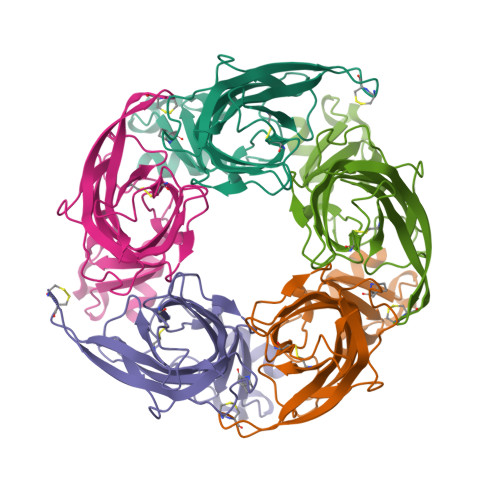
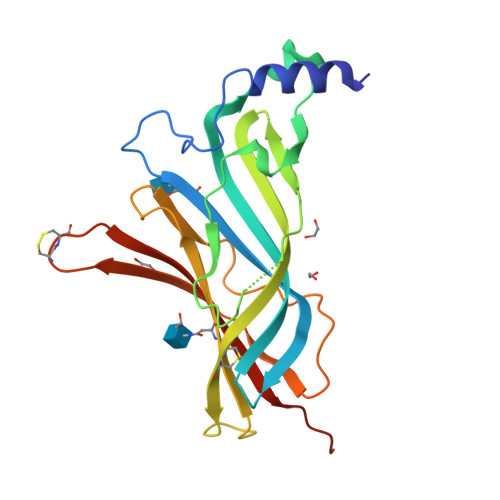
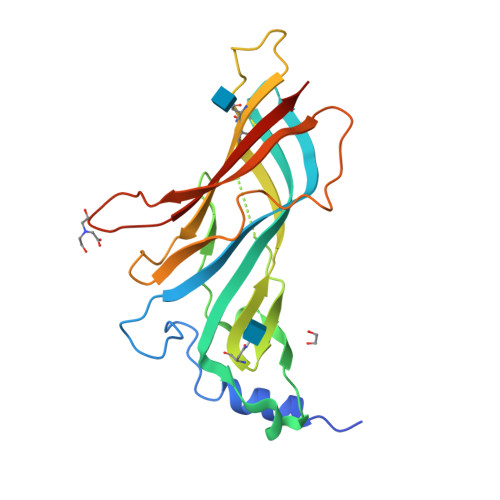
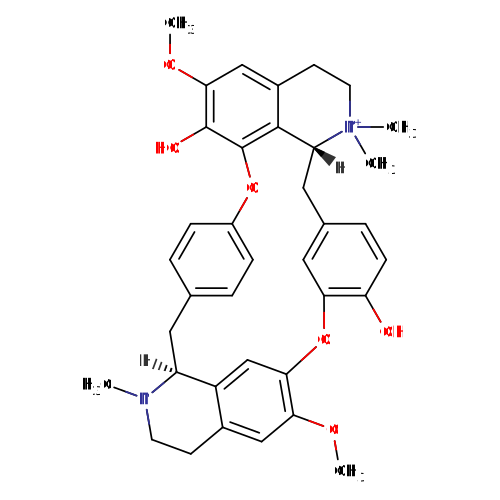
Tubocurarine (CED0003747)

Record Information
Version1.0
Creation Date2009-07-23 18:26:15 UTC
Update Date2026-05-14 16:58:42 UTC
SynCED IDCED0003747
Secondary Accession Numbers
  • CHEM002432
  • T3D3097
Identification
Common NameTubocurarine
ClassSmall Molecule
Description
Tubocurarine belongs to the ethers, a subclass of organooxygen compounds within the organic compounds. With an average molecular weight of 609.73 g/mol, Tubocurarine is a heavy molecule. This exogenous compound has the chemical formula C37H41N2O6 and exists as a solid at room temperature. It functions as a muscle relaxant and a nicotinic antagonist. As a non-depolarizing muscle relaxant, it acts as a competitive antagonist at nicotinic acetylcholine receptors. The compound targets several proteins, including the acetylcholine receptor subunit alpha (CHRNA1), neuronal acetylcholine receptor subunit alpha-2 (CHRNA2), neuronal acetylcholine receptor subunit alpha-3 (CHRNA3), and neuronal acetylcholine receptor subunit alpha-4 (CHRNA4), among 12 other proteins. Other recorded protein targets include acetylcholinesterase (ACHE), 5-hydroxytryptamine receptor 3A (HTR3A), solute carrier family 22 member 2 (SLC22A2), and multidrug and toxin extrusion protein 2 (SLC47A2). In terms of health effects, Tubocurarine has a therapeutic effect on inflammation (PMC12970233). Tubocurarine is found in several recorded sources, including healthcare, pharmaceuticals, and veterinary products as a muscle relaxant, as well as in food preservation. It is also associated with household cleaning and consumer products such as cigar cigarettes, pipe accessories, other smoking requisites, tobacco smoke filters, and non-electric simulated smoking devices. Additionally, it is found in electrically stimulated smoking devices and in building and construction materials like tents or canopies. Recorded exposure routes for this compound include intravenous and intramuscular administration.
Contaminant Type
  • Amine
  • Drug
  • Ether
  • Metabolite
  • Muscle Relaxant, Skeletal
  • Natural Compound
  • Neuromuscular Nondepolarizing Agent
  • Nicotinic Antagonist
  • Organic Compound
  • Plant Toxin
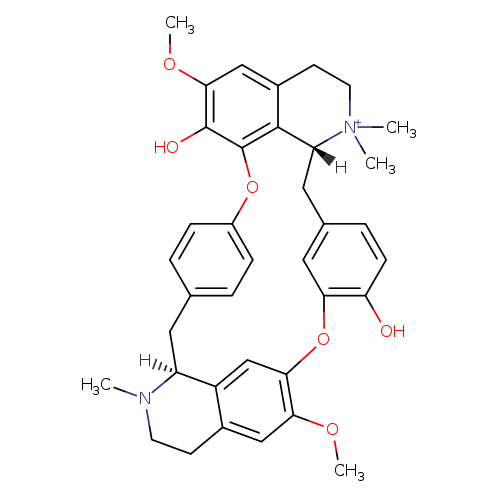
Chemical Structure
Synonyms
ValueSource
(+)-TubocurarineChEBI
7',12'-Dihydroxy-6,6'-dimethoxy-2,2',2'-trimethyltubocuraraniumChEBI
D-TubocurarineChEBI
TubocurarinChEBI
D-Tubocurarine chlorideHMDB
Isoquinoline alkaloidHMDB
Tubocurarine chlorideHMDB
TubocurarinumHMDB
D-TubocurareHMDB
TubocurareHMDB
Chemical FormulaC37H41N2O6
Average Molecular Mass609.731 g/mol
Monoisotopic Mass609.296 g/mol
CAS Registry Number6989-98-6
IUPAC Name(1S,16R)-9,21-dihydroxy-10,25-dimethoxy-15,15,30-trimethyl-7,23-dioxa-15,30-diazaheptacyclo[22.6.2.2³,⁶.1⁸,¹².1¹⁸,²².0²⁷,³¹.0¹⁶,³⁴]hexatriaconta-3,5,8(34),9,11,18(33),19,21,24,26,31,35-dodecaen-15-ium
Traditional Nametubocurarine
SMILES[H][C@@]12CC3=CC=C(OC4=C5C(CC[N+](C)(C)[C@]5([H])CC5=CC(OC6=C(OC)C=C(CCN1C)C2=C6)=C(O)C=C5)=CC(OC)=C4O)C=C3
InChI IdentifierInChI=1S/C37H40N2O6/c1-38-14-12-24-19-32(42-4)33-21-27(24)28(38)16-22-6-9-26(10-7-22)44-37-35-25(20-34(43-5)36(37)41)13-15-39(2,3)29(35)17-23-8-11-30(40)31(18-23)45-33/h6-11,18-21,28-29H,12-17H2,1-5H3,(H-,40,41)/p+1/t28-,29+/m0/s1
InChI KeyJFJZZMVDLULRGK-URLMMPGGSA-O
Chemical Taxonomy
Description Belongs to the class of organic compounds known as diarylethers. These are organic compounds containing the dialkyl ether functional group, with the formula ROR', where R and R' are aryl groups.
KingdomOrganic compounds
Super ClassOrganic oxygen compounds
ClassOrganooxygen compounds
Sub ClassEthers
Direct ParentDiarylethers
Alternative Parents
Substituents
  • Diaryl ether
  • Tetrahydroisoquinoline
  • Anisole
  • Alkyl aryl ether
  • 1-hydroxy-2-unsubstituted benzenoid
  • Aralkylamine
  • Benzenoid
  • Tetraalkylammonium salt
  • Quaternary ammonium salt
  • Tertiary amine
  • Tertiary aliphatic amine
  • Oxacycle
  • Azacycle
  • Organoheterocyclic compound
  • Amine
  • Organic nitrogen compound
  • Organonitrogen compound
  • Hydrocarbon derivative
  • Organopnictogen compound
  • Organic salt
  • Organic cation
  • Aromatic heteropolycyclic compound
Molecular FrameworkAromatic heteropolycyclic compounds
External Descriptors
Biological Properties
StatusDetected and Not Quantified
OriginExogenous
Cellular Locations
  • Cytoplasm
  • Membrane
Biofluid LocationsNot Available
Tissue LocationsNot Available
Applications
Biological Roles
Chemical RolesNot Available
Organoleptic EffectsNot Available
Physical Properties
StateSolid
AppearanceWhite powder.
Experimental Properties
PropertyValue
Melting PointNot Available
Boiling PointNot Available
Solubility3.23e-04 g/L
Predicted Properties
PropertyValueSource
Water Solubility0.00032 g/LALOGPS
logP3.12ALOGPS
logP3.14ChemAxon
logS-6.3ALOGPS
pKa (Strongest Acidic)6.45ChemAxon
pKa (Strongest Basic)8.12ChemAxon
Physiological Charge1ChemAxon
Hydrogen Acceptor Count5ChemAxon
Hydrogen Donor Count2ChemAxon
Polar Surface Area80.62 ŲChemAxon
Rotatable Bond Count2ChemAxon
Refractivity187.06 m³·mol⁻¹ChemAxon
Polarizability66.41 ųChemAxon
Number of Rings7ChemAxon
BioavailabilityYesChemAxon
Rule of FiveNoChemAxon
Ghose FilterNoChemAxon
Veber's RuleNoChemAxon
MDDR-like RuleNoChemAxon
Spectra
Spectra
Spectrum TypeDescriptionSplash KeyDeposition DateView
Predicted GC-MSPredicted GC-MS Spectrumsplash10-052f-0000091000-3781da48d16d597964ccNot AvailableView Spectrum
Predicted GC-MSPredicted GC-MS Spectrumsplash10-01bi-0000009000-cf3870f9fb70af6daa94Not AvailableView Spectrum
Predicted GC-MSPredicted GC-MS SpectrumNot AvailableNot AvailableView Spectrum
LC-MS/MSLC-MS/MS Spectrumsplash10-03di-0000090000-3b12a16109f25ee30930Not AvailableView Spectrum
LC-MS/MSLC-MS/MS Spectrumsplash10-03di-0000090000-7ed720c5e8c5ce8facd3Not AvailableView Spectrum
Predicted LC-MS/MSPredicted LC-MS/MS Spectrumsplash10-0a59-0000089000-ac5f8d663869b48af1f0Not AvailableView Spectrum
Predicted LC-MS/MSPredicted LC-MS/MS Spectrumsplash10-0560-0000091000-b985ecd4a2b2ff4197d8Not AvailableView Spectrum
Predicted LC-MS/MSPredicted LC-MS/MS Spectrumsplash10-0fk9-0000090000-ae66666801b8fb874ed4Not AvailableView Spectrum
Toxicity Profile
Toxicity Values
Toxicity ValueOrganismDose DescriptorRoute of ExposurePredicted or ExperimentalToxicity RatingReference
17.0 Log mg/kg [9:30]RatLD50oralpredictedNot AvailableNot Available
Toxicity / Toxin ClassNot Available
Mechanism of ToxicityTubocurarine is a cholinesterase or acetylcholinesterase (AChE) inhibitor. A cholinesterase inhibitor (or 'anticholinesterase') suppresses the action of acetylcholinesterase. Because of its essential function, chemicals that interfere with the action of acetylcholinesterase are potent neurotoxins, causing excessive salivation and eye-watering in low doses, followed by muscle spasms and ultimately death. Nerve gases and many substances used in insecticides have been shown to act by binding a serine in the active site of acetylcholine esterase, inhibiting the enzyme completely. Acetylcholine esterase breaks down the neurotransmitter acetylcholine, which is released at nerve and muscle junctions, in order to allow the muscle or organ to relax. The result of acetylcholine esterase inhibition is that acetylcholine builds up and continues to act so that any nerve impulses are continually transmitted and muscle contractions do not stop. Among the most common acetylcholinesterase inhibitors are phosphorus-based compounds, which are designed to bind to the active site of the enzyme. The structural requirements are a phosphorus atom bearing two lipophilic groups, a leaving group (such as a halide or thiocyanate), and a terminal oxygen.
Carcinogenicity (IARC Classification)No indication of carcinogenicity to humans (not listed by IARC).
Minimum Risk LevelNot Available
SymptomsCurare is a muscle relaxant and thus causes paraylsis. (2)
TreatmentIf the compound has been ingested, rapid gastric lavage should be performed using 5% sodium bicarbonate. For skin contact, the skin should be washed with soap and water. If the compound has entered the eyes, they should be washed with large quantities of isotonic saline or water. In serious cases, atropine and/or pralidoxime should be administered. Anti-cholinergic drugs work to counteract the effects of excess acetylcholine and reactivate AChE. Atropine can be used as an antidote in conjunction with pralidoxime or other pyridinium oximes (such as trimedoxime or obidoxime), though the use of '-oximes' has been found to be of no benefit, or possibly harmful, in at least two meta-analyses. Atropine is a muscarinic antagonist, and thus blocks the action of acetylcholine peripherally.
Health Effects
Health EffectRelationshipDirectionReference
inflammation?has_therapeutic_effect_onNot AvailablePMC12970233
Exposure Sources
Source IDSourceSectorReference
CEDs000233Brushes?Brushes used in personal care and cosmetics can be a source of synthetic chemical contamination due to the materials and coatings used in their manufacturing.Personal care & cosmeticsNot Available
CEDs000365Muscle relaxants?Muscle relaxants are synthetic chemicals primarily used to alleviate muscle spasms and discomfort by acting on the central nervous system or peripheral neuromuscular junctions.Healthcare, pharmaceuticals & veterinary productsNot Available
CEDs000503Tents Or Canopies?Tents and canopies used in various applications can be a source of synthetic chemical contamination primarily due to the materials from which they are made.Building & ConstructionNot Available
CEDs000518Electrically Stimulated Smoking Devices?Electrically stimulated smoking devices, commonly known as e-cigarettes or vape pens, utilize electrical components to heat a liquid solution, often containing nicotine, flavorings, and other additives, to produce an aerosol for inhalation.Electrical & Electronic EquipmentNot Available
CEDs000545Food Preservation?Food preservation often involves the use of synthetic chemicals, such as preservatives, flavor enhancers, and color additives, to extend shelf life and enhance the sensory qualities of food products.Food, food processing & cookwareNot Available
CEDs000556Cigar Cigarettes?Cigar cigarettes are a source of synthetic chemical contamination due to the combustion of various tobacco blends and additives.Household cleaning & consumer productsNot Available
CEDs000559Non Electric Simulated Smoking Devices?Non-electric simulated smoking devices, often designed to mimic the experience of smoking without combustion, can be sources of synthetic chemical contamination due to the materials and chemicals used in their construction and operation.Household cleaning & consumer productsNot Available
CEDs000560Other Smoking Requisites?Other smoking requisites, including items such as lighters, matches, and rolling papers, can introduce synthetic chemical contamination through various components and additives.Household cleaning & consumer productsNot Available
CEDs000562Pipe Accessories?Pipe accessories, such as fittings, connectors, and seals, are components used in plumbing systems to facilitate the flow of liquids and gases.Household cleaning & consumer productsNot Available
CEDs000569Tobacco Smoke Filters?Tobacco smoke filters are designed to reduce the inhalation of harmful substances in cigarette smoke, including tar and other particulate matter.Household cleaning & consumer productsNot Available
CEDs000578Making Cigars?The process of making cigars involves several steps, including the cultivation of tobacco, fermentation, and the application of various additives to enhance flavor and preservation.Industrial manufacturing & chemical processingNot Available
CEDs000580Manufacture Preparation Of Tobacco Products?The manufacture and preparation of tobacco products involve various processes that can result in the introduction of synthetic chemicals into the environment.Industrial manufacturing & chemical processingNot Available
CEDs000611Anti Perspirants Or Body Deoderants?Antiperspirants and body deodorants commonly contain synthetic chemicals such as aluminum compounds, parabens, and synthetic fragrances.Personal care & cosmeticsNot Available
CEDs000614Essential Oils Or Perfumes?Essential oils and perfumes are complex mixtures of volatile compounds derived from natural or synthetic sources, commonly used for their aromatic properties.Personal care & cosmeticsNot Available
CEDs000632Apparel?Apparel production often involves the use of various synthetic chemicals, including dyes, finishing agents, and preservatives.Textiles, leather & furnishingsNot Available
CEDs000696Nanotechnology?Nanotechnology involves the manipulation of materials at the molecular or atomic level, typically within the range of 1 to 100 nanometers.Industrial manufacturing & chemical processingNot Available
CEDs000739Inks?Inks are complex mixtures composed of pigments or dyes, solvents, resins, and additives used primarily for printing and writing applications.Paper, pulp & fiber productsNot Available
CEDs000740Paper?Paper production involves the processing of wood fibers and the use of various chemicals, which can lead to synthetic chemical contamination.Paper, pulp & fiber productsNot Available
Pathways
1 pathwayPathway Source: PathBank
Targets
StructureProteinUniProt IDOrganismRelationshipDetails
D(1A) dopamine receptor structureClick to view 3D structureD(1A) dopamine receptorP21728HumansPredicted (SEA)
Prediction Confidence Score
0.345
Applicability Domain
0.357
Statistical Significance
0.0155
Supporting Reference Compounds
425
E-value
121.056
D(2) dopamine receptor structureClick to view 3D structureD(2) dopamine receptorP14416HumansPredicted (SEA)
Prediction Confidence Score
0.343
Applicability Domain
0.357
Statistical Significance
0.0429
Supporting Reference Compounds
1103
E-value
334.362
5-hydroxytryptamine receptor 2A structureClick to view 3D structure5-hydroxytryptamine receptor 2AP28223HumansPredicted (SEA)
Prediction Confidence Score
0.332
Applicability Domain
0.357
Statistical Significance
0.0451
Supporting Reference Compounds
955
E-value
351.256
5-hydroxytryptamine receptor 1A structureClick to view 3D structure5-hydroxytryptamine receptor 1AP08908HumansPredicted (SEA)
Prediction Confidence Score
0.33
Applicability Domain
0.349
Statistical Significance
0.0422
Supporting Reference Compounds
953
E-value
328.835
Click to view 3D structureD(2) dopamine receptorP61169RatPredicted (SEA)
Prediction Confidence Score
0.329
Applicability Domain
0.354
Statistical Significance
0.0336
Supporting Reference Compounds
528
E-value
261.807
Click to view 3D structureD(1A) dopamine receptorP18901Rattus norvegicusPredicted (SEA)
Prediction Confidence Score
0.329
Applicability Domain
0.354
Statistical Significance
0.014
Supporting Reference Compounds
206
E-value
108.755
D(1B) dopamine receptor structureClick to view 3D structureD(1B) dopamine receptorP21918HumansPredicted (SEA)
Prediction Confidence Score
0.327
Applicability Domain
0.357
Statistical Significance
0.0136
Supporting Reference Compounds
209
E-value
106.108
D(3) dopamine receptor structureClick to view 3D structureD(3) dopamine receptorP35462HumansPredicted (SEA)
Prediction Confidence Score
0.326
Applicability Domain
0.349
Statistical Significance
0.0426
Supporting Reference Compounds
861
E-value
331.949
5-hydroxytryptamine receptor 2C structureClick to view 3D structure5-hydroxytryptamine receptor 2CP28335HumansPredicted (SEA)
Prediction Confidence Score
0.326
Applicability Domain
0.349
Statistical Significance
0.0386
Supporting Reference Compounds
823
E-value
300.498
5-hydroxytryptamine receptor 7 structureClick to view 3D structure5-hydroxytryptamine receptor 7P34969HumansPredicted (SEA)
Prediction Confidence Score
0.326
Applicability Domain
0.349
Statistical Significance
0.0305
Supporting Reference Compounds
565
E-value
237.596
Tissue factor structureClick to view 3D structureTissue factorP13726HumansPredicted (SEA)
Prediction Confidence Score
0.318
Applicability Domain
0.333
Statistical Significance
0.0033
Supporting Reference Compounds
29
E-value
25.4567
ATP-binding cassette sub-family C member 4 structureClick to view 3D structureATP-binding cassette sub-family C member 4O15439HumansPredicted (SEA)
Prediction Confidence Score
0.316
Applicability Domain
1.0
Statistical Significance
6.00e-05
Supporting Reference Compounds
30
E-value
0.467095
5-hydroxytryptamine receptor 2B structureClick to view 3D structure5-hydroxytryptamine receptor 2BP41595HumansPredicted (SEA)
Prediction Confidence Score
0.315
Applicability Domain
0.349
Statistical Significance
0.0377
Supporting Reference Compounds
686
E-value
293.414
D(4) dopamine receptor structureClick to view 3D structureD(4) dopamine receptorP21917HumansPredicted (SEA)
Prediction Confidence Score
0.312
Applicability Domain
0.333
Statistical Significance
0.0438
Supporting Reference Compounds
524
E-value
340.98
Click to view 3D structureMultidrug and toxin extrusion protein 1Q96FL8HumansPredicted (SEA)
Prediction Confidence Score
0.311
Applicability Domain
1.0
Statistical Significance
1.20e-04
Supporting Reference Compounds
35
E-value
0.934191
Click to view 3D structureAlpha-1A adrenergic receptorP43140Rattus norvegicusPredicted (SEA)
Prediction Confidence Score
0.307
Applicability Domain
0.354
Statistical Significance
0.0197
Supporting Reference Compounds
208
E-value
153.052
Click to view 3D structureNeuronal acetylcholine receptor subunit alpha-7Q05941Rattus norvegicusPredicted (SEA)
Prediction Confidence Score
0.306
Applicability Domain
0.986
Statistical Significance
0.0019
Supporting Reference Compounds
55
E-value
14.48
Click to view 3D structureAlpha-1B adrenergic receptorP35368HumansPredicted (SEA)
Prediction Confidence Score
0.302
Applicability Domain
0.349
Statistical Significance
0.0271
Supporting Reference Compounds
298
E-value
211.049
Alpha-2C adrenergic receptor structureClick to view 3D structureAlpha-2C adrenergic receptorP18825HumansPredicted (SEA)
Prediction Confidence Score
0.297
Applicability Domain
0.349
Statistical Significance
0.0338
Supporting Reference Compounds
386
E-value
263.52
Alpha-1A adrenergic receptor structureClick to view 3D structureAlpha-1A adrenergic receptorP35348HumansPredicted (SEA)
Prediction Confidence Score
0.29
Applicability Domain
0.322
Statistical Significance
0.0456
Supporting Reference Compounds
376
E-value
355.382
Click to view 3D structureAlpha-1D adrenergic receptorP25100HumansPredicted (SEA)
Prediction Confidence Score
0.289
Applicability Domain
0.322
Statistical Significance
0.0316
Supporting Reference Compounds
258
E-value
246.081
Sigma non-opioid intracellular receptor 1 structureClick to view 3D structureSigma non-opioid intracellular receptor 1Q99720HumansPredicted (SEA)
Prediction Confidence Score
0.285
Applicability Domain
0.296 Low confidence
Statistical Significance
0.085
Supporting Reference Compounds
562
E-value
661.563
5-hydroxytryptamine receptor 6 structureClick to view 3D structure5-hydroxytryptamine receptor 6P50406HumansPredicted (SEA)
Prediction Confidence Score
0.285
Applicability Domain
0.349
Statistical Significance
0.0633
Supporting Reference Compounds
536
E-value
492.708
Sodium-dependent dopamine transporter structureClick to view 3D structureSodium-dependent dopamine transporterQ01959HumansPredicted (SEA)
Prediction Confidence Score
0.277
Applicability Domain
0.349
Statistical Significance
0.0773
Supporting Reference Compounds
506
E-value
601.619
Alpha-2B adrenergic receptor structureClick to view 3D structureAlpha-2B adrenergic receptorP18089HumansPredicted (SEA)
Prediction Confidence Score
0.272
Applicability Domain
0.322
Statistical Significance
0.0585
Supporting Reference Compounds
340
E-value
455.184
5-hydroxytryptamine receptor 3A structureClick to view 3D structure5-hydroxytryptamine receptor 3AP46098HumansKnownNot Available
Acetylcholinesterase structureClick to view 3D structureAcetylcholinesteraseP22303HumansKnownNot Available
Neuronal acetylcholine receptor subunit alpha-7 structureClick to view 3D structureNeuronal acetylcholine receptor subunit alpha-7P36544HumansKnownCurare is a non-depolarizing muscle relaxant that acts as a competitive antagonist at the nicotinic acetylcholine receptors. (L1256)
Acetylcholine receptor subunit alpha structureClick to view 3D structureAcetylcholine receptor subunit alphaP02708HumansKnownCurare is a non-depolarizing muscle relaxant that acts as a competitive antagonist at the nicotinic acetylcholine receptors. (L1256)
Click to view 3D structureAcetylcholine receptor subunit betaP11230HumansKnownCurare is a non-depolarizing muscle relaxant that acts as a competitive antagonist at the nicotinic acetylcholine receptors. (L1256)
Click to view 3D structureAcetylcholine receptor subunit deltaQ07001HumansKnownCurare is a non-depolarizing muscle relaxant that acts as a competitive antagonist at the nicotinic acetylcholine receptors. (L1256)
Click to view 3D structureAcetylcholine receptor subunit epsilonQ04844HumansKnownCurare is a non-depolarizing muscle relaxant that acts as a competitive antagonist at the nicotinic acetylcholine receptors. (L1256)
Click to view 3D structureAcetylcholine receptor subunit gammaP07510HumansKnownCurare is a non-depolarizing muscle relaxant that acts as a competitive antagonist at the nicotinic acetylcholine receptors. (L1256)
Click to view 3D structureMultidrug and toxin extrusion protein 1Q96FL8HumansKnownNot Available
Click to view 3D structureMultidrug and toxin extrusion protein 2Q86VL8HumansKnownNot Available
Click to view 3D structureNeuronal acetylcholine receptor subunit alpha-10Q9GZZ6HumansKnownCurare is a non-depolarizing muscle relaxant that acts as a competitive antagonist at the nicotinic acetylcholine receptors. (L1256)
Neuronal acetylcholine receptor subunit alpha-2 structureClick to view 3D structureNeuronal acetylcholine receptor subunit alpha-2Q15822HumansKnownCurare is a non-depolarizing muscle relaxant that acts as a competitive antagonist at the nicotinic acetylcholine receptors. (L1256)
Neuronal acetylcholine receptor subunit alpha-3 structureClick to view 3D structureNeuronal acetylcholine receptor subunit alpha-3P32297HumansKnownCurare is a non-depolarizing muscle relaxant that acts as a competitive antagonist at the nicotinic acetylcholine receptors. (L1256)
Neuronal acetylcholine receptor subunit alpha-4 structureClick to view 3D structureNeuronal acetylcholine receptor subunit alpha-4P43681HumansKnownCurare is a non-depolarizing muscle relaxant that acts as a competitive antagonist at the nicotinic acetylcholine receptors. (L1256)
Click to view 3D structureNeuronal acetylcholine receptor subunit alpha-5P30532HumansKnownCurare is a non-depolarizing muscle relaxant that acts as a competitive antagonist at the nicotinic acetylcholine receptors. (L1256)
Click to view 3D structureNeuronal acetylcholine receptor subunit alpha-6Q15825HumansKnownCurare is a non-depolarizing muscle relaxant that acts as a competitive antagonist at the nicotinic acetylcholine receptors. (L1256)
Neuronal acetylcholine receptor subunit alpha-9 structureClick to view 3D structureNeuronal acetylcholine receptor subunit alpha-9Q9UGM1HumansKnownCurare is a non-depolarizing muscle relaxant that acts as a competitive antagonist at the nicotinic acetylcholine receptors. (L1256)
Neuronal acetylcholine receptor subunit beta-2 structureClick to view 3D structureNeuronal acetylcholine receptor subunit beta-2P17787HumansKnownCurare is a non-depolarizing muscle relaxant that acts as a competitive antagonist at the nicotinic acetylcholine receptors. (L1256)
Neuronal acetylcholine receptor subunit beta-3 structureClick to view 3D structureNeuronal acetylcholine receptor subunit beta-3Q05901HumansKnownCurare is a non-depolarizing muscle relaxant that acts as a competitive antagonist at the nicotinic acetylcholine receptors. (L1256)
Neuronal acetylcholine receptor subunit beta-4 structureClick to view 3D structureNeuronal acetylcholine receptor subunit beta-4P30926HumansKnownCurare is a non-depolarizing muscle relaxant that acts as a competitive antagonist at the nicotinic acetylcholine receptors. (L1256)
Solute carrier family 22 member 2 structureClick to view 3D structureSolute carrier family 22 member 2O15244HumansKnownNot Available
Concentrations
Not Available
External Links
DrugBank IDDB01199
HMDB IDHMDB0015330
FooDB IDNot Available
Phenol Explorer IDNot Available
KNApSAcK IDC00001927
BiGG IDNot Available
BioCyc IDNot Available
METLIN IDNot Available
PDB IDNot Available
Wikipedia LinkTubocurarine_chloride
Chemspider ID5778
ChEBI ID9774
PubChem Compound ID6000
Kegg Compound IDC07547
YMDB IDNot Available
ECMDB IDNot Available
References
Synthesis ReferenceNot Available
MSDSLink
General References
  1. Youssef SA, Ramadan A, Afifi NA, Aziz MD: Influence of sodium taurocholate on the potency and duration of action of some neuromuscular blocking agents. Dtsch Tierarztl Wochenschr. 1991 Jun;98(6):213-6. [PubMed: 1889362]
  2. Wikipedia. Curare. Last Updated 9 June 2009. - http://en.wikipedia.org/wiki/Curare