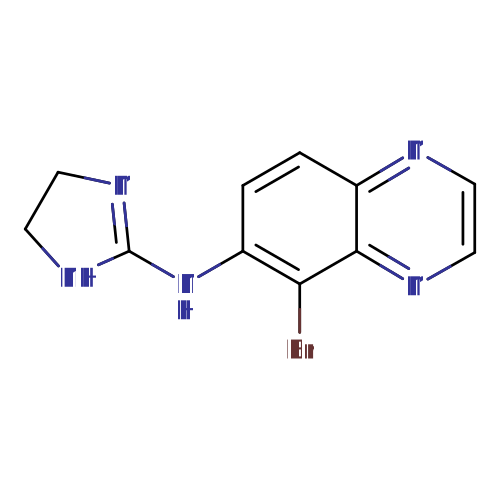
Brimonidine (CED0004342)

Record Information
Version1.0
Creation Date2009-07-30 17:58:43 UTC
Update Date2026-05-14 16:40:08 UTC
SynCED IDCED0004342
Secondary Accession Numbers
  • CHEM002507
  • T3D3487
Identification
Common NameBrimonidine
ClassSmall Molecule
Description
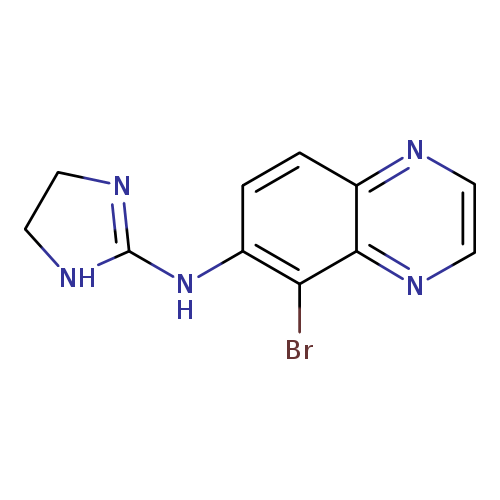
Brimonidine is an exogenous compound with the formula C11H10BrN5 and an average molecular weight of 292.13 g/mol. It exists as a solid at room temperature. Brimonidine belongs to the benzodiazines, a subclass of diazanaphthalenes within the organic compounds. Functioning as an alpha-adrenergic agonist, this compound targets the Alpha-2A (ADRA2A), Alpha-2B (ADRA2B), and Alpha-2C (ADRA2C) adrenergic receptors. It is utilized as an antihypertensive agent and an adrenergic agonist. In clinical applications, it is used to treat glaucoma by decreasing aqueous humor synthesis. Fluorophotometric studies in humans and animals suggest a dual mechanism of action characterized by the reduction of aqueous humor production and the increase of uveoscleral outflow, with a peak ocular hypotensive effect occurring two hours after dosing. Additionally, a topical gel formulation marketed as Mirvaso received FDA approval in August 2013 for the treatment of rosacea. Brimonidine is found in various recorded sources, including healthcare, pharmaceuticals, and veterinary products such as miotics, antiglaucoma preparations, antiallergics, and decongestants, as well as dermatological preparations. It is also identified in food preservation, electrical and electronic equipment like electrically stimulated smoking devices, and household consumer products including tobacco smoke filters, cigar cigarettes, non-electric simulated smoking devices, and other smoking requisites. Exposure to the compound occurs via topical and ophthalmic routes.
Contaminant Type
  • Adrenergic alpha-2 Receptor Agonist
  • Adrenergic alpha-Agonist
  • Amide
  • Amine
  • Antihypertensive Agent
  • Bromide Compound
  • Drug
  • EENT Preparation
  • Metabolite
  • Organic Compound
  • Organobromide
  • Synthetic Compound
Chemical Structure
Synonyms
ValueSource
5-Bromo-6-(2-imidazolin-2-ylamino)quinoxalineChEBI
BrimonidinaChEBI
BrimonidinumChEBI
BromoxidineChEBI
Brimonidine tartrateHMDB
AlphaganHMDB
Purite, brimonidineHMDB
RatioBrimonidineHMDB
SanrosaHMDB
Brimonidine tartrate (1:1)HMDB
Brimonidine tartrate (1:1), (S-(r*,r*))-isomerHMDB
5-Bromo-6-(2-imidazolin-2-ylamino)quinoxaline D-tartrateHMDB
Ratio brimonidineHMDB
Tartrate, brimonidineHMDB
MirvasoHMDB
5-Bromo-6-(imidazolidinylideneamino)quinoxalineHMDB
5-Bromo-6-(imidazolin-2-ylamino)quinoxalineHMDB
Alphagan pHMDB
Ratio-brimonidineHMDB
Brimonidine puriteHMDB
Brimonidine tartrate, (R-(r*,r*))-isomerHMDB
Chemical FormulaC11H10BrN5
Average Molecular Mass292.135 g/mol
Monoisotopic Mass291.012 g/mol
CAS Registry Number59803-98-4
IUPAC Name5-bromo-N-(4,5-dihydro-1H-imidazol-2-yl)quinoxalin-6-amine
Traditional Namebrimonidine
SMILESBrC1=C(NC2=NCCN2)C=CC2=NC=CN=C12
InChI IdentifierInChI=1S/C11H10BrN5/c12-9-7(17-11-15-5-6-16-11)1-2-8-10(9)14-4-3-13-8/h1-4H,5-6H2,(H2,15,16,17)
InChI KeyXYLJNLCSTIOKRM-UHFFFAOYSA-N
Chemical Taxonomy
Description Belongs to the class of organic compounds known as quinoxalines. Quinoxalines are compounds containing a quinoxaline moiety, a bicyclic heterocycle made up of a benzene ring fused to a pyrazine ring.
KingdomOrganic compounds
Super ClassOrganoheterocyclic compounds
ClassDiazanaphthalenes
Sub ClassBenzodiazines
Direct ParentQuinoxalines
Alternative Parents
Substituents
  • Quinoxaline
  • Aryl bromide
  • Aryl halide
  • Pyrazine
  • Benzenoid
  • 2-imidazoline
  • Heteroaromatic compound
  • Guanidine
  • Azacycle
  • Carboximidamide
  • Propargyl-type 1,3-dipolar organic compound
  • Organic 1,3-dipolar compound
  • Organic nitrogen compound
  • Hydrocarbon derivative
  • Organonitrogen compound
  • Organobromide
  • Organohalogen compound
  • Organopnictogen compound
  • Aromatic heteropolycyclic compound
Molecular FrameworkAromatic heteropolycyclic compounds
External Descriptors
Biological Properties
StatusDetected and Not Quantified
OriginExogenous
Cellular Locations
  • Cytoplasm
  • Extracellular
  • Membrane
Biofluid LocationsNot Available
Tissue LocationsNot Available
Applications
Biological Roles
Chemical RolesNot Available
Organoleptic EffectsNot Available
Physical Properties
StateSolid
AppearanceWhite powder.
Experimental Properties
PropertyValue
Melting Point207.5°C
Boiling PointNot Available
SolubilitySoluble (1.5 mg/mL)
Predicted Properties
PropertyValueSource
Water Solubility0.15 g/LALOGPS
logP1.27ALOGPS
logP1.37ChemAxon
logS-3.3ALOGPS
pKa (Strongest Basic)8.32ChemAxon
Physiological Charge1ChemAxon
Hydrogen Acceptor Count5ChemAxon
Hydrogen Donor Count2ChemAxon
Polar Surface Area62.2 ŲChemAxon
Rotatable Bond Count1ChemAxon
Refractivity68.49 m³·mol⁻¹ChemAxon
Polarizability25.74 ųChemAxon
Number of Rings3ChemAxon
BioavailabilityYesChemAxon
Rule of FiveYesChemAxon
Ghose FilterYesChemAxon
Veber's RuleNoChemAxon
MDDR-like RuleNoChemAxon
Spectra
Spectra
Spectrum TypeDescriptionSplash KeyDeposition DateView
Predicted GC-MSPredicted GC-MS Spectrumsplash10-03xr-0190000000-cd1ec9d5bf9d24fab607Not AvailableView Spectrum
Predicted GC-MSPredicted GC-MS SpectrumNot AvailableNot AvailableView Spectrum
LC-MS/MSLC-MS/MS Spectrumsplash10-0006-0190000000-49c10e93a1977cbe01daNot AvailableView Spectrum
Predicted LC-MS/MSPredicted LC-MS/MS Spectrumsplash10-0006-0090000000-2f188927245c7fb3c618Not AvailableView Spectrum
Predicted LC-MS/MSPredicted LC-MS/MS Spectrumsplash10-0006-1090000000-fdfdc04ca6c5f2b62c3eNot AvailableView Spectrum
Predicted LC-MS/MSPredicted LC-MS/MS Spectrumsplash10-014i-9030000000-2d727aeec5962a767e61Not AvailableView Spectrum
Predicted LC-MS/MSPredicted LC-MS/MS Spectrumsplash10-0006-0090000000-91069ec802c3a06026d7Not AvailableView Spectrum
Predicted LC-MS/MSPredicted LC-MS/MS Spectrumsplash10-0006-0090000000-7bd1085ed4367b683e29Not AvailableView Spectrum
Predicted LC-MS/MSPredicted LC-MS/MS Spectrumsplash10-0002-2290000000-6351edb1d68a299dfd2dNot AvailableView Spectrum
Predicted LC-MS/MSPredicted LC-MS/MS Spectrumsplash10-0006-0090000000-5f6f82bdb9f8c51818c9Not AvailableView Spectrum
Predicted LC-MS/MSPredicted LC-MS/MS Spectrumsplash10-000f-0490000000-2720653740ec8305f05dNot AvailableView Spectrum
Predicted LC-MS/MSPredicted LC-MS/MS Spectrumsplash10-0006-0090000000-ffef408a4fb5db76cb85Not AvailableView Spectrum
Predicted LC-MS/MSPredicted LC-MS/MS Spectrumsplash10-0006-1090000000-0b1325c866472eaa216aNot AvailableView Spectrum
Predicted LC-MS/MSPredicted LC-MS/MS Spectrumsplash10-0f9j-3690000000-b5ba2dea82c37975ad75Not AvailableView Spectrum
Toxicity Profile
Toxicity Values
Toxicity ValueOrganismDose DescriptorRoute of ExposurePredicted or ExperimentalToxicity RatingReference
50.0 mg/kg miceLD50oralexperimentalNot AvailableNot Available
100.0 mg/kg ratLD50oralexperimentalNot AvailableNot Available
219.0 Log mg/kg [120:390]RatLD50oralpredictedNot AvailableNot Available
Toxicity / Toxin ClassNot Available
Mechanism of ToxicityBrimonidine is an alpha adrenergic receptor agonist (primarily alpha-2). It has a peak ocular hypotensive effect occurring at two hours post-dosing. Fluorophotometric studies in animals and humans suggest that Brimonidine has a dual mechanism of action by reducing aqueous humor production and increasing uveoscleral outflow. The topical gel reduces erythema through direct vasocontriction.
Carcinogenicity (IARC Classification)No indication of carcinogenicity to humans (not listed by IARC).
Minimum Risk LevelNot Available
SymptomsOral LD50 is 50 mg/kg in mice and 100 mg/kg in rats.
TreatmentNot Available
Health Effects
Health EffectRelationshipDirectionDescriptionReference
glaucomaNot AvailableNot AvailableA disorder characterized by an increase in pressure in the eyeball due to obstruction of the aqueous humor outflow. (NCI CTCAE)PMC6687460 , PMC7248996
rosaceaNot AvailableNot AvailableNot AvailablePMC7201191
ocular hypertensionNot AvailableNot AvailableAn eye disease that is characterized by elevated intraocular pressure in the absence of optic nerve damage or visual field loss. (DO)PMC7201191 , PMC7248996
open-angle glaucomaNot AvailableNot AvailableNot AvailablePMC7201191
Macular geographic atrophyNot AvailableNot AvailableNot AvailablePMC10892262
Exposure Sources
Source IDSourceSectorReference
CEDs000010Insecticides?Insecticides are synthetic chemicals designed to control or eliminate insect pests that threaten crops and other agricultural products.Agriculture & land managementPubChem
CEDs000315Dermatological preparations?Dermatological preparations encompass a wide range of topical products, including creams, ointments, gels, and lotions, designed for the treatment of skin conditions.Healthcare, pharmaceuticals & veterinary productsNot Available
CEDs000398Antiglaucoma preparations and miotics?Antiglaucoma preparations and miotics are pharmacological agents utilized to manage intraocular pressure in patients with glaucoma.Healthcare, pharmaceuticals & veterinary productsNot Available
CEDs000400Decongestants and antiallergics?Decongestants and antiallergics are synthetic chemicals commonly used in the treatment of nasal congestion and allergic reactions, respectively.Healthcare, pharmaceuticals & veterinary productsNot Available
CEDs000518Electrically Stimulated Smoking Devices?Electrically stimulated smoking devices, commonly known as e-cigarettes or vape pens, utilize electrical components to heat a liquid solution, often containing nicotine, flavorings, and other additives, to produce an aerosol for inhalation.Electrical & Electronic EquipmentPubChem
CEDs000545Food Preservation?Food preservation often involves the use of synthetic chemicals, such as preservatives, flavor enhancers, and color additives, to extend shelf life and enhance the sensory qualities of food products.Food, food processing & cookwarePubChem
CEDs000556Cigar Cigarettes?Cigar cigarettes are a source of synthetic chemical contamination due to the combustion of various tobacco blends and additives.Household cleaning & consumer productsPubChem
CEDs000559Non Electric Simulated Smoking Devices?Non-electric simulated smoking devices, often designed to mimic the experience of smoking without combustion, can be sources of synthetic chemical contamination due to the materials and chemicals used in their construction and operation.Household cleaning & consumer productsPubChem
CEDs000560Other Smoking Requisites?Other smoking requisites, including items such as lighters, matches, and rolling papers, can introduce synthetic chemical contamination through various components and additives.Household cleaning & consumer productsPubChem
CEDs000569Tobacco Smoke Filters?Tobacco smoke filters are designed to reduce the inhalation of harmful substances in cigarette smoke, including tar and other particulate matter.Household cleaning & consumer productsPubChem
CEDs000580Manufacture Preparation Of Tobacco Products?The manufacture and preparation of tobacco products involve various processes that can result in the introduction of synthetic chemicals into the environment.Industrial manufacturing & chemical processingPubChem
CEDs000596Acaricides?Acaricides are synthetic chemicals specifically designed to target and control mite populations that can damage crops and plants.Agriculture & land managementPubChem
CEDs000606Plant Growth Regulators?Plant Growth Regulators (PGRs) are synthetic chemicals designed to influence the growth and development of plants.Agriculture & land managementPubChem
CEDs000610Aftersun Products?Aftersun products are designed to soothe and hydrate the skin after sun exposure, often containing various synthetic chemicals such as emollients, preservatives, and fragrances.Personal care & cosmeticsPubChem
CEDs000611Anti Perspirants Or Body Deoderants?Antiperspirants and body deodorants commonly contain synthetic chemicals such as aluminum compounds, parabens, and synthetic fragrances.Personal care & cosmeticsPubChem
CEDs000615Eye Makeup Products?Eye makeup products, including mascaras, eyeliners, and eyeshadows, often contain a variety of synthetic chemicals such as pigments, preservatives, and film-forming agents.Personal care & cosmeticsPubChem
CEDs000632Apparel?Apparel production often involves the use of various synthetic chemicals, including dyes, finishing agents, and preservatives.Textiles, leather & furnishingsPubChem
CEDs000650Purses Luggage Hand Bags?Purses, luggage, and handbags are often manufactured using synthetic materials such as polyvinyl chloride (PVC), polyurethane, and various types of nylon.Textiles, leather & furnishingsPubChem
CEDs000662Yarns Or Threads?Yarns or threads used in textiles can be a source of synthetic chemical contamination due to the production processes and treatments they undergo.Textiles, leather & furnishingsPubChem
CEDs000685Ceramics?Ceramics can be a source of synthetic chemical contamination through various additives and processing agents used in their production.Building & ConstructionPubChem
CEDs000688Glass Coatings?Glass coatings are synthetic chemical formulations applied to glass surfaces to enhance properties such as durability, UV resistance, and aesthetic appeal.Building & ConstructionPubChem
CEDs000696Nanotechnology?Nanotechnology involves the manipulation of materials at the molecular or atomic level, typically within the range of 1 to 100 nanometers.Industrial manufacturing & chemical processingPubChem
CEDs000730Contact Lens Cases?Contact lens cases are small containers designed to store contact lenses in a sterile environment, typically made from various synthetic materials including plastics such as polypropylene or polycarbonate.Healthcare, pharmaceuticals & veterinary productsPubChem
CEDs000744Water, Wastewater, & Sewage Treatment?Water, wastewater, and sewage treatment processes are critical for managing and mitigating pollutants in water systems.Wastewater, sanitation & biosolidsPubChem
Pathways
1 pathwayPathway Source: PathBank
Targets
StructureProteinUniProt IDOrganismRelationshipDetails
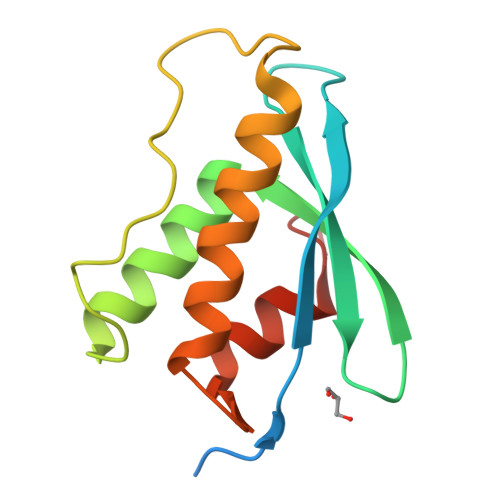
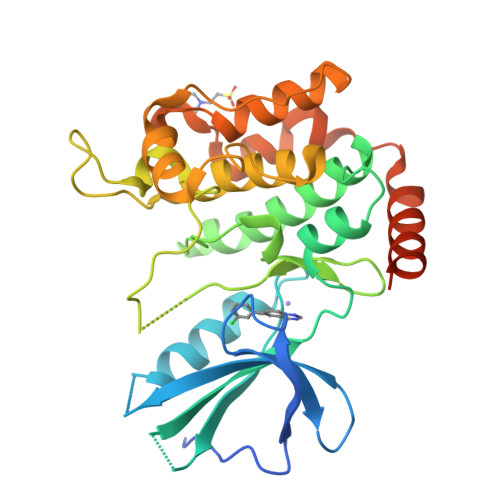
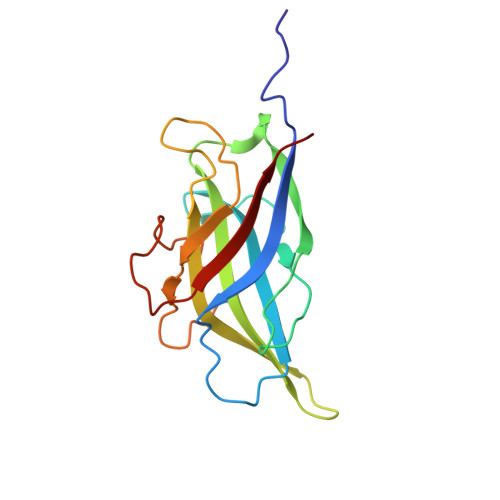
Alpha-2B adrenergic receptor structureClick to view 3D structureAlpha-2B adrenergic receptorP18089HumansPredicted (SEA)
Prediction Confidence Score
0.76
Applicability Domain
1.0
Statistical Significance
6.00e-05
Supporting Reference Compounds
340
E-value
0.467095
Alpha-2A adrenergic receptor structureClick to view 3D structureAlpha-2A adrenergic receptorP08913HumansPredicted (SEA)
Prediction Confidence Score
0.76
Applicability Domain
1.0
Statistical Significance
6.00e-05
Supporting Reference Compounds
487
E-value
0.467095
Alpha-2C adrenergic receptor structureClick to view 3D structureAlpha-2C adrenergic receptorP18825HumansPredicted (SEA)
Prediction Confidence Score
0.76
Applicability Domain
1.0
Statistical Significance
6.00e-05
Supporting Reference Compounds
386
E-value
0.467095
Click to view 3D structureAlpha-1D adrenergic receptorP25100HumansPredicted (SEA)
Prediction Confidence Score
0.76
Applicability Domain
1.0
Statistical Significance
4.00e-05
Supporting Reference Compounds
258
E-value
0.311397
Click to view 3D structureAlpha-1B adrenergic receptorP35368HumansPredicted (SEA)
Prediction Confidence Score
0.655
Applicability Domain
1.0
Statistical Significance
2.10e-04
Supporting Reference Compounds
298
E-value
1.63483
Alpha-1A adrenergic receptor structureClick to view 3D structureAlpha-1A adrenergic receptorP35348HumansPredicted (SEA)
Prediction Confidence Score
0.641
Applicability Domain
1.0
Statistical Significance
3.40e-04
Supporting Reference Compounds
376
E-value
2.64687
Click to view 3D structureAlpha-2B adrenergic receptorP19328Rattus norvegicusPredicted (SEA)
Prediction Confidence Score
0.553
Applicability Domain
1.0
Statistical Significance
2.00e-05
Supporting Reference Compounds
30
E-value
0.155698
Click to view 3D structureAlpha-1A adrenergic receptorP18130Bos taurusPredicted (SEA)
Prediction Confidence Score
0.447
Applicability Domain
1.0
Statistical Significance
8.10e-04
Supporting Reference Compounds
85
E-value
6.30579
Click to view 3D structure5-hydroxytryptamine receptor 1AP19327Rattus norvegicusPredicted (SEA)
Prediction Confidence Score
0.403
Applicability Domain
1.0
Statistical Significance
0.0122
Supporting Reference Compounds
541
E-value
94.9761
Click to view 3D structureAlpha-1B adrenergic receptorG3HDX1Cricetulus griseusPredicted (SEA)
Prediction Confidence Score
0.4
Applicability Domain
1.0
Statistical Significance
2.00e-05
Supporting Reference Compounds
5
E-value
0.155698
Click to view 3D structureAlpha-1A adrenergic receptorP43140Rattus norvegicusPredicted (SEA)
Prediction Confidence Score
0.393
Applicability Domain
1.0
Statistical Significance
0.0051
Supporting Reference Compounds
208
E-value
39.4696
5-hydroxytryptamine receptor 7 structureClick to view 3D structure5-hydroxytryptamine receptor 7P34969HumansPredicted (SEA)
Prediction Confidence Score
0.382
Applicability Domain
0.778
Statistical Significance
0.0135
Supporting Reference Compounds
565
E-value
104.785
Nischarin structureClick to view 3D structureNischarinQ9Y2I1HumansPredicted (SEA)
Prediction Confidence Score
0.333
Applicability Domain
0.412
Statistical Significance
5.60e-04
Supporting Reference Compounds
37
E-value
4.35956
Click to view 3D structureSigma intracellular receptor 2Q5BJF2HumansPredicted (SEA)
Prediction Confidence Score
0.326
Applicability Domain
0.778
Statistical Significance
0.0191
Supporting Reference Compounds
308
E-value
149.081
Click to view 3D structureNischarinQ4G017Rattus norvegicusPredicted (SEA)
Prediction Confidence Score
0.291
Applicability Domain
0.4
Statistical Significance
6.40e-04
Supporting Reference Compounds
18
E-value
4.98235
Sodium-dependent serotonin transporter structureClick to view 3D structureSodium-dependent serotonin transporterP31645HumansPredicted (SEA)
Prediction Confidence Score
0.283
Applicability Domain
0.778
Statistical Significance
0.076
Supporting Reference Compounds
593
E-value
592.043
Alpha-2A adrenergic receptor structureClick to view 3D structureAlpha-2A adrenergic receptorQ28838Bos taurusPredicted (SEA)
Prediction Confidence Score
0.26
Applicability Domain
0.4
Statistical Significance
0.0051
Supporting Reference Compounds
32
E-value
39.7031
5-hydroxytryptamine receptor 1A structureClick to view 3D structure5-hydroxytryptamine receptor 1AP08908HumansPredicted (SEA)
Prediction Confidence Score
0.257
Applicability Domain
0.4
Statistical Significance
0.2213
Supporting Reference Compounds
953
E-value
1723.04
5-hydroxytryptamine receptor 2C structureClick to view 3D structure5-hydroxytryptamine receptor 2CP28335HumansPredicted (SEA)
Prediction Confidence Score
0.244
Applicability Domain
0.391
Statistical Significance
0.3238
Supporting Reference Compounds
823
E-value
2520.99
Voltage-gated inwardly rectifying potassium channel KCNH2 structureClick to view 3D structureVoltage-gated inwardly rectifying potassium channel KCNH2Q12809HumansPredicted (SEA)
Prediction Confidence Score
0.24
Applicability Domain
0.385
Statistical Significance
0.6641
Supporting Reference Compounds
1498
E-value
5170.36
Click to view 3D structureAlpha-1B adrenergic receptorP15823Rattus norvegicusPredicted (SEA)
Prediction Confidence Score
0.229
Applicability Domain
0.4
Statistical Significance
0.1007
Supporting Reference Compounds
130
E-value
783.708
5-hydroxytryptamine receptor 2A structureClick to view 3D structure5-hydroxytryptamine receptor 2AP28223HumansPredicted (SEA)
Prediction Confidence Score
0.222
Applicability Domain
0.391
Statistical Significance
0.5944
Supporting Reference Compounds
955
E-value
4627.67
5-hydroxytryptamine receptor 1D structureClick to view 3D structure5-hydroxytryptamine receptor 1DP28221HumansPredicted (SEA)
Prediction Confidence Score
0.216
Applicability Domain
0.265 Low confidence
Statistical Significance
0.4162
Supporting Reference Compounds
365
E-value
3240.4
Mitogen-activated protein kinase kinase kinase kinase 4 structureClick to view 3D structureMitogen-activated protein kinase kinase kinase kinase 4O95819HumansPredicted (SEA)
Prediction Confidence Score
0.206
Applicability Domain
0.235 Low confidence
Statistical Significance
0.7654
Supporting Reference Compounds
714
E-value
5958.97
Phosphatidylinositol 4,5-bisphosphate 3-kinase catalytic subunit alpha isoform structureClick to view 3D structurePhosphatidylinositol 4,5-bisphosphate 3-kinase catalytic subunit alpha isoformP42336HumansPredicted (SEA)
Prediction Confidence Score
0.204
Applicability Domain
0.235 Low confidence
Statistical Significance
0.6611
Supporting Reference Compounds
536
E-value
5146.69
Alpha-2A adrenergic receptor structureClick to view 3D structureAlpha-2A adrenergic receptorP08913HumansKnownBrimonidine is an alpha adrenergic receptor agonist. It has a peak ocular hypotensive effect occurring at two hours post-dosing. Fluorophotometric studies in animals and humans suggest that Brimonidine has a dual mechanism of action by reducing aqueous humor production and increasing uveoscleral outflow.
Alpha-2C adrenergic receptor structureClick to view 3D structureAlpha-2C adrenergic receptorP18825HumansKnownBrimonidine is an alpha adrenergic receptor agonist. It has a peak ocular hypotensive effect occurring at two hours post-dosing. Fluorophotometric studies in animals and humans suggest that Brimonidine has a dual mechanism of action by reducing aqueous humor production and increasing uveoscleral outflow.
Alpha-2B adrenergic receptor structureClick to view 3D structureAlpha-2B adrenergic receptorP18089HumansKnownBrimonidine is an alpha adrenergic receptor agonist. It has a peak ocular hypotensive effect occurring at two hours post-dosing. Fluorophotometric studies in animals and humans suggest that Brimonidine has a dual mechanism of action by reducing aqueous humor production and increasing uveoscleral outflow.
Concentrations
Not Available
External Links
DrugBank IDDB00484
HMDB IDHMDB0014627
FooDB IDNot Available
Phenol Explorer IDNot Available
KNApSAcK IDNot Available
BiGG IDNot Available
BioCyc IDNot Available
METLIN IDNot Available
PDB IDNot Available
Wikipedia LinkBrimonidine
Chemspider ID2341
ChEBI ID3175
PubChem Compound ID2435
Kegg Compound IDC07886
YMDB IDNot Available
ECMDB IDNot Available
References
Synthesis ReferenceNot Available
MSDSLink
General References
  1. Drugs.com - http://www.drugs.com/cons/Brimonidine.html
  2. FDA label