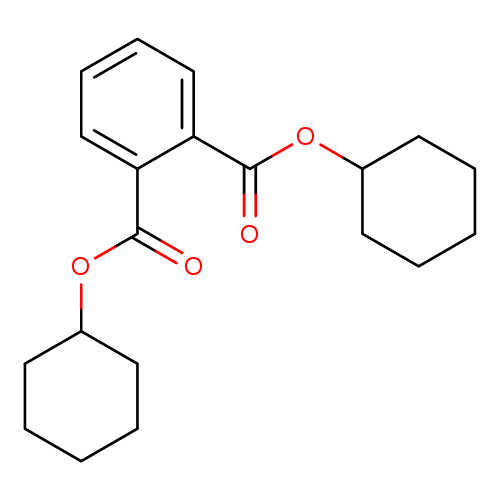
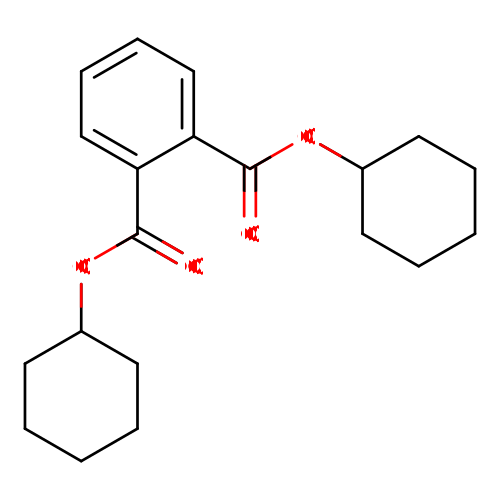
Dicyclohexyl phthalate (CED0011984)

Record Information
Version1.0
Creation Date2009-12-03 20:13:26 UTC
Update Date2026-08-20 06:23:29 UTC
SynCED IDCED0011984
Secondary Accession Numbers
  • CHEM002612
  • T3D3643
Identification
Common NameDicyclohexyl phthalate
ClassSmall Molecule
Description
Dicyclohexyl phthalate (C20H26O4) is a solid at room temperature with an average molecular weight of 330.42 g/mol. Dicyclohexyl phthalate belongs to the benzoic acids and derivatives, a subclass of benzene and substituted derivatives within the organic compounds. This exogenous compound is used industrially as a plasticizer and as processing aids not otherwise specified. The substance is present in plastics such as polyvinyl chloride, polyethylene terephthalate, polyurethane, and ethylene-vinyl acetate, and it is released in polystyrene and polypropylene. It has been found in or released from 25 recorded sources, including drinking water, indoor air, and various household cleaning and consumer products such as soap detergents, bleaching agents, and perfumes within detergents and soaps. Other sources include tobacco smoke filters, food contact materials, fermentation processes for beer, processing meats, and building and construction materials such as stairs and ramps as well as sunshades awnings or outside screens. Additionally, it is associated with electrical and electronic equipment, including electric switches, electric hearing aids, discharge lamps, communication cables or conductors, and conductors or conductive bodies characterised by the conductive materials. Exposure routes include touch, oral, and inhalation. Dicyclohexyl phthalate has six recorded protein targets, including the estrogen receptor (ESR1), nuclear receptor subfamily 1 group I member 2 (NR1I2), retinoic acid receptor RXR-beta (RXRB), and the vitamin D3 receptor (VDR), along with two other proteins. Its presence in polyamide remains inconclusive, and it has not been detected in polycarbonate.
Contaminant Type
  • Aromatic Hydrocarbon
  • Cosmetic Toxin
  • Ester
  • Ether
  • Food Toxin
  • Household Toxin
  • Industrial/Workplace Toxin
  • Organic Compound
  • Phthalate
  • Plasticizer
  • Synthetic Compound
Chemical Structure
Synonyms
ValueSource
Dicyclohexyl phthalic acidGenerator
Chemical FormulaC20H26O4
Average Molecular Mass330.418 g/mol
Monoisotopic Mass330.183 g/mol
CAS Registry Number84-61-7
IUPAC Name1,2-dicyclohexyl benzene-1,2-dicarboxylate
Traditional Namedicyclohexyl phthalate
SMILESO=C(OC1CCCCC1)C1=CC=CC=C1C(=O)OC1CCCCC1
InChI IdentifierInChI=1S/C20H26O4/c21-19(23-15-9-3-1-4-10-15)17-13-7-8-14-18(17)20(22)24-16-11-5-2-6-12-16/h7-8,13-16H,1-6,9-12H2
InChI KeyVOWAEIGWURALJQ-UHFFFAOYSA-N
Chemical Taxonomy
Description Belongs to the class of organic compounds known as benzoic acid esters. These are ester derivatives of benzoic acid.
KingdomOrganic compounds
Super ClassBenzenoids
ClassBenzene and substituted derivatives
Sub ClassBenzoic acids and derivatives
Direct ParentBenzoic acid esters
Alternative Parents
Substituents
  • Benzoate ester
  • Benzoyl
  • Dicarboxylic acid or derivatives
  • Carboxylic acid ester
  • Carboxylic acid derivative
  • Organic oxygen compound
  • Organic oxide
  • Hydrocarbon derivative
  • Organooxygen compound
  • Aromatic homomonocyclic compound
Molecular FrameworkAromatic homomonocyclic compounds
External Descriptors
Biological Properties
StatusDetected and Not Quantified
OriginExogenous
Cellular Locations
  • Membrane
Biofluid LocationsNot Available
Tissue LocationsNot Available
ApplicationsNot Available
Biological RolesNot Available
Chemical RolesNot Available
Organoleptic EffectsNot Available
Physical Properties
StateSolid
AppearanceColorless liquid.
Experimental Properties
PropertyValue
Melting Point66°C
Boiling PointNot Available
Solubility0.004 mg/mL at 24°C
Predicted Properties
PropertyValueSource
Water Solubility0.0011 g/LALOGPS
logP5.01ALOGPS
logP5.58ChemAxon
logS-5.5ALOGPS
pKa (Strongest Basic)-6.7ChemAxon
Physiological Charge0ChemAxon
Hydrogen Acceptor Count2ChemAxon
Hydrogen Donor Count0ChemAxon
Polar Surface Area52.6 ŲChemAxon
Rotatable Bond Count6ChemAxon
Refractivity92.14 m³·mol⁻¹ChemAxon
Polarizability36.74 ųChemAxon
Number of Rings3ChemAxon
BioavailabilityYesChemAxon
Rule of FiveNoChemAxon
Ghose FilterYesChemAxon
Veber's RuleNoChemAxon
MDDR-like RuleYesChemAxon
Spectra
Spectra
Spectrum TypeDescriptionSplash KeyDeposition DateView
Predicted GC-MSPredicted GC-MS Spectrumsplash10-001i-9130000000-bf0948298eaf003c4b85Not AvailableView Spectrum
Predicted GC-MSPredicted GC-MS SpectrumNot AvailableNot AvailableView Spectrum
LC-MS/MSLC-MS/MS Spectrumsplash10-0002-0900000000-6292662bbf9b60a81a1fNot AvailableView Spectrum
LC-MS/MSLC-MS/MS Spectrumsplash10-0002-0900000000-2cfad1f4af158b70d42bNot AvailableView Spectrum
LC-MS/MSLC-MS/MS Spectrumsplash10-0002-0900000000-b282160570c579fdfe29Not AvailableView Spectrum
LC-MS/MSLC-MS/MS Spectrumsplash10-014j-0900000000-485433678a4139d43b45Not AvailableView Spectrum
LC-MS/MSLC-MS/MS Spectrumsplash10-00kb-0900000000-1571f7fd0d316e936cd1Not AvailableView Spectrum
LC-MS/MSLC-MS/MS Spectrumsplash10-00kb-0961000000-c88d62b294acffd6dcb1Not AvailableView Spectrum
LC-MS/MSLC-MS/MS Spectrumsplash10-0002-0900000000-2efae9c6305335252bfaNot AvailableView Spectrum
LC-MS/MSLC-MS/MS Spectrumsplash10-0002-0900000000-1a9c5667074c58fd3aeaNot AvailableView Spectrum
LC-MS/MSLC-MS/MS Spectrumsplash10-000i-0900000000-dc2329b6e9627b0ab41eNot AvailableView Spectrum
LC-MS/MSLC-MS/MS Spectrumsplash10-000i-0900000000-0e9e05d84dece9c4fcf4Not AvailableView Spectrum
LC-MS/MSLC-MS/MS Spectrumsplash10-0592-1900000000-5dde58db5f1d07da7958Not AvailableView Spectrum
LC-MS/MSLC-MS/MS Spectrumsplash10-004i-0009000000-d6f710e95c96144c9293Not AvailableView Spectrum
LC-MS/MSLC-MS/MS Spectrumsplash10-004r-0908000000-2feeaa694888a4f85bc6Not AvailableView Spectrum
LC-MS/MSLC-MS/MS Spectrumsplash10-059b-1900000000-1bcdee72e6811fa5577aNot AvailableView Spectrum
LC-MS/MSLC-MS/MS Spectrumsplash10-006t-2900000000-7fd656f0fb35208fe09eNot AvailableView Spectrum
LC-MS/MSLC-MS/MS Spectrumsplash10-0002-0900000000-65d03365935b622d1c5aNot AvailableView Spectrum
LC-MS/MSLC-MS/MS Spectrumsplash10-0002-0900000000-7d99b84ee48e55ce76c7Not AvailableView Spectrum
LC-MS/MSLC-MS/MS Spectrumsplash10-0002-0900000000-5b09efcb9bfbcd703743Not AvailableView Spectrum
Predicted LC-MS/MSPredicted LC-MS/MS Spectrumsplash10-001i-4049000000-19a242cdddec79ba89d4Not AvailableView Spectrum
Predicted LC-MS/MSPredicted LC-MS/MS Spectrumsplash10-001i-9252000000-827bb993f2bceb843e28Not AvailableView Spectrum
Predicted LC-MS/MSPredicted LC-MS/MS Spectrumsplash10-0536-9200000000-85eeb6af0b4b3ace20c3Not AvailableView Spectrum
Predicted LC-MS/MSPredicted LC-MS/MS Spectrumsplash10-004i-2019000000-b1267d2f456e3940f8d8Not AvailableView Spectrum
Predicted LC-MS/MSPredicted LC-MS/MS Spectrumsplash10-004j-6289000000-9268ea958926bcb137a8Not AvailableView Spectrum
Predicted LC-MS/MSPredicted LC-MS/MS Spectrumsplash10-0002-9210000000-911ce1d58439498b5221Not AvailableView Spectrum
Predicted LC-MS/MSPredicted LC-MS/MS Spectrumsplash10-001i-1295000000-0cb0458e63126d3c03d4Not AvailableView Spectrum
Predicted LC-MS/MSPredicted LC-MS/MS Spectrumsplash10-000t-1930000000-545068521fb53ba9c97eNot AvailableView Spectrum
Predicted LC-MS/MSPredicted LC-MS/MS Spectrumsplash10-001i-9031000000-92177c5e45de61647278Not AvailableView Spectrum
Predicted LC-MS/MSPredicted LC-MS/MS Spectrumsplash10-004i-0009000000-99d606b10294240605d3Not AvailableView Spectrum
Predicted LC-MS/MSPredicted LC-MS/MS Spectrumsplash10-004i-1039000000-4c140dd4eb976968d3c2Not AvailableView Spectrum
Predicted LC-MS/MSPredicted LC-MS/MS Spectrumsplash10-006t-2921000000-e0aecbc57278515b9171Not AvailableView Spectrum
MSMS Spectrumsplash10-0002-4900000000-a0f78df766b297c29260Not AvailableView Spectrum
Toxicity Profile
Toxicity Values
Toxicity ValueOrganismDose DescriptorRoute of ExposurePredicted or ExperimentalToxicity RatingReference
3200.0 mg/kg >3200MouseLD50OralexperimentalNot Available1
1600.0 mg/kg MouseLD50IntraperitonealexperimentalNot Available1
10014.0 Log mg/kg [5600:18000]RatLD50oralpredictedNot AvailableNot Available
Toxicity / Toxin ClassNot Available
Mechanism of ToxicityPhthalate esters are endocrine disruptors. They decrease foetal testis testosterone production and reduce the expression of steroidogenic genes by decreasing mRNA expression. Some phthalates have also been shown to reduce the expression of insulin-like peptide 3 (insl3), an important hormone secreted by the Leydig cell necessary for development of the gubernacular ligament. Animal studies have shown that these effects disrupt reproductive development and can cause a number of malformations in affected young. (2)
Carcinogenicity (IARC Classification)No indication of carcinogenicity to humans (not listed by IARC).
Minimum Risk LevelNot Available
SymptomsPhthalate esters are endocrine disruptors and can cause a number of developmental malformations termed 'phthalate syndrome'. (2)
TreatmentNot Available
Health Effects
Health EffectRelationshipDirectionDescriptionReference
type 2 diabetes mellitusAssociated With?Not AvailableNot AvailablePMC10194346
metabolic diseaseAssociated With?Not AvailableNot AvailablePMC10194346 , PMC10194346
vascular alterationAssociated With?decreaseNot AvailablePMC12696147
Exposure Sources
Source IDSourceSectorReference
CEDs000010Insecticides?Insecticides are synthetic chemicals designed to control or eliminate insect pests that threaten crops and other agricultural products.Agriculture & land managementPubChem
CEDs000013Soil?Soil serves as a critical medium for plant growth and sustains various ecological functions; however, it can become a reservoir for synthetic chemical contamination.Agriculture & land managementPMC10973024
CEDs000019Indoor air?Indoor air can be a significant reservoir for synthetic chemical contaminants, which often originate from various sources within enclosed environments.Air, dust & atmospheric transportNot Available
CEDs000115Drinking water?Drinking water can be a medium for synthetic chemical contamination, often originating from various industrial processes and agricultural practices.Drinking water & water supplyNot Available
CEDs000164Toys?Toys can be a source of synthetic chemical contamination due to the materials and additives used in their production.Household itemsPMC10235726
CEDs000181Ballast water?Ballast water, taken on by ships to maintain stability and balance, often contains a diverse array of microorganisms, including bacteria, viruses, and plankton.Marine, shipping & aquaculturePubChem
CEDs000182Bilge water?Bilge water is a byproduct generated from the accumulation of water in the lowest part of a ship's hull, which may include a mixture of seawater, oil, fuel residues, and various contaminants.Marine, shipping & aquaculturePubChem
CEDs000233Brushes?Brushes used in personal care and cosmetics can be a source of synthetic chemical contamination due to the materials and coatings used in their manufacturing.Personal care & cosmeticsPubChem
CEDs000494Food contact materials?Food contact materials refer to substances and products that are intended to come into contact with food during processing, packaging, or preparation.Food, food processing & cookwareNot Available
CEDs000500Stairs And Ramps?Stairs and ramps in construction are often treated with various synthetic chemicals to enhance durability, slip resistance, and weather resistance.Building & ConstructionPubChem
CEDs000501Sunshades Awnings Or Outside Screens?Sunshades, awnings, and outside screens are often constructed using synthetic materials such as polyvinyl chloride (PVC), polyester, or acrylic fabrics.Building & ConstructionPubChem
CEDs000502Sunshades Awnings Or Outside Screens?Sunshades, awnings, and outside screens are commonly used in construction to enhance energy efficiency and provide shade.Building & ConstructionPubChem
CEDs000510Communication Cables Or Conductors?Communication cables or conductors are essential components in the transmission of data and signals in various applications, including telecommunications and networking.Electrical & Electronic EquipmentPubChem
CEDs000511Conductors Or Conductive Bodies Characterised By The Conductive Materials?Conductors, or conductive bodies, are materials that allow the flow of electrical current, typically made from metals such as copper, aluminum, or silver.Electrical & Electronic EquipmentPubChem
CEDs000514Discharge Lamps?Discharge lamps, including fluorescent and high-intensity discharge (HID) lamps, are commonly used for lighting applications due to their energy efficiency and brightness.Electrical & Electronic EquipmentPubChem
CEDs000516Electric Hearing Aids?Electric hearing aids are small electronic devices designed to amplify sound for individuals with hearing loss.Electrical & Electronic EquipmentPubChem
CEDs000517Electric Switches?Electric switches, integral components in numerous devices, can be a source of synthetic chemical contamination due to the materials and manufacturing processes involved in their production.Electrical & Electronic EquipmentPubChem
CEDs000519Electrodes?Electrodes, used in various electrical and electronic applications, can be a source of synthetic chemical contamination due to the materials from which they are constructed and the processes involved in their manufacturing.Electrical & Electronic EquipmentPubChem
CEDs000520Emergency Protective Devices?Emergency protective devices, such as circuit breakers and surge protectors, are essential components in electrical systems designed to prevent damage from overcurrent and surges.Electrical & Electronic EquipmentPubChem
CEDs000523Gas Filled Discharge Tubes With Solid Cathode?Gas Filled Discharge Tubes with Solid Cathodes are electrical components that facilitate the flow of current by ionizing gas within a sealed tube.Electrical & Electronic EquipmentPubChem
CEDs000524Hybrid Capacitors?Hybrid capacitors are energy storage devices that combine the properties of electrolytic and supercapacitors, utilizing a combination of electrochemical principles to achieve higher energy density and power density.Electrical & Electronic EquipmentPubChem
CEDs000525Line Transmission Systems?Line Transmission Systems, commonly used for the distribution of electrical energy, can be a source of synthetic chemical contamination through the insulation materials and coatings utilized in their construction.Electrical & Electronic EquipmentPubChem
CEDs000529Power Cables?Power cables are used to transmit electrical energy and are typically composed of conductive materials, insulation, and protective coatings.Electrical & Electronic EquipmentPubChem
CEDs000530Radio Transmission Systems?Radio transmission systems utilize a variety of synthetic chemicals in their manufacturing and maintenance processes.Electrical & Electronic EquipmentPubChem
CEDs000537Television Systems?Television systems can be a source of synthetic chemical contamination due to the various materials and components used in their manufacture and operation.Electrical & Electronic EquipmentPubChem
CEDs000544Fermentation Processes For Beer?Fermentation processes for beer involve the conversion of sugars into alcohol and carbon dioxide by yeast.Food, food processing & cookwarePubChem
CEDs000552Processing Meats?Processing meats can lead to synthetic chemical contamination primarily through the use of additives and preservatives.Food, food processing & cookwarePubChem
CEDs000555Bleaching Agents?Bleaching agents are chemical substances used to whiten or lighten materials, often employed in various cleaning products for their stain removal and disinfecting properties.Household cleaning & consumer productsPubChem
CEDs000561Perfumes Within Detergents And Soaps?Perfumes within detergents and soaps are synthetic fragrance compounds added to enhance the sensory experience of cleaning products.Household cleaning & consumer productsPubChem
CEDs000563Soap Detergents?Soap detergents are synthetic surfactants designed to enhance the cleaning efficacy of water by reducing surface tension, allowing for better interaction with dirt and grease.Household cleaning & consumer productsPubChem
CEDs000569Tobacco Smoke Filters?Tobacco smoke filters are designed to reduce the inhalation of harmful substances in cigarette smoke, including tar and other particulate matter.Household cleaning & consumer productsPubChem
CEDs000580Manufacture Preparation Of Tobacco Products?The manufacture and preparation of tobacco products involve various processes that can result in the introduction of synthetic chemicals into the environment.Industrial manufacturing & chemical processingPubChem
CEDs000596Acaricides?Acaricides are synthetic chemicals specifically designed to target and control mite populations that can damage crops and plants.Agriculture & land managementPubChem
CEDs000611Anti Perspirants Or Body Deoderants?Antiperspirants and body deodorants commonly contain synthetic chemicals such as aluminum compounds, parabens, and synthetic fragrances.Personal care & cosmeticsPubChem
CEDs000614Essential Oils Or Perfumes?Essential oils and perfumes are complex mixtures of volatile compounds derived from natural or synthetic sources, commonly used for their aromatic properties.Personal care & cosmeticsPubChem
CEDs000615Eye Makeup Products?Eye makeup products, including mascaras, eyeliners, and eyeshadows, often contain a variety of synthetic chemicals such as pigments, preservatives, and film-forming agents.Personal care & cosmeticsPubChem
CEDs000618Lip Makeup Products?Lip makeup products, such as lipsticks, lip glosses, and lip liners, often contain a variety of synthetic chemicals, including pigments, preservatives, and emollients.Personal care & cosmeticsPubChem
CEDs000630Toys?Toys, particularly those made from synthetic materials such as plastics, can be a source of chemical contamination due to the presence of various additives and compounds used in their production.Recreation & sports surfacesPubChem
CEDs000632Apparel?Apparel production often involves the use of various synthetic chemicals, including dyes, finishing agents, and preservatives.Textiles, leather & furnishingsPubChem
CEDs000635Buttons?Buttons, often made from synthetic materials such as polyester, nylon, or polycarbonate, can be a source of synthetic chemical contamination during their production, use, and disposal.Textiles, leather & furnishingsPubChem
CEDs000638Decorating Textiles?Decorating textiles often involves the use of synthetic chemicals such as dyes, finishes, and coatings.Textiles, leather & furnishingsPubChem
CEDs000642Footwear?Footwear production often involves the use of various synthetic chemicals, such as adhesives, dyes, and treatments, which can contribute to environmental contamination.Textiles, leather & furnishingsPubChem
CEDs000643Headwear?Headwear made from synthetic materials often incorporates chemicals used in the manufacturing and finishing processes, such as dyes, flame retardants, and water repellents.Textiles, leather & furnishingsPubChem
CEDs000650Purses Luggage Hand Bags?Purses, luggage, and handbags are often manufactured using synthetic materials such as polyvinyl chloride (PVC), polyurethane, and various types of nylon.Textiles, leather & furnishingsPubChem
CEDs000652Ropes?Ropes manufactured from synthetic fibers, such as polypropylene, nylon, and polyester, are widely used in various applications, including marine, construction, and outdoor activities.Textiles, leather & furnishingsPubChem
CEDs000653Sewing?Sewing processes often involve the use of various synthetic chemicals, which can become sources of contamination in the environment.Textiles, leather & furnishingsPubChem
CEDs000657Surface Finishing Of Leather?Surface finishing of leather often involves the use of various synthetic chemicals, including dyes, resins, and finishing agents.Textiles, leather & furnishingsPubChem
CEDs000659Transfer Printing?Transfer printing is a process used to apply designs and patterns onto various substrates, commonly utilizing synthetic dyes and inks that can contain hazardous chemicals.Textiles, leather & furnishingsPubChem
CEDs000662Yarns Or Threads?Yarns or threads used in textiles can be a source of synthetic chemical contamination due to the production processes and treatments they undergo.Textiles, leather & furnishingsPubChem
CEDs000679Phosphatic Fertilisers?Phosphatic fertilizers are synthetic chemical products primarily composed of phosphorus, which is essential for plant growth.Agriculture & land managementPubChem
CEDs000685Ceramics?Ceramics can be a source of synthetic chemical contamination through various additives and processing agents used in their production.Building & ConstructionPubChem
CEDs000686Clay Wares?Clay wares are ceramic products made from natural clay, often utilized in various construction applications such as tiles, bricks, and sanitary ware.Building & ConstructionPubChem
CEDs000688Glass Coatings?Glass coatings are synthetic chemical formulations applied to glass surfaces to enhance properties such as durability, UV resistance, and aesthetic appeal.Building & ConstructionPubChem
CEDs000691Non Oxide Glass?Non-oxide glass refers to a category of glasses primarily composed of materials other than silicon dioxide, such as boron oxide or phosphorous oxide.Building & ConstructionPubChem
CEDs000693Silica Glass?Silica glass, primarily composed of silicon dioxide (SiO2), is widely used in various applications, including windows, glass facades, and insulation materials.Building & ConstructionPubChem
CEDs000696Nanotechnology?Nanotechnology involves the manipulation of materials at the molecular or atomic level, typically within the range of 1 to 100 nanometers.Industrial manufacturing & chemical processingPubChem
CEDs000705Bookbinding?Bookbinding involves the use of various synthetic chemicals, including adhesives, inks, and coatings, which can contribute to environmental contamination.Paper, pulp & fiber productsPubChem
CEDs000707Books?Books can be a source of synthetic chemical contamination due to the use of various chemicals in their production and preservation processes.Paper, pulp & fiber productsPubChem
CEDs000716Erasers?Erasers, commonly used in writing and drawing applications, are often made from synthetic rubber or thermoplastic materials, which can contain various additives such as plasticizers, fillers, and colorants.Paper, pulp & fiber productsPubChem
CEDs000727Printing Machines Or Presses?Printing machines or presses commonly utilize synthetic chemicals such as inks, solvents, and cleaning agents.Paper, pulp & fiber productsPubChem
CEDs000729Stamps?Stamps, particularly those produced using synthetic inks and adhesives, can contribute to chemical contamination when disposed of improperly.Paper, pulp & fiber productsPubChem
CEDs000734Coating Compositions?Coating compositions, which include paints, sealants, and varnishes, are formulated with a variety of synthetic chemicals such as solvents, resins, pigments, and additives.Building & ConstructionPubChem
CEDs000735Explosives?Explosives are chemical compounds or mixtures designed to undergo rapid decomposition, releasing energy in the form of gas and heat.Defense & military infrastructurePubChem
CEDs000739Inks?Inks are complex mixtures composed of pigments or dyes, solvents, resins, and additives used primarily for printing and writing applications.Paper, pulp & fiber productsPubChem
CEDs000740Paper?Paper production involves the processing of wood fibers and the use of various chemicals, which can lead to synthetic chemical contamination.Paper, pulp & fiber productsPubChem
CEDs000741Pigment Pastes?Pigment pastes are concentrated dispersions of pigments used to impart color and properties to materials.Paper, pulp & fiber productsPubChem
CEDs000743Sludge Treatment?Sludge treatment involves the processing of waste materials generated from wastewater treatment plants, which often contain a variety of organic and inorganic substances.Wastewater, sanitation & biosolidsPubChem
CEDs000744Water, Wastewater, & Sewage Treatment?Water, wastewater, and sewage treatment processes are critical for managing and mitigating pollutants in water systems.Wastewater, sanitation & biosolidsPubChem
CEDs01157FoodsFood, food processing & cookwarePMC8997706
CEDs01800Food Contact MaterialsPackagingPMC11599199
CEDs01830Packaging MaterialPackagingPMC10995151
CEDs01850Food PackagesPackagingPMC10235726
CEDs01886PlasticIndustrial manufacturing & chemical processingPMC11768991
CEDs02255WaterAquatic systems & sedimentsPMC8997706
CEDs02589AirAir, dust & atmospheric transportPMC9876422
CEDs02684ParticulatesAir, dust & atmospheric transportPMC9696275
CEDs02823FlooringsBuilding & ConstructionPMC10235726
CEDs02845CosmeticsPersonal care & cosmeticsPMC10235726
CEDs02847Personal Care ProductsPersonal care & cosmeticsPMC10235726
CEDs03169Consumer ProductsHousehold cleaning & consumer productsPMC8997706
Pathways
0 pathwaysPathway Source: PathBank

No pathways found

No metabolic pathways have been associated with this synthetic chemical

Targets
StructureProteinUniProt IDOrganismRelationshipDetails
Glucocorticoid receptor structureClick to view 3D structureGlucocorticoid receptorP04150HumansKnownNot Available
Estrogen receptor structureClick to view 3D structureEstrogen receptorP03372HumansKnownNot Available
Androgen receptor structureClick to view 3D structureAndrogen receptorP10275HumansKnownNot Available
Nuclear receptor subfamily 1 group I member 2 structureClick to view 3D structureNuclear receptor subfamily 1 group I member 2O75469HumansKnownNot Available
Neuronal acetylcholine receptor subunit alpha-7 structureClick to view 3D structureNeuronal acetylcholine receptor subunit alpha-7P36544HumansPredicted (SEA)
Prediction Confidence Score
0.346
Applicability Domain
0.383
Statistical Significance
0.0038
Supporting Reference Compounds
77
E-value
29.5827
Click to view 3D structureMuscarinic acetylcholine receptor M2P10980Rattus norvegicusPredicted (SEA)
Prediction Confidence Score
0.335
Applicability Domain
0.375
Statistical Significance
0.0024
Supporting Reference Compounds
98
E-value
18.9174
Click to view 3D structureMuscarinic acetylcholine receptor M3Q8VH26Cavia porcellusPredicted (SEA)
Prediction Confidence Score
0.325
Applicability Domain
0.375
Statistical Significance
0.0011
Supporting Reference Compounds
52
E-value
8.95266
Click to view 3D structureMuscarinic acetylcholine receptor M1P08482Rattus norvegicusPredicted (SEA)
Prediction Confidence Score
0.321
Applicability Domain
0.375
Statistical Significance
0.0037
Supporting Reference Compounds
109
E-value
28.8042
Muscarinic acetylcholine receptor M3 structureClick to view 3D structureMuscarinic acetylcholine receptor M3P08483Rattus norvegicusPredicted (SEA)
Prediction Confidence Score
0.317
Applicability Domain
0.353
Statistical Significance
0.0011
Supporting Reference Compounds
55
E-value
8.64126
Muscarinic acetylcholine receptor M5 structureClick to view 3D structureMuscarinic acetylcholine receptor M5P08912HumansPredicted (SEA)
Prediction Confidence Score
0.314
Applicability Domain
0.383
Statistical Significance
0.0124
Supporting Reference Compounds
266
E-value
96.6887
Click to view 3D structureNeuronal acetylcholine receptor subunit alpha-7Q05941Rattus norvegicusPredicted (SEA)
Prediction Confidence Score
0.303
Applicability Domain
0.383
Statistical Significance
0.002
Supporting Reference Compounds
55
E-value
15.7255
Muscarinic acetylcholine receptor M3 structureClick to view 3D structureMuscarinic acetylcholine receptor M3P20309HumansPredicted (SEA)
Prediction Confidence Score
0.302
Applicability Domain
0.341
Statistical Significance
0.0202
Supporting Reference Compounds
310
E-value
157.255
Click to view 3D structureNeuronal acetylcholine receptor subunit alpha-7P49582Mus musculusPredicted (SEA)
Prediction Confidence Score
0.302
Applicability Domain
0.383
Statistical Significance
1.50e-04
Supporting Reference Compounds
8
E-value
1.16774
Click to view 3D structureMuscarinic acetylcholine receptor M1Q8WMX0Bos taurusPredicted (SEA)
Prediction Confidence Score
0.298
Applicability Domain
0.375
Statistical Significance
8.30e-04
Supporting Reference Compounds
18
E-value
6.46149
Acetylcholine-binding protein structureClick to view 3D structureAcetylcholine-binding proteinP58154Lymnaea stagnalisPredicted (SEA)
Prediction Confidence Score
0.296
Applicability Domain
0.39
Statistical Significance
9.10e-04
Supporting Reference Compounds
20
E-value
7.08428
Muscarinic acetylcholine receptor M1 structureClick to view 3D structureMuscarinic acetylcholine receptor M1P11229HumansPredicted (SEA)
Prediction Confidence Score
0.295
Applicability Domain
0.341
Statistical Significance
0.0347
Supporting Reference Compounds
385
E-value
269.981
Muscarinic acetylcholine receptor M2 structureClick to view 3D structureMuscarinic acetylcholine receptor M2P08172HumansPredicted (SEA)
Prediction Confidence Score
0.293
Applicability Domain
0.341
Statistical Significance
0.0337
Supporting Reference Compounds
373
E-value
262.508
Click to view 3D structureSodium-dependent dopamine transporterP23977Rattus norvegicusPredicted (SEA)
Prediction Confidence Score
0.289
Applicability Domain
0.39
Statistical Significance
0.0244
Supporting Reference Compounds
203
E-value
190.186
Muscarinic acetylcholine receptor M4 structureClick to view 3D structureMuscarinic acetylcholine receptor M4P08173HumansPredicted (SEA)
Prediction Confidence Score
0.289
Applicability Domain
0.341
Statistical Significance
0.0299
Supporting Reference Compounds
297
E-value
232.458
Cholinesterase structureClick to view 3D structureCholinesteraseP06276HumansPredicted (SEA)
Prediction Confidence Score
0.285
Applicability Domain
0.333
Statistical Significance
0.036
Supporting Reference Compounds
234
E-value
280.413
Sodium-dependent serotonin transporter structureClick to view 3D structureSodium-dependent serotonin transporterP31645HumansPredicted (SEA)
Prediction Confidence Score
0.284
Applicability Domain
0.383
Statistical Significance
0.0741
Supporting Reference Compounds
593
E-value
576.629
Click to view 3D structureEpoxide hydrolase 1P07099HumansPredicted (SEA)
Prediction Confidence Score
0.283
Applicability Domain
0.359
Statistical Significance
0.0051
Supporting Reference Compounds
18
E-value
39.781
Click to view 3D structurePhosphodiesterase 4AO77823Sus scrofaPredicted (SEA)
Prediction Confidence Score
0.28
Applicability Domain
0.365
Statistical Significance
0.0022
Supporting Reference Compounds
9
E-value
17.2825
5-hydroxytryptamine receptor 1A structureClick to view 3D structure5-hydroxytryptamine receptor 1AP08908HumansPredicted (SEA)
Prediction Confidence Score
0.278
Applicability Domain
0.383
Statistical Significance
0.1226
Supporting Reference Compounds
953
E-value
954.276
5-hydroxytryptamine receptor 3A structureClick to view 3D structure5-hydroxytryptamine receptor 3AP46098HumansPredicted (SEA)
Prediction Confidence Score
0.275
Applicability Domain
0.383
Statistical Significance
0.038
Supporting Reference Compounds
228
E-value
295.827
Click to view 3D structureMuscarinic acetylcholine receptor M4P08485Rattus norvegicusPredicted (SEA)
Prediction Confidence Score
0.274
Applicability Domain
0.341
Statistical Significance
0.0025
Supporting Reference Compounds
38
E-value
19.8516
5-hydroxytryptamine receptor 4 structureClick to view 3D structure5-hydroxytryptamine receptor 4Q13639HumansPredicted (SEA)
Prediction Confidence Score
0.274
Applicability Domain
0.383
Statistical Significance
0.0188
Supporting Reference Compounds
101
E-value
146.201
Click to view 3D structureEpoxide hydrolase 1Q9D379Mus musculusPredicted (SEA)
Prediction Confidence Score
0.273
Applicability Domain
0.359
Statistical Significance
0.0026
Supporting Reference Compounds
8
E-value
20.4743
Bifunctional epoxide hydrolase 2 structureClick to view 3D structureBifunctional epoxide hydrolase 2P34913HumansPredicted (SEA)
Prediction Confidence Score
0.273
Applicability Domain
0.359
Statistical Significance
0.0358
Supporting Reference Compounds
93
E-value
279.089
Estrogen receptor structureClick to view 3D structureEstrogen receptorP03372HumansKnownNot Available
Estrogen receptor beta structureClick to view 3D structureEstrogen receptor betaQ92731HumansKnownNot Available
Nuclear receptor subfamily 1 group I member 2 structureClick to view 3D structureNuclear receptor subfamily 1 group I member 2O75469HumansKnownNot Available
Vitamin D3 receptor structureClick to view 3D structureVitamin D3 receptorP11473HumansKnownNot Available
Click to view 3D structureTranslocator proteinP30536HumansKnownNot Available
Retinoic acid receptor RXR-beta structureClick to view 3D structureRetinoic acid receptor RXR-betaP28702HumansKnownNot Available
Concentrations
Not Available
External Links
DrugBank IDNot Available
HMDB IDHMDB0251213
FooDB IDNot Available
Phenol Explorer IDNot Available
KNApSAcK IDNot Available
BiGG IDNot Available
BioCyc IDNot Available
METLIN IDNot Available
PDB IDNot Available
Wikipedia LinkNot Available
Chemspider ID6519
ChEBI IDNot Available
PubChem Compound IDNot Available
Kegg Compound IDC14529
YMDB IDNot Available
ECMDB IDNot Available
References
Synthesis ReferenceNot Available
MSDSNot Available
General References
  1. Quadros EV, Jacobsen DW: The dynamics of cobalamin utilization in L-1210 mouse leukemia cells: a model of cellular cobalamin metabolism. Biochim Biophys Acta. 1995 Jun 9;1244(2-3):395-403. [PubMed: 7599160]
  2. Wilson VS, Blystone CR, Hotchkiss AK, Rider CV, Gray LE Jr: Diverse mechanisms of anti-androgen action: impact on male rat reproductive tract development. Int J Androl. 2008 Apr;31(2):178-87. doi: 10.1111/j.1365-2605.2007.00861.x. [PubMed: 18315717]
  3. Wittassek M, Angerer J: Phthalates: metabolism and exposure. Int J Androl. 2008 Apr;31(2):131-8. Epub 2007 Dec 7. [PubMed: 18070048]
  4. Wikipedia. Phthalate. Last Updated 22 November 2009. - http://en.wikipedia.org/wiki/Phthalate
  5. European Chemicals Bureau (2000). IUCLID Dataset, Dicyclohexyl Phthalate (84-61-7).