Hydrated silica (CED0001696)

Record Information
Version1.0
Creation Date2016-05-19 03:05:06 UTC
Update Date2026-08-19 21:32:46 UTC
SynCED IDCED0001696
Secondary Accession Numbers
  • CHEM009447
Identification
Common NameHydrated silica
ClassSmall Molecule
Description
Hydrated silica belongs to the amines, a subclass of organonitrogen compounds within the organic compounds. This compound has the formula C17H25N and an average molecular weight of 243.39 g/mol. It is classified under the superclass of organic nitrogen compounds and the class of organonitrogen compounds. Industrially, hydrated silica serves a wide variety of roles and uses. It is employed as a filler, abrasive, absorbent, opacifer, and flow promoter. Additionally, it functions as a deodorizer, diluent, dispersing agent, viscosity modifier, thickening agent, and fragrance. It is also used as a surface modifier, an anti-adhesive/cohesive agent, and as a crystal growth modifier acting as a nucleating agent. It is further utilized as a processing aid not otherwise specified. The compound is found in or released from 28 recorded sources. These include electrical and electronic equipment, such as amplifiers, antennas, auxiliary devices, communication cables or conductors, and conductors or conductive bodies characterised by the conductive materials, among 10 others. In household cleaning and consumer products, it is present in bleaching agents, cigar cigarettes, perfumes within detergents and soaps, soap detergents, and tobacco pipes, as well as one other source. Within building and construction, it is found in ceilings, floors, and roofs. It is also associated with food, food processing, and cookware, specifically in food preservation, processing meats, and fermentation processes for beer. Furthermore, it is found in household items such as key rings. Regarding biological activity, hydrated silica has five recorded protein targets, acting as an antagonist/inhibitor of Sigma non-opioid intracellular receptor 1 (SIGMAR1), Glutamate receptor ionotropic NMDA 1 (GRIN1), Glutamate receptor ionotropic NMDA 2B (GRIN2B), Glutamate receptor ionotropic NMDA 3A (GRIN3A), and one other protein.
Contaminant Type
  • Human Neurotoxin
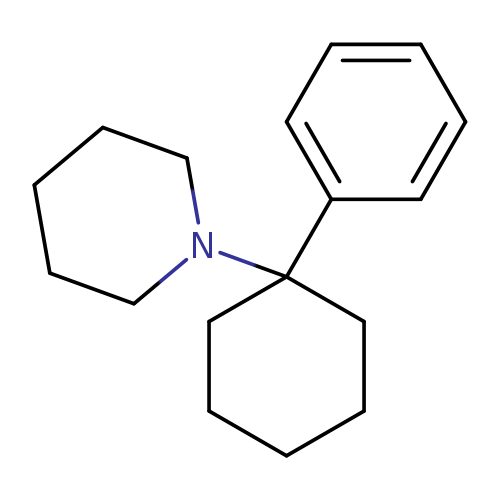
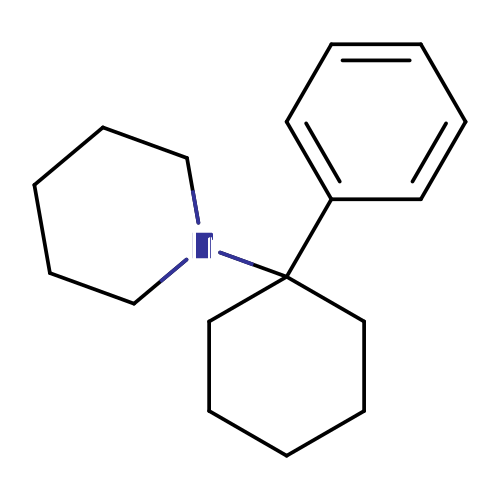
Chemical Structure
Synonyms
ValueSource
FenciclidinaChEBI
PCPChEBI
PhencyclidinumChEBI
Angel dustMeSH
SerylanMeSH
Dust, angelMeSH
Phencyclidine hydrochlorideMeSH
SernylMeSH
1-(1-Phenylcyclohexyl)piperidineMeSH
Phencyclidine hydrobromideMeSH
Chemical FormulaC17H25N
Average Molecular Mass243.387 g/mol
Monoisotopic Mass243.199 g/mol
CAS Registry Number112926-00-8
IUPAC Name1-(1-phenylcyclohexyl)piperidine
Traditional Nameselma
SMILESC1CCN(CC1)C1(CCCCC1)C1=CC=CC=C1
InChI IdentifierInChI=1S/C17H25N/c1-4-10-16(11-5-1)17(12-6-2-7-13-17)18-14-8-3-9-15-18/h1,4-5,10-11H,2-3,6-9,12-15H2
InChI KeyJTJMJGYZQZDUJJ-UHFFFAOYSA-N
Chemical Taxonomy
Description Belongs to the class of organic compounds known as aralkylamines. These are alkylamines in which the alkyl group is substituted at one carbon atom by an aromatic hydrocarbyl group.
KingdomOrganic compounds
Super ClassOrganic nitrogen compounds
ClassOrganonitrogen compounds
Sub ClassAmines
Direct ParentAralkylamines
Alternative Parents
Substituents
  • Aralkylamine
  • Cyclohexylamine
  • Benzenoid
  • Piperidine
  • Monocyclic benzene moiety
  • Tertiary aliphatic amine
  • Tertiary amine
  • Azacycle
  • Organoheterocyclic compound
  • Organopnictogen compound
  • Hydrocarbon derivative
  • Aromatic heteromonocyclic compound
Molecular FrameworkAromatic heteromonocyclic compounds
External Descriptors
Biological Properties
StatusDetected and Not Quantified
OriginNot Available
Cellular LocationsNot Available
Biofluid LocationsNot Available
Tissue LocationsNot Available
ApplicationsNot Available
Biological Roles
Chemical RolesNot Available
Organoleptic EffectsNot Available
Physical Properties
StateNot Available
AppearanceNot Available
Experimental Properties
PropertyValue
Melting PointNot Available
Boiling PointNot Available
SolubilityNot Available
Predicted Properties
PropertyValueSource
Water Solubility0.0032 g/LALOGPS
logP5.31ALOGPS
logP4.49ChemAxon
logS-4.9ALOGPS
pKa (Strongest Basic)10.64ChemAxon
Physiological Charge1ChemAxon
Hydrogen Acceptor Count1ChemAxon
Hydrogen Donor Count0ChemAxon
Polar Surface Area3.24 ŲChemAxon
Rotatable Bond Count2ChemAxon
Refractivity77.65 m³·mol⁻¹ChemAxon
Polarizability29.66 ųChemAxon
Number of Rings3ChemAxon
BioavailabilityYesChemAxon
Rule of FiveYesChemAxon
Ghose FilterYesChemAxon
Veber's RuleYesChemAxon
MDDR-like RuleNoChemAxon
Spectra
Spectra
Spectrum TypeDescriptionSplash KeyDeposition DateView
GC-MSGC-MS Spectrumsplash10-0uyl-9740000000-a1aa5f844f1483af1bc7Not AvailableView Spectrum
Predicted GC-MSPredicted GC-MS Spectrumsplash10-00di-0920000000-67053cf44c8040a3c510Not AvailableView Spectrum
Predicted GC-MSPredicted GC-MS SpectrumNot AvailableNot AvailableView Spectrum
Predicted LC-MS/MSPredicted LC-MS/MS Spectrumsplash10-0006-0190000000-169bbbaf9329b1569703Not AvailableView Spectrum
Predicted LC-MS/MSPredicted LC-MS/MS Spectrumsplash10-052f-2690000000-b23ab1907da4b999f8b7Not AvailableView Spectrum
Predicted LC-MS/MSPredicted LC-MS/MS Spectrumsplash10-00kf-9840000000-cfc9c01b91cc06847aa7Not AvailableView Spectrum
Predicted LC-MS/MSPredicted LC-MS/MS Spectrumsplash10-0006-0090000000-40ebbb38b0f7a643c4deNot AvailableView Spectrum
Predicted LC-MS/MSPredicted LC-MS/MS Spectrumsplash10-0006-1190000000-e851147ab61218e666cfNot AvailableView Spectrum
Predicted LC-MS/MSPredicted LC-MS/MS Spectrumsplash10-00ec-9630000000-71b986393f4551b0d976Not AvailableView Spectrum
Toxicity Profile
Toxicity Values
Toxicity ValueOrganismDose DescriptorRoute of ExposurePredicted or ExperimentalToxicity RatingReference
252.0 Log mg/kg [140:450]RatLD50oralpredictedNot AvailableNot Available
Toxicity / Toxin ClassNot Available
Mechanism of ToxicityNot Available
Carcinogenicity (IARC Classification)Not Available
Minimum Risk LevelNot Available
SymptomsNot Available
TreatmentNot Available
Health Effects
Health EffectRelationshipDirectionDescriptionReference
inflammationHas Therapeutic Effect OnNot AvailableNot AvailablePMC12563372
necrosisAssociated With?Not AvailableA disorder characterized as a form of cell injury which results in the premature death of cells in living tissue by autolysis.PMC3649668
liver diseaseAssociated With?Not AvailableA disorder characterized by any variety of factors leading to damage to the liver.PMC3649668
neurodegenerative diseaseNot AvailableNot AvailableA central nervous system disease that results in the progressive deterioration of function or structure of neurons. (DO)PMC9610736
Oxidative StressHas Therapeutic Effect OnNot AvailableNot AvailablePMC9610736
Lung InjuryAssociated With?Not AvailableNot AvailablePMC10078756
Hot flashesAssociated With?increaseNot AvailablePMC8187273 , PMC8187273
ParanoiaAssociated With?Not AvailableNot AvailablePMC8523815
Exposure Sources
Source IDSourceSectorReference
CEDs000010Insecticides?Insecticides are synthetic chemicals designed to control or eliminate insect pests that threaten crops and other agricultural products.Agriculture & land managementPubChem
CEDs000013Soil?Soil serves as a critical medium for plant growth and sustains various ecological functions; however, it can become a reservoir for synthetic chemical contamination.Agriculture & land managementPMC7765096 , PMC7765096
CEDs000048Marine sediment?Marine sediment can serve as a significant reservoir for synthetic chemical contaminants, which may originate from various anthropogenic activities.Aquatic systems & sedimentsPMC5895666
CEDs000050Groundwater?Groundwater serves as a vital resource for drinking water and agricultural irrigation but is increasingly susceptible to contamination from synthetic chemicals.Aquatic systems & sedimentsPMC7765096 , PMC182943
CEDs000051Surface water?Surface water can serve as a significant vector for the introduction of synthetic chemical contaminants into aquatic ecosystems.Aquatic systems & sedimentsPMC11775160
CEDs000070Stormwater runoff?Stormwater runoff refers to the flow of rainwater or melted snow that does not soak into the ground and instead collects pollutants as it travels over impervious surfaces such as roads and parking lots.Automotive & urban infrastructurePubChem
CEDs000115Drinking water?Drinking water can be a medium for synthetic chemical contamination, often originating from various industrial processes and agricultural practices.Drinking water & water supplyPMC3649668
CEDs000181Ballast water?Ballast water, taken on by ships to maintain stability and balance, often contains a diverse array of microorganisms, including bacteria, viruses, and plankton.Marine, shipping & aquaculturePubChem
CEDs000182Bilge water?Bilge water is a byproduct generated from the accumulation of water in the lowest part of a ship's hull, which may include a mixture of seawater, oil, fuel residues, and various contaminants.Marine, shipping & aquaculturePubChem
CEDs000233Brushes?Brushes used in personal care and cosmetics can be a source of synthetic chemical contamination due to the materials and coatings used in their manufacturing.Personal care & cosmeticsPubChem
CEDs000464Leachate?Leachate is a liquid that forms when water percolates through waste material, dissolving soluble compounds and carrying various contaminants.Waste management, landfill & incinerationPMC7765096 , PMC7765096
CEDs000495Ceilings?Ceilings in built environments can be a source of synthetic chemical contamination due to the materials used in their construction and finishes.Building & ConstructionPubChem
CEDs000497Floors?Floors in built environments can be a significant source of synthetic chemical contamination due to the materials and finishes used in their construction.Building & ConstructionPubChem
CEDs000499Roofs?Roofs can be a significant source of synthetic chemical contamination due to the materials used in their construction and maintenance.Building & ConstructionPubChem
CEDs000505Amplifiers?Amplifiers, commonly used in various electronic devices to enhance signal strength, can be a source of synthetic chemical contamination due to the materials and processes involved in their production and disposal.Electrical & Electronic EquipmentPubChem
CEDs000506Antennas?Antennas, commonly used in communication technologies, can be a source of synthetic chemical contamination through the materials and coatings used in their construction.Electrical & Electronic EquipmentPubChem
CEDs000507Auxiliary Devices?Auxiliary devices, such as capacitors, transformers, and circuit breakers, are integral components in various electronic systems.Electrical & Electronic EquipmentPubChem
CEDs000510Communication Cables Or Conductors?Communication cables or conductors are essential components in the transmission of data and signals in various applications, including telecommunications and networking.Electrical & Electronic EquipmentPubChem
CEDs000511Conductors Or Conductive Bodies Characterised By The Conductive Materials?Conductors, or conductive bodies, are materials that allow the flow of electrical current, typically made from metals such as copper, aluminum, or silver.Electrical & Electronic EquipmentPubChem
CEDs000516Electric Hearing Aids?Electric hearing aids are small electronic devices designed to amplify sound for individuals with hearing loss.Electrical & Electronic EquipmentPubChem
CEDs000517Electric Switches?Electric switches, integral components in numerous devices, can be a source of synthetic chemical contamination due to the materials and manufacturing processes involved in their production.Electrical & Electronic EquipmentPubChem
CEDs000518Electrically Stimulated Smoking Devices?Electrically stimulated smoking devices, commonly known as e-cigarettes or vape pens, utilize electrical components to heat a liquid solution, often containing nicotine, flavorings, and other additives, to produce an aerosol for inhalation.Electrical & Electronic EquipmentPubChem
CEDs000519Electrodes?Electrodes, used in various electrical and electronic applications, can be a source of synthetic chemical contamination due to the materials from which they are constructed and the processes involved in their manufacturing.Electrical & Electronic EquipmentPubChem
CEDs000520Emergency Protective Devices?Emergency protective devices, such as circuit breakers and surge protectors, are essential components in electrical systems designed to prevent damage from overcurrent and surges.Electrical & Electronic EquipmentPubChem
CEDs000521Fixed Capacitors And Their Manufacture?Fixed capacitors are passive electronic components used to store and release electrical energy, playing a critical role in various circuits.Electrical & Electronic EquipmentPubChem
CEDs000524Hybrid Capacitors?Hybrid capacitors are energy storage devices that combine the properties of electrolytic and supercapacitors, utilizing a combination of electrochemical principles to achieve higher energy density and power density.Electrical & Electronic EquipmentPubChem
CEDs000530Radio Transmission Systems?Radio transmission systems utilize a variety of synthetic chemicals in their manufacturing and maintenance processes.Electrical & Electronic EquipmentPubChem
CEDs000537Television Systems?Television systems can be a source of synthetic chemical contamination due to the various materials and components used in their manufacture and operation.Electrical & Electronic EquipmentPubChem
CEDs000539Video Games?Video games, through their production and disposal processes, can be a source of synthetic chemical contamination.Electrical & Electronic EquipmentPubChem
CEDs000544Fermentation Processes For Beer?Fermentation processes for beer involve the conversion of sugars into alcohol and carbon dioxide by yeast.Food, food processing & cookwarePubChem
CEDs000545Food Preservation?Food preservation often involves the use of synthetic chemicals, such as preservatives, flavor enhancers, and color additives, to extend shelf life and enhance the sensory qualities of food products.Food, food processing & cookwarePubChem
CEDs000552Processing Meats?Processing meats can lead to synthetic chemical contamination primarily through the use of additives and preservatives.Food, food processing & cookwarePubChem
CEDs000555Bleaching Agents?Bleaching agents are chemical substances used to whiten or lighten materials, often employed in various cleaning products for their stain removal and disinfecting properties.Household cleaning & consumer productsPubChem
CEDs000556Cigar Cigarettes?Cigar cigarettes are a source of synthetic chemical contamination due to the combustion of various tobacco blends and additives.Household cleaning & consumer productsPubChem
CEDs000561Perfumes Within Detergents And Soaps?Perfumes within detergents and soaps are synthetic fragrance compounds added to enhance the sensory experience of cleaning products.Household cleaning & consumer productsPubChem
CEDs000563Soap Detergents?Soap detergents are synthetic surfactants designed to enhance the cleaning efficacy of water by reducing surface tension, allowing for better interaction with dirt and grease.Household cleaning & consumer productsPubChem
CEDs000566Tobacco Pipes?Tobacco pipes, often made from materials such as plastic, wood, or metal, can serve as sources of synthetic chemical contamination due to the residues left by tobacco products.Household cleaning & consumer productsPubChem
CEDs000569Tobacco Smoke Filters?Tobacco smoke filters are designed to reduce the inhalation of harmful substances in cigarette smoke, including tar and other particulate matter.Household cleaning & consumer productsPubChem
CEDs000573Key Rings?Key rings are commonly made from various synthetic materials, including plastics and metals, which can be sources of chemical contamination.Household itemsPubChem
CEDs000578Making Cigars?The process of making cigars involves several steps, including the cultivation of tobacco, fermentation, and the application of various additives to enhance flavor and preservation.Industrial manufacturing & chemical processingPubChem
CEDs000579Manufacture Of Iron Or Steel?The manufacture of iron or steel involves various processes, including smelting, refining, and alloying, which can result in the release of synthetic chemicals and contaminants.Industrial manufacturing & chemical processingPubChem
CEDs000580Manufacture Preparation Of Tobacco Products?The manufacture and preparation of tobacco products involve various processes that can result in the introduction of synthetic chemicals into the environment.Industrial manufacturing & chemical processingPubChem
CEDs000581Paper Making Machines?Paper making machines utilize various synthetic chemicals throughout the production process, including additives, coatings, and bleaching agents.Industrial manufacturing & chemical processingPubChem
CEDs000583Anchoring Equipment?Anchoring equipment, commonly used in marine applications, can be a source of synthetic chemical contamination due to the materials and coatings utilized in their manufacturing.Marine, shipping & aquaculturePubChem
CEDs000584Buoys?Buoys, often used for navigation and marine monitoring, can be sources of synthetic chemical contamination due to the materials and coatings employed in their construction.Marine, shipping & aquaculturePubChem
CEDs000585Canoes And Kayaks?Canoes and kayaks, commonly used for recreational and transportation purposes, can contribute to synthetic chemical contamination primarily through the materials used in their construction and maintenance.Marine, shipping & aquaculturePubChem
CEDs000588Inflatable Life Saving Equipment?Inflatable Life Saving Equipment (ILSE) is commonly made from synthetic materials such as polyvinyl chloride (PVC), thermoplastic polyurethane (TPU), or nylon coated with polymer films.Marine, shipping & aquaculturePubChem
CEDs000589Life Buoys?Life buoys, commonly used in marine environments for safety and rescue operations, can be a source of synthetic chemical contamination due to the materials used in their production.Marine, shipping & aquaculturePubChem
CEDs000590Lifeboat Equipment?Lifeboat equipment typically includes various synthetic materials used in the construction of life rafts, flotation devices, and safety gear.Marine, shipping & aquaculturePubChem
CEDs000592Marine Propulsion Or Steering?Marine propulsion and steering systems often rely on various synthetic chemicals, including lubricants, fuels, and hydraulic fluids.Marine, shipping & aquaculturePubChem
CEDs000593Nautical Instruments?Nautical instruments, often utilized for navigation and monitoring in marine environments, can be a source of synthetic chemical contamination due to the materials and processes involved in their manufacture and operation.Marine, shipping & aquaculturePubChem
CEDs000595Ships?Ships, as vehicles for international trade and transportation, can be significant sources of synthetic chemical contamination in marine environments.Marine, shipping & aquaculturePubChem
CEDs000596Acaricides?Acaricides are synthetic chemicals specifically designed to target and control mite populations that can damage crops and plants.Agriculture & land managementPubChem
CEDs000598Fertiliser Distributors?Fertiliser distributors play a critical role in the supply of synthetic fertilizers, which are widely used to enhance soil fertility and crop yield.Agriculture & land managementPubChem
CEDs000600Herbicides And Algicides?Herbicides and algicides are synthetic chemicals primarily used to control unwanted plants and algae in various environments.Agriculture & land managementPubChem
CEDs000603Nematocides?Nematocides are synthetic chemicals specifically designed to control nematodes, which are microscopic roundworms that can cause significant damage to crops and plants.Agriculture & land managementPubChem
CEDs000606Plant Growth Regulators?Plant Growth Regulators (PGRs) are synthetic chemicals designed to influence the growth and development of plants.Agriculture & land managementPubChem
CEDs000610Aftersun Products?Aftersun products are designed to soothe and hydrate the skin after sun exposure, often containing various synthetic chemicals such as emollients, preservatives, and fragrances.Personal care & cosmeticsPubChem
CEDs000611Anti Perspirants Or Body Deoderants?Antiperspirants and body deodorants commonly contain synthetic chemicals such as aluminum compounds, parabens, and synthetic fragrances.Personal care & cosmeticsPubChem
CEDs000614Essential Oils Or Perfumes?Essential oils and perfumes are complex mixtures of volatile compounds derived from natural or synthetic sources, commonly used for their aromatic properties.Personal care & cosmeticsPubChem
CEDs000615Eye Makeup Products?Eye makeup products, including mascaras, eyeliners, and eyeshadows, often contain a variety of synthetic chemicals such as pigments, preservatives, and film-forming agents.Personal care & cosmeticsPubChem
CEDs000617Lip Care Products?Lip care products, including lipsticks, balms, and glosses, often contain a variety of synthetic chemicals such as parabens, phthalates, and synthetic fragrances.Personal care & cosmeticsPubChem
CEDs000618Lip Makeup Products?Lip makeup products, such as lipsticks, lip glosses, and lip liners, often contain a variety of synthetic chemicals, including pigments, preservatives, and emollients.Personal care & cosmeticsPubChem
CEDs000620Card Games?Card games often utilize synthetic materials for playing cards and associated gaming equipment, which may contain various chemicals such as polyvinyl chloride (PVC), plastics, and dyes.Recreation & sports surfacesPubChem
CEDs000622Game Accessories?Game accessories, such as synthetic turf, athletic shoes, and other sports-related equipment, often incorporate various synthetic chemicals in their production.Recreation & sports surfacesPubChem
CEDs000624Merry Go Rounds?Merry-go-rounds, commonly found in playgrounds and recreational areas, can be a source of synthetic chemical contamination primarily due to the materials used in their construction.Recreation & sports surfacesPubChem
CEDs000625Racing Sports?Racing sports often utilize synthetic surfaces, such as polyurethane or rubberized tracks, to enhance performance and safety.Recreation & sports surfacesPubChem
CEDs000627Roulette Games?Roulette games, often played on synthetic surfaces like those found in recreational facilities, can be associated with various synthetic chemical contaminants.Recreation & sports surfacesPubChem
CEDs000629Swings?Swings, commonly found in playgrounds and recreational areas, are often constructed using synthetic materials such as plastics and rubber composites.Recreation & sports surfacesPubChem
CEDs000630Toys?Toys, particularly those made from synthetic materials such as plastics, can be a source of chemical contamination due to the presence of various additives and compounds used in their production.Recreation & sports surfacesPubChem
CEDs000632Apparel?Apparel production often involves the use of various synthetic chemicals, including dyes, finishing agents, and preservatives.Textiles, leather & furnishingsPubChem
CEDs000633Azo Dyes?Azo dyes are synthetic organic compounds characterized by the presence of one or more azo groups (-N=N-), which are widely used for coloring textiles, leather, and furnishings.Textiles, leather & furnishingsPubChem
CEDs000637Collar Studs?Collar studs, often used in garments and accessories, can be a source of synthetic chemical contamination primarily due to the materials and coatings employed in their production.Textiles, leather & furnishingsPubChem
CEDs000642Footwear?Footwear production often involves the use of various synthetic chemicals, such as adhesives, dyes, and treatments, which can contribute to environmental contamination.Textiles, leather & furnishingsPubChem
CEDs000643Headwear?Headwear made from synthetic materials often incorporates chemicals used in the manufacturing and finishing processes, such as dyes, flame retardants, and water repellents.Textiles, leather & furnishingsPubChem
CEDs000648Nitro Dyes?Nitro dyes are synthetic colorants that contain nitro groups (-NO2) in their chemical structure.Textiles, leather & furnishingsPubChem
CEDs000650Purses Luggage Hand Bags?Purses, luggage, and handbags are often manufactured using synthetic materials such as polyvinyl chloride (PVC), polyurethane, and various types of nylon.Textiles, leather & furnishingsPubChem
CEDs000652Ropes?Ropes manufactured from synthetic fibers, such as polypropylene, nylon, and polyester, are widely used in various applications, including marine, construction, and outdoor activities.Textiles, leather & furnishingsPubChem
CEDs000657Surface Finishing Of Leather?Surface finishing of leather often involves the use of various synthetic chemicals, including dyes, resins, and finishing agents.Textiles, leather & furnishingsPubChem
CEDs000661Umbrellas?Umbrellas are commonly manufactured using synthetic materials such as polyester, nylon, and polyvinyl chloride (PVC), which can contribute to synthetic chemical contamination.Textiles, leather & furnishingsPubChem
CEDs000662Yarns Or Threads?Yarns or threads used in textiles can be a source of synthetic chemical contamination due to the production processes and treatments they undergo.Textiles, leather & furnishingsPubChem
CEDs000665Fire Extinguishers?Fire extinguishers contain various synthetic chemicals designed to suppress flames and prevent the spread of fire.Fire suppression systems & agentsPubChem
CEDs000671Airplanes And Helicopters?Airplanes and helicopters are significant sources of synthetic chemical contamination primarily through the use of aviation fuels, lubricants, and de-icing agents.Aviation & AerospacePubChem
CEDs000672Light Than Air Aircraft?Light than air aircraft, such as dirigibles and airships, utilize lifting gases like helium or hydrogen for buoyancy.Aviation & AerospacePubChem
CEDs000673Unmanned Aerial Vehicles?Unmanned Aerial Vehicles (UAVs), commonly known as drones, utilize various synthetic chemicals in their manufacturing, operation, and maintenance processes.Aviation & AerospacePubChem
CEDs000678Nitrogenous Fertilisers?Nitrogenous fertilizers are synthetic chemical compounds primarily used to enhance plant growth by supplying essential nitrogen, a crucial nutrient for photosynthesis and protein synthesis.Agriculture & land managementPubChem
CEDs000679Phosphatic Fertilisers?Phosphatic fertilizers are synthetic chemical products primarily composed of phosphorus, which is essential for plant growth.Agriculture & land managementPubChem
CEDs000684Cements?Cements are a composite material primarily used as a binding agent in construction applications, formed by the calcination of limestone and clay minerals at high temperatures.Building & ConstructionPubChem
CEDs000685Ceramics?Ceramics can be a source of synthetic chemical contamination through various additives and processing agents used in their production.Building & ConstructionPubChem
CEDs000686Clay Wares?Clay wares are ceramic products made from natural clay, often utilized in various construction applications such as tiles, bricks, and sanitary ware.Building & ConstructionPubChem
CEDs000688Glass Coatings?Glass coatings are synthetic chemical formulations applied to glass surfaces to enhance properties such as durability, UV resistance, and aesthetic appeal.Building & ConstructionPubChem
CEDs000690Lime?Lime, primarily comprised of calcium oxide (CaO) or calcium hydroxide (Ca(OH)₂), is widely used in various applications, including as a key ingredient in mortars, plasters, and cement.Building & ConstructionPubChem
CEDs000696Nanotechnology?Nanotechnology involves the manipulation of materials at the molecular or atomic level, typically within the range of 1 to 100 nanometers.Industrial manufacturing & chemical processingPubChem
CEDs000698Jewellery?Jewellery production often involves the use of various synthetic chemicals during the extraction and processing of metals.Mining & metal processingPubChem
CEDs000699Mining Or Quarrying?Mining and quarrying operations can lead to synthetic chemical contamination through the release of various pollutants associated with the extraction and processing of minerals.Mining & metal processingPubChem
CEDs000701Ventilation Of Mines Or Tunnels?Ventilation in mines or tunnels is essential for maintaining air quality and ensuring the safety of workers.Mining & metal processingPubChem
CEDs000717Fountain Pens?Fountain pens utilize a liquid ink that often contains synthetic chemicals, including dyes, pigments, and solvents, which can contribute to environmental contamination.Paper, pulp & fiber productsPubChem
CEDs000720Ink Reservoir Pens2?Ink reservoir pens are writing instruments that utilize a reservoir to store ink, which is often composed of synthetic dyes, solvents, and additives.Paper, pulp & fiber productsPubChem
CEDs000727Printing Machines Or Presses?Printing machines or presses commonly utilize synthetic chemicals such as inks, solvents, and cleaning agents.Paper, pulp & fiber productsPubChem
CEDs000733Walking Sticks?Walking sticks, while primarily designed for mobility assistance, can be sources of synthetic chemical contamination if not properly manufactured or maintained.Healthcare, pharmaceuticals & veterinary productsPubChem
CEDs000735Explosives?Explosives are chemical compounds or mixtures designed to undergo rapid decomposition, releasing energy in the form of gas and heat.Defense & military infrastructurePubChem
CEDs000738Cooling Circuit Water?Cooling circuit water is utilized in various industrial processes to absorb and dissipate heat generated during operations.Industrial manufacturing & chemical processingPubChem
CEDs000739Inks?Inks are complex mixtures composed of pigments or dyes, solvents, resins, and additives used primarily for printing and writing applications.Paper, pulp & fiber productsPubChem
CEDs000740Paper?Paper production involves the processing of wood fibers and the use of various chemicals, which can lead to synthetic chemical contamination.Paper, pulp & fiber productsPubChem
CEDs000743Sludge Treatment?Sludge treatment involves the processing of waste materials generated from wastewater treatment plants, which often contain a variety of organic and inorganic substances.Wastewater, sanitation & biosolidsPubChem
CEDs000744Water, Wastewater, & Sewage Treatment?Water, wastewater, and sewage treatment processes are critical for managing and mitigating pollutants in water systems.Wastewater, sanitation & biosolidsPubChem
CEDs00764Surface SoilAgriculture & land managementPMC3167238
CEDs00766Soil SamplesAgriculture & land managementPMC10547192
CEDs00793Soil SampleAgriculture & land managementPMC3381800
CEDs00805Soil Organic MatterAgriculture & land managementPMC3907510
CEDs00807Soil MatrixAgriculture & land managementPMC3381800 , PMC3907510
CEDs01392PorkFood, food processing & cookwarePMC12749537
CEDs01473Food WebsFood, food processing & cookwarePMC12749537
CEDs02255WaterAquatic systems & sedimentsPMC7765096 , PMC3167238
CEDs02264SedimentAquatic systems & sedimentsPMC7765096 , PMC5895666
CEDs02268Water SamplesAquatic systems & sedimentsPMC11194710 , PMC7911634
CEDs02276Aquatic EnvironmentAquatic systems & sedimentsPMC10026936
CEDs02309Wetland EcosystemAquatic systems & sedimentsPMC7765096
CEDs02346Bottom SedimentsAquatic systems & sedimentsPMC5895666
CEDs02937Home DustHousehold itemsPMC3649668
Pathways
0 pathwaysPathway Source: PathBank

No pathways found

No metabolic pathways have been associated with this synthetic chemical

Targets
StructureProteinUniProt IDOrganismRelationshipDetails
Cytochrome P450 2B6 structureClick to view 3D structureCytochrome P450 2B6P20813HumansPredicted (SEA)
Prediction Confidence Score
0.353
Applicability Domain
1.0
Statistical Significance
0.0014
Supporting Reference Compounds
150
E-value
10.6653
Click to view 3D structureSodium-dependent dopamine transporterP23977Rattus norvegicusPredicted (SEA)
Prediction Confidence Score
0.326
Applicability Domain
0.5
Statistical Significance
0.0115
Supporting Reference Compounds
203
E-value
89.4488
Click to view 3D structureSigma non-opioid intracellular receptor 1Q60492Cavia porcellusPredicted (SEA)
Prediction Confidence Score
0.303
Applicability Domain
0.343
Statistical Significance
0.0336
Supporting Reference Compounds
229
E-value
261.651
CXXC-type zinc finger protein 5 structureClick to view 3D structureCXXC-type zinc finger protein 5Q7LFL8HumansPredicted (SEA)
Prediction Confidence Score
0.302
Applicability Domain
0.302
Statistical Significance
3.00e-04
Supporting Reference Compounds
1
E-value
2.33548
Cytochrome P450 2D6 structureClick to view 3D structureCytochrome P450 2D6P10635HumansPredicted (SEA)
Prediction Confidence Score
0.3
Applicability Domain
0.364
Statistical Significance
0.1084
Supporting Reference Compounds
1130
E-value
843.574
Mu-type opioid receptor structureClick to view 3D structureMu-type opioid receptorP35372HumansPredicted (SEA)
Prediction Confidence Score
0.28
Applicability Domain
0.291 Low confidence
Statistical Significance
0.1026
Supporting Reference Compounds
527
E-value
799.122
Delta-type opioid receptor structureClick to view 3D structureDelta-type opioid receptorP41143HumansPredicted (SEA)
Prediction Confidence Score
0.276
Applicability Domain
0.32
Statistical Significance
0.0871
Supporting Reference Compounds
427
E-value
677.833
Kappa-type opioid receptor structureClick to view 3D structureKappa-type opioid receptorP41145HumansPredicted (SEA)
Prediction Confidence Score
0.269
Applicability Domain
0.32
Statistical Significance
0.1284
Supporting Reference Compounds
532
E-value
999.74
Click to view 3D structureSigma intracellular receptor 2Q5U3Y7Rattus norvegicusPredicted (SEA)
Prediction Confidence Score
0.267
Applicability Domain
0.289 Low confidence
Statistical Significance
0.0453
Supporting Reference Compounds
110
E-value
353.046
Voltage-gated inwardly rectifying potassium channel KCNH2 structureClick to view 3D structureVoltage-gated inwardly rectifying potassium channel KCNH2Q12809HumansPredicted (SEA)
Prediction Confidence Score
0.267
Applicability Domain
0.289 Low confidence
Statistical Significance
0.3746
Supporting Reference Compounds
1498
E-value
2916.23
D(2) dopamine receptor structureClick to view 3D structureD(2) dopamine receptorP14416HumansPredicted (SEA)
Prediction Confidence Score
0.262
Applicability Domain
0.289 Low confidence
Statistical Significance
0.2211
Supporting Reference Compounds
1103
E-value
1721.09
Histamine H3 receptor structureClick to view 3D structureHistamine H3 receptorQ9Y5N1HumansPredicted (SEA)
Prediction Confidence Score
0.262
Applicability Domain
0.279 Low confidence
Statistical Significance
0.0838
Supporting Reference Compounds
294
E-value
652.532
Nociceptin receptor structureClick to view 3D structureNociceptin receptorP41146HumansPredicted (SEA)
Prediction Confidence Score
0.261
Applicability Domain
0.291 Low confidence
Statistical Significance
0.0407
Supporting Reference Compounds
73
E-value
316.768
Sodium- and chloride-dependent glycine transporter 1 structureClick to view 3D structureSodium- and chloride-dependent glycine transporter 1P48067HumansPredicted (SEA)
Prediction Confidence Score
0.261
Applicability Domain
0.291 Low confidence
Statistical Significance
0.0035
Supporting Reference Compounds
36
E-value
27.3251
Click to view 3D structureD(2) dopamine receptorP61169RatPredicted (SEA)
Prediction Confidence Score
0.26
Applicability Domain
0.289 Low confidence
Statistical Significance
0.1318
Supporting Reference Compounds
528
E-value
1026.29
Muscarinic acetylcholine receptor M2 structureClick to view 3D structureMuscarinic acetylcholine receptor M2P08172HumansPredicted (SEA)
Prediction Confidence Score
0.255
Applicability Domain
0.286 Low confidence
Statistical Significance
0.1154
Supporting Reference Compounds
373
E-value
898.069
Muscarinic acetylcholine receptor M1 structureClick to view 3D structureMuscarinic acetylcholine receptor M1P11229HumansPredicted (SEA)
Prediction Confidence Score
0.254
Applicability Domain
0.286 Low confidence
Statistical Significance
0.1267
Supporting Reference Compounds
385
E-value
986.583
Click to view 3D structureMu-type opioid receptorP33535Rattus norvegicusPredicted (SEA)
Prediction Confidence Score
0.254
Applicability Domain
0.286 Low confidence
Statistical Significance
0.0801
Supporting Reference Compounds
229
E-value
623.417
Cytochrome P450 2E1 structureClick to view 3D structureCytochrome P450 2E1P05181HumansKnownNot Available
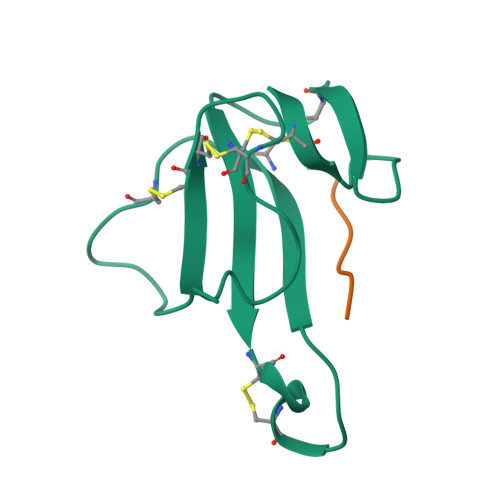
Caspase-3 structureClick to view 3D structureCaspase-3P42574HumansKnownNot Available
Sigma non-opioid intracellular receptor 1 structureClick to view 3D structureSigma non-opioid intracellular receptor 1Q99720HumansPredicted (SEA)
Prediction Confidence Score
0.569
Applicability Domain
1.0
Statistical Significance
8.60e-04
Supporting Reference Compounds
562
E-value
6.69503
Click to view 3D structureSigma non-opioid intracellular receptor 1Q9R0C9Rattus norvegicusPredicted (SEA)
Prediction Confidence Score
0.498
Applicability Domain
1.0
Statistical Significance
0.001
Supporting Reference Compounds
207
E-value
7.94062
Glutamate receptor ionotropic, NMDA 2C structureClick to view 3D structureGlutamate receptor ionotropic, NMDA 2CQ00961Rattus norvegicusPredicted (SEA)
Prediction Confidence Score
0.461
Applicability Domain
1.0
Statistical Significance
1.10e-04
Supporting Reference Compounds
35
E-value
0.856341
Lysosomal Pro-X carboxypeptidase structureClick to view 3D structureLysosomal Pro-X carboxypeptidaseP42785HumansPredicted (SEA)
Prediction Confidence Score
0.443
Applicability Domain
1.0
Statistical Significance
1.00e-05
Supporting Reference Compounds
12
E-value
0.0778492
Acetylcholine receptor subunit alpha structureClick to view 3D structureAcetylcholine receptor subunit alphaP02710Torpedo californicaPredicted (SEA)
Prediction Confidence Score
0.417
Applicability Domain
1.0
Statistical Significance
1.00e-05
Supporting Reference Compounds
11
E-value
0.0778492
Glutamate receptor ionotropic, NMDA 1 structureClick to view 3D structureGlutamate receptor ionotropic, NMDA 1P35439Rattus norvegicusPredicted (SEA)
Prediction Confidence Score
0.387
Applicability Domain
1.0
Statistical Significance
1.00e-05
Supporting Reference Compounds
22
E-value
0.0778492
Click to view 3D structureCholinesteraseQ03311Mus musculusPredicted (SEA)
Prediction Confidence Score
0.361
Applicability Domain
1.0
Statistical Significance
0.0016
Supporting Reference Compounds
22
E-value
12.4559
Concentrations
Not Available
External Links
DrugBank IDDB03575
HMDB IDHMDB0256399
FooDB IDNot Available
Phenol Explorer IDNot Available
KNApSAcK IDNot Available
BiGG IDNot Available
BioCyc IDNot Available
METLIN IDNot Available
PDB IDNot Available
Wikipedia LinkPhencyclidine
Chemspider ID6224
ChEBI ID8058
PubChem Compound IDNot Available
Kegg Compound IDC07575
YMDB IDNot Available
ECMDB IDNot Available
References
Synthesis ReferenceNot Available
MSDSNot Available
General ReferencesNot Available